
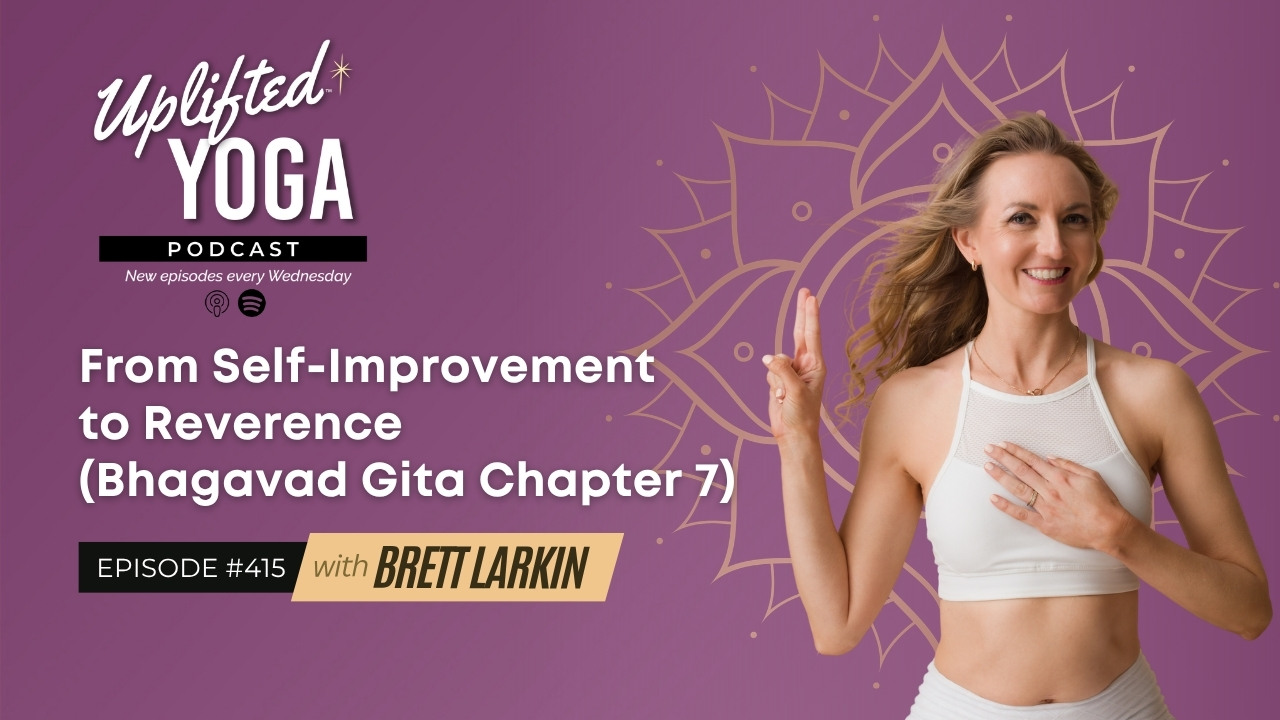
Are you collecting yogic wisdom… or in a relationship with Divine mystery? Today we’re opening into Chapter 7 of the Bhagavad Gita, and it’s a true turning point. The first six chapters have been so much about discipline, self-mastery, and effort… but here, we pivot into the bhakti arc: relationship with the divine.
Before we drop into the verses, I frame the big shift this chapter is asking of us — and I weave it through a distinction that changes everything: jnana (intellectual knowing) vs vijnana (realized, embodied knowing).
Here are the 5 biggest takeaways from this episode:
🔹 The pivot from self-effort to reverence + relationship (and why this is such good news if you’re tired of over-efforting)
🔹 Jnana vs vijnana: reading about truth vs living it in your nervous system, your body, your actual life
🔹 Krishna’s reveal: not “worship me as a personality,” but recognize the animating intelligence of reality (taste in water, light in sun + moon, Om…)
🔹 The gunas as weather patterns — and bhakti as remembering the “sky” behind them
🔹 The radical reframe: awakening isn’t a solo achievement… it’s participatory — you’re being met
If you’re loving this deeper dive into yogic texts, come join me inside the Uplifted Membership for the Yoga Sutras Book Club — it’s where we keep studying together (with prompts, practices, and community) so the teachings move from your head into your life.
💖 Join the membership today and get all the details on our next call → https://www.brettlarkin.com/uplifted/
FREE Practice: The Healing Power of Divine Love | VINYASA FLOW HEART OPENING
Relevant Blog: What Are The Gunas In Yoga? A Complete Overview
Relevant to Today’s Episode:
✅ History of Yoga
📚 Healing with Somatic Yoga Book
🔮 300-hour Online Yoga Teacher Training
🎧 Also Listen to:
#297 – What is Samkhya Philosophy and How is it Different from Yoga?
#364 – Dissecting The 8 Limbs and Their Origins
#404 – What If I Fail? Krishna’s Answer to Your Inner Critic (Bhagavad Gita Chapter 6)
© 2026 Uplifted Yoga | BrettLarkin.com

Transcript:
Brett Larkin:
It’s time for you to walk through the world with the confidence and serenity of someone who’s deeply tethered to their inner wisdom. If you have this insatiable hunger to uplift your personal life and make a bigger impact in your wellness career, leveraging yoga’s ancient wisdom, welcome. I’ve certified thousands of yoga instructors online, I teach to over half a million subscribers on YouTube, but I still haven’t remotely quenched my thirst for more yogic knowledge.
I’m Brett Larkin, founder of Uplifted Yoga, and this is the Uplifted Yoga Podcast. Let’s get started. Are you collecting yogic wisdom or are you in a relationship with the mysteries of the universe? This is what we’re going to explore today in the Bhagavad Gita, Chapter 7, that the universe isn’t neutral.
It actually wants to be in relationship with you. This is where the bhakti yoga arc begins in the Gita. It’s the turning point from effort to devotion.
We’re going to explore this idea of reverence, relationship, the gunas, and explore this big reframe that awakening isn’t your solo achievement, it’s participatory. And if you’re loving this deeper dive into yogic texts, I want to invite you to join me inside my Yoga Sutras book club. This is where we study together with prompts, practices, and community.
You even have the option for me to ship you my Yoga Sutras journal. This is a beautiful workbook that you can write in. It’s a 25-day journey through the first book of the Yoga Sutras, and it’s really designed to move these teachings from your head into your life.
We have a call coming up. I would love for you to be there. Everything you need to get started will be in both the digital guide, and of course, you have the option to order the physical copy if you like to write in pen and paper.
You’ll have your group discussion questions there. Whether you want to train your attention on the sutras by yourself or in community, this is so rewarding and so much better than training your attention on social media and whatever the algorithm is serving you. So join today to get connected or just to go deep into this text on your own.
BrettLarkin.com/uplifted is where you can get the journal, all the details, and get your invite to join our next book club call, which is coming up super soon. Now let’s dive in to Bhagavad Gita chapter 7. Hello my friends. I am so excited to be going into chapter 7 of the Bhagavad Gita today.
This is a turning point, and I’ve been hinting at it, like if you’re a regular listener of the podcast, you know, I’ve been hinting at this transition. We’ve also been exploring sort of the concept of God in the podcast in different episodes, cross-culturally, because what’s about to happen here in chapter 7 of the Gita is that Krishna, who is God in this particular story, starts to reveal his true nature. And this is the beginning of the bhakti yoga arc of the Gita.
So to review, chapters 1 through 6 of the Bhagavad Gita were very much about what’s called karma yoga. And we were focused on discipline, meditation, self-mastery. Chapter 6, which we looked at earlier, was all about meditation.
So what’s this big shift that’s happening right now? It’s so cool because now in chapter 7, we’re asking, okay, what are we meditating on? Who are we meditating on? And this is where Krishna begins to fully reveal himself in this chapter. So those of you who are really into somatic yoga like I am, I really want you to pay attention to what’s happening here in the text at this moment, because the first six chapters of the Gita were very much about self-effort, all the things that we have to do. And now we’re starting the bhakti yoga arc, and we move from self-effort into relationship, into relationship with the divine.
That’s what these next several chapters are going to be about. So if you’re burnt out, tired, exhausted from over-efforting, if you’re one of those yogis who’s used to always doing more and trying to achieve more and do harder meditations for longer amounts of time and achieve more poses, and you’re burnt out and you’re over it, get your listening ears on. Get so excited.
I’m so excited. Hopefully, you can hear how excited I am, because we’re shifting. And we’re shifting into the yoga of relationship as opposed to the yoga of effort.
So I often like to start by looking at just what this chapter is called in various translations. And I think it’s really going to serve us here to highlight some of these key themes. So the Godsong translation calls this chapter seven, Know and Discern.
Okay, interesting. The Bhagavad Gita as it is calls this chapter, Knowledge of the Absolute. Barbara Stoller Miller calls this seventh chapter, Knowledge and Judgment.
And if we look at the Sanskrit of like where these titles are coming from, there are two key words to focus on. So the first is Jnana, okay? Often we hear Jnana, but that’s actually not how it’s pronounced. It’s Jnana, Jnana Yoga.
So this is intellectual knowledge. And again, often you hear it Jnana Yoga. But this is understanding yoga through study, through philosophy, through logic.
So we have that on one half of our screen. And then we have what’s called Vigyana, Vigyana. Vigyana is a little bit different.
Vigyana is realized knowledge, meaning embodied, lived, experiential knowledge. So Jnana Yoga or Jnana Yoga, intellectual knowledge, might be like reading about love. While Vigyana, knowledge, would be like actually being in love, right? Totally different.
So we’re talking about intellectual knowledge, studying anatomy, compared to realized knowledge, maybe actually like feeling your nervous system regulate. So does that make sense? One is experiential. I love the love example, because it’s like you can read about love all day long.
But then when you experience love at first sight or that first big love story of your life, you’re like, okay, I get it. I’ve been reading about this in books. But now you have this realized, embodied knowledge of love.
And so there’s a shift that’s happening here from the intellectual to the realized. And we’re gonna see this as a key theme as we look at chapter seven together. And you might say, wait a minute, Brett, didn’t you just tell me that the first six chapters are about karma yoga? Like, why are you now talking about Jnana Yoga? And there’s a little bit of nuance here.
Like the first six chapters of the Gita, it’s often simplified, like the first six chapters are about karma yoga, which means selfless action. If you go back and re-listen or look at all we’ve been exploring together, yes, those first chapters of the Gita, those first six chapters, that first arc, is about karma yoga and selfless action. That’s definitely there.
But it’s also very much describing Jnana Yoga, right? Meditation, dhyana, remember from the eight limbs meditation? It’s talking about discipline, it’s talking about self-mastery. It’s all about training the body as an instrument, aka it’s all about effort. It’s not just intellectual knowledge, like the philosophical path of discriminating what to do.
But if we look at the first six chapters, they’re very much about like, here’s how we can purify the ego so it becomes capable of devotion. That’s what we’ve been focused on up to this point. And now chapter seven marks the pivot point.
Krishna’s essentially gonna tell us, okay, now that you’ve disciplined your mind, you’ve put yourself into action, you’ve meditated, you have the discipline, you’re in a service mindset, you have self-mastery. Now that you’ve disciplined your mind, let me tell you about who I am. And as a reminder, if you haven’t been following every single Gita podcast, if you need just a refresher, what this book is, is it’s a dialogue between Krishna, who is God in this story, and Arjuna, who’s the warrior, or essentially us in the story, the mortal, the person with the difficult decision.
Arjuna is a warrior who has the very difficult task of basically needing to decide if he wants to murder his family by going into battle with them. But he kind of has to because if he doesn’t, darkness will reign forever. So he’s kind of between a rock and a hard place.
The thing is, he’s having this moment of turmoil, like this difficult decision. So basically, he’s between this rock and a hard place. There’s no good option, right? It’s like either kill your family, that’s not fun, or have evil take over the world, that’s worse.
Which makes them so relatable because we all have problems like this, where there’s no good option. We feel stuck, we feel confused, we feel torn. In the opening chapters of the Gita, we see Arjuna having a panic attack, which many of us often experience, something like that.
And he’s on the battlefield with his charioteer, who’s like a mentor, a friend to him, who is Krishna. But what we don’t know up until this point is that Krishna is actually God. He thinks Krishna is a very sage-wise person, who is like an advisor to him within the context of a royal family, essentially.
But he doesn’t actually know that Krishna is God. So this is a big reveal that’s coming up and that we’re gonna see in this arc. So to recap, chapters one through six of the Gita are about self-effort, karma, and meditation.
Chapters seven through 12, that’s the journey we’re starting now, are about devotion, bhakti. But it’s not just like sentimental devotion or blind devotion, it’s devotion informed by knowledge. And then chapters 13 through 18 of the Gita will be about kind of wisdom and integration.
So in Sanskrit, this chapter is called Vijnana Yoga, because it’s talking about intellectual knowledge and realized and embodied knowledge. And just to go full circle, we saw that in the chapter headings, Stolar Miller, she called this, she translated this knowledge and judgment, the seventh chapter. Godsong called it know and discern.
But I don’t think those translations really capture what a big, beautiful thing is happening. I’m spending extra time on this because in 21st century yoga culture, I think we tend to emphasize asana. And yes, now we’re emphasizing nervous system regulation, which is fantastic.
Obviously, we’re focused on self-development. We’re thinking, though, about my growth. Those are the things that 21st century yogis are focused on.
Asana, nervous system regulation, self-development, and my growth. Here’s what we don’t often emphasize and what’s about to become the focus of these next chapters. We often don’t emphasize surrender, relationship to something greater than us, personal connection to the divine.
So many of us are actually extremely skilled at chapters one through six, which have been exploring practice, discipline, study, refinement. But what’s gonna get asked of us now as readers of the Gita in chapter seven is something different. The new question is, who are you in relation to the whole? I’ll leave some silence here and say that again.
Who are you in relation to the whole? This can feel like a very uncomfortable question, especially in our culture that prioritizes autonomy and control pretty much above everything else. Many of us have mastered self-regulation. You’ve taken all the teacher trainings.
Maybe you even took my Yoga for Self Mastery course. That’s literally the title. It’s about Kriya Yoga.
But what we’re entering now in the Gita in these next several chapters and what I wanna pose to you is like, okay, cool, but have you learned reverence? That’s the pivot point. And what we’re gonna see, and I promise we’ll get into the text in a moment, but what we’re gonna see is that Krishna is gonna start revealing himself in this chapter as God. He’s gonna describe himself as the taste in water, the light in the sun, the syllable Om, the life force of all beings.
It’s so beautiful, it’s so poetic. But he’s not saying you need to worship me as a historical personality. What he’s pointing to is the animating intelligence of reality.
So when you go in and read this chapter, if you choose to read it or if you just wanna listen to these podcasts, that’s totally fine too. But he’s not saying you have to worship me, Krishna. He’s saying that there is an underlying universal intelligence that you need to pay attention to and be in relationship with.
And of course, in this story, he’s a personification of that intelligence. But if you’re a Christian, you might call that intelligence God. If you’re spiritual but not religious, you might call that consciousness.
If you’re secular, you might call it the organizing intelligence of life. So bhakti is not about culture, it’s more about relational awareness. And ultimately, a relational awareness that requires humility, that requires intimacy.
And bhakti yoga, again, is not very often celebrated in modern yoga, cuz it feels a little bit awkward, right? We’re really comfortable with breath work and trauma processing and alignment cues and all those things are great. We’re a lot less comfortable with prayer, surrender, saying I don’t control everything. But here’s the thing, without bhakti, without these next chapters and exploring bhakti yoga and everything we’re about to go into in this next section of the Gita, yoga basically just becomes self-optimization.
It just becomes this never-ending self-improvement project. But you add in this element of bhakti, and yoga becomes reverence. So we’re gonna dive in now, but I want you to see this pivot that’s happening.
Because the Gita’s gonna stop being so philosophical right now, and it’s going to start asking you to become intimate with this animating intelligence of reality. And this is a great moment to pause before we dive in and just ask yourself, are you someone who just collects spiritual information? Like more, more, more, like a never-ending hungry Pac-Man machine person? Or are you allowing yourself to be in relationship with mystery? So, opening, Krishna said, the blessed Lord said, mind fixed on me, with me your refuge. Yoked in yoga, Partha, Partha’s another name for Arjuna.
You can know me whole, without a doubt. Now listen how. Okay, so Krishna, who at this point is still just an advisor, mentor to us, to Arjuna, is saying, yoked in yoga, Arjuna, you can know me whole.
So basically yoked in yoga to me, that means like doing all the stuff I just told you in the first six chapters that we just went over in the first six chapters. Like having dissolved your ego, having discipline, awareness, all this stuff, meditation that you’ve done. Yoked in yoga, you can know me whole.
Listen how. Knowledge with discernment. I’ll tell you both and leave nothing out.
Okay, so we already went over that, knowledge with discernment. Once you know them, there is nothing further to be known here. Humans, thousands of them, hardly anybody strives towards perfection.
Even among perfected strivers, hardly anybody really knows me. Going into verse four now. Earth, water, fire, wind, air, mind, intellect, and sense of self.
These divide my nature eight ways. So Krishna just described what’s called apara-pakriti. Those of you who’ve done 300 with me or know Samkhya philosophy, pakriti is nature, it’s manifest reality.
So Krishna just described in that verse four, lower nature. Lower nature, apara-pakriti, is earth, water, fire, air, ether, mind, ego, intellect, and then in verse five, he says, but these are lower. These are lower things.
This water, this fire, this earth, mind, ether, all of that is lower nature. Know my highest nature to be different, great-armed Arjuna. It’s the living spirit that undergrids the universe.
And I love this. I’m reading from the God Song translation, by the way. So he’s now just said that there’s this lower nature, this lower manifest reality of water, fire, air, earth, or mind, all this stuff.
However, there is something higher than that. I have a higher identity than that. And it’s the living spirit that undergrids the universe.
Love that translation. This higher nature, this para-pakriti, is the conscious life force that animates everything. It’s exactly what we were talking about earlier.
I’m curious how some other folks translate. Barbara Stoller Miller says, that is my lower nature. Know my higher nature too, the life force that sustains this universe.
Yeah, I think the God Song is definitely the most poetic. So he goes on to say, understand this, womb of every being, the universe entire, I originate and I dissolve. Verse seven, there is nothing else that’s higher than me, Arjuna.
All this is strung on me like pearls on a thread. I am the flavor in water, Arjuna. I am the shining forth of the sun and moon.
I am the Aum that hums in every Veda, the sound of air, the manhood in men. I am the sacred fragrance in the earth. I am the brilliance in the flame, the life in every species.
I am the rigor of the ascetics. Know me, Arjuna, for the everlasting seed of every species. The wisdom of the wise is me, the brilliance of the brilliant, me.
The strength of the strong men, also me, of lust and passion free. In every species, Arjuna, I’m the lust that doesn’t contravene the Dharma. How poetic is this? How beautiful is this? Let’s keep reading Barbara Stoller Miller.
Know that nature’s qualities come from me. Lucidity, passion, and dark inertia. I am not in them, they are in me.
And I’m switching back to God’s song now. These three ways of being, the gunas, braid the whole world, which, deluded, does not recognize I am above them and above decay. Okay, so let’s pause for a hot sec, because I actually love how Barbara Stoller Miller translated the gunas.
Lucidity, passion, and dark inertia. So lucidity would be satva, passion would be rajas, and dark inertia would be tamas. This whole section is so beautiful.
I love this idea, or the translation from the God song version, of Krishna revealing himself as the living spirit that undergrids the universe. And then he talks about, we have this section, it’s such beautiful poetry. He’s this I am section, I am the flavor in water, I am the shining forth of the sun.
I am the om that hums in every veda, on and on, it’s so beautiful. I see those I am statements as parallel to some of the things we see in the Book of Revelation or the Gospel of John, right? We hear, I am the alpha and the omega, I am the way, the truth, and the life. If you’ve been loving all the yoga philosophy we’ve been exploring on this podcast, but sometimes feel like you’re missing the bigger picture, my History of Yoga course is basically your best friend.
It gives you a clear visual timeline of how yoga actually evolved. From the Vedas, to the Upanishads, to the Bhagavad Gita, the Yoga Sutras, Hatha Yoga, all the way through to modern postural yoga. I’m talking slides, printable timelines, a gorgeous manual, everything finally clicks into place.
If you want context, not just concepts, you can explore it at brettlarkin.com/history or grab the course at the link in the show notes. So whether it’s Krishna or God, Jesus, we have this tradition of a divine figure that’s claiming a cosmic identity. So the Gita is operating in a worldview where this animating intelligence of reality can appear as a personal form.
And I think this can be a little bit challenging for the Western mind, because when we hear God, we’re like, okay, God is a literal being or God is a metaphor. But here in the Gita, we don’t have that split. Krishna is simultaneously a historical character, mentor friend to Arjuna, a divine incarnation.
He’s also a metaphysical absolute, meaning he is the living spirit that undergrids the universe. And he’s the inner self. So he’s like all of those things.
And the fact that he’s all of those things and that fluidity can be uncomfortable, I think, for a lot of modern readers when we’re trained in kind of like a binary thinking. But what’s interesting is chapter seven is not just saying, okay, there’s this living spirit that undergrids the universe and you should know about it. It’s saying that like this living spirit is relational, that reality is relational.
It’s not just a mechanical thing. It’s relational. And in this instance, it’s relational in the form of Krishna.
But maybe for you, it’s relational in the form of God or in the form of Jesus or in the form of universal intelligence or however you want to relate to it. And Krishna is not saying like convert to worship me specifically. He’s asking you to consider like is reality personal? Like does the universe merely operate like cogs in a machine operate? Or does it relate? Does it relate to you? Which means we need to be willing to consider like what if reality isn’t neutral or like a cog in a machine? What if this consciousness wants to be in relationship with us and wants us to be in a surrendered devotional relationship with it? This is what I mean when I say like chapter seven is like pushing boundaries and pushing us into new territory.
Because in modern Western thinking, we often assume that the universe is impersonal and that it runs on laws and that it doesn’t care, that it’s mechanical, that it’s indifferent, that it functions. And if that’s your worldview, then spirituality becomes essentially self-regulation, like I’m going to regulate myself inside of this indifferent, neutral cosmic system. Which means I need to calm my nervous system.
I need to optimize my mindset. And the universe is just neutral. And there’s nothing wrong with that.
But that’s not what chapter seven is actually describing. What Krishna is describing when he’s saying like, I am the taste in the water. I am the seat of all beings.
I am the intelligence of the intelligent. He’s not describing like a neutral cog in the machine kind of universal intelligence. He is describing a living, aware, self-disclosing reality that’s very, very different.
He’s saying the fabric of existence isn’t just energy. It’s awareness. It wants to communicate with you.
It can be known by you. It can be related to by you. And if you’re like, what does consciousness being relational even mean? Like, I hear you.
These are hard topics to discuss. But what I mean by relational is that consciousness isn’t just something you observe. Like all of us have been trained to do that in meditation.
Like we observe our thoughts. We observe consciousness. We are the witness, right? But what bhakti yoga and these next chapters and what’s being revealed to us here is that consciousness is relational and that the sense that it’s not just something you observe or witness.
It’s something that meets you. It’s in a responsive relationship with you. And if that’s true, if reality is consciousness that’s relational, then it means relationship is possible.
And if relationship is possible, then surrender, trust, love, devotion. These are appropriate responses. The bhakti response is appropriate.
And this again can feel uncomfortable because modern yoga culture is so deeply influenced by psychology and neuroscience, which is great. And the secular mindfulness movement. So we’re very comfortable saying stuff like your nervous system relaxes when you feel safe.
But we’re less comfortable saying you actually also might be held by something larger than yourself because that sounds theological and that can feel risky. So we tend to reduce spirituality to these internal processes, which again, there’s nothing wrong with that. The first section of the Gita was actually about that.
But chapter 7 here is opening us up into something new, right? So I’m hoping you’re realizing like there’s this difference between calming yourself inside a silent universe and realizing the universe itself might be alive and might want to be in relationship with you. Verse 10 really caught my attention because he says, Know me, Arjuna, as every creature’s timeless seed. And that word seed or that metaphor seed in Sanskrit is bijam really stood out to me because when Krishna says he’s the seed of all beings, it’s like a seed is not neutral.
A seed is not only growing, but it contains like an intelligence blueprint in order to grow, right? A seed is something that has direction that’s unfolding, that has purpose. Like think of the seed of a flower, for example. It’s generative.
And it fascinated me too, because if we look like comparative theology lens for a second, Jesus in the Gospels is always talking about like the kingdom of God is like a mustard seed, right? Or often he’s talking about it as like yeast in bread, like something very small that we can’t see. We see this also in the Tao and Taoism. So across traditions, ultimate reality is described as like a seed that contains this intelligence.
Like I thought it was so cool that we see that exact word, that exact metaphor of the seed in so many different traditions, because the seed is living, it’s creative, it’s generative, it’s self-revealing. A seed is not cold and indifferent. Okay, and then going back to the gunas, right? The gunas are what makes something alive.
We talk about that in 300-hour teacher training, right? If something is manifest, it’s subject to the gunas. Coming back to our flower or our tree, right? The tree is subject to the gunas, meaning it’s going to lose all its leaves and be barren in winter. And then it’s going to have these radiant states.
And then it’s going to have these states where it’s too hot and it needs to shed all the leaves, right? So we and everything in nature is subject to the gunas. But there’s something which the deluded do not recognize, says the God Song translation, that is this undergrid of the universe, this living spirit that undergrids the universe that is above the gunas and above decay. So that’s verse 13.
And then verse 14, coming back to Barbara Stoller Miller, composed of nature’s qualities, my divine magic is hard to escape, but those who seek refuge in me cross over this magic. So it’s really easy for us to get lost in the gunas. I’m angry.
I’m happy. I’m hungry. I’m sad.
I’m frustrated. I’m impatient. I’m irritated at technology.
The gunas are just always moving, always fluctuating. I’m having this experience in a human body, right, where I’m menstruating. I’m not.
I’m pregnant. I’m going through menopause. Everything is just always changing.
And it’s like the gunas have us. But there’s this other thing that we can tune into, this underlining fabric of reality that is beyond the gunas. And then Krishna says, those who take refuge in me cross beyond maya.
Remember, maya is illusion. So when we’re identifying with all our thoughts or all our bodily sensations, we’re in maya, right? And in verse 14 of the God song translations, he says, this maya of mine is divine, like the material world. Like, yeah, I am the material world.
It’s also like always fluctuating. And it’s hard to get beyond that. Only people who resort to me, meaning like only people who are in a devotional relationship with me, Krishna, the higher aspect of me.
Remember, not the lower prakriti aspect, but the higher prakriti aspect where I’m the living spirit that undergrids the universe. Only those who are devoted to me in that way transcend this maya, transcend this constant fluctuation of the gunas, this being identified with our body and our thoughts. And then he goes on in verse 15 to say, fools and criminals, the basest men do not take refuge in me, meaning they’re not in a devotional relationship with this underlying animating life force that’s the fabric of reality.
Instead, they’re associated with the gunas, their knowledge carried off by maya. They resort to a demonic way of being, meaning they’re carried away by the gunas. They’re living in the maya that the guna creates, this illusion, right? It’s not reality because Krishna, as the underlining spirit that undergrids the universe, he’s reality.
It’s almost like, do you want to tune into what’s still and what’s true or what’s always fluctuating? So the three gunas bind us. Most people don’t see Krishna because of maya and the three gunas. We could also relate these gunas to nervous system states, right? Sympathetic, freeze, regulated.
In a different translation, I just dug up of verse 14. This divine maya of mine instituted of the gunas is difficult to cross, but those who take refuge in me cross beyond it. It’s the same way of saying what I said before, but it’s a little bit clearer.
If you’re always identified with the fluctuating qualities of your mind and body, you don’t recognize the deeper reality behind everything. When you’re anxious, rajas. When you’re depressed, tamas.
Or even when you’re peacefully regulated, sattva, you can mistake those states for who you really are. But actually, the gunas are weather patterns, right? And Krishna’s pointing to the sky. And going back to that first 14, I love how he says, but those who take refuge in me cross beyond the gunas.
We can’t think our way out of the gunas. We have to take refuge. We have to be in a relationship with the divine.
So moving forward, four kinds of men worship me, Arjuna, the sufferer, the questioner, the driven seeker, and the knower. So basically, Krishna is describing four types of devotees who turn to him, people who are distressed, people who are seeking gain, like people who want prosperity and security, people who want knowledge, and then lastly, people who are wise. Again, so many parallels I see with the parable of the sower from the Gospel of Luke.
I believe it’s Luke 8, you know, where he talks about some seeds fall on the path and the birds eat them. Some seeds fall on the rocky soil and have no roots. Some seeds fall among thorns and get choked.
Some seeds fall on good soil, right? It’s a powerful parallel because in both instances, we have like a category of types of seekers. There’s an invitation to recognize the divine. And in the parable of the sower, it’s like not everyone responds.
And it’s not because God is withholding. It’s because receptivity differs, right, depending on how the soil is. If you have rocky soil, right, there’s not receptivity there.
And there’s a similar thing happening with Krishna’s list, right? Like, yeah, some people might turn to him, but they’re doing it because they want personal gain, because you want more knowledge for yourself or because you want prosperity. So which one would you say you are right now of the types of people who turn towards the divine in Krishna’s model? Are you distressed? And that’s why you’re like, I’m doing yoga. I’m doing meditation.
I’m doing all this stuff because I’m stressed out. I’m distressed. Or because I want more knowledge.
I want to improve. I want to teach. Or because you think it’ll make your life better, right? You’re doing it for prosperity, like, because I want to feel happier.
Or are you like the last one? Are you doing it because you’re wise? What this is saying is, like, the highest devotee loves Krishna or loves God or loves this silent underlying grid that underpins reality for its own sake. That’s mature bhakti. That’s the wise one.
You don’t have an agenda for being in a relationship with the divine. You’re doing it because you love being in the divine’s company. Real bhakti yoga is you love God or you love this underlying fabric of reality, this stillness for its own sake, because you’re in relationship with it, not because you have some agenda.
So to put the four types in, like, more modern language, as I ask the really, like, confronting question, like, which one of these four are you? You know, the distressed. This is the person who’s, you know, turning to the divine or praying or getting into yoga and meditation, all that stuff, because they’re desperate. They have, like, illness, loss, fear.
Most people turn to something greater when suddenly they’re suffering. Sometimes devotion starts in a crisis. That’s OK, but we’re just going to have awareness of that.
Are you the second thing? The seeker of security, the person who wants success, stability, safety, abundance. You’re doing all your abundance mantras. It’s a transactional relationship.
And again, Krishna’s not saying he rejects them. He’s not shaming them. He’s just inviting the awareness that the relationship could be different.
And then third, are you the seeker of knowledge? OK, probably you, if you’re listening to this podcast, you’re a seeker of knowledge. I definitely am. I’m, like, guilty, guilty, guilty.
Right? You’re curious. You’re maybe philosophical. It’s like spiritual interest, but it’s not surrender.
And then the last type of person he talks about, the wise, right? This is the one who loves the divine for its own sake. Not because we want the divine to rescue us, not because we want a reward, not because we’re curious and need to fill our little minds and learn more, but it’s because we crave intimacy with the underlying fabric of reality or God, however you define it. So to review, verses 13 through 15 say we don’t recognize the divine because we’re caught in the gunas, agitation, dullness, egoic striving.
Today, that might look like scrolling, constant productivity or chronic anxiousness, right? Meanwhile, the signal is there. The divine is always here. It’s reaching out.
It wants a relationship with us. It’s the underlining fabric of reality. But we’re just too busy to notice it because we’re distracted by the gunas and living in maya.
And then verse 16 says something actually really tender, right? There’s four types of people who turn to the divine. People who are distressed, people who are seeking security, people who are curious. And then there’s the people who are truly wise, and Krishna honors all of them, right? So this is great news.
Your devotion doesn’t have to start pure. Wherever you are right now is okay. It can start in desperation.
It can start in curiosity. That’s fine. But what matters is the turning, the turning point that this chapter is inviting you into.
And the chapter goes on. He starts to talk about, you know, some people are ravished of knowledge by this or that, to desire. Some take refuge with other gods.
They resort to this or that religious rule, ruled by their own natures. This is now verse 20. And then verse 21, Krishna says, So here Krishna’s saying like, yeah, there’s people whose intelligence is carried away by worshiping different desires and maybe even other deities.
But these deities grant limited results. And if that word deity is confusing, or some books translate these as like demigods, and you’re like, what are these demigods? But in Vedic cosmology, these devas, because the Sanskrit word is deva, are like divine beings or personifications of forces of nature, like Indra, the storm god, or Agni, the fire god, or Surya as the sun. So they’re not false, but they’re not the ultimate reality, right? They’re part of that lower nature that Krishna described at the beginning.
He’s really trying to explain that he’s the supreme reality that underpins and underlines all of these things. And basically, he’s kind of just saying like, you need to devote yourself fully to this intimate relationship with the divine that you’re in without an agenda for the relationship. And that when you devote yourself to partial things, right, success or validation or status or even healing, you get results.
But those results are temporary, and they’re never going to satisfy that deeper longing you have in your heart, that emptiness that all humans have. Like, we’re not programmed for this world. We’re programmed for God.
We’re programmed for the next world, right? That’s why, like, nothing in this world can really give us lasting satisfaction. That’s what those, you know, verses 20 to 23 are hinting at. And there’s some beautiful lines to close out this chapter.
I mean, verse 27 from the God Song translation, since yearning and aversion surge. I love that line, since yearning and aversion surge. Think about just like the rest of your day.
What are the things you’re wanting to happen? And what are the things you don’t want to have happen? And you’re kind of dreading, right? Like, we’re all subject to yearning and aversion. So since yearning and aversion surge, because dualities delude, right, we’re constantly a victim of this binary either-or thinking, all beings fall into delusion, Arjuna, at birth, right? And those of you who’ve taken 300, you know exactly what we’re talking about here, right? We’ll also link up the Samkhya philosophy podcast for those of you who want to learn a little bit more. But basically, when we come into being and become manifest, we pay the price of duality, right? And we’re no longer whole.
There’s a part of us that’s empty and is governed by binary either-or, black-and-white type thinking. That’s exactly what verse 27 here is talking to. Then verse 28, people whose works are pure, whose sins are at an end, freed of dualities delusion, worship me with solid vows.
Strivers who depend on me for freedom from old age and death know Brahman completely and met a self and karma whole. Verse 30, this is the last verse, they know me, yoked in thought, they know me even at the hour of their passing. And Barbara Stoller Miller translates that last line as, men who know me as their inner being, essentially inner divinity and inner sacrifice, have disciplined their reason, they know me at the time of death.
So what’s emerging across all these verses is that there is a living spirit that undergrids the universe and is the seed of all existence. And instead of getting trapped in the material world and the gunas, we want to be in a genderless relationship with this living spirit that undergrids the universe. If you devote yourself towards fragments, like just one aspect of the divine or material success or things like that, well, you’re going to get fragmented results.
Only devotion to this wholeness is going to not only lead to lasting realization, but to you feeling whole, to be free from craving. And then we’re also seeing this theme of that yoga isn’t just about becoming strong enough to reach the divine. It’s also about becoming receptive enough to notice that the divine has already reached for you because the divine isn’t a machine.
It has a consciousness and it wants to be in relationship with you, just like Krishna wants to be in relationship with Arjuna. And this is challenging one of the most dominant assumptions in modern spirituality, which is that like awakening is a personal achievement, like awakening is something I do and I control and that if I meditate hard enough and heal enough trauma and regulate enough and study enough philosophy, I will arrive. Right.
And that’s all the energy of chapters one through six, that discipline, that effort, the climbing, the service and all of that is OK. But here, chapter seven is destabilizing that. And Krishna is implying you are awakening within a larger intelligence and you’re not actually producing any of this.
You are participating in it, just like a wave does not generate the ocean. The wave arises because the ocean is already there. That’s like the reframe camera angle change that is like happening here in chapter seven, because modern yoga often treats awakening like the wave is perfecting itself.
Right. And chapter seven is like, OK, but yeah, you’ve you’ve done all these practices in chapters one through six and you know how to meditate, you know how to dissolve the ego and you know how to do all this stuff. But you’re already actually moving in something vast.
And this is such good news because if awakening is totally self-generated, that means you carry the full burden. But if, like chapter seven is saying, awakening is participatory, that means that you have support, that you are being met. It doesn’t erase all your effort, but it reframes it.
Your effort can become responsive. This is the essence of bhakti. Right.
It’s like the safety that we’re trying to build internally is actually the recognition that we’re already held by a relational awareness. So as we close, if you take one thing away from this chapter, I would encourage you to have this awareness that modern spirituality is really, really built on the self-improvement model. We optimize our nervous systems.
We track our habits. We meditate to become more awake. But chapter seven here is asking us something radical.
It’s saying, what if you aren’t self-generating your own awakening? What if the very consciousness that you’re trying to access, right? That witness consciousness that you’re trying to gain isn’t something that you produce, but something you’re already immersed in? And that this awakening that you’re craving isn’t like a personal achievement that you have to go on and get by yourself, but actually a relational recognition. That can change the way you approach your practice profoundly. And this is just the beginning of this second bhakti yoga arc of the Gita.
So stay tuned for more. Before you go, I want to remind you that my new book, Healing with Somatic Yoga, a six-week journey to release emotions, rewire your nervous system, and reclaim your body is officially out in the world. If this podcast has supported you, inspired you, or helped you feel even a tiny bit more home in your animal body, this book is the safe hug that your nervous system has been longing for.
Inside, I take you through my full six-week rest method, somatic shaking, decoding your survival responses, breath and safety, the whole journey. It’s everything I teach in my trainings distilled into something that you can curl up with on your couch. And here’s my little thank you gift to you.
If you buy the book and leave an Amazon review, heartfelt, honest, short or long, I will send you my brand new 2026 Somatic Deaths Calendar for free as a gift. This calendar contains monthly somatic reminders and little nervous system love notes to keep you regulated all year long. Go to brettlarkin.com/somaticreview to claim your calendar.
Your reviews really, truly matter. They help more yogis discover somatic yoga and finally feel safe coming home into their bodies. Thank you for being here and I’ll see you in the next episode.