(And How to Know Which One You Actually Need)
If you’ve ever found yourself googling “somatic healing” at 2am wondering whether you need a therapist… or a yoga mat… or a good cry… you’re not alone.
The world of somatic work is exploding right now — and with it comes a lot of confusion.
People know they want to heal through the body.
They know talk therapy isn’t always enough.
But then what?
Somatic therapy? Somatic yoga? Somatic coaching?
They sound similar, they overlap, and yet they serve completely different purposes.
Let’s make it simple.
What “Somatic” Actually Means (In Normal-People Language)
Somatics has a rich history but to keep things simple—at its root, somatic means “of the body.”
Somatic practices help you tune into the inner sensations, impulses, and signals your body uses to communicate.
Because here’s the truth most of us were never taught:
Your body speaks in sensation.
Your mind speaks in words.
Healing happens when those two finally get on the same team.

Somatic work is any approach that helps you notice — and respond to — the body’s language.
That includes breath, movement, sound, awareness, and the five senses.
But different somatic modalities use these tools in different ways.
That’s where the confusion begins… and where hopefully this blog, and my book Healing with Somatic Yoga: A 6-Week Journey to Release Emotions, Rewire Your Nervous System, and Reclaim Your Body finally gives you clarity.
What Is Somatic Therapy (and How Is It Different from Somatic Coaching?)
Both somatic therapy and somatic coaching are body-based approaches that work with the nervous system, emotions, and psychological patterns — but they are not the same, and they serve people at different stages of healing.
Understanding the distinction helps you choose the kind of support that’s actually right for you.
Somatic Therapy
Somatic therapy is a mental health modality led by a licensed clinician trained to treat trauma, dysregulation, and psychological distress through the body.
It includes approaches such as:
- Somatic Experiencing (SE)
- Sensorimotor Psychotherapy
- Hakomi
- Body-centered psychotherapy
A somatic therapist may use tools like:
✔ tracking bodily sensations
✔ titration and pendulation
✔ parts work
✔ grounding and orientation
✔ breathwork
✔ subtle movement impulses
Somatic Coaching
Somatic coaching is also body-based, but it is led by a certified somatic coach, not a licensed therapist.
Somatic coaches are trained to work with:
- the nervous system
- emotional patterns
- embodiment
- behavior change
- psychological dynamics without diagnosing or treating mental illness
Somatic coaching assumes the client is resourced, capable, and whole, and focuses on supporting present-moment awareness and future-forward change through the body.
Here’s the Key Difference
Somatic therapy is designed to:
✔ heal trauma
✔ resolve nervous system dysregulation
✔ process painful or overwhelming experiences
✔ work directly with the past
Somatic coaching works from a place of post-trauma growth.
That means:
- the client has some capacity to self-regulate
- emotions may still be big, but they’re navigable
- the focus is on living more fully now
- the work is oriented toward the present and future, not reprocessing the past
In other words:
Therapy helps you heal what happened.
Coaching helps you live differently because of it.
Somatic Therapy vs. Somatic Coaching
| Somatic Therapy | Somatic Coaching |
| Led by a licensed mental health clinician | Led by a certified somatic coach |
| Clinical mental health treatment | Non-clinical personal growth modality |
| Past-focused | Present & future-focused |
| Designed to treat trauma and dysfunction | Designed to support post-trauma growth |
| Can diagnose and treat mental health conditions | Does not diagnose or treat |
| Works directly with trauma processing | Works with regulation, embodiment, and choice |
| Therapist is the expert | Coach is a partner and mirror |
| Often slow, titrated, and highly contained | Structured yet client-responsive |
What a Somatic Therapist Can Help With
- Diagnosing and treating mental health conditions
- Processing trauma safely
- Supporting dissociation, freeze, shutdown, or overwhelm
- Working through emotional material that feels too big to hold alone
- Expanding your window of tolerance
What a Somatic Coach Can Help With
- Building embodied self-awareness
- Strengthening your ability to self-regulate
- Noticing and shifting patterns as they arise
- Integrating insights into daily life
- Making aligned decisions from the body, not just the mind
- Moving toward meaningful change without “fixing” yourself
Both approaches are powerful — when used for the right purpose.
So Where Does Somatic Yoga Fit?
Somatic therapy and somatic coaching work relationally, one-on-one.
Somatic yoga, on the other hand, is a self-led, movement-based practice that gives you the tools to regulate, express, and reconnect with your body in everyday life.
Which brings us to…
What Is Somatic Yoga?
(The Movement-Based, Empowering, At-Home Practice)

Somatic yoga is an intuitive, body-led movement practice that helps you reconnect with your body’s wisdom through sensation, expression, and nervous system regulation.
It uses breath, movement, sound, and sensory awareness to support regulation — not by forcing change, but by listening more deeply.
As I define it in my book, Healing with Somatic Yoga:
Somatic Yoga is an intuitive, body-led movement practice that helps you reconnect with your body’s wisdom through sensation, expression, and nervous system regulation.
(Healing with Somatic Yoga, p. 5)
The word somatic comes from the Greek soma, meaning the living body — not the body as an object to fix or improve, but as a sensing, feeling, intelligent being.
Somatic yoga works with that intelligence.
What Somatic Yoga Is (and Isn’t)
Somatic yoga is:
- non-clinical
- accessible
- experiential
- designed to help you feel safe in your body
- rooted in your natural physiology
While traditional yoga often emphasizes alignment, discipline, and performance, somatic yoga emphasizes inner experience:
- How does your body want to move?
- What sensation is arising right now?
- What message is your nervous system sending?
- What happens if you slow down… even more?
Somatic yoga gently shifts you out of your thinking mind and into your sensing body — what I call your animal body, the place where instinct, intuition, and healing live.
Somatic Healing Masterclass: Rewire Trauma, Reclaim Your Intuition (usually $67) FREE👇
Traditional Yoga vs. Somatic Yoga
This comparison chart appears in Healing with Somatic Yoga (p. 6), and it often gives readers an immediate “aha” moment:
| Traditional Yoga | Somatic Yoga |
| Follows set sequences and precise alignment | Encourages intuitive, organic movement |
| Emphasizes discipline and control | Emphasizes curiosity and sensation |
| Aims to perfect the pose | Aims to explore what feels good |
| Often dissociates from body sensation | Deeply connects with body wisdom |
| Guided by external standards | Guided by internal awareness |
| Body as a project to improve | Body as a partner to trust |
Traditional yoga can be powerful, strengthening, and transformative.
But it doesn’t always help us discharge, remap, or repattern survival responses stored in the nervous system.
That’s where somatic yoga comes in.
Why Somatic Yoga Works Differently
In Healing with Somatic Yoga, I describe three models of healing that somatic yoga supports:
- The Adjustment Model – small, intuitive movements help the nervous system recalibrate
- The Discharge Model – shaking, sound, breath, and movement help release stored stress and survival energy
- The Process Model – emotions and patterns are allowed to unfold organically, without force or bypassing
Traditional yoga often aims to transcend the body in pursuit of enlightenment.
Somatic yoga works with the body, honoring its pacing, its boundaries, and its need for safety first.
Your body’s responses — tension, bracing, collapse, freeze — aren’t problems to fix.
They’re brilliant survival strategies.
Somatic yoga creates the conditions for those strategies to soften naturally, without re-traumatization.

What Somatic Yoga Supports (and What It Doesn’t)
Unlike somatic therapy:
- Somatic yoga does not diagnose or treat mental health conditions
- It does not process trauma directly
- It does not dig into your past
- It does not require a clinician
Instead, somatic yoga gives you daily, embodied tools to support:
✔ nervous system regulation
✔ emotional digestion
✔ softening bracing patterns
✔ releasing stress cycles
✔ increasing capacity
✔ building resilience
It is a practice, not a treatment — and that’s precisely what makes it so powerful and accessible.
Where Somatic Yoga Fits in a Healing Journey
Many people discover somatic yoga:
- before therapy, as a gentle way back into the body
- after therapy, to integrate and live differently
- alongside therapy or somatic coaching, to support regulation between sessions
It meets you exactly where you are.
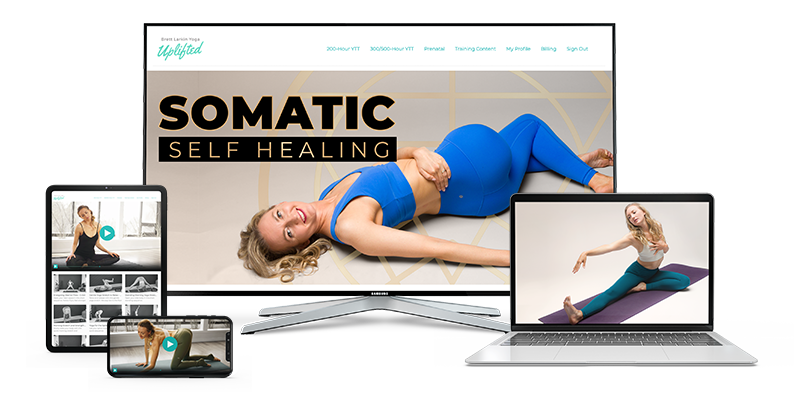
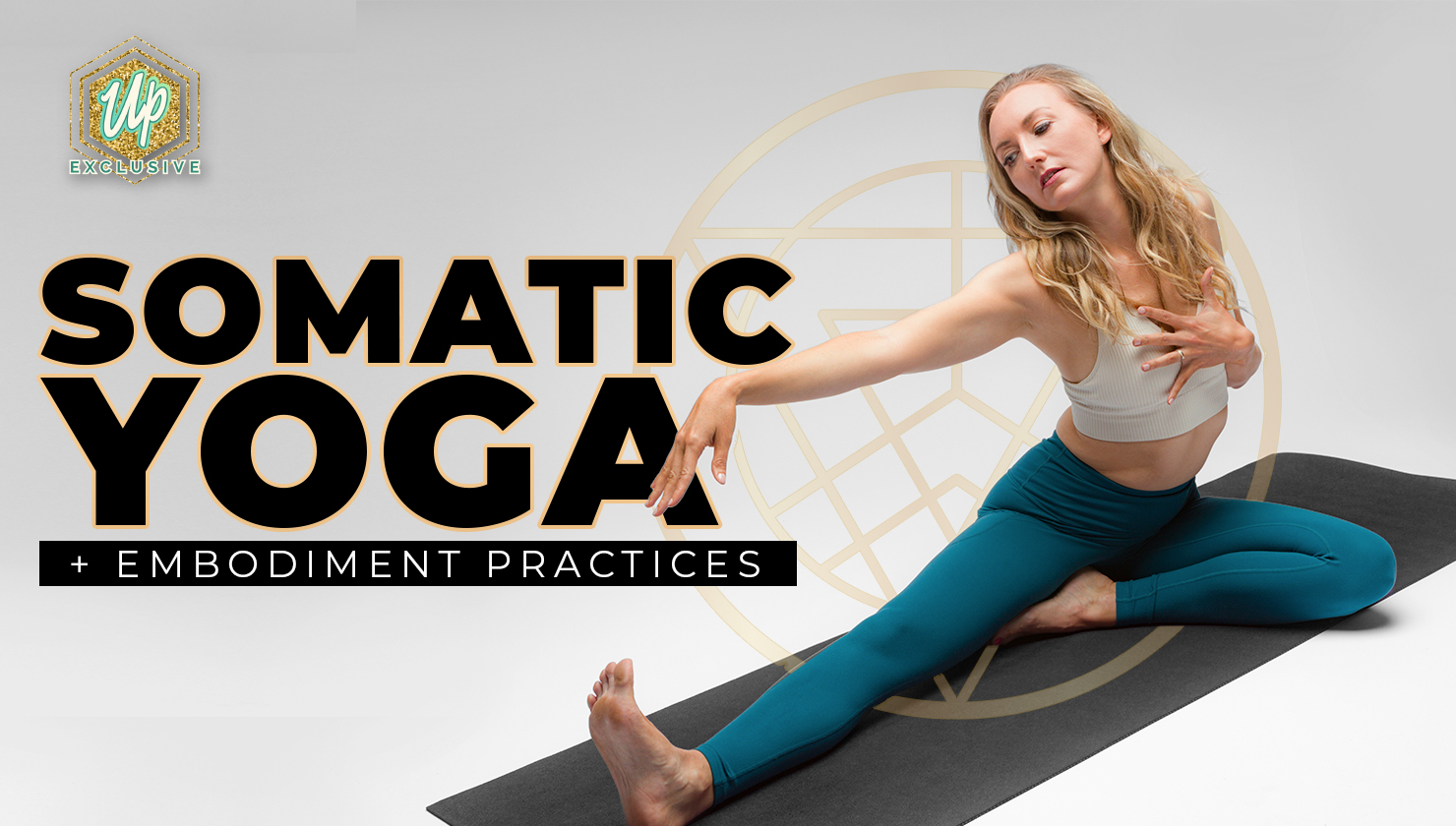
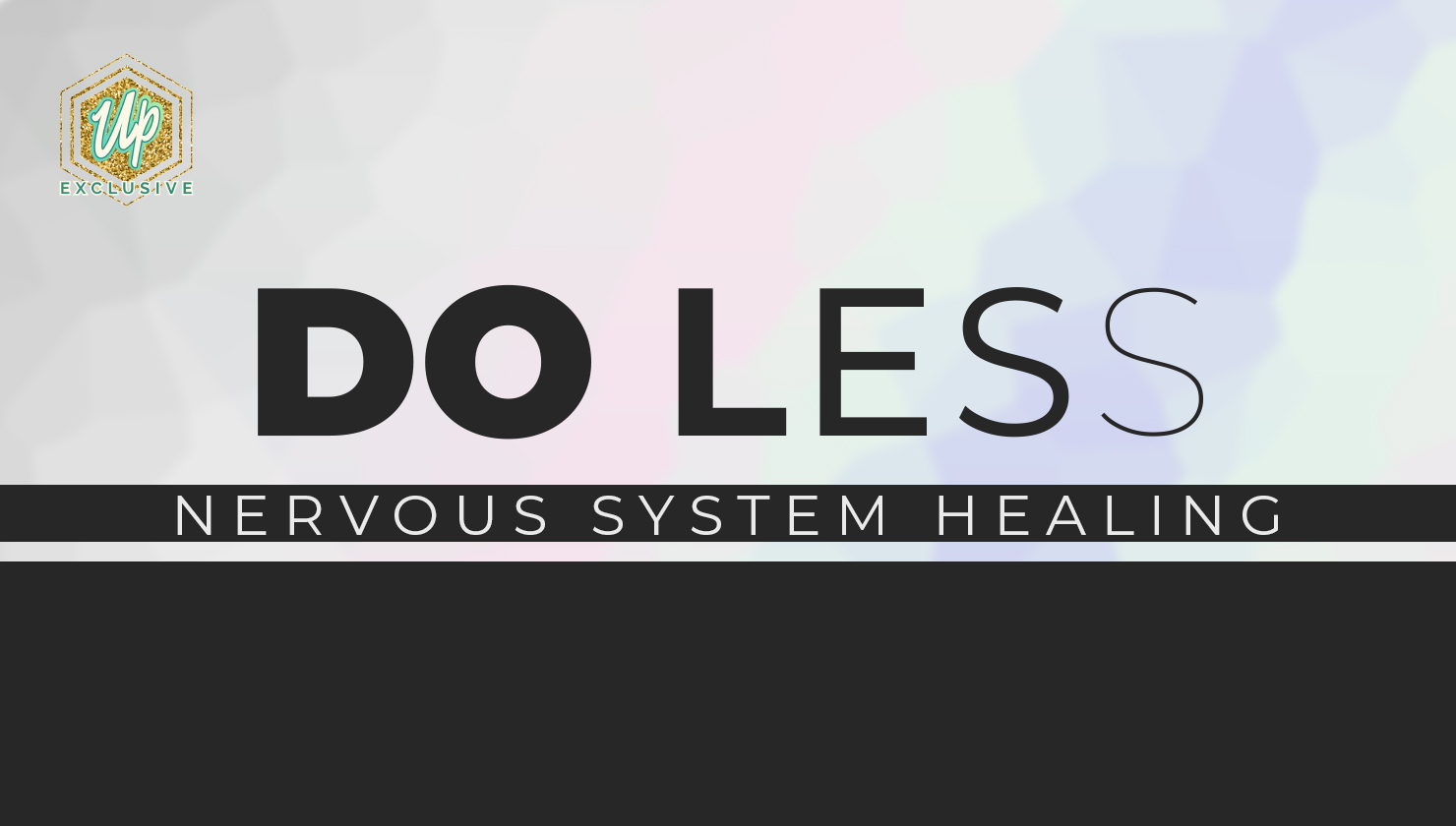
If you want to explore somatic yoga at home, the best place to start is my Uplifted Yoga Membership, where you’ll find:
- An entire Somatic Yoga section
- The Do Less Nervous System Healing series
- Gentle, trauma-sensitive practices you can return to again and again
And if you want the full framework — including science, stories, and step-by-step practices — you can dive deeper in my book.
So What’s the Actual Difference Between Somatic Therapy, Coaching, and Yoga?
Here’s the simplest way to understand the difference:
Somatic therapy = bottom-up body awareness + clinical psychological processing
Somatic coaching = bottom-up body awareness + present and future-focused embodied change
Somatic yoga = bottom-up body awareness + nervous system support through movement and sensation
All three work with the body.
All three support regulation.
All three honor the nervous system.
But their intentions are different.
Somatic Therapy Focuses On:
- healing trauma
- resolving nervous system dysregulation
- understanding how the past shapes the present
- expanding the window of tolerance
- working with complex or overwhelming emotional material
Somatic Coaching Focuses On:
- post-trauma growth
- strengthening self-regulation capacity
- embodied decision-making
- aligning actions with values and desires
- learning to live differently now
Somatic Yoga Focuses On:
- reconnecting with the body
- sensing, expressing, and releasing energy
- cultivating inner safety
- supporting daily emotional digestion
- building embodied resilience
- completing stress cycles through movement
Somatic therapy helps you make sense of what shaped you.
Somatic coaching helps you embody how you want to live.
Somatic yoga helps your body feel safe enough to do both.
They are complementary — and distinct.
Which One Do You Need? (A Simple Decision Guide)
Here’s a grounded, no-nonsense breakdown.
Choose Somatic Therapy If:
- You have unprocessed trauma that feels overwhelming
- You shut down, dissociate, or panic under stress
- Your anxiety feels unmanageable
- You want structured support from a licensed clinician
- You’re working through past memories or attachment wounds
- Your emotional waves feel too big to navigate alone
To become a somatic therapist, you must already be a licensed clinician.
Many therapists I work with choose to add somatic coaching and movement tools on top of their clinical practice once clients reach a post-trauma growth phase.
Choose Somatic Coaching If:
- You’ve done trauma work and want to live differently now
- You can self-regulate but want support staying embodied
- You feel “functional” but not fully alive
- You want a partner, not an expert
- You want to work with the body without reprocessing the past
If you’re interested in becoming a somatic coach — or adding somatic coaching to your existing work — you can explore my Somatic Coaching Certification (EYLC), which trains coaches to work ethically with the nervous system, emotions, and embodiment in a post-trauma-growth framework.
Choose Somatic Yoga If:
- You want to reconnect with your body gently
- You want practical tools for everyday regulation
- You’re healing bracing patterns, chronic tension, or overwhelm
- You’re learning to feel again after years of numbing
- You want a movement-based practice you can do at home
If you’re curious, you can try somatic yoga in my free somatic masterclass, which gives you a felt sense of how this work supports the nervous system through movement and sensation.
If you want ongoing support, my Uplifted Yoga Membership includes an entire somatic yoga section — plus the Do Less Nervous System Healing series — designed to help you regulate, release, and come home to your body.
And if you want to teach this work, my Somatic Yoga Teacher Training is for those who want to focus on movement-based healing, nervous system regulation, and trauma-sensitive embodiment.
Choose More Than One If:
Honestly? This is where many people thrive.
Therapy helps you process the past.
Somatic coaching helps you design the present and future.
Somatic yoga helps your body feel safe enough to support both.
Together, they create a powerful, sustainable feedback loop of healing.
Final Thoughts
Whether you choose somatic therapy, somatic coaching, somatic yoga — or a blend of all three — remember this:
Your body is not the obstacle.
Your body is the path.
Every tension, impulse, and survival response developed to keep you safe.
Somatic practices don’t force change — they create the conditions for change to emerge.
And when you learn to listen to your body with curiosity instead of control?
Everything begins to change.

Next Steps
- Take a deep dive into embodiment and somatic yoga with my Somatic Yoga certification program.
- If you’re interested in practical kriya yoga as a way to improve your daily life and relationships, check out my Yoga for Self Mastery course.
YOU MIGHT ALSO LIKE
- Somatic Yoga vs Somatic Therapy: What’s the Difference?
- 8 Top Somatic Yoga Books to Regulate Your Nervous System
- 5 Best Somatic Yoga Apps for Nervous System Regulation
- Top Somatic Coaching Programs And How To Choose One
- Somatic Yoga Workshop Ideas for Teachers
- Somatic Yoga for Cortisol Detox: A Gentle Path to Stress Relief and Nervous System Healing
- Gentle Somatic Yoga: Heal Chronic Pain, Release Trauma, and Reclaim Your Bod
- Somatic Meditation: A Body-Based Approach to Healing Stress, Anxiety, and Trauma
- Advanced Pelvic Floor Breathing: A Somatic Approach to Healing
- Somatic Yoga For Yoga Teachers: Everything You Need to Know in 10 Steps
- How Somatic Shaking Can Release Tension and Reset Your Nervous System
- Discover Somatic Pilates: Enhance Your Body Awareness and Flexibility
- Kundalini for Feminine Energy: Ignite Your Creative Power and Passion
- 6 Effective Somatic Yoga for Neck and Shoulders
- How to Teach Somatic Yoga: A Practical Guide for Instructors