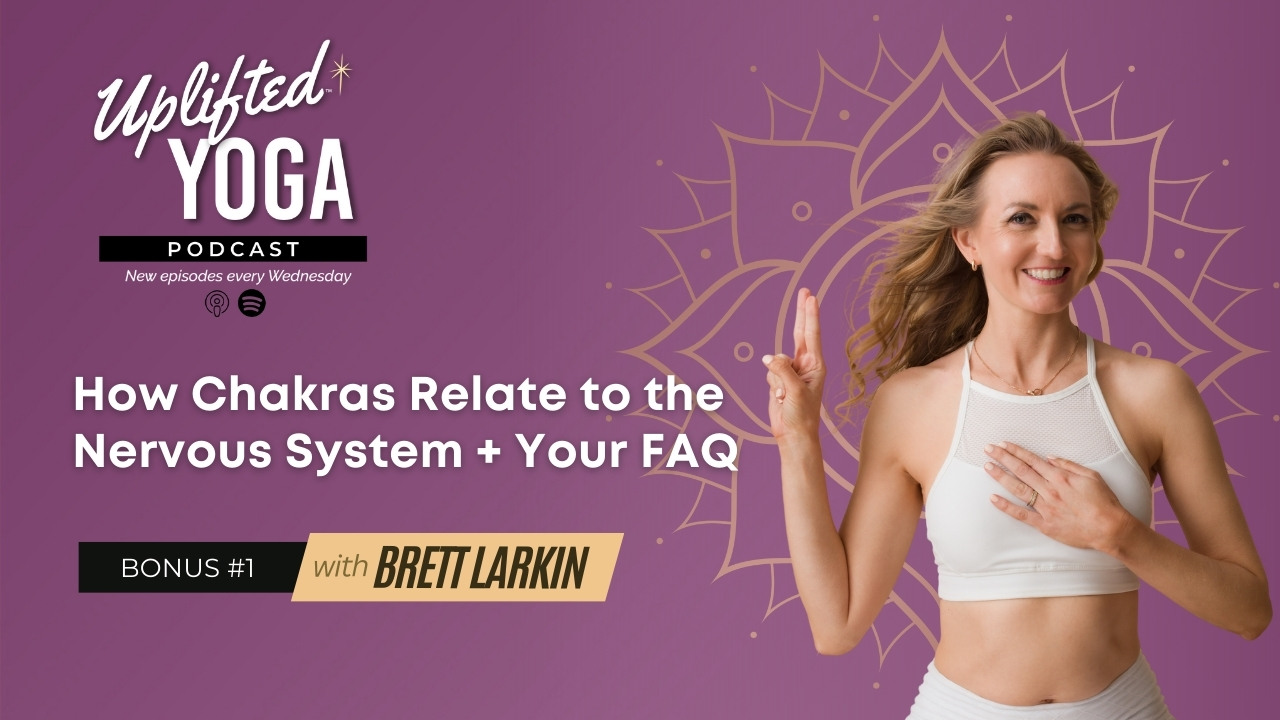
SURPRISE!! I’ve got a bonus episode for you this week.
I’m going to explore three of the most commonly asked questions I hear from students about the chakras — especially how they relate to the nervous system, your fascia, and lived experience.
🔹 Are the chakras literal locations, archetypes, developmental stages — or all three?
🔹 Do chakras actually open and close?
🔹 What’s the relationship between chakra patterns and nervous system regulation?
If you’ve ever wondered how these energy centers show up in your posture, behavior, and emotions — this quick breakdown will connect the dots between yogic wisdom and modern science in a way that’s practical and embodied.
I’ll also share my favorite metaphor for understanding the chakras, and why we need to stop treating them like a spiritual report card.
🌈 Discover your dominant chakra with my FREE dominant chakra test => https://www.brettlarkin.com/chakra-test/
📱Book a Free Clarity Call => https://calendly.com/uplifted-clarity/discovery-call
FREE Practice: Chakra Hatha Yoga | YOGA TO ALIGN & BALANCE YOUR CHAKRAS
Relevant Blog: Crystals For Chakras: Unlock Your Energy and Balance
Relevant to Today’s Episode:
📚 Healing with Somatic Yoga Book
🔮 300-hour Online Yoga Teacher Training
🎧 Also Listen to:
#351 – Unlocking the Secrets of Chakras: Lower Chakra Symbols Explained
#355 – Unlocking the Secrets of Chakras: Upper Chakra Symbols Explained
© 2026 Uplifted Yoga | BrettLarkin.com
Transcript:
Brett:
It’s time for you to walk through the world with the confidence and serenity of someone who’s deeply tethered to their inner wisdom. If you have this insatiable hunger to uplift your personal life and make a bigger impact in your wellness career, leveraging yoga’s ancient wisdom, welcome. I’ve certified thousands of yoga instructors online, I teach to over half a million subscribers on YouTube, but I still haven’t remotely quenched my thirst for more yogic knowledge.
I’m Brett Larkin, founder of Uplifted Yoga, and this is the Uplifted Yoga Podcast. Let’s get started. Welcome to the very first bonus episode of the Uplifted Yoga Podcast.
These are going to be shorter, more focused, little deep dives that I’ll drop in from time to time whenever there’s a set of questions that I know so many of you are wondering about. Honestly, this is the magic of being in community. You hear someone else ask a brilliant question and you’re like, oh yeah, that’s what I’ve been feeling, or that’s what I’ve been wondering, and I just didn’t know how to name it.
If you want that kind of experience, if you want to be with a community of people who ask the most thoughtful, nuanced, embodied questions, consider booking a free conversation with my team. We can help you figure out whether joining the Uplifted Campus or one of my trainings might be the right next step for you. I’ll link that up in the show notes.
So today’s bonus episode is themed around one of my favorite topics, the chakra system, but approached through the nervous system, the fascia, and the lived reality of your body. We’re going to explore three questions that advanced students ask all the time, like are the chakras literal locations, or are they archetypes, developmental stages, or all three? Do chakras actually open and close, or is something else happening? And the big one, the title question of this episode, how do the chakras relate to the nervous system? These are such juicy, delicious questions, and I’m excited to jump into all three. Let’s dive in.
Question one, are the chakras literal locations, archetypes, developmental stages, or all three? Here’s what I tell my students. The chakras are not organs, but they’re also not floating ideas in the sky. They’re mapped to very real, dense, physiological hubs, places where we find major nerve plexuses in the body, fascial intersections, endocrine glands, and diaphragms.
For example, the root chakra sits roughly at the pelvic floor and the pelvic nerve plexus. The sacral chakra maps to the pelvis and the lower belly, the hypogastric plexus. The solar plexus chakra literally maps onto our celiac plexus of nerves, and the heart chakra corresponds to the cardiac plexus and thymus.
The throat chakra aligns with the cervical plexus and the thyroid, parathyroid. The third eye maps onto the pituitary hypothalamic axis. And the crown chakra isn’t one gland per se, but a symbolic seat of consciousness tied to the pineal and cranial vault.
So yes, in that sense, the chakras have literal locations where the body’s communication and regulatory networks concentrate. That’s part of why they’re so potent. But if we stop there, we miss 80% of the richness of the chakra system because the chakras are also psychological archetypes.
Archetypes give off an energy texture. They make each chakra experiential, not theoretical. Some examples of the chakras as archetypes would be the root chakra as the survivor, the provider, the sacral chakra as the lover, the artist, the boundary setter, the solar plexus as the warrior, the sovereign, or the inner critic, the heart chakra as the healer, the empath, the beloved, and the throat chakra as the truth teller, the songbird, the third eye chakra as the seer or the visionary, and the crown chakra as the mystic or the sage.
If you want to explore these archetypes more deeply, I have an entire archetypal series inside the Uplifted Membership where we feel into these energies somatically. We’ve talked about how the chakras do map to anatomical places on the body, usually through major nerve plexuses. We’ve talked about how they can also be related to archetypes, and chakras are also related to developmental stages.
If you’ve read one of my favorite books, Eastern Body, Western Mind, which I always, always recommend, you’ll see the chakra system lines up beautifully with early life developmental psychology, and my teacher, Anadeya Judith, illustrates all of that in that book. She also co-teaches 300-hour teacher training with me inside the Uplifted ecosystem. So if you want to go deeper in a structured, academically grounded way, she and I unpack all of these developmental layers inside a 300-hour online yoga teacher training.
So are the chakras literal, symbolic, archetypal, developmental? The answer is yes. They’re all of those because they’re a multidimensional map of the human experience. They show how your body, your psychology, your spiritual life, and your nervous system are constantly talking to each other.
That’s what makes them interesting. That’s why I find me and most of the students in our community love them. We love them literally because they are this hub.
They are these multidimensional intersection points. Question number two. Do chakras open and close, or is that westernized language for something more subtle? One of my least favorite phrases in the chakra world is this idea that a chakra is closed, not because only is it inaccurate, but it implies that something is wrong with you that you need to fix.
A lot of students end up, I find, weaponizing the chakra system against themselves. They might say, my heart chakra is closed, that’s why I can’t date. Or my throat chakra is blocked, that’s why I can’t speak up.
This makes the chakras feel like a report card rather than a map of your humanity. The truth is chakras don’t open or close like doors. What we’re really talking about are patterns.
Patterns of sensation. Patterns of behavior. Protection.
Patterns of emotion. Patterns of expression. I often tell students to think of the chakras like apps on your phone.
Each one runs a certain program in your life. Just like on my phone, my calendar runs my schedule. My messaging app runs my communication program.
It’s similar with the chakra system when you think of each chakra as a program that’s governing the love program in your life or the safety program or survival program in your life. When a certain program is running in a way that creates harmony and alignment, we feel balanced. But when an app, chakra, or program is running in a way that overwhelms us or forces us to shut down, that’s when we start to feel dysregulated.
And in my 300-hour training, we use the language of excess and deficiency instead of open and closed when it comes to the chakra system. So we bring the gunas into it. The gunas.
Tamas, rajas, and sattva. We’re always aiming for a sattvic expression of each chakra. But what that looks like will be unique for each of us.
And it will change depending on what’s happening in our lives. For example, if you’re falling in love, your heart chakra might feel very excessive. Big emotions.
Big feelings. Big openness. But if your root chakra is steady and your solar plexus is strong, that excess can actually feel pleasurable and grounding and safe.
So just like everything that’s alive is influenced by the gunas, the chakra system is alive too and also influenced by the gunas. It’s always responding to your environment, to your relationships, to your nervous system, to your level of safety. So the goal isn’t perfect balance like all the chakras in a militant straight line.
The goal is awareness of these patterns and programs. And the goal is responsiveness, fluidity, a felt sense of, you know, my system is adapting in a way that supports me right now. So no, the chakras don’t open and close like doors.
They shift the way living things shift, the way an ecosystem shifts. Question number three. How do the chakras relate to the nervous system? When people ask how chakras relate to the nervous system, the simplest answer is this.
The chakras describe the patterned way your nervous system organizes around certain themes in your life. Remember the iPhone analogy I share? Each chakra is like an app that runs a particular set of programs, safety, intimacy, agency, love, expression, intuition, going up the chakras right there. So your nervous system and even your posture and fascia literally shape themselves around these programs.
We see this physically. Think of someone whose chest is collapsed and whose chin is always slightly tucked. Their fascia is wired into a posture of protection, a kind of embodied heart chakra deficiency or throat chakra collapse.
Their nervous system has rehearsed those patterns for so long that the body architecture now reflects them. On the other end of the spectrum, chakras can also be excessive, meaning that the app is running in overdrive. It’s running too much.
When I was filming my 300-hour training with my mentor, Anadeya Judith, PhD, my third chakra, Manipura, was so dominant that she literally couldn’t get me to demo the deficient solar plexus exercises on camera. My belly literally just had no idea how to soften. My system didn’t recognize that pattern as safe or even available.
That’s the nervous system chakra relationship in real time. Your body becomes the shape of these patterns you’ve practiced. And those of you who’ve read my book or are planning to explore my book, Healing with Somatic Yoga, my new book, we talk about this in the book.
We call it your body set map. And there’s even an interactive exercise in PDF that you can download to begin to decode this for yourself. The fascia, your interconnective tissue, plays a huge role here because it holds tension and is the context in which all movement takes place.
Your fascia is that interconnective tissue that every cell, organ, gland, muscle, bone is living in. So when it hardens or solidifies structures in a certain architecture or pattern, it can take a long time for that to shift, which is why intuitive movement, somatic yoga, biomorphic movement, all the things that somatics offer us really are so important. So you can explore new ways of moving, get more nutrient rich diversity in your movement as opposed to exclusively doing traditional yoga postures.
When a chakra theme is excessive or deficient, your fascia, your interconnective tissue responds in ways that reinforce that emotional and energetic pattern. So when we work with the chakras somatically through breath, movement, sound, spiraling, shaking, what we’re actually doing is giving the nervous system a new pattern to organize around, a new way to explore being. If you’re curious what patterns might be dominant for you, I’ll link my dominant chakra quiz in the show notes.
Spoiler alert, my result was third chakra. That’s my dominant chakra. Meaning just the themes of that energy center, that pattern are particularly strong in governing my life and the choices I make.
That’s the app that’s draining my iPhone battery and running the show. When really we want our root chakra, the one that’s connected to source and energy and allows us to charge to, in most cases, be the one that is extremely strong, well-established. And if you have a really strong root chakra, the other ones tend to self-organize quite well.
If you want to go much deeper into all of this, the fascia, the psychology, the posture, the somatics, the developmental stages, we spend a ton of time on this in my 300-hour online teacher training. And you can always take any of these courses to deepen your experience and not necessarily certify to teach. Thank you so much to the person who submitted this question because understanding the nervous system chakra relationship truly changes everything.
I hope this little bonus episode gave you a fresh way of seeing the chakra system, not as something mystical or abstract, and definitely not as a report card to judge yourself with, but as a living, breathing reflection of your nervous system, your fascia, and the patterns your body has rehearsed over time. If you want to be in a community where these kinds of questions are being asked every single week, where we explore yoga, somatics, philosophy, and personal growth in a really embodied and grounded way, book a free conversation with me and my team to learn more about joining the Uplifted Campus. Make sure you’re subscribed here on the podcast wherever you’re listening.
And if you loved this episode format, let me know. I always love hearing from you. You can find me on Instagram @LarkinYogaTV.
Until next time, keep listening to your body, keep learning its language, and take such good care of your animal self. Loving what you’re learning on the podcast? Apply the ancient science of yoga to your daily life surrounded by incredible peers in my Uplifted 200-hour online yoga teacher training, or grow into your role as a leader of others in my 300-hour professional program for yoga teachers, which is also a high-level business mastermind. At any time, I would love to welcome you into my Yoga for Self Mastery course to help you uncover your personal blueprint to serenity.
Or join my Uplifted Yoga membership for an all-access pass to my most popular yoga courses, thematic class plans, and practice calendars. Don’t forget to prioritize your well-being and get on your mat today. From my heart to yours, namaste.