
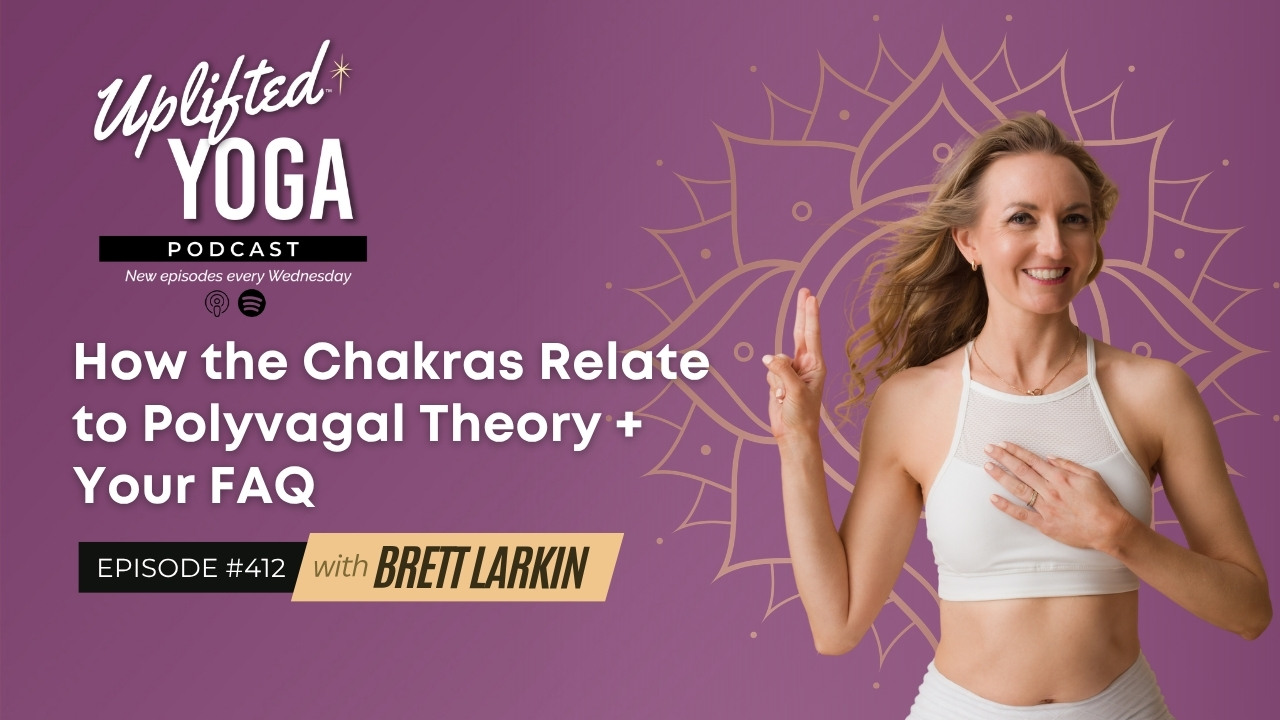
What if your chakra “block” isn’t a block — but your nervous system doing its job?
In this bonus episode, I go deeper into your most advanced chakra questions: from how the polyvagal ladder maps onto the energy body, to why certain life patterns keep repeating. We’ll explore how trauma, somatics, and subtle anatomy intersect — and why your healing path isn’t linear (and was never meant to be). We’ll explore:
🔹 Are chakras sequential or cyclical?
🔹 Why trauma theory transforms how we understand energy centers
🔹 How the koshas and gunas make chakra work more precise
🔹 Why you keep facing the same life lessons — and what to do about it
🔹 How each chakra reflects your nervous system’s state (fight/flight/freeze)
This is a practical, somatic deep-dive into energy anatomy, grounded in compassion, science, and lived experience. If you’ve ever said “I feel stuck,” this one’s for you.
🌈 Discover your dominant chakra with my FREE dominant chakra test => https://www.brettlarkin.com/chakra-test/
🎁 Grab my new book: Healing with Somatic Yoga: A 6-Week Journey to Release Emotions, Rewire Your Nervous System, and Reclaim Your Body → https://amzn.to/3WGulGG
FREE Practice: 30 Min Somatic Yoga Flow through Somatic Movement for Hips, Lower Back, Sacral Chakra
Relevant Blog: Opening Root Chakra Symptoms And How To Balance Muladhara
Relevant to Today’s Episode:
📚 Healing with Somatic Yoga Book
🔮 300-hour Online Yoga Teacher Training
🎧 Also Listen to:
#303 – The 7 Chakras as a Tool for Personal Growth
#324 – The Importance of Emotional Processing and Regulation: DENT Model Trauma
#390 – The Koshas Decoded: Energy Layers, Leadership + Financial Flow with Carla Cline Thomas
© 2026 Uplifted Yoga | BrettLarkin.com

Transcript:
Brett Larkin:
It’s time for you to walk through the world with the confidence and serenity of someone who’s deeply tethered to their inner wisdom. If you have this insatiable hunger to uplift your personal life and make a bigger impact in your wellness career, leveraging yoga’s ancient wisdom, welcome. I’ve certified thousands of yoga instructors online, I teach to over half a million subscribers on YouTube, but I still haven’t remotely quenched my thirst for more yogic knowledge.
I’m Brett Larkin, founder of Uplifted Yoga, and this is the Uplifted Yoga Podcast. Let’s get started. Welcome back to another bonus episode of the Uplifted Yoga Podcast.
If you listened to the first chakra bonus episode, you know these are shorter episodes. They’re my way of giving you deep, precise teachings inspired directly by the questions that come in inside the Uplifted community. Again, this is one of the reasons I always encourage you to get into community, whether that’s joining the Uplifted Campus or booking a free conversation with my team, because you don’t know what you don’t know.
Sometimes you hear someone else ask a question that lights up a doorway in you, a doorway you didn’t even maybe realize was there. So today’s bonus episode is part two of our Chakra FAQ series, and we’re going deeper into trauma patterns, the koshas, the gunas, and how the chakra system mirrors the polyvagal ladder. These are the advanced, nuanced questions that tell me you’re ready to understand the chakra system, not as a rainbow poster, but as a living map of the nervous system, the psyche, and your embodied patterns.
Today we’re going to explore five powerful questions, and here they are. We’re going to explore, are the chakras sequential, or do we heal them non-linearly? We’re going to explore, what does modern trauma theory reveal or challenge about the chakra model? How do the chakras intersect with the koshas and the gunas, and why this is almost never taught together? Question number four, we’re going to look at why does certain life patterns repeat at specific chakra levels, and lastly, how do the chakras relate to the polyvagal ladder? Thank you for these amazing questions, and now let’s dive in. Question number one, are the chakras sequential? Do we really heal them in order? Traditional imagery presents the chakras often as this ladder, starting at the root and climbing to the crown.
And while certain tantric texts follow this structure, the lived human experience simply does not operate in a linear, step-by-step way. Healing is cyclical. Development is cyclical.
Your nervous system is cyclical. If you’re a woman, you’re cycling right now. So you don’t graduate from your root chakra and then never revisit safety or belonging again.
It’s not like you heal intimacy once in your sacral chakra and call it one and done. You don’t activate your solar plexus and then never feel doubt or collapse again. Instead, life pulls you into different chakra themes depending on what’s happening in your life.
That’s my belief. A breakup might shift you into the heart and the root. A career leap activates your solar plexus or challenges it in a new way.
A new creative project lights up the sacral and the throat. Trauma processing work toggles between root, sacral, and solar plexus. In somatic yoga, I often say when it comes to chakra work, we want to work bottom-up for safety when it comes to the chakras and top-down for meaning.
So that’s a helpful overarching meme, bottom-up for safety and top-down for meaning. But here’s the deeper truth. And we talk about this extensively inside my advanced online 300-hour teacher training.
Everything loops through the root chakra. If you don’t feel safe, every other chakra is impacted. Your lack of safety is going to color how you express yourself, throat chakra, how you attach and relate at the heart chakra, how you make decisions, solar plexus chakra, how you vision or project or think about the future, your third eye, and even your sense of trust and connection, the crown chakra.
When safety is compromised, all the higher centers constrict or distort. Your whole system organizes around survival. We talk a lot about Maslow’s hierarchy of needs in that training as well.
So here’s one of my favorite hacks for chakra work. Number one, work with the root chakra, absolutely. But if you’re called towards a specific energy center, work with the chakra underneath the one you think is the problem.
For example, if you’re afraid to speak up, which would be the throat chakra, go into the heart first. Maybe reconnect with why your message matters. Feel the emotional truth behind what you want to say.
And often once the chakra underneath the one you think is the problem, so like once the heart is online, the throat comes back online automatically, organically. Here’s a different example. If you’ve ever been stuck creatively, which you’d think of as like sacral chakra, look one below.
Look at the root. Does your system feel safe enough to play, explore, and take risks? Are you seeing how looking one chakra below the one you think is the problem can be helpful? Let’s give another example, your solar plexus. Let’s say your solar plexus is like you have no motivation.
You have no will, no energy, no agency, check in with the sacral chakra, which would be below. Is there an unresolved emotional issue or boundary confusion underneath? So this is why I teach that you should never work on the chakras in isolation. I would advise you to always consider how does the chakra below support the one you want to work on? How does safety at the root influence everything above it? How does meaning from the crown or intuition or from the third eye trickle downward? So these are some great overarching questions you can ask.
So yes, bottom up for safety, top down for meaning is a great shorthand, but the deeper practice is relational. The chakras talk to each other. They influence each other.
This is an interconnected system. They depend on each other and they especially depend on the root. Question two, what does modern trauma theory reveal or challenge in traditional chakra psychology? Love this question.
Trauma theory actually deepens chakra work in a stunning way. Each chakra, I think, maps beautifully onto trauma themes. The root is obviously about safety, survival, and regulation.
The sacral chakra, intimacy, pleasure, boundaries, the solar plexus, agency, shame, and personal power. The heart chakra, attachment, loss, vulnerability, the throat chakra, expression, truth, selfhood The third eye, perception, worldview, meaning, and then the crown, connection, and existential trust. But trauma theory challenges the simplistic idea of imbalances.
You know how we hear people say, oh, well, a chakra is imbalanced. Trauma isn’t an imbalance. Trauma is an adaptive strategy the body used to stay alive.
So a closed heart chakra, in quotes, isn’t a failure. It’s not your fault. It’s not something you need to fix with a wrench.
It’s a brilliant survival response. A collapsed solar plexus chakra isn’t weakness. It’s your system protecting you from overwhelm or shame.
And this really ties into the intro of my book, Healing with Somatic Yoga, where I talk about how your body loves you. And even these things you think are problems or symptoms are your body trying to communicate with you, trying to get your love story back on track, trying to connect with you, trying to get you to slow down and listen. So trauma theory teaches us to work with the chakras through titration.
That’s a word we talk a lot about in somatic teacher training, through titration, pacing, and safety. So rather than trying to blast the chakras open or balance it or fix it through intense breath work or cathartic exercises, we’re bringing compassion into the model. That’s what trauma theory is adding in here.
And going back to the question before, it’s like, realistically, we’re not going to balance or solve a lot of these issues without really looking at safety first, without really looking at the nervous system first. So trauma theory, I think, brings the nervous system back into the chakra conversation, which is exactly where it belongs and why I’m so passionate about somatic yoga, because somatic yoga is really very much about the nervous system. How can you learn the language of your animal body through breath, sensation, and movement, and start to feel safe in your own skin again? Question three, how do the chakras intersect with the koshas and the gunas, and why don’t most yogis learn them together? Okay, this is one of my favorite advanced questions, so thank you, everyone.
Because the truth is, these frameworks were never meant to be siloed. I think we did that in the West to make yoga teachable in like 60-minute teacher training lesson formats, perhaps. The chakras describe themes of consciousness.
The koshas describe layers of your being, body, energy, mind, wisdom, bliss. The gunas describe the qualities of nature, tamas, rajas, and sattva. So when you put them together, you get a 3D map of the human experience.
This is why it’s so important to really know all three. And I’ll say these again, and know that I have much longer podcasts on each of these as well. So chakras describes themes of consciousness, koshas, which we’ll link up in the show notes, some of the longer podcasts I have about the koshas, but the koshas describe the layers of your being.
So like the body sheath, the energy sheath, the mind, the wisdom body, the bliss body. And then the gunas are describing the qualities of nature. We live in, I call it polarity planet.
We live here on Earth. So we’re affected by the fluctuation of nature, tamas, rajas, and sattva. When we put all of these three dimensions, chakras, koshas, and gunas together, we really begin to understand the human experience in a deeper way.
For example, the solar plexus chakra can show up differently depending on the gunas, right? A rajastic solar plexus, an overactive solar plexus, often looks like overdrive, control, hyper productivity, while a tamastic deficient solar plexus chakra often looks like collapse or shame or passivity. And then a sattvic, more balanced solar plexus might look like empowerment, clear, grounded agency. So in my trainings, we’re always looking at the chakras through this lens of the gunas, through this lens of excess and deficiency.
And then when you look at the chakras through the koshas, you see the physical solar plexus, which is like digestion, posture, maybe the diaphragm, the emotional layer of the solar plexus, confidence, anger, boundaries, the mental solar plexus, which would be like personal narratives, that inner critic, the wisdom layer of the solar plexus, discernment, integrity, and then the bliss layer of the solar plexus, which would be that like effortless aligned action, you taking action, but it feels like you’re in flow. So when you combine these three frameworks, the chakras, the koshas, and the gunas, your understanding becomes incredibly precise. You know exactly where, how, and why a pattern might be showing up and what layer you need to work with to shift it.
And this is what we do nonstop in approach to sequencing yoga and our personal lives and our business in a 300-hour teacher training. It’s why I bring all these systems together and force you to apply this knowledge to yourself as maybe a business owner or a healer or a leader, because once you see how the koshas and gunas interact with the chakras and how all of this is interplaying within you and resulting in your patterns and your current reality, it changes everything. Question four, why do certain life patterns repeat at specific chakra levels? Such a great question.
And the answer is because your nervous system is always seeking completion. It’s always trying to resolve what has remained unresolved. It’s always trying to complete the stress cycle.
For those of you that read Healing with Somatic Yoga, patterns repeat because the body wants to recreate the conditions that mirror an old story, hoping for a new ending. Okay? So for example, sacral patterns repeat when intimacy, boundaries, desire, or abandonment wounds are still present, are still alive. So that’s why you attract the same partner even though you moved across the country to get away from their doppelganger.
It’s the same relationship. It’s the same dynamics over and over, even though it doesn’t maybe seem that way in the beginning. Solar plexus patterns, for example, repeat when shame, self-doubt, or fawning were adapted earlier in life.
The Dent Model of Trauma podcast, which maybe we can also link up below, talks a lot about the fawn response, one of the underlooked responses when it comes to trauma. So maybe you have a solar plexus pattern of choosing the same job, power dynamic, or relationship, and your power is always diminished. Life is going to keep presenting you with that situation or similar situations.
This is what we talk about in training as karma, right? Life presenting you with circumstances for you to work out those dynamics. So heart chakra patterns repeat when an attachment wound or grief hasn’t been tended to. You haven’t been able to sit with that or you don’t have the capacity to stay with that.
So vulnerability feels dangerous, even if love is what you consciously want, or slowing down and giving some love to yourself feels dangerous, even though staying busy would feel more comfortable. So the chakra system shows you where the pattern lives. The nervous system shows you how to experience it.
And a somatic practice gives you a pathway to update the pattern. It takes a lot more TLC, tender loving care, than we might think. It’s like flowing through just a bunch of chaturangas and sun salutes isn’t enough in my experience.
So if you feel like you keep having to learn the same lesson, or you see these patterns repeating at the level of each chakra, just know that it’s not punishment. It’s biology seeking integration. It’s your stress cycle literally being like, let’s create this again in the hopes that this time you’ll actually close the cycle.
You’ll move through it a different way and we’ll end up in a completely different place in narrative. Question five, how do the chakras relate to the polyvagal ladder? Oh my gosh, love this question. And this is where the whole model comes alive.
Your chakra system dims or lights up depending on your autonomic state. So let’s think about fight, flight, which would call sympathetic nervous system activation. What’s happening? Solar plexus chakra goes into overdrive.
The heart and the throat tighten, the root becomes restless or hypervigilant. Your sacral loses any kind of fluidity because we’re gearing up and tensing up to fight or flight. Let’s look at freeze, the dorsal vagal state.
Here the solar plexus collapses, heart chakra goes numb, the throat shuts down, the root becomes hypoactive, the sacral loses creative impulse, and the third eye becomes foggy. We’re freeze, dorsal vagal shut down. Again, the Dent Model of Trauma podcast, which we’ll link up below, has a great deeper dive into all of these nervous system states.
Okay, ventral vagal, for you polyvagal fans out there, which would be like safety, the ventral vagal state, that’s a root that feels grounded. Sacral chakra feels fluid and creative. The solar plexus feels confident, heart feels open, the throat is expressing truth, the third eye proceeds clearly, the crown senses connection and trust.
So I think you can view the polyvagal ladder as the physiological map, and the chakra system is the symbolic and psychological map. When you put them together, suddenly the chakras stop being so mystical and abstract, and actually become a somatic portrait of how safe or unsafe your nervous system feels. And this is one of the reasons my somatic yoga work is some of my favorite content I’ve put out there, because we’re not just working with energy, we’re working with the physiology, the body state underneath the energy.
Those of you who have the book, maybe you’ve done that body set map exercise with me, where we’re kind of mapping how we react to stress physically in our body. That’s an example of us working with the physiology underneath the energy of a particular chakra. I hope this bonus episode helped you see the chakra system through a deeper, more embodied lens, one that honors the nervous system, the fascia, the trauma theory, and the patterns and ways your body shapes in response to life.
If you want to explore your own patterns, I’ll link my dominant chakra quiz in the show notes. You can definitely take that, figure out which is your dominant chakra, and if you want to learn this work at the level where it really becomes second nature, where you can feel a chakra or a pattern in your body before you can even name it, join us, join me inside the Uplifted campus, either through the Uplifted membership, or book a free conversation with my team to explore which of the many trainings might meet you where you’re at. I’ll be releasing more of these bonus episodes soon, so make sure you’re subscribed.
And if you’re loving this format, let me know. I would also love to hear your feedback. Thank you so much for being here.
Until next time, take good care of your body, your animal self, and your very precious nervous system. Thank you so much for being here and listening all the way to the very end. I want us to get to 1,000 reviews on this podcast.
We’re already over 500. And as a free gift to you, if you leave a review, I want to send you my chakra balancing audio track and journaling hack. Maybe you have a problem right now and you’re not really sure how to solve it.
Well, guess what? Did you know you can ask your chakras? So I’m going to send you this five-minute self-inquiry process that I use all the time. It’s a PDF and audio, so you can consult and balance your chakras. All you have to do is leave a review wherever you are listening to this podcast, screenshot the review before you hit submit, because sometimes it takes a while to show up, and then send your screenshotted review to info at upliftedyoga.com, subject line podcast.
And we will respond within 48 hours with your chakra balancing audio track and journaling PDF. I’m so excited to share with you this special way that I quickly connect with and balance my chakras. Thank you so much for your review and claim your free copy today.