
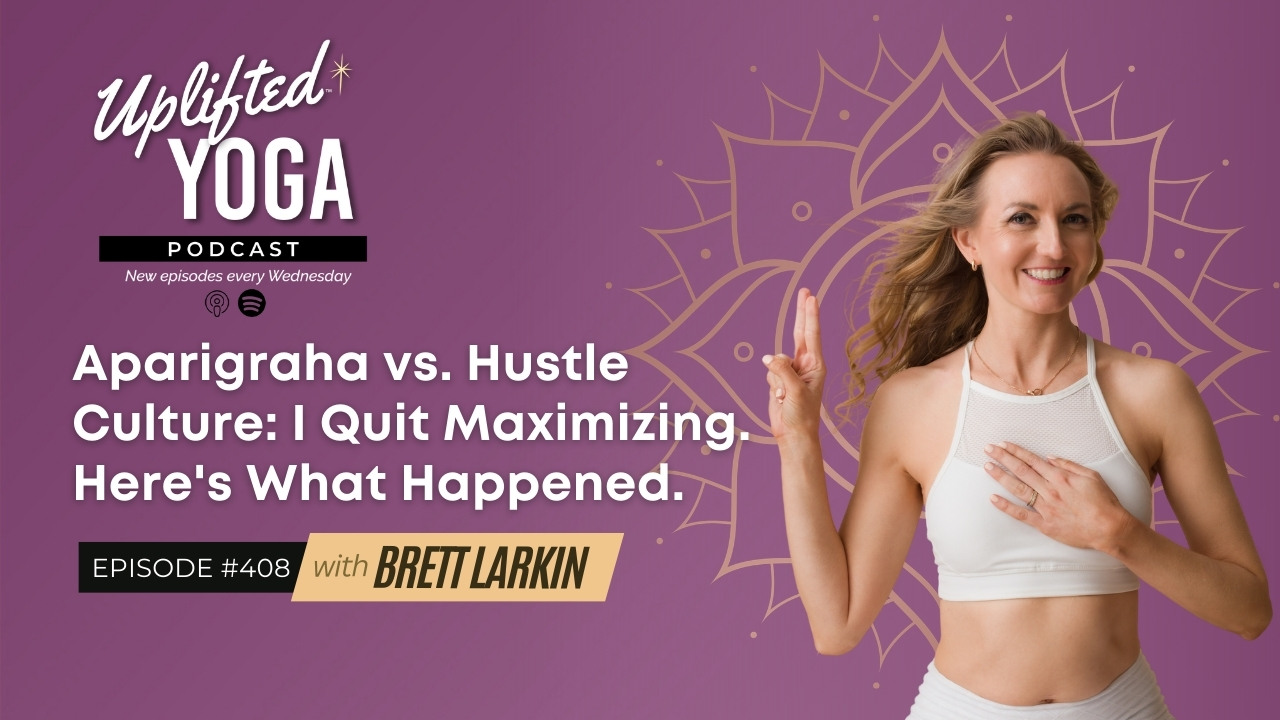
Are you addicted to efficiency? This episode explores the fifth Yama, Aparigraha — non-grasping, through the lens of modern life. We talk hoarding… not of stuff, but of tasks, to-dos, and productivity itself.
If you’ve ever found yourself trying to “earn” your rest or multitasking even in your downtime, this one’s for you. Let’s talk about:
🔹 What it really means to stop grasping (hint: it’s not just about material things)
🔹 The dark side of the “maximizer” mindset
🔹 Why we hoard productivity (and how it erodes presence)
🔹 How contentment (Santosha) offers an antidote to overwhelm
🔹 What Mary & Martha can teach us about being vs. doing
Yoga begins with your relationship to time, tasks, and how you be with yourself. Let this episode be your reminder: You don’t need to do more to be more.
💖 Give yourself permission to slow down, check in, and come home to yourself with my Yoga For Self Mastery course => https://www.brettlarkin.com/yoga-for-self-mastery/
FREE Practice: Yoga for Anxiety & Anger: Yoga to Surrender & Calm Down (25-min) – All Levels
Relevant Blog: Aparigraha: 6 Ways To Completely Let Go In Yoga
Relevant to Today’s Episode:
📖 Yoga Life Book
📚 Healing with Somatic Yoga Book
🎧 Also Listen to:
#384 – Do Less, Heal More: 7 Invitations to Resolve Trauma from Organic Intelligence
#403 – Why You Keep Failing at Self-Care — and What to Do Differently
#404 – What If I Fail? Krishna’s Answer to Your Inner Critic (Bhagavad Gita Chapter 6)
© 2026 Uplifted Yoga | BrettLarkin.com

Transcript:
Welcome to the Uplifted Yoga Podcast, where ancient yogic wisdom meets modern business strategy. I’m Brett Larkin, creator of Uplifted Yoga, where I’ve certified thousands of yoga teachers, built a multi-seven figure business, and guided over half a million students on YouTube. Here’s the truth, you don’t have to choose between embodying deep yogic wisdom and building a thriving, freedom-based business.
This podcast is your space to integrate both. Because yoga isn’t just what you do on the mat, it’s how you show up in every part of your life. Whether you’re here to deepen your yoga practice, grow your teaching career, or align your energy with your purpose, you’re in the right place.
Let’s dive in. Have you ever found yourself trying to earn rest or multitasking, even though it’s downtime for you? Maybe you’re addicted to efficiency, like me. Well, if anything I’ve been talking about describes you, what we’re going to explore in today’s episode, the fifth yama, a parigraha, non-grasping, is for you.
We’re going to look at this concept of a parigraha through the lens of modern life. What does it really mean to stop grasping beyond just, you know, material things? I’m going to be revealing what I found in myself and that I call the maximizer mindset and the dark side of this mindset. How we often hoard productivity, how it erodes our present, and how contentment, santosha, can offer an antidote to this overwhelm.
We’ll even look at a biblical parable today as it relates to this idea of non-grasping. And if you want to gift yourself permission to slow down, to stay on your own paper, as I like to call it, and really action the tools that we talk about here on the podcast, these different yogic philosophical concepts in your interaction with your spouse or your kids or in the way you’re managing your time, I want to invite you into my Yoga for Self Mastery course. What’s so amazing is when you join that program now, we actually have live accountability calls because I know putting these principles into practice isn’t easy.
And I can’t tell you how transformative it is to go through the videos, go through the beautiful journal that I mail you that corresponds with the videos because I’m a pen and paper girl at the end of the day, and then also be able to have that option of getting on live to meet with other yogis who are trying to transform their relationships, get what they want using these same principles. So it’s not too late to join Yoga for Self Mastery, which is about the three core skills of yoga, svadhyaya, tapas, and isvari pranidhana. You can sign up and move through this type of material with a journal and a group of supportive cheerleaders who are in it with you.
I’ll let the link in the show notes. Friends, today I wanted to talk a little bit about a perigraha. This is the fifth yama.
We see it in Yoga Sutra 2.39, and it means non-grasping, non-hoarding, non-clinging. So as a reminder, the five yamas in order are ahimsa, non-violence, satya, truthfulness, asteya, non-stealing, brahmacharya, wise use of energy, and a perigraha. Both the yamas and the niyamas fit into the eight limbs of yoga.
They are part of that raja yoga, the eight-limbed system. A perigraha comes from the Sanskrit a, a meaning not or negating, non. And perigraha means grasping or seizing.
So literally a perigraha is non-grasping, non-hoarding. It’s about not clinging to things or trying to accumulate or hold on too tightly. The most obvious example we could think of would be like a hoarder who has a ton of material possessions.
But I wanted to challenge us to look a little deeper as advanced yogis today at this idea of are you what I’m calling a maximizer, meaning do you find yourself trying to squeeze in and hoard one more task, one more little thing to get done even in your downtime? Are you the kind of person who’s listening to a podcast while doing six other things? Are you anxious if you’re not being productive? Here’s how you might know you’re a maximizer, a.k.a. a hoarder of productivity. First you might think, well, I’m already upstairs. So since I’m upstairs and the vacuum’s upstairs, maybe I should just quickly, you know, like vacuum that thing that spilled earlier, do three chores, grab the laundry, and then I’ll earn my cup of tea when I go downstairs later because it makes more sense for me to do the upstairs things while I’m upstairs.
Or maybe you’re planning your kids’ playdates like a logistics manager. You want to make sure everyone’s in an activity at the same time so that you can have this downtime. But in this crazy construction of events, everyone’s so stressed out getting everywhere that you don’t end up feeling rested anyway.
And there’s never like the unplanned moment you’re craving. Or when you achieve it, it starts to feel hollow. Maybe you think, well, I’m dropping my kid off at that science class and the library’s right next door.
So even though I’m already running late, let me gather all the library books in the house so I can take them and drop the books off while I’m in that location because those two things make sense. And this is why I think this type of hoarding or productivity greed can be so incredibly seductive because like on paper, it makes sense. It makes sense that if you’re going to the science center, which is right next to the library, that you should bring your library books.
Or maybe for you, it’s like, I’m tired and I’m hungry, but I’m already like intellectually really deep in this task and it’ll just be way too hard to context switch and get back to this place later. So I’m just going to push myself and finish it now, even though I’m tired and my eyes are burning from staring at the screen. So in our culture, we tend to worship productivity.
We tend to worship and actually be praised for this kind of action where it’s like we’re really making things make sense so that we can make the most happen and get done. The problem with this is that this is an energy that is really good at like a high level. Like this is a skill set of like you being able to stack a perfect day on a calendar.
But when you actually drop down and need to live that day, it’s a totally different story. There’s a huge gap between the logical high-level planning and the embodied feeling of what it’s actually like to live out, running around your house, looking for all the library books when you’re already a little bit late, then having to rush into the car, then you don’t get to listen or put on the uplifting music or maybe podcast or whatever you were going to look forward to listening to in the car because you’re just like, I’m rushing, I got to go. And then, you know, that energy kind of bubbles over into your interaction with your kids when you pick them up from school or like whatever your life looks like.
The issue is that this is a headspace and it’s valuable to be able to think this way. But when we forget to bring in the body, like what it will be actually like to live out that plan and what my nervous system is going to need and how my nervous system might respond to all this. And, you know, what I talk about in Yoga for Self-Mastery is like you’re Svadhyaya, you’re like self-care bank.
How much debits am I going to take from that Svadhyaya self-care bank in the running around, in collecting all the books, in being frustrated that I can’t find, you know, one of them, in then driving in a rush state. And then, you know, I have less nourishment for when I’m interacting with my kids later and maybe something else goes wrong or they need me. We want to make decisions with our whole body, really following the river, following the train of thought into the body.
They always say like the hardest six inches to traverse is like from the head dropping down into the heart and asking, you know, how is that going to feel in my heart? How is that going to feel in my pelvis? How is this going to feel in my body? But when you’re in the maximizer mindset, you’re not thinking about any of that. And I really wanted to link this concept to a Perigraha because if you’ve been seduced by like the just trying to fit one more thing in, it’s important to recognize that as a hoarding, a hoarding of productivity. I even noticed this in myself, like things that seem innocuous, like I wanted to spend some extended time in prayer.
And yet I wanted to also be doing a yin yoga pose because I was like, well, I want to get some stretching in while I’m praying. And I was like, this is absurd. Like I was able to actually catch myself because I feel like I connect when I do like prayerful time.
There’s a particular position that in a particular place in my house where I kind of just sit and it’s not necessarily like a hardcore meditative posture, but I kind of know the posture where I get that connection that I’m really craving. And despite that fact, I was like, nope, just I’d like to maximize the productivity of this time and also make it about stretching my low back by being in like a yin style forward fold at the same time. And that is the maximizer mindset at its most pervasive.
So I invite you to think about something like that in your life, like something that seems, seems like innocuous, like not a big deal, but it’s really an example of you having so either little esteem for your nervous system or so little esteem and faith in what just pure stillness and focusing on one thing can bring you, that you fall into the productivity trap and fall into this paragraha hoarding of wanting to maximize every moment. And we have so much science that shows us that like when you multitask, you lose. Our brains not wired it for it.
We’re not designed for it. There’s something to be said, especially in this day and age, for just doing one thing and doing it well. Here’s like another innocuous example.
It’s like I’m going to rest and read a book. Well, what if I just rested and didn’t read a book? And this was actually the inspiration for my Do Less series, the nervous system healing series that’s in the Uplifted membership right now, where it’s actually exercises that are training you on how to how to do less, how to be comfortable doing nothing, because there is so much healing in that white space. What I love about the philosophy that I offer at the start of that Do Less series is that the nervous system, the body knows how to recalibrate.
It’s it’s not like you’re you’re broken. And I know some of us and some of you might feel like you are and have things to process. And luckily, we have a lot of somatic and trauma informed yoga tools to help you.
But so often the recalibration can happen if we just create the white space, some blank canvas time, some empty time for the body to to recalibrate because your body’s already doing so much. It’s like and I say this in the series, in the Uplifted membership, it’s like even when you’re doing nothing, what you perceive as nothing, your body’s doing a million things. It’s regulating your heart rate.
It’s enabling you to breathe in and out. It’s doing that without your conscious control. It’s regulating your hormones.
It’s maybe prepping your next menstrual cycle like it’s it’s digesting your food. It’s helping your immune function. It’s doing so much.
There’s so much going on already, even when you’re doing nothing. And here’s a philosophical angle to this. When you’re in Parigraha hoarding productivity maximizer mode, you’re basically putting yourself in this seat of I have to be in charge of everything.
I know exactly how things should go. And we start to essentially worship our own effort, our own productivity instead of worshiping whatever we want to be worshiping God, the universe, Jesus, whatever you believe in. So that’s another angle you can bring in.
It’s like, can you let go of the need to be like the mini God or goddess of your own life? Often we’re doing these things for good reasons. We’re doing things because, you know, we’re maximizing because we want to help our families or we want to help our students or we want to help our low back pain with a stretch. We want to create the best experience.
But at the end of the day, this is all controlling energy, the opposite of Ishvara Pranidhana, that relinquishing control. At the end of the day, you end up putting so much pressure on yourself to be all knowing and all doing. It creates a bracing pattern because we’re in control.
We’re in the driver’s seat. And that shows up as tension that shows up as harm to our nervous system. Could part of your spiritual practice be to let go of that control, that hoarding of productivity, and trust that things will unfold even if we’re not maximizing every second? Perhaps even to go as far as to trust that things that are maybe even better that we might not have expected to unfold could occur if we’re not so obsessed with maximizing every second.
Like maybe I don’t get the library books from all over the house. I leave early to pick up my kids. I’m really regulated.
I’m really rested. I’m breathing. There was no need to rush or maximize, you know, this this trip to the science center that the library happens to be near or whatever.
I just focus on me being good, me being OK. And then when I pick him up from school, when he’s upset, instead of not having the self-care, like gas in my self-care bank that would have been depleted, I have enough to maybe talk to him, maybe some sort of beautiful conversation or connection moment, some intimacy unfurls or unfolds that I never could have even imagined happening. So as a counterbalance to this maximizer tendency, let’s talk a little bit about Santosha.
Santosha is the second niyama. We see it in Yoga Sutra 2.42, and it’s often translated as contentment, deep acceptance, inner sufficiency. The five niyamas in order, if you need a reminder, saucha, purity, santosha, contentment, which we’re talking about now, tapas, discipline, svadhyaya, self-study, anishvarya, pranidhana, surrender.
Those last three make up what’s called Kriya Yoga, which is what we study in depth in the Yoga for Self Mastery course and also in my book, Chapter 2, I believe, of Yoga Life. And I really feel for Santosha because I feel like it’s one of those like quieter niyamas that pretty much always gets overlooked. And yet it’s so central to this idea of doing less and just being OK with how things are.
So we have this contentment translation of Santosha. We could think of it as inner peace, acceptance. But what if we thought about it as like trust in the present moment? Like I don’t need to do more or achieve more or hoard more productivity or be a maximizer.
I can trust in the present moment without needing things to be different than they are. And I think the overlooked piece here is where we find that contentment is often in relationship, in relationship with God, in relationship with spirit, in relationship with spouses, partners, children, friends. Santosha is about being steady in yourself, which means a regulated nervous system and not constantly chasing things, which is what society wants us to do.
Wisdom traditions don’t want us to do those things. Santosha comes from the root sam, which means completely or altogether. Tosha, which means like satisfaction or contentment.
So Santosha is really about complete contentment, a sense of being at ease with what is a sense of being at ease with the moment. Sorry to interrupt, but quick pause. If you’ve ever felt called to go deeper into yoga, not just practicing it, but actually understanding it, my uplifted 200 hour teacher training is open year round and fully online.
So you can move at your own pace. No pressure, no burnout. It’s for people who love yoga, want a strong foundation and care about teaching safely, ethically and with heart, whether or not you plan to teach right away.
You’ll learn anatomy, sequencing, philosophy, cuing and how to actually hold space for real humans. You can find all the online 200 hour teacher training details at barrettlarkin.com. And if it’s meant for you, you’ll feel it. In my newest book, Healing with Somatic Yoga, I talk about how stories are remembered 22 times more than facts alone.
We also talk about this in the somatic coaching program. I love teaching with stories and incorporating storytelling, which I did in the somatic book, including some composite stories and anecdotes to help understand some more abstract concepts. And I want to try to do that with Santosha here, as well as Aparigraha, like what teachable myths kind of help us understand what we’re talking about today.
And one that I surfaced is from the Mahabharata. This is a story about Aparigraha kind of taken to its extreme. So the myth is that there was this king, Harish Chandra is his name, and he was incredibly famous for his truthfulness and his dharma.
But he’s tested by a sage, the sage Vishwamitra. And one by one, almost like similar to the book of Job, Harish Chandra loses his kingdom, his wealth, his family, his social identity. And he ends up actually working by the end of the story as a cremation ground attendant, collecting fees from grieving families.
So he’s taken this fall from essentially being a king to a janitor at a cemetery. And what he demonstrates in this myth is that even as the cremation ground attendant, he refuses to grasp or manipulate or optimize his way out of the situation. He continues to relinquish control more and more.
And only after total relinquishment is everything restored to him. What we see here with him, and it makes me think of the book of Job as well, is King Harish Chandra refuses to control the moral arc of the story. He doesn’t strive.
He doesn’t try to fix it. He does less. He doesn’t try to do more.
He doesn’t try to manage optics or efficiency or outcomes or get out of all these bad things that are happening. He really refuses the role of like a mini god who must make all the things turn out right. And what I like about this story is it’s illustrating this idea that a paragraha isn’t just about like hoarding physical stuff or money and needing to give things away.
It’s actually about releasing our need to engineer a certain reality. And this contrasts with this maximizer mindset I’ve been talking about, where it’s like if I just stack things better, manage better, optimize harder, then everything will be OK and I’ll be safe. And it’s like we’re totally missing that safety, santosha, is available to us in the present moment.
And in a lot of stories, there’s a couple stories in the Upanishads where we don’t have like a single name character, but we see this like typical arc of a sage who’s, you know, wandering in the woods and eats whatever food comes their way, whether it’s good or bad or no food at all. And they practice contentment as just being in the moment, as freedom. And it’s showing that santosha is not like positive thinking.
It’s non-reactivity to the circumstances around you. The sage in these stories isn’t optimizing for like nourishment, shelter, or comfort, or like trying to find a better cave to sleep in that night. He’s just in relationship with what is, whatever is showing up in the forest.
I think it’s interesting, too, that the goddess Lakshmi, who we also have a course on in the Uplifted Membership, a really fun one, a course that’s in classes all around her themes. She’s the goddess of abundance, but she never stays in one place forever. Wherever there’s greed or control or entitlement, she bounces.
She leaves. And instead, where there’s humility and devotion and contentment, she stays for a while. And I think this is also a brilliant Aparigraha teaching because it’s saying like even the goddess of abundance, she’s not about hoarding abundance.
Actually trying to control it makes it flee, makes it goes away. So when you’re in the maximizer mindset, you believe in stacking tasks, achieving more wealth. You think that’s going to create security.
But when we look at Lakshmi and the fact that she never even stays in the same place for long, it’s really this metaphor that like grasping destroys flow. And then, of course, if you’ve been reading the Gita with me, there’s a great line in chapter 2, verse 47, which is kind of like the anti-maximizer verse. And this verse says, it’s Krishna speaking.
He says, you have a right to action alone, never to its fruits. Boom. It’s like we have Aparigraha and Ishvara Pranidhana relinquishing control in one sentence.
It’s like act, but then release ownership of the results. Don’t try to control. Don’t try to manage outcomes.
Don’t measure worth by results. And like if you identify with the maximizer archetype, like the maximizer isn’t a bad person or immoral. The maximizer is just exhausted from trying to be God and control everything herself.
And so I want to close just talking about Mary and Martha, which is one of my favorite Bible stories. There are three stories of Mary of Bethany in the New Testament. And every time she shows up, it’s like so exciting because the author is really teaching us about what it means to be a disciple by contrasting her with Martha.
So we have Mary and Martha, like classic teaching technique. The famous, maybe most famous of these three stories about Mary and Martha shows up in the book of Luke. So it’s 10 verses 38 to 42.
If you want to ever look it up, I’m going to read it to you. So Jesus visits Mary and Martha. Now, as they went on their way, he, Jesus entered a certain village where a woman named Martha welcomed him into her home.
She had a sister named Mary who sat at the Lord’s feet. The Lord here is Jesus and listened to what he was saying. But Martha was distracted by her many tasks.
So she came to him and asked, Lord, do you not care that my sister has left me to do all the work by myself? Tell her then to help me. But the Lord answered her, Martha, Martha, you are worried and distracted by many things. There is need of only one thing.
Mary has chosen the better part, which will not be taken away from her. I feel like these four verses encompass everything about what it is to be, like, especially a woman in this modern world. What’s happening here is Jesus is coming to visit these friends, Mary, Martha, Lazarus.
They show up in similar stories, and they’re all friends. And so when he comes into the home, Martha is a maximizer. She’s thinking, oh, my gosh, the Lord is in our home.
And it’s almost like she wants to impress Jesus with the charcuterie board, with the lighting being perfect, by cleaning up the counters, hiding the kids’ toys. She’s running around the house, anxious, striving, productive, trying to make everything perfect. In contrast, Mary is still receptive.
But most important, she’s relational. She doesn’t care that the charcuterie board’s not made. She doesn’t care that the house is maybe messy.
She sits at Jesus’s feet. And this is also significant because that kind of discipleship, we also see that in the words, Upanishad, like sitting at the feet of the teacher, that kind of discipleship and sitting at the foot of a teacher in both traditions were traditionally reserved for men. So sitting at the feet of a rabbi or sitting at the feet of Jesus, that’s the posture of a formal disciple.
But of course, we’re in the book of Luke. And Luke loves, loves talking about like women and the underdogs. And so what he’s really showing in the story is that like he’s signaling that Mary is a true follower.
And you could think of this as like another mom, let’s say, coming over to your home and even just sitting with her. Maybe she’s upset about something. Maybe you can be present with her.
Maybe you can be relational with her, as opposed to being like, oh, my gosh, hi, my house is such a mess. Let me, you know, get this clean. Let me fix this.
Or even, you know, having the perfect house and the perfect charcuterie board and almost being cold so that she’s not even really willing to enter into relationship with you. Maybe she feels too intimidated. So to go back, verse 39, she had a sister named Mary who sat at the Lord’s feet and listened to what he was saying.
For Mary, she found instant contentment just by being in the presence of God. And if you think of, you know, switching lineages and traditions here for a minute, a lot of what the yogic texts are saying is that like you should recognize God in everyone you see. Right.
That’s basically namaste, right? Like the light in me honors the light in you. So I think it’s a key point that this example of Mary is that she’s relational. She’s she’s not she’s interested in people.
In this case, it’s it’s Jesus. But I have a feeling even if someone else like a female friend walked through the door, Mary would be really in her heart in front of that person connecting with them. But Martha, verse 40, was distracted by her many tasks.
So Martha’s not relational. She’s not focused on the big God or the God in other people. She’s being a mini God herself trying to run around control and make everything perfect.
And we can just pause there and like think about how hysterical this is because Jesus is in her house and she’s so blind to this fact that she’s not even sitting with him, being with him, soaking up his wisdom, like as if this wasn’t bad enough. It gets worse. She then comes and says to Jesus as if she’s like smarter than him.
Lord, do you not care that my sister has left me to do all this work by myself? Tell her then to help me. And like the pride, the arrogance, like it’s so funny and I so relate to this, right? Where it’s like universe or God or Jesus, right? Like you should have made me get this job. Why didn’t you make this work out for me? You should have done.
It’s like thinking that we’re higher than spirit, thinking that we’re smarter, thinking that we’re in control. Like it’s hysterical. She’s like literally telling the Lord what to do.
And it’s even worse. She’s not even telling the Lord what to do. Like in her life, she’s being like, you should scold my sister, meaning she’s not focused on the fact that she’s in the presence of God.
She’s focused on her sister. I don’t know if they’re actually sisters. I should look that up.
But she’s focused on on getting Jesus to scold Mary, being like, tell her to get up, tell her to help me unload this dishwasher and get this charcuterie board ready for you. She’s just in like pure Santosha contentment, like basking in the present moment and being in your presence. I’m the productive one.
I’m the victim archetype. I’m the one running around trying to get things done. Verse 41, but the Lord answered her, Martha, Martha.
And it’s every translation. It’s the name two times. So he’s saying her name two times, which to me, it’s like he has compassion for her.
He’s kind of trying to wake her up, kind of like shake her a little bit. He says, Martha, Martha, you are worried and distracted by many things. That is the maximizer mindset.
You are worried and distracted by many things. He says there is need of only one thing. Mary has chosen the better part, which will not be taken away from her, meaning like I’m not going to scold Mary and tell her to get up and help you with the charcuterie board.
And he doesn’t say Mary has chosen the better way. He says Mary has chosen the better part. And that’s so key, I think, because the lesson here is not that you should just do nothing and be totally surrendered and be 100 percent a Mary.
The lesson isn’t do nothing. I mean, we saw that in the Bhagavad Gita, too. Like, what is Krishna spend the first couple chapters doing, telling Arjuna like, no, you can’t run away to a cave.
No, you can’t run away and escape life. You have to fight this battle. And I want to credit my friend Candice Oliver, who’s a pastor who really brought this into focus in a lecture of hers that I listened to.
This Mary has chosen the better part is essentially saying that the lesson isn’t to be Martha or be Mary. It’s OK to be Martha. It’s OK to get stuff done.
But what you want is to be Mary first. You want to be content. You want to be filled up with spirit, love, whatever that means to you.
You want to be content, slow, whole, nervous system regulated. And then you can go make a charcuterie board. This is why you need a practice, whether it’s yoga, whether it’s meditation, whether it’s time in prayer.
All of these wisdom traditions are pointing to the same thing. And this particular story is so deep and so dear to my heart because it’s so easy to fall for the lie that your achievement and your control is going to be the thing that saves you, either making you feel safe or the thing that literally saves you in like the existential sense. Like, look at all my good works.
Look at all the stuff I’ve achieved. This would be called the ahamkara, the ego identity in like the yogic philosophy. But both of these wisdom traditions are like, but you need to connect to the part of yourself that’s made up of the same stuff as the divine, as God.
That would be the Vedic approach. Or here, it’s like Jesus like saying, OK, you’ve accomplished all this stuff. You made all these charcuterie boards.
You did all these things. You’ve been busy. You’ve achieved all this stuff.
But I don’t even know you. Like, you’re not in a relationship with me. So whichever lens you view to choose to view it, it’s like we need Santosha first.
If we want to go back to Patanjali, Patanjali is intentional, right? The yamas come first. And those are our relational ethics. How am I moving through the world with other people? And the maximizer, Martha, however you want to think about it, mindset, often violates the yamas subtly.
So if you take one thing away from this episode, yoga doesn’t start with a pose. It starts with how we treat time, our relationship with achievement, and how we treat one another. I hope bringing in some different myths and different stories today helped you gain depth and awareness of Aparigraha and Santosha.
I can’t wait to connect with you again next week. And until next time, take care of you. Before you go, I want to remind you that my new book, Healing with Somatic Yoga, A Six-Week Journey to Release Emotions, Rewire Your Nervous System, and Reclaim Your Body is officially out in the world.
If this podcast has supported you, inspired you, or helped you feel even a tiny bit more home in your animal body, this book is the safe hug that your nervous system has been longing for. Inside, I take you through my full six-week rest method, somatic shaking, decoding your survival responses, breath and safety, the whole journey. It’s everything I teach in my trainings distilled into something that you can curl up with on your couch.
And here’s my little thank you gift to you. If you buy the book and leave an Amazon review, heartfelt, honest, short or long, I will send you my brand new 2026 Somatic Deaths Calendar for free as a gift. This calendar contains monthly somatic reminders and little nervous system love notes to keep you regulated all year long.
Go to brettlarkin.com/somaticreview to claim your calendar. Your reviews really truly matter. They help more yogis discover somatic yoga and finally feel safe coming home into their bodies.
Thank you for being here and I’ll see you in the next episode.