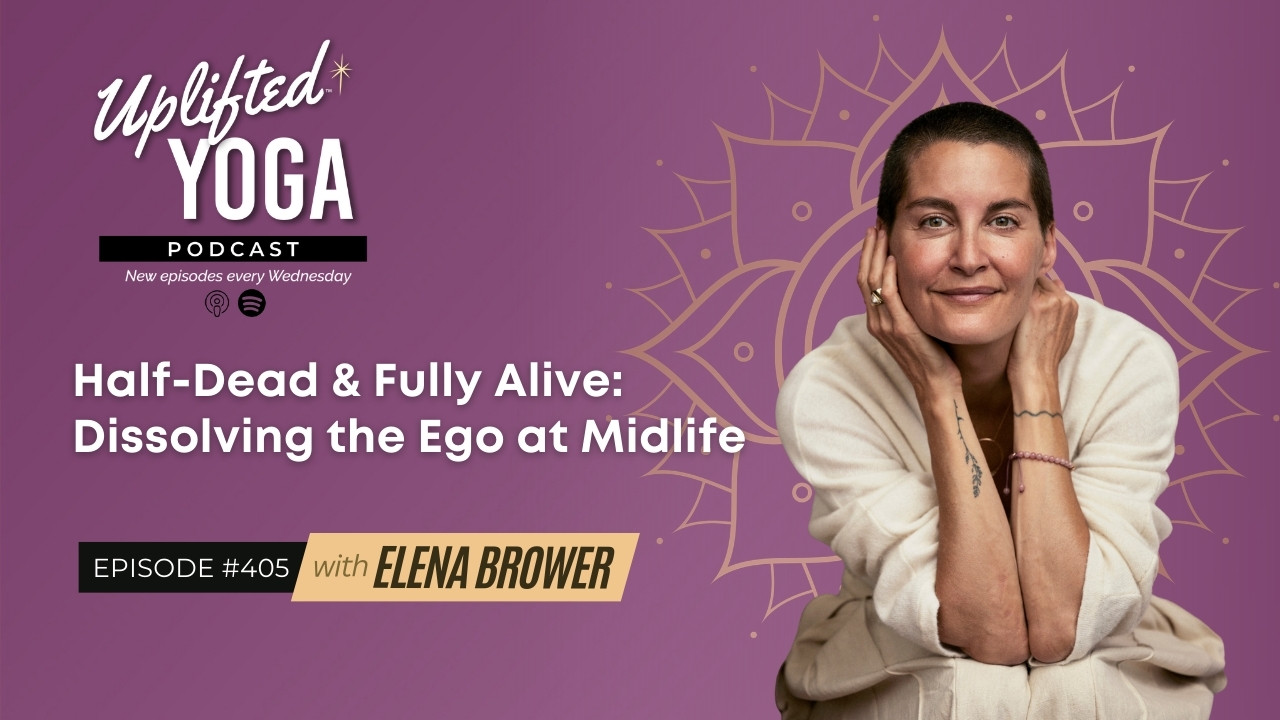
What if thinking about death wasn’t morbid—but liberating?
In this conversation, Elena Brower (author of “Hold Nothing”) and I get real about turning 40, 50, and beyond. We talk about why ego dissolution might be the greatest gift of aging, how meditation is actually an act of service to others, and why certainty is killing your relationships.
Elena shares why she’s ready to let all her accomplishments dissolve, the difference between prayer and meditation (spoiler: maybe there isn’t one), and a simple exhale practice that serves humanity.
This isn’t your typical “graceful aging” conversation. It’s about ruthlessly re-prioritizing, slowing down radically, and preparing for death in the most relaxed way possible.
In this episode:
- Why “I’m half-dead” is the most freeing thought you can have
- The invisible gift your meditation practice gives everyone around you
- How sitting still helps your kids solve their own problems
- Why knowing everything makes you terrible company
- A breathing practice you can do right now to serve humanity
💖 Ready to ‘DO LESS’ in your practice? Explore the Uplifted Membership here => https://www.brettlarkin.com/uplifted/
🐍 Download your FREE Feminine Kundalini Starter Pack: https://www.brettlarkin.com/online-kundalini-yoga-teacher-training/
GUEST EXPERT: Elena Brower | https://elenabrower.com/
Mother, mentor, poet, artist, volunteer, bestselling author, and podcast host, Elena Brower is a celebrated international yoga and meditation teacher on Glo, guiding transformative practices since 1999. Her new book, Hold Nothing, was published by Shambhala Publications in November 2025. Her column on Substack by the same name, Hold Nothing, supports girls and women, through On The Inside, Girls on Fire Leaders, Women for Women, and Free Food Kitchen.
FREE Practice: 60 Min Restorative Yoga | RESTORATIVE YOGA FOR TIGHT HIPS
Relevant Blog: Somatic Meditation: A Body-Based Approach to Healing Stress, Anxiety, and Trauma
Relevant to Today’s Episode:
🐍 Yoga for Self Mastery
🎧 Also Listen to:
#320 – Less Is More: How To Honor Yourself & Your Students with Elena Brower
#397 – How to Live Smartphone Free (From a 20 Year Old) with Yunus M.
#401 – Who Has Your Attention? Attention Economy vs the Ancient Path
© 2026 Uplifted Yoga | BrettLarkin.com
Trauma-Informed, Feminine Kundalini Starter Pack [Free Download]
Transcript:
Brett Larkin:
Welcome to the Uplifted Yoga Podcast, where ancient yogic wisdom meets modern business strategy. I’m Brett Larkin, creator of Uplifted Yoga, where I’ve certified thousands of yoga teachers, built a multi-seven figure business, and guided over half a million students on YouTube. Here’s the truth, you don’t have to choose between embodying deep yogic wisdom and building a thriving, freedom-based business.
This podcast is your space to integrate both. Because yoga isn’t just what you do on the mat, it’s how you show up in every part of your life. Whether you’re here to deepen your yoga practice, grow your teaching career, or align your energy with your purpose, you’re in the right place.
Let’s dive in. What if thinking about death wasn’t morbid, but actually liberating? In this conversation with one of my teachers and mentors, Elena Brower, we get real about turning 40, turning 50, and beyond.
We talk about why ego dissolution might actually be the greatest gift of aging, and how meditation can be an act of service towards others, and also why certainty is probably killing some of your most intimate relationships, and how to stay curious. In this episode, Elena and I also talk about the difference between prayer and meditation, how sitting in meditation can actually help your kids solve their own problems. If you love the vibe of today’s episode, you will absolutely love my Do Less series inside the Uplifted membership, which is all about doing less, and very much on the theme of this week’s episode.
You can become an Uplifted member at the link in the show notes, and also check out Elena’s new book, Hold Nothing, which we talk about throughout the episode. And don’t forget that my brand new feminine form Kundalini online yoga teacher training is starting in April, so you can download your free feminine Kundalini starter pack also in the show notes at brettlarkin.com/online-kundalini-yoga-teacher-training/.
Hi, everyone. Welcome back to the show. I’m really excited today to be with a friend, longtime mentor, very influential teacher of mine who’s been on the show before, Elena Brower. Elena, welcome.
Thank you so much for having me back, Brett.
Elena Brower:
Well, before we talk about your new book, what’s true for you today? It just came from the 80th birthday of a good friend of mine over at the Upayasen Center. He’s a priest there, and he’s the sort of resident calligrapher and artist.
And he was asked to say a few words in honor of his birthday at his lunch. And he said, my practice is why I’m here. Two cancers, 80 years old, spry as a spring chicken, and just touting the practice.
And that’s what’s true for me right now.
[Brett Larkin]
I actually want to dive right into a quote from your book that relates to practice, actually. So if it’s okay with you, I’m going to read it out loud. Everyone listening, if you don’t know, Elena’s new book is called Hold Nothing, an invitation to let go and come home to yourself.
So I want to ask you about the title as well. But since you just started with practice, I had highlighted this because I wanted to read it on the show. So you say, when I sit in meditation, you benefit.
When you sit, I benefit. At the dining room table, when I manage to sit supportively still, my son feels heard and safe enough to solve his own quandaries. Meditation practice provides a structure that nourishes our experience of intimacy within ourselves, which yields a feeling of safety and inward peace for all.
What I’ve come to understand is that there isn’t actually a destination. Whether in practice or a conversation, realization is already present, answers are already unfolding. In Zen, sitting quietly and observing the breath is both practice and realization, as are lighting incense, copying verses, cleaning intentionally, and bowing deeply.
Sitting still so my son can safely sort through difficulty is both practice and realization. And then the other little piece that was a page or two later I wanted to read said, returning to the present moment is a practice. With practice, I become less attached to outcome, less connected to habits of thinking, less obsessed with goals.
And this was my favorite word, more curious about the process.
[Elena Brower]
Okay.
[Brett Larkin]
So hearing that read, is there anything you want to just reflect or share before I tell people a little bit more why I like love those two little passages?
[Elena Brower]
I honestly, it’s so nice to hear them and to be confirmed in what I was thinking this morning when I went to the morning sit and then I went to the midday sit for in honor of my friend. And it’s really this kind of invisible accrual of trust in myself. And the days when I sit more than once, especially, I really feel very trusting, very peaceful.
And that’s kind of the thrust of what you, the passage that you just read.
[Brett Larkin]
What stood out to me about it is that I think we often think of meditation as a solo activity, like we’re retreating to do this thing. But what I loved about that passage in particular is it was really talking about how actually when we do that, we’re able to bring a different level of presence or in the case with your son, just simply listening instead of feeling like you needed to jump in or be quick to fix. And so there’s this communal benefit from us taking this time to practice.
And then the word practice often makes us think, okay, we’re practicing for a result or we’re practicing to get something or gain somewhere or be somewhere. And I have had a couple people this past, I don’t know, however many months, this big reframe into like just being curious and being curious is the practice and there not being a destination was like the other piece of that that I just loved and I wanted to pull forward for folks.
[Elena Brower]
Thank you so much.
[Brett Larkin]
I think it also comes with age. How old are you now? Well, I turned 40 this year, so I’m having this really rich, beautiful midlife crisis and it’s really enjoyable.
[Elena Brower]
I need to say I’m really proud of you. Welcome to the 40s. It only gets better from here.
And at 55, I can say with total certainty, I’m so excited about growing older. I consider myself very lucky and I have no attachment to how long it lasts because I really do tend to every day and I tend to my kid, I tend to my partner. It’s all very simple, practical, simple.
It’s just a practice, all of it. And if we can stick with that orientation, I think getting older just feels like a gift.
[Brett Larkin]
So maybe on that theme, let’s talk a little bit about the title of this book, which is Hold Nothing, which is a little bit of a mic drop title, I think, because culture would tell us we want to hold a lot. We want to get more. We want to have more.
And so this idea of holding nothing, I guess, what do you think or what are we holding that maybe some of us don’t realize we’re holding or what inspired the title of the book?
[Elena Brower]
You know, I want to just honor the fact that I did get to about the age of 52 or 53 before this came about. This book, 54, it was titled, roughly, much easier as I get older to consider dropping all the things that I’ve accomplished because I accomplished a lot of things. So I can’t really speak to this neutrally, you know, with a neutral mind.
But what I can say is I’m definitely ready for all of that to dissolve. The many accolades and accomplishments and, you know, you and I are similar in this regard. We value and prioritize the quality and caliber of the work that we do.
We’re very persistent, very consistent, and we deliver a really high, high bar to our folks, to the folks who are with us and learning alongside us. It’s easier now for me to be a little less perfect and less consistent and less, you Because I know that eventually, having been around a lot of dying people now, that we leave with nothing but what’s in our hearts, nothing. So selfishly, this book orients me and whoever chooses to take it on to preparing for our death and getting there in a reasonable, relaxed way.
[Brett Larkin]
I love that you say death because I think that’s something people have an aversion to. Again, the culture is all about youth and beauty and, you know, anti-aging and all of this stuff. But since turning 40 myself, and this sounds so weird to say, but we’re going to talk about it because I’d actually love to share this with you and get your opinion.
But I often just think about like I’m a half dead person, like I’m walking around half dead. And this isn’t a morbid bad thing. It actually is like so liberating because it just makes me like ruthlessly reorganize some of my priorities because it’s like, wow, like this story is already half over.
So like with whatever comes next, I’m really don’t want to sweat the small stuff. I’m slowing down so much. And it’s been like this huge practice of me exploring also publicly on this podcast, like what that looks like and how do I do that and still honor, you know, I’m sure same for you.
There’s lots of people who work with me who I think this is kind of like the blessing and curse of owning your own business, right? It’s not like you can just turn off for a couple of years and come back or maybe you can. I don’t know.
But there’s so many other people who would be affected. And so, yeah, for me, it’s been really interesting of like I feel that kind of a little bit ego dissolution that you’re talking about where I don’t want to be on camera as much and I don’t want, you know, like all those things that used to bring me a lot of joy and excitement. I’m more just like I want to just be with my kids and be still and be in scripture or be in ancient texts or go to church or walk in the woods or, you know, I’m going to let you reflect back.
[Elena Brower]
I just want your people and my people who find their way to this conversation to really hear that, like this is a natural progression of human life to, you know, emerge and really shine in some cases, in your case, definitely. And then to slowly realize the value of receding, coming back to yourself, you know, just becoming familiar with the process of whatever your prayer, your ritual, your practice happens to be and just becoming so deeply familiar with it that you can sit or whatever you’re praying, chanting, whatever it is, and feel gone from that process. And only the practice itself is left in the space where you aren’t and are, you know, like the boundary of your body and all of the cells and all of the processes for moments at a time kind of disappear when you’re in that in that realm.
It’s not woo-woo. I’m not, you know, this is not some sort of magical thinking. This is just when I’m in practice and I think you’re the same, right, when I’m in practice and I’m really in it, just checking out the whole process of the practice.
I have no concerns for moments at a time. I’m really just this vessel of practice.
[Brett Larkin]
One of the things I appreciate about the book and I want people to know, as I’m hoping they will also get it, is that it has a lot of personal stories from you. And they’re kind of like vignettes, I would say, like little snippets from your life, whether it’s you as a young girl at camp or with your mother or with your son. And so while the book feels very meta, and I mean that in a good way, like I think the way to consume this book is like very slowly.
Like that’s how when I first got it and I was really lucky to get an advanced copy. But I just had it at my breakfast table and I was just reading sort of one chapter because each chapter is a little bit like a cone or a mystery. And Alayna is sharing a story from her life, so it feels rooted, but it’s giving you some really pretty profound things to think about.
And if you are a journaler, you definitely could journal. But even for me, I think I didn’t do too much written journaling. I was just soaking it in and I felt like I still got so much out of it.
And this idea of slowing down and emptying, staying on that another minute, or is there anything you want to say about how people might consume or engage with the book before we move on?
[Elena Brower]
So my ideal is that you’re not, it doesn’t feel like you’re consuming the book. You’re actually creating the book. You, listener, dear, dear listener or viewer, you as the reader are actually also the creator of this book.
The prompts in the back of each section, and I like what you said, Brett, I appreciate it about doing one section at a time. I think it will really sink in that way. And everyone I love has said, I’m taking this book in one section at a time at night or one section in the morning, one section in the afternoon.
And it is so profound for me. I’m learning things about myself that I didn’t really realize and never took the time. So that’s why I’m shifting the word respectfully from consuming to creating, because I want you in your reading of it to feel like you’re also creating.
This is where I wrote on the page to talk to these prompts in this particular section. But there are so many. I think it’s important to know that.
[Brett Larkin]
Yeah. And if you’re listening and you don’t have the video, the book has Alina’s artwork in it as well. So there are spaces, there are her art.
It doesn’t feel like super text heavy. I mean, obviously, there’s a lot of text, but it feels like there’s white space, too. And clearly that that is intentional and part of the design.
I think let’s talk about emptiness, because that word can freak people out or even hold nothing. Right. It’s like, does that mean we renounce all our possessions?
I know that’s not what you mean, but I’m just curious, like, what would you say or how do you define emptiness in a way that feels safe and also nourishing?
[Elena Brower]
I have so many teachers who have spoken so beautifully on this topic. There’s a great talk by Norman Fisher. He’s on the West Coast, F-I-S-C-H-E-R, on emptiness.
It’s really beautiful and you can pretty easily find it online. Dining Category talks about it. So many, all the Zen teachers talk about it.
This is not about you renouncing all of your possessions, as Brett just said. It really is about you figuring out what is extra. I was talking with my Substack folks today.
We talk once a month about Dining Category refers to this one of the Zen teachers that I hold in high esteem. He was Suzuki Roshi’s, the author of Zen Mind Beginner’s Mind. He was his kind of, I don’t know, assistant acolyte for many, many years.
And he talks about the fact that most of what we put on in our lives, be it a job, an outfit, an activity, most of it is decoration. He uses that word, decoration. Just blew my mind.
I was looking at it going, oh, my God. Today, after probably six months of rolling this around in my mind and figuring out what is decoration, even blush is decoration on me. Figure it out for yourself, dear listener.
And Brett, too. What is the extra and what can you release? There’s no rule.
But when you do release that which you have determined is extra, it’s very simple and very practical. You get to the heart of things much more readily. So you can be in a conversation.
You’re not so concerned with all this extra stuff that you’ve normally been thinking about. You can go right to the heart of the matter. Ah, this person acting this way is just looking for love.
Just easier to make contact with reality without all the decoration, whatever it may be. And that’s for me in this moment on this day. Ask me again tomorrow.
It’ll be different. That’s what emptiness means. I really like that.
[Brett Larkin]
Easier to connect with the present moment.
[Elena Brower]
Yeah.
[Brett Larkin]
Less. It reminds me of how you talk about in the book, too, about our presence being the biggest gift we can give people. And it almost feels like the less decoration we have, the more we can show up with what really matters, which is the quality of our presence.
And that’s what those around us are really craving and want to see. And I love the anecdotes that you share about your mother and your son and I think even a best friend that you had in your life. Is there anything you’d like to say about about that?
It’s like I sometimes just feel like the world is really conspiring against us getting to be present because of technology. And I’ve been talking about that a lot on the podcast this year. Like, how can we really detox from these devices and so much of culture that’s really been designed to captivate and extract our attention?
[Elena Brower]
Yeah, it’s what’s true right now. And I think the most sort of revelatory and revolutionary act is sitting still. It doesn’t matter what you’re focused on.
Is it your breath, your mindfulness, your scripture, your koans? It can be anything. But you sitting still and not being a consumer.
It’s an act of resistance. I mean that. There is something so important to this.
And I’m not saying, you know, trash your TV, although I did trash mine about 30 years ago and I feel all the better for it. It’s more about figuring out, same with decoration, figuring out what it is that does not serve you anymore. Just very gently, very humanely, gently dissolving it from your experience of the day to day existence.
To me, that makes sense.
[Brett Larkin]
Yeah, there’s a great teacher I was listening to. She was saying, as culture accelerates, the evolution of your soul will not also accelerate. That’s going at its own trajectory and pace.
And I thought that was so liberating because speaking to a lot of women, I know, especially during COVID, people got in this trap of like always having because we were always at home. It’s like we always had to be productive. Right.
So it’s like, well, I’m going for a walk. I need to be listening to a podcast. If I’m folding laundry, I need to be listening to this.
And I’m so guilty and I’m really proud to report to you as someone who I look up to as a teacher that like in these past 18 months, I have more silence in my life than ever before. Like I can go for a walk without my cell phone or sometimes I bring it, but I’m just silent, like no headphones in, just able to be alone with my thoughts. And I think it was this same teacher.
Her name’s Crystal Sparks, I believe. She was talking about how if you can’t experience silence for, you know, any amount of time or a long amount of time, like it almost means like your soul is sick. She had a more eloquent way of putting it.
But it was like, you know, you’re not comfortable just being just being with yourself. And I’m so proud of myself because even now when I get in the car, I’ll just drive somewhere in total silence and it doesn’t feel weird or uncomfortable. I actually love it.
And me a couple of years ago had no capacity to do that. I think we actually have to train our nervous system to have more capacity for silence and stillness because we’re so ingrained in the go, go, go.
[Elena Brower]
This is our society and our upbringing and for better, for worse. And you and I have landed in places of some, I don’t know, regard, I guess, or sort of the role of the teacher. Quote unquote, I say this with kind of air quotes and a little bit of humor and humility.
We were raised during a time women had just gotten some of their rights and they were raising us to uphold those things and work like a man, earn like a man. You are equal to a man. This is what was going on in the 80s, for better or for worse.
And now we find ourselves these three decades later, so in the 80s, 90s, kind of a tangle, I would say, where we, as you have very adeptly elucidated, we have to undo all of that. I’m not saying don’t earn money. I’m not saying money is a beneficent force and it will help you to be charitable, care about things that you care about in a concrete way.
Resources are good. What’s not good is this grasping kind of ambitious striving. I can now really catch it in my body and in my mind.
And I don’t, I’m moving away from that very slowly, backing away from the vehicle and seeing where it was instilled in me, by whom and how. It killed my mother. She was 69 when she died 10 years ago.
Like, she should not be dead. That and sugar. And I am unwilling to go that route.
Like you, I have had to train my nervous system. This is a work in progress. I don’t think it will ever be done, but it is happening and it’s in process.
And, you know, I’m, I’m noticing, I’m observing, I’m in silence a lot. Also, I listen to a book every now and again, but much more reading now. I actually have books on the couch.
I’m actually reading on the couch, sis. That’s about the most activity I want to be doing when I am not working. And I think there’s something really interesting to, there’s a teaching that I have out in front of me that I was looking at while I was drinking tea before.
Our great responsibility as human beings is to manifest eternity, beauty, right in the middle of this impermanence. If we want to help human beings, this is our responsibility. Then very naturally we understand human life and death.
So this is one of the great Zen teachers. There’s nothing about Zen in here, and yet it’s everything about Zen. And it works under any auspices, any religion.
Our responsibility is to manifest eternity right in the middle of this. How do we do that? We give our undivided attention to things.
How do we give our undivided attention to things? We are not super consumers. We read a book, we take our time, we do the dishes, fold a few pieces of laundry, read a little more.
We communicate with our people in the best way that we can. We give our full undivided attention. And things begin to fall into place in our lives and particularly in our nervous systems, as you have experienced yourself.
[Brett Larkin]
I know I used to really resent, especially during COVID, and I think when my kids were younger and things were just felt harder all around. Sorry to interrupt, but quick pause. If you’ve ever felt called to go deeper into yoga, not just practicing it, but actually understanding it, my uplifted 200 hour teacher training is open year round and fully online, so you can move at your own pace, no pressure, no burnout.
It’s for people who love yoga, want a strong foundation, and care about teaching safely, ethically, and with heart, whether or not you plan to teach right away, you’ll learn anatomy, sequencing, philosophy, cueing, and how to actually hold space for real humans. You can find all the online 200 hour teacher training details at brettlarkin.com. And if it’s meant for you, you’ll feel it.
I resented unloading the dishwasher, cleaning my kitchen so much. And it’s so funny, again, how things can shift because if you told me a couple years ago, I’d be like rolling my eyes if I was hearing this on the podcast. But now it’s like I genuinely enjoy that moment of like cleaning up and being like I manifested one of my biggest dreams, which was to have a family and to have a beautiful home.
[Elena Brower]
I know.
[Brett Larkin]
And this is like a moment of celebration every night where if I don’t want to be somewhere else or doing something else, or if I can just be present doing this one thing, this is so nourishing to be in this kitchen, like wiping down the counters. It helped. It also helped when I got a new dishwasher.
I got like the most amazing dishwasher. It lights up inside. I don’t know.
There’s something about it that just feels so mysterious. It’s like a disco item. And I just feel like this overwhelming gratitude, right?
It’s like I’m almost brought to tears telling you about this. And it’s just so funny how a couple of years of what practice can make such a difference where, you know, old me was in there like ranting in my head at my husband. Why isn’t he unloading the dishwasher?
You know, all of this stuff. And then I wanted to share too, and I want to ask you about Zen specifically. So I want to go there too.
But, you know, when you were saying about like backing away from the vehicle, I think for me, it’s also like realizing these addiction patterns of, for me, like how much work is an addiction for me and in ways that’s a trauma response. Or, you know, we think of addiction just being to alcohol or to food or, but I’ve had to really get honest with myself. And workaholism is our society’s most acceptable way to be an addict, but I am an addict and it’s really real that I have these compulsions to check slack, be always busy, be feeling.
And that’s, that’s something that I need to resolve. You know, that’s a nervous system work and that’s the work I’ve been doing.
[Elena Brower]
Yeah, that is guilty also as charged. And again, I think it goes back to the feeling of accomplishment that we were chasing and that we’ve been taught to sort of value as kids in our upbringing. You accomplish things, you get a good grade, you win today, you win today.
And that still lives in some canyon of our consciousness that we have to finish and we have to accomplish and we have to do it perfectly. For you to get through that and sort of see it and, you know, like I said, slowly back away from it is healing all women. I mean that, you know, we’re all learning from each other all the time, energetically and actually.
And I think it’s one of the most important things that I can practice. If any other women who are paying attention to anything that I’m doing care to see, that’s one of the most important things I can do is actually practice not being the ambitious, striving, grasping human that I was. There’s something really important about it.
[Brett Larkin]
Yeah, I think sharing and talking about it like we are right now is so important. And I’ve been trying to be more courageous and do that. It’s like summer camp Hunger Games starting at the time of recording this podcast.
I don’t know if you remember this from when you had your son, but it’s like, you know, everyone’s like, you got to get your kids in the summer camp. And it starts in January. And I just keep telling all my mom friends, I’m like, you know, I’m finding the magic moments for me are the white space where I have nothing planned.
And last summer I bought into none of this. And these were my requirements for summer camp. I need to be able to bike there.
That was it. I was like, I don’t even want to get in the car. I want it to be that simple, that slow, that easy, you know, and it was the best summer last summer.
There was so much empty space. Like to get anywhere, all we had to do was get on a bike. And so I was getting my exercise and my time outside.
I don’t know. But I’ve been trying to talk to people more and more about how, yeah, like what I’m finding, it’s like in the not having stuff scheduled and then and that kind of opting out of, whether it’s summer camp, Hunger Games or whatever it is for you and your life right now, listener like that, that thing. It’s very counterculture.
[Elena Brower]
It is. It’s a resistance. Don’t buy into it.
If it doesn’t feel true to you just because everyone else is rocking it, it’s OK. It’s true for them. That’s great.
And I think also key to this is not having a whole conversation about it in your head. You’re very committed. If I can bike there, it’s going to work for me.
And that’s enough onward. A lot of times I see, you know, friends, clients, mentees, students, a lot of swirl, a lot of rumination. And I really understand it.
And that’s a real point of contention that I have with myself. If I notice that I’m swirling on something, it’s time to meditate. It’s time to have a very practical practice with every exhalation.
Whatever that thought was is gone. There’s another one coming right around the corner. And whatever that thought was is gone with the next breath.
That really helps me. And that’s how to get out of the swirl of rumination, overthinking, overanalyzing. It’s very natural and human, given the way we were raised and the pace at which our lives are going.
It’s a great gal, Graham. Her name is Nabalo. Iris is her first name, but her account is N-A-B-A-L-O.
She teaches a course called Earth Kind. It’s the antidote to all the things that we’re talking about. And in that course, she even writes the words, I’m going to paraphrase it, we are not made for the pace of this current reality.
Our bodies are simply not made. You said it earlier, too. You know, you’re the person that you were paying attention to, that your soul will not pick up the pace.
Your soul is your soul at its own damn pace. And I think there’s a lot of importance in that consideration and that remembrance, like respect.
[Brett Larkin]
Yes, I often think it’s like we’re living in the middle of Tokyo, very fast, flashing lights, lots of traffic. But like our animal body is still like in the Andes, rural country, and just doesn’t can’t deal with all of that. So we got to go move slower.
I want to make sure I ask you about Zen because there’s a lot of yoga teachers listening, passionate yoga students who are very familiar with yoga. But I know so much of your journey and evolution, and it shines in this book very clearly, has been the Zen influence. And so I’m just curious if you want to speak a little bit for folks who maybe are less familiar with that tradition, like what did Zen give you that yoga didn’t?
And what did yoga give you that maybe Zen by itself didn’t?
[Elena Brower]
What a great question, dude. Wow. What yoga gives me, and I give this to the folks at the Zen Center, is movement.
Really important, particularly if you’re doing the copious numbers of sits every day that people do, particularly in practice periods. What Zen taught me and continues to do, teach me, is that the whole of this existence, the umbrella under which I sit and you sit and we all sit, is our bodhisattva nature, bodhicitta, our awakened heart, our capacity to serve. There are so many ways we could talk for an hour about these two terms, but that’s what I’m saying when I say these two words.
There are lots of bodhisattvas on the earth. You are probably one if you’re listening to this. You signed on to have a life of serving other people.
You’re a bodhisattva. And let’s think of a popular one. Taylor Swift is a bodhisattva.
The way she gave out almost $200 million as a bonus across a few hundred people because her tour did so well. Each person making, you know, a couple hundred thousand dollars. Life-changing.
That’s a bodhisattva. It’s a good example of a popular one. Zen has given me the orientation to giving.
And when I first started practicing, I first noticed there was some like empty hole. I didn’t know what it was, but I just kept sitting, kept sitting, kept sitting. Year two, I started volunteering in hospice.
That felt like a very natural progression of things. And I went. It is one of the most important things that I do.
Not saying you have to go do it right now. I’m just saying that Zen has as its overarching understanding. We’re here to give.
Now, I want to make sure that our listener who already gives way too much, who’s already gone way over the edge into pathological altruism knows I’m not talking to you in terms of you have to give more and drain yourself. What I’m saying is for all of us who are never oriented to this understanding, where can we serve as closely as we can to our homes and our communities? There’s something that we can do that we’re not doing that will give us a feeling of a full life in this life, that beauty that that quote talked about right here in the middle of impermanence, the smallest actions, the way I I touch someone’s.
This is so uncomfortable. But the way I touch someone in their private regions when they’re close to death and they need to be changed with a great deal of dignity and care, that’s a way to bring beauty in the midst of this crazy impermanence that’s giving. I’m not patting myself on the back, even though it feels so good to me.
And I go home and I have a wonderful meal and I am so joyful to be alive and to have my health. This is what we have to focus on. And this is what Zen has taught me, that a life of giving is a full, complete life, whether it’s to my friends, but people with whom I work or my husband or my kid giving.
[Brett Larkin]
Yeah, I like that. I wanted to to also make sure to ask you about prayer, which is a word you said earlier, and it’s in the book in a couple places. And this is a word I’ve really been just kind of, yeah, being with and playing with and embodying also the past year or so.
So I want to ask you your take, because I think for me, meditation, like yoga, chitti vritti narodaha, right? It’s like yoga is a quieting of the mind. And when we first maybe learn meditation, we’re learning.
We want to focus on a particular breathing technique. We want to maybe move through that eight limbed program and quiet the mind. And to me, that is very, very different than prayer.
And so what I’ve really been exploring this past year is like, well, I have to say, like I’ve nailed meditation, but like I actually am quite good at meditation because I’ve spent like 20 years doing it. So I’ve been getting more curious about like, well, what does a prayer life look like? Like, what does that look like in my body?
How am I doing it? Where am I doing it? How is it different?
And I’ve really been trying to challenge myself to do that in a way where it’s not just like, well, I’m doing meditation and saying a little prayer at the end. Like I really am trying to explore it as like this separate thing. And so I want to ask you about that word because I think you even have a chapter or two maybe that have that word in the title.
So what are your thoughts on kind of the traditional yogic meditation as compared to prayer? I would answer this with one word, which is yes.
[Elena Brower]
And I would say the way in which I was trained, I came up in Tibetan Buddhism and then Srividya Tantra. So all of that is actually what gave rise to what we know as Zen. This was all in India.
This was brought then by Bodhidharma to China, touched by the Tao, by Confucianism. It’s very sort of rudimentary and abbreviated, but we’ll follow it. And then the Japanese teachers came to China to learn with those teachers that they’d heard about and brought it over to Japan.
Diana, Chan, Zen, India, China, Japan. Okay. I just happen to really love wearing black and having nothing on and living a very simple life.
It makes me happy. However, this practice that you say, prayer, meditation, I think it’s all one in the same. Whether I’m sitting still in Zazen, I’m not moving a muscle for 40 minutes.
I am so gone from this place. Just holding the posture and breathing deeply, allowing my breath to sort of take the thought so that there’s no trace of the thought. And then eventually, one moment, there’s no trace of me gone.
That is probably what people who pray, particularly in really dire circumstances, I know for me, I have prayed in dire circumstances. It’s what we’re experiencing. We sort of dissolve and the thing for which we’re asking or praying takes center stage, whether it’s peace in the world, peace in our family, peace in our heart, health for a friend or a dear loved one.
Prayer to me, just as meditation is, is a way of stabilizing, of living a practice. So if prayer to your listener or breath is what suits you and what connects you to that stability that is very much inherent within you, it’s not something outside of you. No teacher can hand it to you.
It’s all you take with you when you go. If prayer connects you to that, bueno, buenisimo.
[Brett Larkin]
It sounds like what you described. I just want to make sure I understood. It’s like it’s almost like you empty yourself out and then you use the prayer as like a stabilizing force for, okay, yeah.
[Elena Brower]
And that’s what Zazen is. That’s what prayer is. That’s what the, you know, limbs are moving us towards Samadhi.
We’re going there. This, even in Zen texts, Zen literature, you’re finding that Samadhi is a practice. And when you put yourself into the position for Zazen, upright, crown to sky, back body strong, front body soft, you’re actually embodying and personifying, let’s say, Samadhi.
You are realization practicing.
[Brett Larkin]
Would you say, or could we say that within this Samadhi is the element of the curiosity of not knowing or something like that? I don’t know. I just love the curiosity piece, right?
There better be.
[Elena Brower]
If I’m going to be a good student to all the teachers that have touched my heart, whether alive or posthumously, yeah, I don’t know anything. I really don’t know. What I’m relating to you is what has served and helped me in my parenting, my partnering, my friending, my practice of being a good person in the world.
All these things have helped me. I know nothing. I know nothing.
You better not know. Because if you know, as I mentioned in this book, and a lot of people have picked up on it, so it’s kind of top of mind. Certainty is a liability.
If I have certainty, the conversation ends. That sucks. You know what it is to talk to somebody who knows everything?
Yes. It’s no fun. I definitely was that person for a long time.
I’m giving you only my humble, personal experience. If anything doesn’t work, like take it out of your brain because it doesn’t belong.
[Brett Larkin]
Oh, yeah. No, I know. I think I just wanted to pull the curiosity back in because I feel like once we throw out the Samadhi word, right?
Like it can feel really intimidating to people because it’s like the destination or it’s like no thing or it’s like bliss. But, you know, coming back to where we opened, which might be a nice way to close, what I’ve come to understand is that there isn’t actually a destination, whether in practice or conversation. So when it’s like Samadhi is that quiet observing of the breath is both practice and realization.
I mean, this is very meta, but this is why you guys all need to read Elena’s book, because if you go through the chapters, it’s going to like, I don’t know, your brain is going to be thinking in really interesting ways, or at least that was my experience.
[Elena Brower]
How about you that you found that, that you got us right to that section. Thank you so much. That’s something that I try to do when I’m interviewing folks on my podcast.
And I now know why very often when I click stop, the person says, wow, that was a really those were really great questions. Thank you so much. And I’m going to say it before you click stop.
Thank you. Your questions are awesome. You really read the book.
You found the sections that were relevant to what I mentioned. Like, it’s not nothing. It is so sweet to be seen by you.
Thank you.
[Brett Larkin]
Really. You’re welcome. And I want to make sure you gave us a practice, but I think you did.
And I think it’s something we can all do for the rest of the day after. I’m going to do it now. I’m going to go pick up my children from school, or if you’re listening, like just that exhale that you taught us, right?
[Elena Brower]
A longer exhalation.
[Brett Larkin]
Yeah. We feel this spiraling, just exhale all the way out down into the earth and know the next one’s coming and do it again. Is there anything you’d add to that?
Or that’s, that’s pretty much, that’s it.
[Elena Brower]
I can’t improve upon that in that, in that regard, if you could exhale, if you can notice what is not serving you or anyone else in your space and really take a nice long exhale, thoughtfully let it go for now, you’ve just done a great service to humanity and to anyone near you, they felt it. They will feel it. They will continue to feel it.
It’s never not new. It’s always a good idea. I would say thank you for your practice too, because like you started, you practice, I benefit.
[Brett Larkin]
You practice, I benefit. And listeners, you practice, we benefit and everyone around you benefits. So Elena, thank you so much for joining me.
And I love our conversation. So grateful for you as a teacher and a friend and congratulations on this book. Obviously we’ll link it in the show notes as well as all of your, your details so listeners can find you.
Thank you so much. Loving what you’re learning on the podcast, apply the ancient science of yoga to your daily life, surrounded by incredible peers and my uplifted 200 hour online yoga teacher training, or grow into your role as a leader of others in my 300 hour professional program for yoga teachers, which is also a high level business mastermind. At any time, I would love to welcome you into my Yoga for Self Mastery course to help you uncover your personal blueprint to serenity or join my Uplifted Yoga membership for an all access pass to my most popular yoga courses, thematic class plans, and practice calendars.
Don’t forget to prioritize your wellbeing and get on your mat today. From my heart to yours, Namaste.