
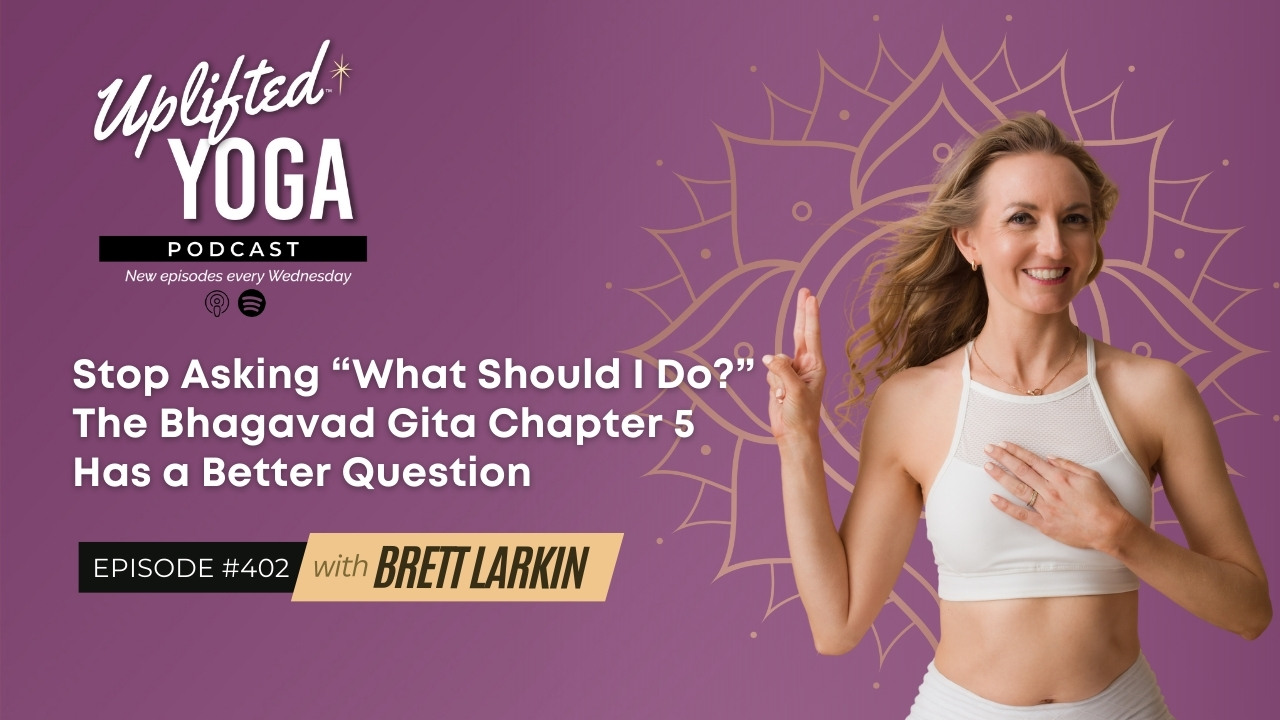
Today, I take you into Chapter 5 of the Bhagavad Gita, where Krishna shifts the spotlight from what you do to how you are being when you do it. This is the heart of Karma Yoga — acting in the world without clinging to the outcome.
We unpack the powerful metaphor of the lotus leaf (living in the world, untouched), explore the nature of witness consciousness, and look at what it really means to “renounce” in a modern world.
🔹 What it means to act without attachment
🔹 Why the question is no longer “What should I do?”
🔹 How inner renunciation leads to clarity and peace
🔹 The lotus leaf: your new spiritual metaphor
🔹 How Krishna reframes spiritual maturity and hierarchy
Whether you’re making a big decision or trying to navigate daily life with more presence, this chapter has wisdom for you.
Loved this episode?
👉 Dive deeper into yoga’s origins with my History of Yoga Course
🐍 Or explore my 200-Hour Kundalini Training
📖 Different translations mentioned:
Barbara Stoler Miller: https://www.amazon.com/Bhagavad-Gita-Krishnas-Counsel-Bantam-Classics/dp/0553213652
Godsong by Amit Majmudar: https://www.amazon.com/Godsong-Verse-Translation-Bhagavad-Gita-Commentary/dp/1524733474
Eknath Easwaran: https://www.amazon.com/Bhagavad-Gita-2nd-Eknath-Easwaran/dp/1586380192
Bhagavad-Gita As It Is by Swami Prabhupada: https://www.amazon.com/Bhagavad-Gita-As-Bhaktivedanta-Swami-Prabhupada/dp/0892131233
FREE Practice: 15 Min Vinyasa Flow For Flexibility | BEGINNERS VINYASA YOGA
Relevant Blog: The Complete Glossary of Sanskrit Words Used in Yoga
Relevant to Today’s Episode:
📖 History of Yoga
🔮 300-hour Online Yoga Teacher Training
🎧 Also Listen to:
#297 – What is Samkhya Philosophy and How is it Different from Yoga?
#358 – Intro to The Bhagavad Gita: How Do You Navigate Moral Dilemmas?
#392 – How to Act from Wisdom & Make Every Moment Sacred: Bhagavad Gita Chapter 4
© 2026 Uplifted Yoga | BrettLarkin.com

Transcript:
Welcome to the Uplifted Yoga Podcast, where ancient yogic wisdom meets modern business strategy. I’m Brett Larkin, creator of Uplifted Yoga, where I’ve certified thousands of yoga teachers, built a multi-seven figure business, and guided over half a million students on YouTube. Here’s the truth.
You don’t have to choose between embodying deep yogic wisdom and building a thriving, freedom-based business. This podcast is your space to integrate both, because yoga isn’t just what you do on the mat. It’s how you show up in every part of your life.
Whether you’re here to deepen your yoga practice, grow your teaching career, or align your energy with your purpose, you’re in the right place. Let’s dive in. Hello, yoga family.
Today, we are going into chapter five of the book of Adhita. You do not have to have been following the entire Gita series I’ve been doing on the podcast to just jump in and enjoy these episodes. You’re welcome to join us right here, right now, because this is the moment where Krishna shifts the spotlight from what you do to how you are supposed to be when you do it.
This is the heart of what we’re going to talk about today, karma yoga, acting in the world without clinging to the outcome. We’re going to talk about in this episode what it means to renounce in a modern world, what it actually looks like to act without attachment. In this chapter, we also see the really famous lotus leaf metaphor.
Whether you’re a teacher or a student, I know you’re going to really love all the delicious philosophy in today’s episode. As always, if you want to look at the different translations that I’m reading from, I have those linked up for you in the show notes. I also want to announce that if you happen to be curious about kundalini yoga, but want an approach that’s grounded, trauma aware, and relevant for modern life, my online kundalini yoga teacher training is starting really soon at the time of recording this podcast.
It’s a brand new training. It honors the roots of the tradition while teaching kundalini in a way that’s safe, embodied, deeply human. If you’d love to spend some time learning how to work with the breath, mantra, movement, and energy without bypassing the body or overwhelming the nervous system, this training is for practitioners and teachers.
The link is in the show notes, or you can find the kundalini training at brettlarkin.com. Hello, my friends. Today we are diving into chapter five of the book of Agita, and I thought it might be helpful to do a little review to figure out how the puzzle pieces come together with these different chapters and topics. And as always, to get us sort of primed and ready, look at what different translators call each of these sections.
So for example, in the God song translation, this fifth segment of the Agita is called renounce through works. Similarly, Barbara Stoller Miller says this chapter is called renunciation of action. Eknath Eswaran says this chapter is called renounce and rejoice.
And our Swami Prabhupada translation says this chapter is called karma yoga, action in Krishna consciousness. So what’s interesting here is in chapter five, we’re coming to the end of the first big arc of the Agita. So in the intro episode about the Agita, which I’ll link up if you want to review, but we have three main sections that scholars generally divide the Agita into.
The first six chapters are all about action, karma yoga, and we’re solving the physiological problem of like, how do I move through the world? And we start, you know, on the battlefield where Arjuna doesn’t know what to do, what action to take. And that’s why we’re very kind of action oriented these first six chapters, like how do we take action in the world? How does he get through this decision? And what’s interesting when you read, if you choose to read this chapter yourself, you’ll find that it’s like a little bit repetitive. You’re like, haven’t we covered a lot of these things already? But that’s because chapter five sits here as the technical clarification of karma yoga.
So a lot of the key principles have been mentioned earlier. Remember that chapter three was huge. Some of those early chapters, I think I even had to divide them into two episodes because the writing style or the teaching style here is that Krishna covered so much in those early chapters.
And now we’re kind of in the FAQ section where Arjuna is double clicking into specific topics. And like us as the student asking for additional clarification on things that have been covered previously. So if this feels a little bit repetitive, when you read it, just know that it’s repetitive by design and repetition is a Vedic teaching method.
Each repetition is giving you a sharper lens. So chapter three is a review was all about doing your duty. Chapter four was like, do your duty with knowledge.
Now we’re in chapter five and it’s about do your duty with inner renunciation. In chapter six, spoiler alert, it’s going to be about do your duty with meditative steadiness. So if you find that this chapter feels like an FAQ or a refinement, it’s because it’s a bridge between the teaching on action and the teaching on meditation that’s coming up.
Here’s what’s exciting and why you should buckle your seatbelt or maybe it’s already buckled if you’re driving, but get really excited for today’s short, lovely little chapter is because it’s shifting the emphasis from what should I do, which is where most of us are often in life. We like have a lot of decisions to make and it’s like, what’s the right decision? What should I do? And we can so connect again, going back to review to Arjuna who starts off in this moment of crisis as a review, he’s on the battlefield. He’s being asked to enter into civil war with essentially his beloved cousins.
He has to kill the cousins. Otherwise evil will rule the world. But obviously he doesn’t want to kill them because he likes them.
He’s caught between a rock and a hard place and very much feels like a victim in this family feud where there are no good answers. It’s like a chessboard and there’s no good moves for him. And he starts having a panic attack on the battlefield.
It’s very relatable. It’s very much like us as humans feeling overwhelmed by our circumstance, feeling like a victim, maybe even having a panic attack ourselves. And we’re just in that headspace of like, what should I do? And of course, listen to the prior episodes in this series of how Krishna kind of talks him down, works him through that, gives him teachings about Dharma and how he has to do his duty, how he should weave in knowledge.
And now that Arjuna is not in panic attack mode anymore, he’s actually able sort of like us when we’re more regulated in our nervous system, he’s able to ask some deeper questions, some better questions. So I just want you to think about that. When we’re in a tense, fraught moment, and of course for Arjuna, it’s on a literal battlefield, but remember the battlefield is metaphoric because we’re all waging some sort of war in our lives or even just in our own heads with our own thoughts.
When we’re panicked and operating from a dysregulated space, we’re not able to ask sophisticated questions. Our viewpoint is very limited. So what’s really cool as we start now going into chapter four, and then I definitely think five is a turning point and six as well.
We see Arjuna, who’s the stand-in for us, right? He represents people in this dialogue, mortals. He’s getting a little bit more regulated and is like, okay, I’m hearing what you’re teaching. Let me start asking some sophisticated follow-up questions.
And that’s exactly how chapter five begins. And the emphasis shifts, and this is what’s coming back to what’s really exciting. Instead of being like, what should I do? Krishna, tell me what to do.
I’m having a panic attack on this battlefield. I don’t know what to do. Us and our life.
Should I have another baby or not have another baby? Should I move to go to college in this state or should I avoid student loan debt and do it locally? Should I send my kids to private school or public school? The millions of decisions. Instead, we’re moving from the distinction of what should I do to how should I be while I do it. So it’s less about what are the external circumstances and what path should I take, public, private, move, not move.
We’re moving into an interior space. Now we’re talking about the internal battlefield. Like how should I be? What should my disposition be when I make a big decision? So instead of asking what to do, it’s like he’s asking who should I be when I’m choosing and making decisions in chapter five of the Gita.
We’re not asking anymore. What’s the right choice? We’re asking what’s the right consciousness from which to choose and what Krishna is going to show Arjuna and all of us in this chapter is essentially if you try to choose from confusion, like if your internal state is confusion, you’re going to get confused. If you try to choose from a state of avoidance, you’ll get avoidance.
But if you cultivate inner renunciation, this non-grasping, the decision can reveal itself. And if you act from this sense of unity, any path can become Dharmic. And remember, Dharmic is that really important word, righteousness.
So if you wanted to take a somatic lens on this chapter, it could basically be summed up as like before deciding you should regulate and before choosing you should savor and feel what’s good about life, like some sort of internal bliss. And before taking any action, you need to untangle all of your attachments. And this chapter is essentially framing decision-making as like energetic self-regulation as opposed to mental overthinking.
We’ll see it all in the text right away because chapter five opens with a question. So Arjuna says, and he’s referring to what was just taught in the previous chapter. Arjuna says, Krishna, first of all, you asked me to renounce work.
And then again, you recommended work with devotion. Now, tell me definitively, which of the two is more beneficial? So you see, we’re double-clicking in to a concept that was already mentioned. The God Song translation says, renouncing action, yoga.
You praise one, then the other, Krishna. Of the two, which one is better? Tell me definitively. That was the God Song translation.
I’m back in Swami Prabhupada’s translation now. Krishna replies, essentially, the renunciation of work and work in devotion are both good for liberation. But of the two, work in devotional service is better than renunciation of work.
So in the last chapter, Krishna was talking to Arjuna about sannyasa, the renunciation of action, and karma yoga, performance of action. And he told Arjuna that through karma yoga, which is intense, selfless action, that that’s how we attain unity, help others. And so Arjuna’s basically saying to his teacher, well, is it this or is it that? And he’s in his logical mind doing that binary either-or thinking.
Teacher, which is it? You’ve told me about both these things, but which is it definitively? Can you just give me a simple answer? So commentators say that this need to categorize, even this opening question, is very characteristic of the intellect, the way the mind works. And of course, Krishna is going to say, well, it’s not either-or, it’s both-and. So in the second verse, Krishna says both renunciation of action and performance of action lead to the supreme goal.
But the path of action is better than renunciation. So what Krishna is essentially doing in these next couple verses is he’s dismantling the idea that withdrawing from the world is more spiritual. He says the true renunciant isn’t someone who goes and lives in a cave, for example.
It’s the person who’s acting in the world without clinging to outcomes. So this is huge, especially if you’re someone who fantasizes about quitting everything and moving to the woods or just wanting to go on retreat or sabbatical for years or has that escapism fantasy. Krishna’s saying, no, quitting everything isn’t spiritual.
Meditating off in caves or doing three months of silent retreat, that’s great. But the chapter is really reinforcing that yoga happens in life through action that’s done with clarity and steadiness and without grasping. So verse 5.2 is this thesis statement where Krishna says both renunciation of action and selfless action lead to the highest good.
But of the two, selfless action, aka karma yoga, is superior, saying that it’s like a reframe of like, if we want to be spiritual, we need to participate in the world. We can’t just withdraw. And then skipping ahead to verse 5.7, Krishna paints this picture of like the integrated yogi, okay? He says the yogi who is pure, self-controlled, whose mind is united with the divine, even when acting in the world, that’s someone who’s truly not entangled.
Here’s Barbara Stoller, Miller’s translation of that line. Armed with discipline, he purifies and subdues the self, masters his senses, unites himself with the self of all creatures. Even when he acts, he is not defiled.
Verse 8. Seeing, hearing, touching, smelling, eating, walking, sleeping, breathing. The disciplined man who knows reality should think, I do nothing at all. When talking, giving, taking, opening and closing his eyes, he keeps thinking, open quote, it is the senses that engage and sense objects, close quote.
So Krishna is essentially teaching about witness consciousness. What he’s saying in these lines is essentially like let your body act and do all the stuff while consciousness witnesses everything you’re doing. So that quote from earlier, the knower of truth thinks I do nothing at all.
This is a major philosophical moment. It’s the essence of Samkhya philosophy. So I will link the entire episode I have on Samkhya philosophy in the show notes.
You can go back and listen to it. It’s also covered extensively in 300-hour teacher training. It’s one of my favorite things to think on and talk about.
But essentially, the model of Samkhya is that we have Purusha, the witness consciousness and Prakriti, the body-mind-sense complex that is under governance of the gunas. And what Krishna is saying in these opening verses is that your deeper self is not the doer. Your deeper self is witness consciousness.
And your body-mind-sense complex, which is Prakriti, is doing all this stuff, but you’re not attached to them. You’re not personalizing everything. You’re not catastrophizing your decisions.
You’re not trying to control thinking constantly about your outcomes. You’re not afraid. You have this inner state of calm from which clear decisions can emerge.
And then we get a very famous verse, 5.10, the lotus leaf metaphor. And this is one of the Gita’s most famous lines, 5.10. One who offers all actions to Brahman and acts without attachment remains untouched by sin, like a lotus leaf untouched by water. Barbara Stoller Miller’s translation says, a man who relinquishes attachment and dedicates actions to the infinite spirit is not stained by evil, like a lotus leaf unstained by water.
The Godsong translation says, placing his actions in Brahman, giving attachment up, he does his work, and he is smeared no more by sin than a lotus leaf by water. So the deal with the lotus leaf is that a lotus leaf is submerged in water, but it will never actually get wet because it’s floating on the water. And the image that the text is trying to evoke here is like being in the world, but not of it.
All right, quick pause, because I need to tell you something exciting. My new book, Healing with Somatic Yoga, A Six-Week Journey to Release Emotions, Rewire Your Nervous System, and Reclaim Your Body, is finally here. If you’ve been listening to this podcast and thinking, I wish I could go deeper.
I wish I had all this information about the nervous system and somatic yoga and healing in one place. Well, this book is the nervous system guide I wish had existed when I was struggling. It’s practical, it’s gentle, it’s nervous system healing designed for yogis and filled with the exact tools I teach inside my trainings.
And because you’re part of this podcast community, I’m giving you something special. If you leave an Amazon review for the book, I’ll ship you my 2026 Somatic Desk Calendar for free. It’s gorgeous, filled with month-by-month reminders and nervous system grounding cues to support your whole year.
Enjoy the book, then screenshot your review, submit it at brettlarkin.com/somaticreview. Thank you for helping this book reach the yogis who need it. And now back to the episode.
So the teaching arc in these first 10 verses is essentially like, don’t obsess over choosing action compared to renunciation. So the opening lines, then he clarifies renunciation is not withdrawal. If you totally run away from the world or running away from life, it’s reactive.
Instead, real renunciation is non-reactivity to the material world. Krishna keeps clarifying actual renunciation. This is like related to verse six, requires inner training, aka yoga, not escapism.
And I think Krishna’s really breaking all of this down so much because he knows that Arjuna secretly is still like wanting to run off this battlefield. So he’s, he’s very aware of that as he gives this teaching. Then in verse eight and nine, which we just read, he said, realize that you are the witness.
You are not the doer. So coming back to our decision-making framework, because verse 10 is really saying with this lotus flower image that we want to offer our actions to the divine and remain unattached. It’s less about the right decision.
And it’s more that the right decision is going to flow from you being in the right identity. Are you identifying with the prakriti part of yourself that, you know, craves chocolate and wants to be liked and is in the world and, you know, has cravings and aversions and all of those things, or are you taking action from your purusha, witness consciousness identity? There’s a Christian writer, scholar, Lisa Turkest, who I, who I love. And it reminded me of some of her, her work in writing.
She writes that there are essentially three steps to making a good decision. Number one, analyzing the decision. Number two, making the decision.
And number three, owning the decision. And she ties this to Proverbs, Proverbs three, lines five through six, which open with, you know, the first lines, trust God from the bottom of your heart. Don’t try to figure everything out on your own.
Listen for God’s voice in everything you do, everywhere you go. He’s the one who’ll keep you on track. Trust the Lord with all your heart and do not rely on your own understanding.
Think about him in all your ways and he will guide you on the right paths. Trust in the Lord with all your heart and lean not on your own understanding. In all your ways, submit to him and he will make your path straight.
And looking at this, she says, it’s easy to think that there are only three parts to making the decision. Like I said previously, analyzing the decision, making the decision and owning the decision. But she says there’s actually five parts to making a decision and it’s like a hamburger.
And the first part and the fifth part are almost the same, but they’re what hold the process together. And so she said the first step is actually trusting in God by placing my desire under his authority. Getting in the right headspace is essentially what she’s saying.
Then analyzing the decision, then making the decision, then owning the decision. And then the last step, like the bottom of the hamburger bun, trusting God to work good from whatever the decision is, even if it’s a not so good one or has not so good parts. So even though this may seem like it has nothing to do with these upcoming verses of the Bhagavad Gita, like even verse 5.11, for example, the method that Krishna is teaching here is to dedicate your actions to Brahman, to act without attachment, to stay unstained.
And this is also essentially a recipe for burnout prevention, which is get in the right headspace, connect with God or connect with the part of yourself that is witness consciousness and is the same thing as the divine in the Vedic model. From that place, from that space, make a decision, act, and then offer and release and trust that God or Brahman, universal intelligence, whatever you believe in, will work good even from the not so good parts of your potential decision. And this is the opposite of what most of us do, right? Most of us act quickly and impulsively, maybe even from a dysregulated state like Arjuna was at the top of the book, right? Then we cling to that decision.
We over-identify with it. So what Krishna is teaching is that inner peace comes from being non-attached, relinquishing the fruit of action, writes Barbara Stoller Miller, this is verse 12. The disciplined man attains perfect peace.
The undisciplined man is in bondage, attached to the fruit of his desire. So if your success is making you anxious, it’s not success, it’s bondage. So the lesson here is like detach to act better.
Next line, staying with Barbara Stoller Miller, renouncing all actions with the mind, the masterful embodied self dwells at ease in its nine gated fortress. It neither acts nor causes action. And I love that we have the word embodied here.
So pulling some somatic teaching into this, it’s like when you witness your body from the inside out, breath, sensation, movement, you start to realize that you aren’t the action, but that action is happening in you. You might notice your breath, notice your heartbeat, notice the different impulses. And that city of nine gates in this verse refers to the human body itself with its nine openings.
So Krishna is saying the body acts, prana is moving in your system, your senses are engaged all day long, but the self, the true self, the witness consciousness does not act. This is Samkhya philosophy 101. The distinction between purusha, not changing, prakriti, always changing.
Some days we’re craving a cookie. Some days we’re craving pumpkin pie. Some days we’re craving tiramisu.
And then verse 14, and this is very, very different from other religions or Christianity. Verse 5.14 is essentially saying God doesn’t make you act. God isn’t going to punish you.
But all of these actions that are happening and arising in the natural universe arise from the gunas, sattva, rajas, and tamas. And the world operates through cause and effect, not through some deity who’s micromanaging us. And it’s saying your patterns, your habits, your nervous system tendencies, all through the gunas are producing your actions, not a morally judging deity.
So verse 14 reads, the Lord of the world does not create agency or actions or a union of fruits with actions, but his being unfolds into existence. The Lord does not partake in anyone’s evil or good conduct. Knowledge is obscured by ignorance, so people are deluded.
When ignorance is destroyed, this is verse 16, by knowledge of the self, then like the sun, knowledge illuminates ultimate reality. So what these verses are saying is that suffering is simply ignorance. It’s not a divine punishment.
So in many religions, Christianity as an example, you suffer because of sin or because you’ve been sinful, which means you’re no longer in friendship with God. Salvation comes through grace. Here in this model that Christian is outlining, he’s saying you’re suffering because you’re ignorant and liberation comes through knowledge.
Stop attaching to outcomes. Stop over identifying with the senses. Stop confusing what’s going on with like in your body chemistry with the self.
And then that verse 16 is saying when knowledge shines, ignorance dissolves. So the Gita often is using like light as a metaphor. Knowledge is sunlight.
Ignorance is darkness or nighttime. And we’re working up to verse 5.18, which is super famous. Okay, so we’ve got another really super famous verse here.
The wise see with equal vision, a learned priest, a cow, an elephant, a dog, an outcast. So this is one of the most powerful social verses in the Gita. Remember, Gandhi loved the Gita.
And Christian is teaching here that true spiritual wisdom dissolves hierarchy. So we need to think back historically to the context of the time that this was written. And at the time, Brahmins were the highest caste, right? We had a caste system.
Cows were considered sacred. Elephants were considered royal. Dogs were seen as impure, kind of like rats.
And obviously an outcast is so low that they’re outside the caste system entirely. So to list these things, I’m sticking with Barbara Stoller Miller’s translation today. Learned men see with an equal eye, a scholarly and dignified priest, that would be the Brahmin, a cow, an elephant, a dog, and even an outcast scavenger.
That’s essentially Krishna exploding the social order. He is saying that true spiritual wisdom dissolves hierarchy. And the same self, like when we’re in that Purusha state, we are all equal.
And so we have parts of this text that really differ from traditional religion, differ from Christianity. Here we have parallels again, right? This is what he’s saying here is very similar to Jesus saying, you know, everything he did, eating with tax collectors, women, lepers, and people who were unclean. So the big idea, and this keeps getting expanded upon in the following verses, is that when you basically stop seeing through your ego and your preferences, you’re able to experience spiritual freedom right now, regardless of your circumstances.
And that’s why acting from the right state, a regulated nervous system, the part of you that’s connected to something bigger, whatever that is that you believe in, whether it’s yourself, that’s reflected like you as the drop of the ocean of Brahman, or you in connection with whatever you believe in. It’s that connection. It’s that state of who you are before the decision is even made.
That’s the most important, like the top of the hamburger bun, like I talked about from that other analogy, that other author. And I love this because it really helps simplify your decision-making instead of thinking future focus, like all the different potential outcomes of like, if I do this, what might people think? Or how might it be interpreted? And instead, you just go back to yourself like, am I regulated? What are my motives for doing this? Really? Is it out of a sense of devotion? Am I overly attached still to Prakriti, like the ever fluctuating world governed by the gunas? Or am I connected to my truth? And it’s more about knowing your motivations and your internal state. And if those things are clear, then what decision to take becomes obvious.
You’re not thinking forward about like how the chips may fall. You’re not thinking about whether you’ll get praise or criticism. You’re not thinking about revenue swings or likes or follows or enrollments or algorithm changes.
We could call verse 5.20, where he’s describing like being this emotionally unshakable sage as like the CEO verse of the Gita. Like this is how you want to CEO your life. Verse 5.20, They are steady, confused, and anchored in the self.
It’s like you’re making decisions from your values. It’s really that simple. So the rest of these verses just continue on this theme, like 5.21, Krishna distinguishes between pleasure, which is dependent on external contact, and Ananda, the inner bliss of the self.
Verse 5.22, You’ve experienced this. We’ve all experienced this. The pleasure that arises from contact with objects are sources of suffering because they have a beginning and an end.
You know, it’s really fun. You start eating the cake, but then it’s over. And that experience goes away.
Like literally nothing in this world, this life is permanent. The pleasure you seek eventually ends, and then craving begins, and then suffering follows. So he’s essentially explaining like the dopamine cycle.
He’s not saying pleasure is wrong. He’s just like, it’s unstable. You need something deeper than just going after whatever you want in the external world.
Skipping forward, verse 5.25, So Krishna’s praising inner purity, emotional regulation, compassionate action, aka you, when you are operating from clarity, emotional steadiness, nervous system regulation, compassion, non-reactivity in line with your values, well, then you’re a capable conscious leader. Here’s Barbara Stola Miller on verse 27, almost at the end here. He shuns external objects, fixes his gaze between his brows, and regulates his vital breaths as they pass through his nostrils.
Here’s the last line, 5.29, Knowing me, me knowing Krishna, as the enjoyer of sacrifices and penances, lord of all worlds and friend of all creatures, he finds peace. So in these earlier lines, we see Krishna actually giving some physical instruction for meditation, right? He’s talking about pratyahara, withdrawing the senses. He’s talking about adrishti, the third eye gaze.
He’s talking about pranayama, right? Equalizing the breath. He’s talking about controlling prana, regulation. He’s talking about manas control, like where we place our attention.
It’s pretty rare for Krishna to give an explicit technique, which is why this verse, 5.27 and 5.28, I definitely wanted to read aloud. We can definitely connect this section to hatha yoga, even though this text predates it. It’s the first time Krishna is describing the physiology of peace, of the breath, the gaze, the sensory withdrawal, the stillness.
And then this final verse that he closes out with, 5.29, is a coming back to devotion as the culmination of everything. And this is the beginning of the pivot, everyone. Note the pivot.
This is the pivot to the next chapter, and then what’s going to be the whole next six chapter arc. Krishna says three things about himself here to close out. He says, I am the enjoyer of all offerings, essentially the one to whom all actions return.
So like all the things that you’re doing, if you’re in devotion to me, they’re coming back to me. I am lord of the universe, meaning I am the background consciousness of everything. Like I’m the fabric, the texture that is everywhere.
And then number three, I am the friend of all beings. I am benevolent. I’m not a punitive God.
So here it’s foreshadowing chapter seven, where we’re going to learn about jnana yoga and chapter nine, where we’re going to learn about the supreme science of devotion and chapter 12, which is going to be like proper straight up bhakti yoga. And this last piece, this last line is the closest the Gita comes to like having a personal God moment with Krishna. Krishna as our enjoyer, our protector, our friend, very much like a Jesus figure or a deity figure who we can connect with.
And for those of you who want to go into like a deep comparative theology moment with me here, in this closing verse of this book, 5.29, Krishna’s three roles, these three identities that he’s calling out is painting a picture of a personal God who is simultaneously transcendent, imminent, and relational. And it’s very rare that we see this in non-dual Eastern philosophy. And it’s so fascinating to me that we see it at the end of this chapter that literally starts off talking about Samkhya philosophy.
It’s crazy to me too, because when Krishna talks about being the Lord of all worlds, and it carries this idea of he’s the consciousness that pervades all beings, the awareness of everything, the awareness inside everything, it reminds me of the Holy Spirit in Christianity, where the Holy Spirit’s this idea of the indwelling presence of God, the breath of creation. So the Gita is really saying like, I’m the consciousness underlying the universe. In Christianity, that might look like the spirit, the Holy Spirit’s filling everything.
So there’s really an astonishing conceptual overlap. And the fact that Krishna ends this by saying that I’m your friend, I’m your intimate friend, the Sanskrit word that’s used, S-U-H-R-D, the Sanskrit word is not just a casual friend, it’s like a friend who trusts you completely, who wants to stand with you, who wants what’s good for you, who’s like a trusted companion. So it’s really fascinating to me that this closes out with Krishna talking about how he’s cosmic, he’s personal, and he’s our companion.
It’s really rare in different world religions to see this. Krishna’s saying he’s the cosmic source of everything, he’s the divine recipient, and he’s also the companion guiding you. So going back to the beginning, you’ll notice that Krishna never actually answered Arjuna’s question the way Arjuna wanted.
Do you remember how Arjuna started? He wanted a decision tree. He was at a fork in the road, and he was like, tell me which is better, renouncing the world or acting in the world. And Krishna, masterful teacher that he is, keeps redirecting Arjuna and redirecting us again and again towards this realization that it’s not about the path that you choose, it’s about the consciousness that you bring to that path.
So if there’s one takeaway from chapter five, it’s that spiritual maturity isn’t defined by the decisions you make or what you do, it’s by who you are when you do it. And the invitation here is to be like a lotus leaf, right? To be fully in the world, but not defined by the world’s values, but by our own. To not be buffeted about, but to have a connection to that witness consciousness and a devotion to something so that we’re taking action from a grounded place rather than being worried about the future focus things that might happen.
And Krishna isn’t finished, because in chapter six, Arjuna is going to ask a new question, question I think all of us, every yogi or meditator or seeker has ever had, which is essentially, how do I control my mind? It’s wild. It runs everywhere. And sometimes I feel completely incapable of doing what you just told me to do.
And what we’ll see coming up next in chapter six is that Krishna is actually going to address the psychology of meditation, how difficult it is to have this inner discipline. And Krishna is actually going to tell us why the mind resists stillness, why meditation is so hard, why our discipline often collapses, and exactly what to do when we fall off the wagon. So this chapter five was about the state from which you act.
And then chapter six, which we’re going to cover next, will be all about the practice that trains that state. Thank you so much for listening all the way to the very end. Look forward to chapter six, and I will see you there.
At any time, I would love to welcome you into my Yoga for Self-Mastery course to help you uncover your personal blueprint to serenity. Or join my Uplifted Yoga membership for an all-access pass to my most popular yoga courses, thematic class plans, and practice calendars. Don’t forget to prioritize your well-being and get on your mat today.
From my heart to yours, namaste.