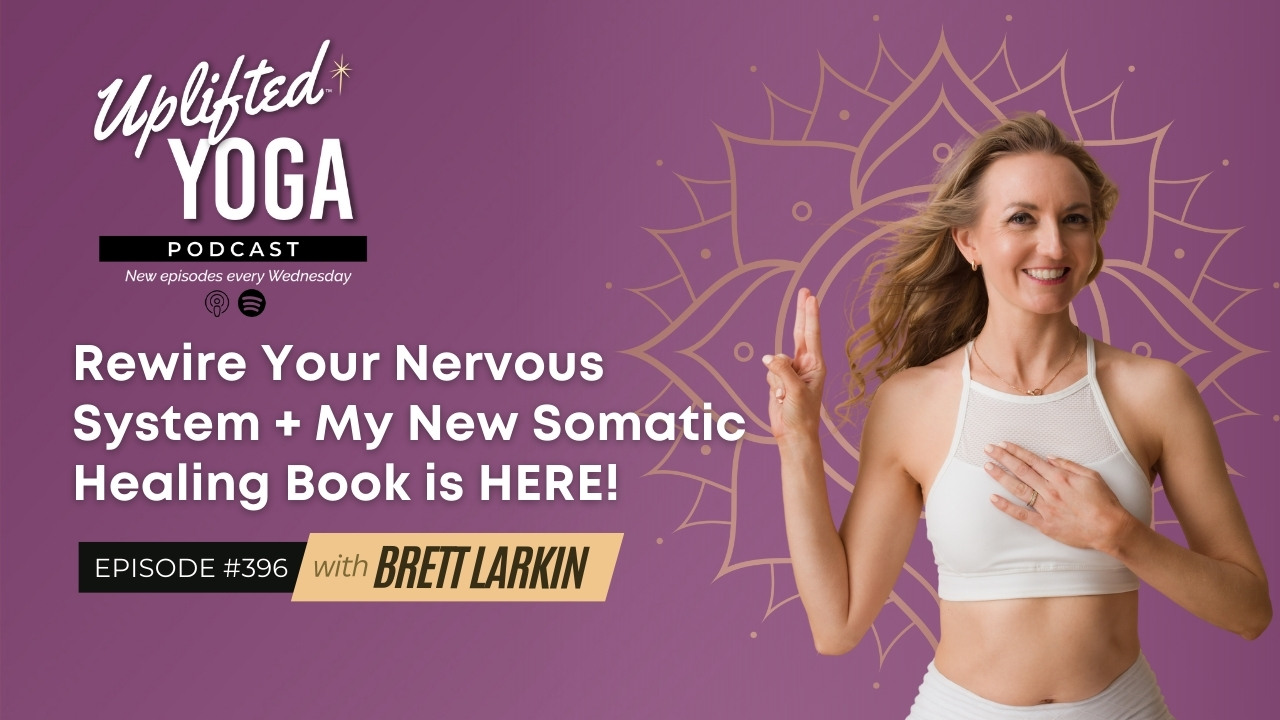
Today’s episode is a little different and really special. I’m finally sharing the story behind my new book, Healing with Somatic Yoga. This book is the heart of everything I’ve been teaching, practicing, and living — and I can’t wait for you to hold it in your hands.
If you’ve ever felt like traditional wellness advice just doesn’t reach the deeper layers — like something’s missing — you’re not alone. We’re entering what I’m calling the Decade of the Nervous System. It’s time to stop muscling through healing and start listening to the body that’s been protecting you all along.
You’ll hear:
🔹 Why your body is not a problem to fix — it’s an animal trying to keep you safe
🔹 How unprocessed stress lives in the body (and what to do about it)
🔹 The 3 distinct models of somatic healing I teach inside the book
🔹 How storytelling rewires your brain (and why it’s a key healing tool)
🔹 Why healing can (and should) feel pleasurable and fun
🔹 What makes this book different from anything else on somatics or yoga
This isn’t just a book — it’s a nervous system manual for our times. I’m so excited to finally share it with you.
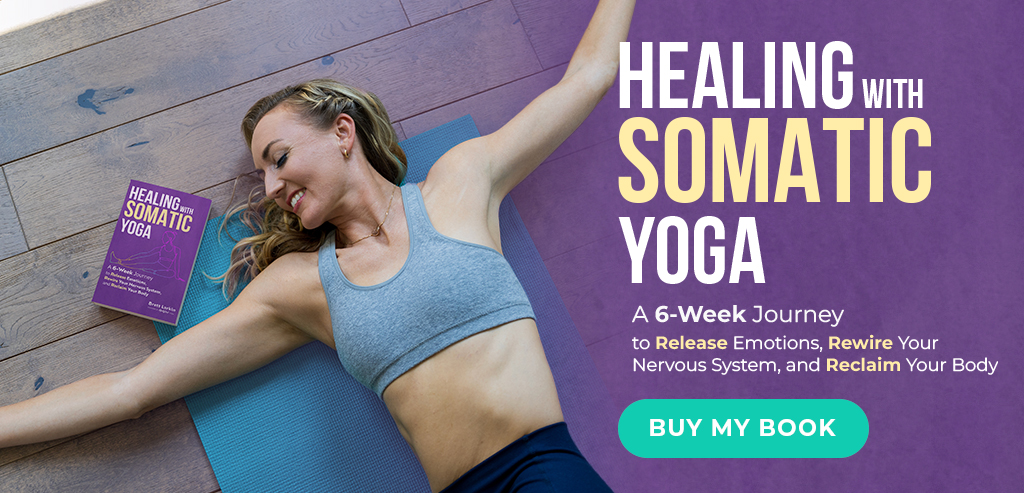
🎉📘 Grab my new book: Healing with Somatic Yoga: A 6-Week Journey to Release Emotions, Rewire Your Nervous System, and Reclaim Your Body → https://amzn.to/3WGulGG and claim the bonus videos and gifts exclusively for early book purchasers!
FREE Practice: Somatic Yoga Workout for Women with Music | Release Anger, Anxiety, Stress, Hip Tension & Trauma
Relevant Blog: What Is Somatic Yoga? Everything You Need To Know
Relevant to Today’s Episode:
💖 Uplifted Membership
🎧 Also Listen to:
#318 – What Is Somatic Yoga?
#330 – Somatic Yoga vs. Traditional Yoga: Breaking Down How 5 Poses Differ in your Yoga Practice
#384 – Do Less, Heal More: 7 Invitations to Resolve Trauma from Organic Intelligence
© 2025 Uplifted Yoga | BrettLarkin.com
Transcript:
Welcome to the Uplifted Yoga Podcast, where ancient yogic wisdom meets modern business strategy. I’m Brett Larkin, creator of Uplifted Yoga, where I’ve certified thousands of yoga teachers, built a multi-seven figure business, and guided over half a million students on YouTube. Here’s the truth.
You don’t have to choose between embodying deep yogic wisdom and building a thriving, freedom-based business. This podcast is your space to integrate both. Because yoga isn’t just what you do on the mat.
It’s how you show up in every part of your life. Whether you’re here to deepen your yoga practice, grow your teaching career, or align your energy with your purpose, you’re in the right place. Let’s dive in.
If you’ve ever felt like your mind and body are at war, your body’s tired, but your brain won’t stop. This episode is for you. We have lived through the decade of mindfulness.
Remember Jack Kornfield, mindfulness-based stress reduction, when all of that was the rage? After that, we entered the decade of mindset, neuro-linguistic programming, life coaches, setting goals, training our brain, positive thinking. But right now, we’re entering the decade of the nervous system. And I wrote a brand new book for this moment.
For those of you that are practicing yoga, meditation, and ticking all the wellness boxes, yet still feeling stressed, anxious, resentful, or angry, even though you’re practicing so much yoga, my brand new book, releasing publicly today, Healing with Somatic Yoga, is your invitation to a deeper kind of healing. In six weeks, you’ll learn a groundbreaking somatic system that blends the three essential models of body-based healing. So whether you crave gentle nervous system regulation, cathartic emotional release, or the healing power of self-touch, this book is my offering to you, my invitation to you to come home to your body.
Now let’s get in to this week’s episode. I am so excited to be announcing publicly today this book, and it’s finally here. Yes, you can get it on Kindle.
Yes, you can get it as an audio book. Healing with Somatic Yoga, a six-week journey to release emotions, rewire your nervous system, and reclaim your body is now available. Today I want to share the behind-the-scenes story of the book, hopefully convince you that healing doesn’t happen in the mind, that it happens in the body, in the tiny, quiet moments when we finally listen to our body.
After COVID, constant new technology, algorithms that just get smarter and smarter at sucking our attention, the burnout, the endless optimization and striving, I think all of us collectively are finally realizing we can’t out-think our biology. And I’m so excited to share this body of work with you because somatic yoga is the bridge between what your brain knows and your body actually feels. And I almost want you to think of this book or somatic yoga as a dictionary, like a glossary to decode your body because the reality is that your brain and your body speak completely different languages.
And I wrote this book to really be the manual for this new era, a field guide for yogis to reconnect to their senses, their instincts, and their natural intelligence. So keep listening because today I’m going to be giving you four big reframes. These are key somatic tools that are going to change the way you’re practicing and change the way you think about yoga right now.
Before we go there, I want to give you a little bit of the behind-the-scenes story of how this book came into fruition because in all honesty, I was not planning on writing another book. My first book, Yoga Life, Habits, Poses, and Breathwork to Channel Joy Amidst the Chaos, was very chaotic. Writing the book on top of leading trainings and everything else that I do, it really took a lot out of me.
And I’m so glad I did it. I love that book. Thank you for all of you who’ve supported the book.
It’s actually doing better on Amazon than it ever has been doing before. And that book’s all about creating a personalized practice that fits your personality. It’s really about how as yogis, we shouldn’t all be practicing the same thing.
And all of us doing the same poses, the same way to the same breath cadence, the same types of movements in sync, like synchronized swimmers, is a fallacy. And how you really experience the magic and the potency of yoga when you personalize it. And I help you figure out how to do that through quizzes.
And it’s an incredibly fun book to really build a personal practice and also figure out how to live and integrate some core yogic principles into your life off the mat. I went through a traditional publisher for that book. I had a big book deal.
There was so much writing on it. And I did all the things you’re supposed to do when you launch a book. I was going on news shows.
I was flying all over the country promoting it. I went on so many podcasts and guess what? It burned me out, unsurprisingly. I always have so much compassion for anyone who tells me they’re writing or launching a book because I know now how much work goes into it behind the scenes.
It’s such a huge effort. Those of you who’ve been listening to the podcast for a while know that I’ve been talking about for years now, this trend towards embodiment and how I think the next hundred years are going to be about the journey down the chakras, not the journey up the chakras. The book Yoga Life really hinted, especially chapter two of Yoga Life, it talks about the evolution of modern yoga and kind of like, how did we get here? How did we get to this place where it’s about these beautiful postures and athletic prowess and precision and achieving more and more complex acrobatic things and doing it all the same way.
In doing all this, we’ve kind of bypassed healing and yoga has very much become about achievement and then mirror that with the fact that we have all of this intense breathwork and pranayama and it’s even in the meditation sphere. It’s like, okay, well, can you do an 11-minute meditation? Can you do a 60-minute meditation? Can you chant for 22 minutes? It’s yoga, but it’s in the model of our more, more, more, no pain, no gain, strive to achieve culture. Chapter two of my book Yoga Life really dissects how did we get here? How did this happen? I talk about Krishnamacharya.
I talk about how yoga was originally designed for kind of the priestly class. It wasn’t about getting more in touch with your body. The body, in fact, was seen as an obstacle to overcome and then how it did get positioned for health and wellness at the turn of the century and then what happened when yoga came to America.
I have a whole online course called the History of Yoga that can give you more context on this process as well as it also looks at all of the key texts that we have in yoga from the Vedas through to the Hatha Yoga Pradipika. After publishing Yoga Life, I really saw this trend, this decade of the nervous system. People are burnt out.
We don’t want to strive and achieve perfect poses anymore, nor is that potentially serving us. I’m sure it’s healthy and working for some people, but for a lot of us, it’s putting, again, the body in the position of a project that we want to improve and make better. We’re still in the problem paradigm and this actually ties into the first big reframe I wanted to offer you, which is your body is not a problem.
This is what week one, chapter one of the book opens with, this idea that your body is actually not working against you. Even your pain and tension are protective responses. They’re actually like love letters from your body saying, please, please, please listen to me.
Your body is like this child or animal that desperately, desperately wants to be in a relationship with you and wants your attention, but we just see the body as this vessel. This meat suit that’s carrying us around and we want it to be thinner. We want it to look different.
We want it to have less cellulite. We’re maybe pulling, pushing it into like Spanx and super tight fitting clothing. We’re annoyed with our body when it’s tired.
We’re irritated with our body when it has to have a period and we’re maybe lethargic and need some rest. Most people look in the mirror and only see defects when it comes to their body or they want their body to be more flexible. They want to be able to forward fold and touch their toes.
The big reframe I want to offer you today as you listen to this episode is just to contemplate the idea, and this is really laid out for you in the pathway of the six-week journey of the book, that your body unconditionally loves you more than anyone else in this world, more than your partner or spouse is ever going to, more than your kids. Your body’s the only thing that’s like your ride or die that’s been with you from day one, experienced everything and is going to be with you until your very last breath. I get goosebumps when I talk about this because it’s so powerful and our body has so much information for us.
This has been proven at this point. The vagus nerve is 80% sensory, meaning that it’s feeding information up towards your brain rather than your brain dictating information to your body. And so a micro practice you can do right now, even if you’re driving, wherever you’re listening to this, walking, simply notice one area of tension in your body.
For me right now, it’s my right shoulder. Instead of trying to fix it, simply whisper internally, thank you for protecting me. I’m here.
I’m listening. Notice if simply that moment of acknowledgement invites something to shift. That’s reframe one.
Your body is not a problem. It is this entity that is incredibly intelligent. It just speaks its own language, sort of like an extraterrestrial or birds or whales have their own language.
We just haven’t bothered to learn the body’s language, but it has so much incredible information for us. And this ties into reframe number two, which is thinking about your body as an animal and that it needs to discharge energy and do what I call close the stress cycle. So another huge topic in this book is that stress isn’t a problem.
Isn’t that great news? Stress is not a problem. This should be very exciting for you to hear. Stress is not a problem.
The problem is that modern life has trained us out of closing the stress cycle. So when you understand stress as a cycle, it’s like, you know, we get aroused, there’s cortisol released. But then if you look at animals, they have this ability to discharge energy and move towards the stress completion cycle.
And some of you who might be familiar with TRE or somatic shaking, which I talk a lot about and has really been trending on my socials, which is why I did a whole chapter just on somatic shaking in the book. It’s weird. It’s freeing.
Maybe you’ve already been doing it with me on YouTube or the Uplifted Membership. But in the book, I go deeper. I go into the science of it.
And your dog shakes after a scare. You doom scroll on your phone to avoid feeling that scary feeling and you get stuck mid stress cycle. Your stress cycles stay open.
We’re never closing the loop. And kind of like my book, Yoga Life, this somatic yoga book has a whole chapter called Living Somatically where I actually talk about how you can close the stress cycle in your daily life off the mat. It’s actually maybe my favorite chapter in the book.
So that’s reframe number two. Your body is an animal. And if you’re not driving right now, you can just like shake your hands, like flick your wrists.
Think of something irritating that just happened. I’m doing this right now. And just flick it off.
Flick, flick, flick, flick, flick, flick. Shake the wrist, shake the wrist, shake the wrist. And if you’re in a car, you can do this with your lips, like, you know, flutter your lips.
This is a great way to discharge energy, as is humming. And in closing the stress cycle, we get to big reframe number three that I want to share with you today, which is that our body is speaking a completely different language than us. So I have a chapter in the book where we learn the body’s ABCs, which, spoiler alert, are breath, movement, sound, and the five senses.
Maybe you learned to speak a foreign language in high school. Maybe you learned to speak toddler. You know, if you have kids, like our kids are really little, you like adapt this different way of speaking that’s highly simplified so they can understand you.
And it’s really cute. Maybe you know how to speak a couple different foreign languages or write in code. Maybe you’re a coder, but the most important language that you need to know is the language of the thing you’re living in, which is your body.
Breath is a key component of your body’s language. Breath is like your remote control. Movement is your body’s native tongue.
We break down an entire movement methodology that you can apply to your yoga practice to make it more somatic. Sound is huge. Sound is your amplifier.
And then your five senses are like these translators that help you understand what your animal body is trying to tell you, but also what it needs to feel safe in the present moment. Because everything you are looking for, the serenity, the bliss, the presence, the calm, all of it is on the other side of really being able to communicate well with your body, understanding what it’s saying to you and what you need to say to it. So those are three big reframes that you can take away today.
And of course I got sidetracked and talked about the reframes going back into the behind the scenes of writing the book and how I didn’t want to write another book. But like so many things in life, this book transpired and channeled through me. It’s like I did not so much have a choice, is that it just came out.
Many of you know, I’ve been leading a somatic yoga teacher training. That’s a home study 75 hour course that you can do online that ships with the manual. You can do it as Yoga Alliance Continuing Education Credit or just for your own personal healing.
It’s a beautiful 75 hour home study experience. I also have a somatic yoga life coaching program, which is basically saying how can we coach people but not in the typical goal oriented, linear mind way, but actually incorporate yoga and movement into coaching to get information from the body. And that’s what somatic coaching is.
And after leading these programs for a number of years, the book felt like such a natural extension of everything that I was teaching in those programs, but making them more accessible more organized, more user friendly for a broad audience or for yogis who are maybe just curious about somatic yoga are ticking all the wellness boxes, all the green juices, all the meditations, all the habits, but still feeling so anxious. And it’s just because of this miscommunication with their animal body. And somehow I just started writing this book.
It just started coming out and I really saw the need for it in the marketplace. I saw that there were all these books about somatic yoga on Amazon. So I ordered them all, you know, because I wanted to see what I could learn and what they were about.
And most of them were offering people gentle yoga poses. Like it was a little guidebook of gentle yoga poses. And that’s absolutely valuable.
These books I’m sure mean well, but they’re missing something crucial. They’re telling you to do yoga poses gently and to be mindful and to listen to your body in quotes, but they never teach you how. How do you do that? How do you listen to a body that’s speaking a language you don’t understand? How do you trust a body that you’ve been taught to override by our culture? And I would say also by a lot of traditional yoga and exercise.
How do you come home to a body that maybe feels more like a haunted house than a sanctuary? And I felt like a lot of these books were oversimplifying. They were kind of giving you a hammer when what I think we need is a complete toolbox. So after 14 years of studying every different yoga lineage and somatic approach from myofascial release, which you guys know is a huge passion of mine to trauma therapy, I’ve braided throughout the book.
The fact that there’s actually three distinct ways to heal through the body and you need all three of them. There’s three models of somatic healing, the adjustment model, and this is all about therapeutic touch and body work. It’s extremely powerful, but most people can’t access this because they can’t afford weekly sessions with a skilled practitioner, but you can access this healing through your own touch.
And that’s something that I teach in one of the frameworks. So that’s the first model. The second model is the discharge model, because let’s be honest, sometimes being gentle isn’t enough.
Sometimes you need to close the stress cycle through shaking or screaming or humming or vibrating or crying or bouncing. You need to discharge that trapped survival energy. And none of the somatic books that I found, somatic yoga books mentioned this at all.
And then lastly, third, the process model is incredibly important because you can’t do any of this without creating deep safety in your nervous system, which means learning to partner with your body, building the capacity to feel sensation without getting overwhelmed and shutting down. And this is all about the communication between you and your animal, AKA your body. So I found that while there were a lot of somatic yoga books on the market, most of them just talked about gentle yoga poses.
They didn’t talk about these, what I see, very three distinct models of somatic healing. And ultimately I didn’t see a somatic yoga book that went beyond just poses. So obviously this book has, my book has poses, it has meditations, it has exercises, it even has companion videos that go with every single chapter, but it’s an 80,000 word book.
It is lots of research, lots of science, footnotes, ideas. It reads like a chapter book. And I think for people who want to know the why, not just what to do, but like why, why does it work? What’s the backstory? That’s usually like the uplifted yoga audience or clan.
And I didn’t see a book that really defined somatic yoga, positioning it as a complex healing modality in its own right, as opposed to just like, let’s do yoga poses gently and mindfully. So when I saw that gap in what was available to people, I just knew, I was like, this book is coming through me whether I want it or not. And I even remember being on vacation in Europe, in Spain and writing this book during my vacation.
That’s how passionate I was about it because in my day-to-day life, again, I’m busy running trainings and doing all the things to keep uplifted yoga alive. There’s not a lot of dedicated time to write and a huge part of this book actually was channeled through some vacation time. I was even writing it during a power outage.
There was a big power outage in Spain when I happened to be there. And I remembered my battery, my laptop had enough battery, and I was just channeling, channeling, channeling this book. And like every first draft, it was too big and too sprawling.
But luckily, talking to my editor who helped me edit Yoga Life, my agent, getting inputs from various publishers, I was really able to tighten up the book and meld it around this six-week journey. So part one of the book is the six-week journey. And part two of the book is your somatic yoga toolkit, which is helping you design your personalized somatic yoga practice, use somatic breath work for healing, create safety and regulation for your nervous system, how to do somatic yoga for emotional release or trauma recovery or even weight loss and body image healing.
So yes, there’s poses. Yes, there’s some pictures. Yes, there’s QR codes with videos to all the different meditations and classes that go with each section of the book.
But I don’t honestly see this as a yoga book. I see it as the dictionary that we’ve all been craving to talk animal, to talk to our animal body and understand what our body is trying to tell us, what we can do for it to provide the context of safety. Because when we do that, the healing that we’re craving is naturally there.
It’s available when we create the conditions of safety, when we create the right context. If what we’ve talked about today resonates with you, healing with somatic yoga, a six week journey to release emotions, rewire your nervous system and reclaim your body was written for you. And this isn’t just my story.
I share many stories and anecdotes that are composites drawn from my work with so many students who have moved through my programs. Obviously all names and identifying details have been changed, but the reality is that stories are remembered 22 times more than facts alone. Stories are how we actually truly learn and heal and recognize our own patterns and others’ experiences.
So weaving storytelling into this book, talking about how people are really using these tools in their day-to-day life felt so important to me. That’s something I also didn’t see in any other somatic yoga books. So you’re not just hearing my story, you’re going to hear all sorts of stories and I’m sure you’re going to see yourself in some of them.
This book is the roadmap for you if you’re practicing yoga meditation and ticking all of those wellness boxes, but still feeling stressed, anxious, or angry. And the best part is it talks about how healing doesn’t have to be hard. The theme of this book is that healing can be playful, pleasurable, even fun.
Every week is giving you longer practices and micro in the moment practices, just like my book Yoga Life did, and every week build towards living somatically. Early reviews are the heartbeat of a new book. If you’ve been part of this podcast community, this is the moment where you can really support the work that we do here together.
When you leave a review and submit a screenshot, I’m going to gift you the most beautiful somatic calendar. Yes, it’s a 2026 calendar that I’ve created. It’s a beautiful tool that’s going to help you live the book all year long with somatic mantras, journaling prompts.
This is a calendar that I physically mail to you, and at some point we will run out of them and then I will have some other gift for leaving a review. But if you want to be an early supporter of this work, that would mean the world to me. Search for Healing with Somatic Yoga or the name Brett Larkin on Amazon, Audible, Kindle.
Immerse yourself in the book. You could also choose to get the audio book. And then your honest review would mean so much.
And I know it can be hard to string words together sometimes and we’re all busy. So I even have a little review writing cheat sheet guide to make it super simple for you. And that also has a link where you can claim your free 2026 somatic healing calendar.
All of these links will be in the show notes. I’m so excited to be birthing this new book baby into the world and I can’t do it without your help. So thank you.
Thank you so much for being part of this movement, this movement of coming home to your animal body. This is the decade of the nervous system and I’m so honored to walk it with you. Until next week, take care of you.
Loving what you’re learning on the podcast? Apply the ancient science of yoga to your daily life surrounded by incredible peers in my uplifted 200 hour online yoga teacher training or grow into your role as a leader of others in my 300 hour professional program for yoga teachers, which is also a high level business mastermind. At any time, I would love to welcome you into my yoga for self mastery course to help you uncover your personal blueprint to serenity or join my uplifted yoga membership for an all access pass to my most popular yoga courses, thematic class plans and practice calendars. Don’t forget to prioritize your wellbeing and get on your mat today.
From my heart to yours, namaste.