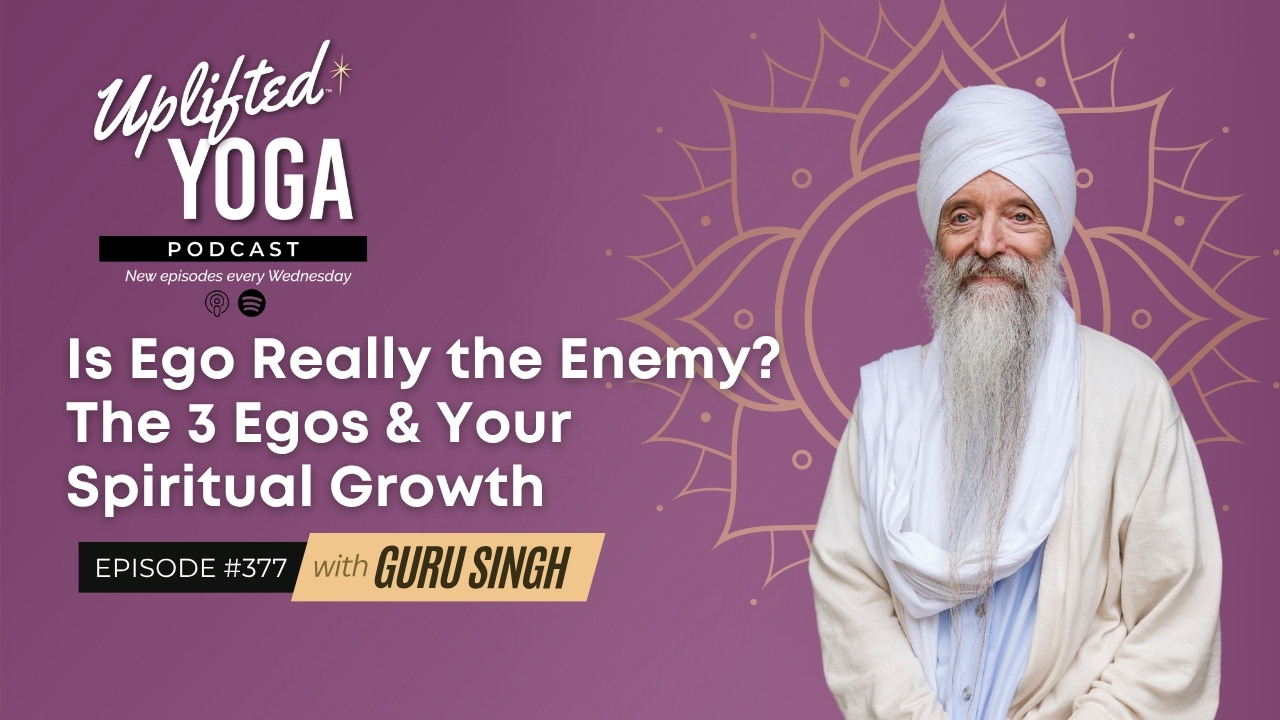
What if your ego wasn’t the enemy—but the gateway?
In this episode, I sit down with Guru Singh to explore the three types of ego—exclusive, inclusive, and universal—and how they shape our spiritual path. We unpack the misconceptions around ego in spiritual circles, and how Kundalini yoga can support our evolution from self-centered survival to universal consciousness.
You’ll learn:
🔹 Why ego is necessary (and not something to “kill”)
🔹 How spiritual bypassing shows up when ego is misunderstood
🔹 The role of Kundalini yoga, meditation, and breathwork in ego transformation
🔹 What it really means to move from exclusive to universal awareness
If you’ve ever struggled with your ego—or judged yourself for having one—this conversation offers a new way forward: grounded, powerful, and deeply compassionate.
💃 Join me for a FREE Kundalini Dance Party => https://www.brettlarkin.com/dance
🐍 Sign up for our 200-hour Kundalini Yoga Teacher Training => https://www.brettlarkin.com/online-kundalini-yoga-teacher-training/
Guru Singh’s 13 Moons Studio: https://the13moons.studio/
FREE Practice: 20-Min Guided Kundalini Kriya Meditation For Inner Truth And Alignment
Relevant Blog: Essential Kundalini Yoga for Beginners: Poses and Practices Explained
Relevant to Today’s Episode:
🐍 Kundalini 200-hour YTT
🎧 Also Listen to:
#316 – Origins of Kundalini & the Yogi Bhajan Scandal – Part 1
#322 – Origins of Kundalini & the Yogi Bhajan Scandal – Part 2
#328 – Defining Sikhism & Its Influence on Kundalini Yoga with Guru Singh
#341 – How To Balance Your 3rd Eye with Guru Singh
© 2025 Uplifted Yoga | BrettLarkin.com
Get 3 Free Training Vidoes from our Kundalini University Experience & Certification Program
Transcript:
Brett Larkin:
It’s time for you to walk through the world with the confidence and serenity of someone who’s deeply tethered to their inner wisdom. If you have this insatiable hunger to uplift your personal life and make a bigger impact in your wellness career, leveraging yoga’s ancient wisdom, welcome. I’ve certified thousands of yoga instructors online, I teach to over half a million subscribers on YouTube, but I still haven’t remotely quenched my thirst for more yogic knowledge.
I’m Brett Larkin, founder of Uplifted Yoga, and this is the Uplifted Yoga Podcast. Let’s get started. What if your ego wasn’t the enemy, but the gateway?
In today’s episode, I sit down with Guru Singh to explore the three types of ego. Yes, I bet you thought you only had one. We talk about the exclusive, inclusive, and universal ego and how they shape your spiritual path.
We’re going to unpack the misconceptions around the ego in spiritual circles and talk about how kundalini yoga can really support your evolution from self-centered survival to universal consciousness. And the ego is necessary. It’s not something we want to kill, so we’re going to talk about that.
But we are going to talk about what it means to move from exclusive ego to universal awareness. This is also a final shout out, a final reminder to join Guru Singh and I in 200-hour online kundalini yoga teacher training. That kicks off this September, but you need to join now because we give you a manual and so many videos, so many practices to watch ahead of the live experience that we’ll be walking you through together starting in September.
And you’re going to have mentorship, support, small groups. We meet twice a week. You can audit the course and come to as little as you want or come once a week if you want that Yoga Alliance certification.
But if 200-hour kundalini teacher training has been something you’re considering, this is the moment to take the leap. As always, I’ll put the link as well as a bunch of other fun free classes and blog posts around this topic in the show notes for you. And let’s get in to today’s episode.
Guru Singh, welcome back to the show. I love all our conversations always about yoga and meditation. I’m so glad to have you back.
Guru Singh:
This is a highlight of my world and obviously now our world is being able to communicate with each other. We’ve done it so much.
[Brett Larkin:]
And I think we’ve done it well. So again, those of you who are interested in Kundalini University with us, it’s a really beautiful experience. I think bridging genders, bridging generations, it’s a really special, special journey that we go on together.
And I think hopefully today’s conversation will be a little bit of a preview, a taste of the depth of what we talk about in that community. We’re discussing today the three egos. And I think that’s something I appreciate about your work.
You always take something that seems commonplace in the yoga world, like this idea of the ego, but then expand much deeper on it. So I think maybe we could start by talking about that word ego, what it means in different spiritual lineages, how it often gets misunderstood. For example, listeners in our Kundalini training, we don’t refer to ego eradicator anymore for that particular pose and breath work where you have the arms up above the head.
We actually call it ego consolidator because you don’t want to eradicate your ego. So maybe you can just speak a little bit.
[Guru Singh:]
You can’t.
[Brett Larkin:]
You can’t. Yes, also, right? Like good luck, but you can’t.
So first of all, tell us a little about this word, and then we can kind of go into these deeper levels that you have of the way you talk about it.
[Guru Singh:]
Yeah. So I’m going to take a big swing at this because in psychology, particularly in Jungian psychology, the word for ego was id, I-D. And that’s because of the Latin resource, the entity that you, your main entity, which is your id entity, right?
Your ego’s entity is where the word identity comes from, id entity. So that’s your identity. So whether you’re a spiritual master or a common everyday human being practicing life, you are an identity.
You are an identity, whatever that identity might be. And that identity is formed around your ego. Ego, and this is very important for people to understand, ego is the force and the glue that holds the soul in physical form.
Without the ego, the soul is released. So at death, you literally become ego-less. In the in-between time, between your birth into your physical body and your release from the physical body, you pass through a series of stages in the ego.
You’re a mother of young children. They’re developing right now what’s known as the exclusive ego. And the exclusive ego is, in a healthy human being, is strongly developed up to the age of puberty.
And that is the I-me-mine ego, which is essential because you have to digest your own food, you have to breathe your own breath, regardless of who you are and how exalted you might be, and you have to exercise your own body. So the exclusive ego has roles throughout your life, and it has a primary role in the initial stages of your life, between the ages of birth and puberty. The reason that ego got a bad name, and because of its bad reputation, there was a sort of a gloss over, I call it actually, that it is that gaslighting, that to say, you know, it’s your ego, get rid of your ego.
Because this is like speaking nonsense. It’s like telling someone that’s not running fast enough that it’s because your feet aren’t moving. You know, there’s no correlation between the speed at which you’re running and your feet moving, unless you stop running and try to take the physiology of the running pattern and divide it up.
But just to tell somebody, it’s your ego or get rid of your ego is really a gaslighting routine. It’s a spiritual bypassing. So the exclusive ego, and we can go on from there, but that’s why ego gets a really bad reputation.
I have a graphic that I’ll use a little later on in our discussion, but there’s three forms of the ego. There’s three stages, the exclusive, then at puberty we are in a healthy life to move into inclusive, and then once we have established that routine of whatever it might be, the householder and working with children and doing all of those inclusive things, business, education, whatever it might be, then it’s time to move primarily into what is called the universal ego and we’ll go into greater depth of that.
But those are the three egos, the exclusive, the inclusive and the universal. And I’ll tell you, the purpose of the ego is so powerful and exalted, and yet it’s got a really, really bad reputation.
[Brett Larkin:]
I think when we often hear that word ego, it’s associated sometimes with selfishness. I think what you said about spiritual bypassing is going to resonate for listeners as well. It’s seen as this thing that we want to overcome.
And if we look at the Kundalini Yoga tradition, we literally have this pose called ego eradicator, meaning you want to get rid. I think it gets associated with this idea of your small self. Do you agree?
People think of it as the smallest part of who they are. And I think the reframe here is that this is actually a core component of being manifest on this plane of consciousness.
[Guru Singh:]
Perfect word, manifest.
[Brett Larkin:]
Right. So I often describe this in the 300 training that you also teach in. But we talk about how when something comes into form, I talk about how when something comes into form, it has to pay the price of polarity, meaning it has to have an individual identity.
And often we think of out there on manifest as the ocean, for example. And then when something becomes manifest, it is manifest because it has individuality attached. It’s almost like that ego is the price that we pay for coming into form.
Instead of being a formless blob, the ocean, we become a drop. We’re still made up of the same stuff as the divine, but we now have our individuality attached. And it’s kind of this thing that we have to have a relationship with.
I mean, what else? You’re chiming in here. So let’s keep going on this train of thought.
[Guru Singh:]
The Buddha talked about what you said, and that is that when you move from formlessness into form, you’re in separation. You’re in separation from the One. And the Buddha said existence, which is that separation, existence is suffering.
And it’s that suffering that drives us to re-merge, to re-unite with infinity. So many metaphors. One example is you use the metaphor of the ocean.
They talk about the bubble on the surface of the ocean. So the bubble rises up, right? It’s got that air pocket inside of it.
And it rises up and it goes, Whoa, look at me, look at me, look at me. And it doesn’t necessarily realize that it’s a part of the whole ocean and that every bubble that it engages with is part of that same one. When you go from the look at me, look at me, which is the exclusive ego, to the look at us, look at us, which is the inclusive ego, to the wow, we are one, which is the universal ego.
The reason that they want to say get rid of it is that they want you to get rid of your, when you use the word selfish, you want to get rid of your selfishness. Forget selfish. That’s just an accusation, right?
But how about selfishness, right? Which is not necessarily inclusiveness, right? So what you want to do is get rid of that self-identity, but you don’t want to, and this is also where spiritual communities have been really, really messed up.
And that is that a leader will have everybody dissolve their own personal needs, proclaiming that that is the way of the way. No. The way of the way is like the old growth forest that you fill yourself up to overflowing so that you share indiscriminately with everyone around you.
That, by the way, is the inclusive ego. The inclusive ego still has the I-me mind that fills the self up, and it overflows to share with everyone else. And by the way, the interesting thing about that old form of spirituality is that it survived into the manuscripts and into the books that have come through the centuries, but it wasn’t the teachings of the great masters.
It was the way in which whatever prospect, whatever organization was wanting to promote the great master’s teachings, turn it into a governmental process, right? And have the hierarchy of rulership, whether it’s the priesthood, the ministership, whatever it might be in those hierarchies, and then you have the commoners. And it was that hierarchy that the great prophets of all of spiritual paths talked from.
They weren’t in a hierarchical state. They considered themselves to be equal and one with everyone because that’s the nature of the universal ego.
[Brett Larkin:]
It sounds like someone who is in a position of power in a good way has an ego. It’s just that universal ego, not that they’ve transcended or gotten rid of it. I want to go back to what you said about when you talked a little bit about Buddhism, and we were talking about things coming into form, right?
So existence equals suffering. And I just wanted to make the connection for folks that that is original sin, same idea, right? In the Garden of Eden originally, our manufacturer’s setting was to God.
I mean, we were still essentially in this utopia as if it were. It was like the out there, but here. And then the division happens with that original sin.
All of a sudden, they realize they’re naked, right? They have shame. So we’re seeing this across all these major world religions.
In order for us to exist, we have to have this ego. That changes our default setting away from God or away from universal consciousness, which is why most of us then end up on some sort of spiritual journey of like, well, how do we tame this thing that we’ve been, I don’t want to use burdened with because I don’t think that’s the right term, but this thing that it’s like a necessary, should we use the word evil? It’s necessary.
It’s like we can’t exist on this plane of consciousness without it. Just like you said, we need food. We need things that are ours, but we can start evolving our ego.
And this is where I think we start seeing different yogic practices come in or different spiritual lineages come in, whatever spiritual lineage you might choose, whether that’s like Buddhism or all these different spiritual paths, bhakti yoga, right? The devotional path. And you and I, of course, like to talk about Kundalini yoga and that path.
So do you want to speak to a little bit now how Kundalini yoga, the different breath work and kriyas and start to kind of work with the ego? Like maybe what does it look like now as we go from this journey to exclusive ego to inclusive ego? And then we can talk about inclusive to universal because I liked so much that analogy of what you were saying of like, I was almost thinking of bubbles in a champagne flute, right?
That’s how they bubble up, but we’re all champagne. We’re all, you know, we have that individuality, but we’re part of something greater. Where do you want to go?
[Guru Singh:]
Yes, I’m with you. Exactly with you. Here’s in Kundalini, one of the greatest outcomes of a kriya meditation, a mantra, is that we move from that sense of two-dimensional analytics defining life into a multi-dimensional experiencing life.
One of the things that general education has done to the human brain is that it has taken us out of experiencing each moment and into defining, discussing, describing, comparing. Each moment, our brain is talking to us. The sun is hot.
The shade is cooler. Instead of actually just being in the warmth and experiencing that warmth or finding some shade and experiencing some relief on a hot day, we leave ourselves in a very short form in the experience because our head brain, which is two-dimensional and is necessary, our head brain is continuously talking and describing and defining. That’s what we are to really educate and propagate during the earliest time of our life.
We learn how to walk. We learn how to talk. We learn how to discuss.
We learn how to negotiate. I’m sure you’re working with your two young children. They’re learning how to negotiate in a friendly environment.
They’re negotiating with mom and dad, and some of their friends out there in the world. That’s all very important to be able to carry through life in the various conditions and positions that we find ourselves in. But what is also extremely important is that we take away the dominance of the head brain, which Kundalini Yoga does very, very astutely and brings in the heart brain, brings in the gut.
Whether we’re doing a Kriya, when we’re doing breath work, whether we’re doing mantra, we’re working with the entire vessel, the entire physical body, the entire emotional body, the entire mental series of bodies. And so what happens in Kundalini is perfectly natural for us to be able to walk from that exclusive ego, which is the way we work with our sympathetic nervous system out in the world, into our parasympathetic, which is very inclusive and non-defensive and very embracing of each situation. Even if this situation is not necessarily what we are wanting or the best, we can figure out how to work with it and move it into a greater position.
So that’s what Kundalini does in its relationship to the egos. And unfortunately, the way it was taught for several decades before Kundalini University came along with you and I is that Kundalini was very much involved in, as you said, ego eradicator and you’re in your ego and all of this, which was okay for forming a hierarchical community, but it wasn’t okay for really furthering the individual ascension into higher consciousness.
[Brett Larkin:]
I think it’s interesting because when you were talking about the head brain and how the head brain is two-dimensional, I really want to make sure those of you listening understand because for me at the beginning, I felt so much of the Kundalini breath works and poses and practices were making me more heady. It was like more energy in my head because so many of these practices are energy ascenders, but to give you some context, if you’re not familiar, is the way that Guru Singh and I teach and talk about this in Kundalini University is Kundalini energy as an orbit. So not as this volcanic explosion up and out through the head, which again, most of us need less energy in our head these days, but we actually work with Kundalini as an orbit, meaning it’s going up Shashamnanadi and then down Ida Pingala in the vagus nerve.
And so we’re talking about this circulatory life sustaining type of energy and really making it a whole body experience just like you talked about with the heart brain and the gut brain. So I just want listeners you to know if you are interested in this type of education, it’s a very full body experience. And I love some of the Kriyas that you bring into the course, Guru Singh, where it really does feel almost like Tai Chi, where you’re doing a lot of horse stance, you’re doing a lot of things that aren’t really fast and rapid breath work.
We have a little in there too, but there’s a lot that feels more grounded. Do you want to speak to that a little bit or just riff on anything I just mentioned?
[Guru Singh:]
Yes. And what you just said was really eloquent. It was well defining.
Kundalini Yoga, as it has been taught for decades, came into the Western world through the 1960s. And there was a lot of paraphernalia being used, a lot of psychedelics, a lot of things that were really occupying the brain space. And so it developed in a way that was, you know, to try to also be a member of that brain space is the way I look at it, because none of these things are individually generated.
It’s collectively generated. What is working for the collective? And so at that time, because so many people were trying to disassemble the old way of thinking and reassemble a new way of envisioning, it got very heady.
The difference between then and now is that the full body experience, which is, as you say, what we teach at Kundalini University, the full body experience brings us out of the two-dimensional, right, wrong, good, bad, yes, no, left, right, you know, if this, then that, which is computer languaging. And it takes us into the heart brain, which is the fourth dimension of time. It’s the beat, right, that rhythm, that pulse, that spiral, right, the sine wave, the apex of the sine wave, which is actually just a two-dimensional vision of the spiraling in motion.
That’s the heart brain. The heart brain is all about that movement and that relation of giving and receiving. It’s the inclusive.
And then there’s the gut brain, which is actually the very first brain that we developed and over the last, say, 100, 120, 30,000 years, we have been, since we’ve really been developing language in a communicative way rather than just an indicative way, language preceded communication with indication, like uh, uh, you know, grunts and groans that were indicating something was needed or necessary. And then along came communication, which was really brought on by sitting around a common fire. And so what brought about communication was the fact that we learned to control fire.
And by controlling fire, we could go anywhere and we could create this central warmth or this central cooking capacity and we would gather and indicative languaging had to, had to grow. And it grew into this, what we now have is the most complex muscle in our series, in our body, which is the tongue, 17 separate muscle groups to be able to form all of the vowels and consonants and sounds. And our communication languaging has become exponential compared to what it used to be in a simpler time.
But along with that came the maximization of the head brain. Now, release the head brain, allow the heart brain of time and timing, giving and receiving to come in, and then allow the gut brain, and the gut brain is this earliest brain that we developed, is all about what do I get nourishment from each moment. Okay.
Right now, you and I are nourishing each other and those that are watching and listening with our conversation. It’s the gut brain between you and I, between us and the listeners and viewers that are connecting here. Because if you and I were in our head brains, we’d be sitting around going, hmm, let me see.
I don’t know about that. You know, I’ve been on podcasts before that, you know, where here I am in a gut-heart head and there in a head-head head. And you can feel it, so you have to navigate that.
But with you and I, and this is what we’ve noticed from day one when Jake, your husband, was our cameraman, that the conversation just starts really accelerating because we are both in the gut-heart head, heart-gut-heart head, wherever it has to be, right? It’s like a long rally tennis match, right? And so, what we’ve got going on here with these multiple brains is, as you said, the Sushumna Nadi, the Kundalini rising, not in this, as the old explanations were, this explosion of fireworks and blah, blah, blah, and you’ve got to watch out because it’s dangerous.
No! It’s this loop that goes up through that Nadi, the central spinal Nadi, comes down through the vagal, the parasympathetic vagal system, which is then nourishing all of the glands and organs that that touches, coming back down to the base, circulating back up and around. And, by the way, speaking of ego, when the Kundalini is circulating, it is dancing between the need for exclusivity, the need for inclusivity, and the need for universality.
Because we all have those needs at different times every single day. You have the need exclusively to put your body to sleep. You have the need exclusively to feed your body, to breathe into your body.
You have the need inclusively as a person in a family or a person in a place of work or a person just in community, a person driving in traffic. You have the need for inclusivity. And then the need for universality is also what Jesus spoke of and Muhammad spoke of and the Buddha spoke of and Nanak spoke of and all of the great masters spoke of.
And that is that universality is what gives you that incredible sensation of even though existence is suffering, if I am universal, that suffering transforms into joy. Which is another quote of the great masters and that is that if you sit with any emotion long enough, it will deliver its message and resolve into joy.
[Brett Larkin:]
Whatever is, is the portal and that that joy is like the texture beneath any intense emotion. If we can sit with that long enough, I want to tie some of what you said, because when you were talking about the head and you know, this two dimension place that we’re constantly a victim in many ways to our preferences in the head brain, right? I prefer the shade, like you said, I don’t prefer the sun.
But if I heard you correctly, it’s like, we’re talking about the gut and the body is a place where I can maybe be a little hot, but say, but be present and be in the moment, right? And be like, I’m feeling the warmth, I’m feeling, you know, the heat on my skin. And then I might pop up to my head, it’s a little warmer than my preference, but I can be with this, I can stay with this.
And, and I think there’s, there’s a piece of this puzzle that’s like the nervous system capacity part, right? Which I think is what you meant when you talked about parasympathetic nervous system, that if I am feeling unsafe, or I don’t have a lot of comfort with discomfort, that’s not a muscle I’ve trained, right? Being too hot is a big problem.
These practices that we do in Kundalini, some of which are uncomfortable, right? Maybe chanting for much longer than we would maybe like to, holding our arms out for longer periods than our body would prefer, right? But in, I think this is what makes Kundalini yoga so unique.
It’s like in doing those types of exercising exercises, we’re expanding our comfort with discomfort. And that enables us to ultimately be more present when things don’t go our way. Am I on the right track here?
What, what would you add in?
[Guru Singh:]
You’re, you’re absolutely on the right track. And, and the only thing I would, I wouldn’t add anything in, I would just expand what you’re talking about in one way. You spoke earlier about manifest and that when you come into the manifest world, into the world, into the material world, you live by Newton’s third law of motion, which is for every action, there’s an equal and opposite reaction.
And so that’s what we can also apply. Let’s go in the same metaphor. It’s too hot out.
Yeah, well, it’s, it’s, it’s hot, but there’s also something in it because for the hotness, there has to be the equal and opposite because it is the sensation. So that’s when you realize that too hot is an expression of an opinion. And what if we go down into that opinion and discover that it actually isn’t based on very much.
Okay. Maybe it’s based on, I don’t want my skin to burn. So maybe it’s a directive to put on some sunscreen, but what you can also find that in that too hot, there is just the singular nature of hot or high warmth or keep going, keep going.
And so warmth becomes life bearing, life giving. And you can go through that haystack and find several needles, if you will, that have really joyful meanings. And one thing that you notice is that on that journey, nothing has changed in the temperature, but you’ve stopped noticing that it’s too hot.
And so as you journey to find the equal and opposite, you spend time in the original stimulation without defining it with an opinion of two, you just start to see it as what gives life to this planet is what’s making it too hot. So that maybe I should just look at, wow, this that I’m experiencing is actually life force. It’s actually a pranic feel.
And in that it’s light, it’s matter, it’s energy. It’s all of the things that my body needs. And then something happens.
You stop attaching negative filtration to your experience and your experience starts to become a positive nature. The other day I was listening to somebody who was talking in person and they were complaining about the heat. And it hasn’t really been that hot here in Los Angeles this late spring, early summer, not at all, never into the 90s and barely into the 80s.
But they were too hot. It’s too hot. And I was thinking, gosh, I haven’t had that sensation once this year.
I have not once this year felt like it was too hot. And I was thinking, because you mentioned it a moment ago, it’s not that something is different, so to speak, it’s that something is different, that I’m experiencing more of each moment than I even did last year or the year before, the year before that. And as I’m experiencing more of each moment, the individuality of too hot, that exclusivity of too hot is becoming not secondary.
It might be tertiary. It could be even less than that in the cycle or the hierarchy of importance.
[Brett Larkin:]
We often hear Kundalini Yoga defined as the yoga of awareness. And I love that definition. And what we’re talking about right now is that in any given moment, instead of being so attached to my preferences and that individual ego, that’s the smallest part of who I am, what this practice is giving me is more options of how to experience the world, see the world, view the world.
And when I have more options, because of this greater awareness that my practice is providing for me, my individuality is able to dissolve somewhat. Maybe I’m stepping into one of these other egos, inclusive, universal, and that even that which seems like it’s not my preference can actually be a portal for pleasure or contentment. And I think that’s really exciting.
I want you to talk about before we close a little bit about this journey from the inclusive ego to the universal ego. And is that akin to a Kundalini awakening? I know Kundalini awakening is something people often have a lot of questions about.
I don’t want people to think, is this ego transcendence? Is this just a mature ego? Talk to us a little bit about that final piece.
[Guru Singh:]
I’m glad you used those two phrases at the end of your question. Transcendence, no. Absolute inclusion, yes.
Universal ego. Inclusion beyond the inclusive ego. The idea of becoming something is a bit of a misdirect.
Neither you nor I have talked about becoming something. I’m just saying that in the world of teaching, become your best. Actually, you are your best, it’s just covered up.
Because at our core, we are universal. We are soul body. And all we are is just uncovering.
Think of it in terms of a small child. I can’t see you. There you are.
You can’t see me. Here I am. That game that we’ve all played with young children.
They go and they put their hands over their eyes and they think that they are not visible. They take their hands away and, hey, I am here. That’s how people, for the most part, the majority of humanity is experiencing their life.
And that is that we are 100% universal, absolutely perfect, absolutely radiant, absolutely enlightened. We are just covered up. And it’s as we are uncovering, or as they call it, discovering.
As we are uncovering, then the true self emerges. So, we’re not becoming. We already are.
We’re just uncovering. And so, the ego is a system that is set in place in order, and it’s an evolutionary system, in order for us to survive through life. In the initial stages, we have to learn to walk for ourselves.
We have to learn to eat for ourselves. We have to learn to talk for ourselves. We have to learn to think for ourselves.
We have to learn to make our needs known, our wants known. That’s all the work of the exclusive ego. And that needs to stay with us throughout life.
Otherwise, we’re basically bypassing ourselves.
[Brett Larkin:]
Yeah, we’re not able to take care of ourselves.
[Guru Singh:]
We’re not. And we’re easily taken over by somebody else. Good point.
Yes. In exchange for take care of me, right? Yes.
And then you have politicians who say, I’ll take care of everything for you. Just vote for me. And that’s the whole political world.
Then we have religion saying, this guy takes, or this girl takes, I didn’t want to be exclusive here. This person takes care of everything for you if you just put all your money on this person or put all your efforts on this person. Spiritual communities do the same thing, right?
It’s all totally nonsensical. The reality is that the great masters and the great spiritual leaders were only giving an example of how to become just like them. Which, by the way, is that step from the inclusive ego into that bhakti state of the universal ego in which monogamy is a perfect example of that bhakti state of universal ego, is that in order for a relationship to really prosper for decades, right?
A monogamous relation to prosper for decades, first you have to get into inclusive and then you have to move rather quickly into universal. And probably you have to move into universal pretty much when children start arriving. Because the inclusivity doesn’t necessarily meet all your needs, but you have to go to universal attitudes, which is the attitude of the old growth forest that I always use, which is the, well, it’s taking care of everything so that I don’t have to take care of everything.
And that’s a good thing, so that I can relax in my own needs and get my own needs met in due time. And that’s how that dance of, because we live in our exclusive, inclusive, and universal throughout our lives, the dance between when do you go exclusive, when do you go inclusive, and when do you go universal. Because obviously so many relationships when children have come along, one or the other is talking about, yeah, but what about my needs?
And that sometimes is a game changer. And so all of a sudden I have to see that if my child’s needs are being met, then that’s actually my needs being met. So that’s how these things don’t just work in the so-called spirit-based community, soul-based community.
They work in the practicality of the householder, which is what Kundalini Yoga is very much of. And that is a path of a householder who also wants to have that higher awareness, as you said, the yoga of awareness, so that you can be fully functioning in the world. You can have a profession.
You can have a skill. You can have a family. You can have so many different things and still be lifting and elevating your awareness so that it can apply to all the things that you’re working with.
[Brett Larkin:]
So to try to tie this in a bow, which is going to be hard, but I’ll attempt it anyway, we’ll do it together. I think what I heard you say is that the inclusive ego is very the me, mine, my needs, and it’s essential for survival. And it’s essential for us not to get taken over or brainwashed.
Essentially, we need it. And there’s going to be moments where we’re in this titration between these three at all times and different or appropriate in different situations. Then we have the inclusive ego, which is like, I want what’s best for me, but also what’s best you and the other people, little bubbles in this ocean champagne flute, pick your metaphor, but who are around me.
And then the universal is almost life giving in the sense that even if I’m not getting what I want, I’m being nourished because things I care about or my kids or whatever are getting what they need. There’s almost like a, I don’t want to say, is there a self-sacrifice piece to it or I don’t know, noodle on with me on this last one.
[Guru Singh:]
That would be an exclusivity interpretation. Let’s stay in the universality. There wouldn’t be a sacrifice at all because what goes around comes around.
Think about it in this term, that when you hear about someone saving a major landmark, a major forest section or whatever, a waterfall that was going to be lost because of a dam project. And then they’ve decided that they’re going to mark out a national territory, a national park so that we can save these exquisite waterfalls and just the things of nature. You feel better.
You feel better. It’s an actual sensation. That’s universal ego.
That’s universal ego feeling better because something is being made better. Something that is important to all of humanity is being made better. The inclusive ego is more, as you said, more along the lines of that which you’re clearly relating to is included in your benevolent circle.
That’s the inclusive ego. The universal ego is more of the nondescript and necessarily the of like kind, but that things are working out. There’s more animal rescuers.
I just heard that animal rescue has become a big thing now in people’s minds. There’s some leaders in it, but there’s a lot of people signing up for it. That makes me feel good because I love animals.
That’s that universal ego that’s engaging so that even though it’s not necessarily touching you, you’re in deep appreciation because of it.
[Brett Larkin:]
Yeah, it’s about the collective and the long game, right? Like the long benefits. Yes, I love that.
Well, this was such a beautiful conversation. I think hopefully everyone has a lot to digest after listening to this. So we hope that this is just the beginning of your relationship with us in conversations like these.
We hope that this is hopefully just the starting point of your journey to come on a many, many months community interactive training with us. We kick off in just a couple of weeks here. I’m going to put all the links for how you can join Gurusing and I for Kundalini University this fall in the show notes.
It really is now or never. There’s just a couple more weeks to sign up. Gurusing, thank you so much for being here, for sharing your wisdom.
It’s so fun always to talk together, teach together. This was a real, real joy for me. So thank you.
[Guru Singh:]
Yeah, and for everybody in the world outside our world, my entire family, wife, daughter, son, grandchildren, and Brett’s entire family have shared bread together many times and we find it just as enthusiastic as we have felt during this podcast. So we ride on each other’s energies and it goes into the entire family with us. So bless you, bless you.
[Brett Larkin:]
Thank you. Thanks everyone. We’d love for you to become a part of our family too.
Thanks. Sat Nam. Thank you so much for being here and listening all the way to the very end.
I want us to get to 1,000 reviews on this podcast. We’re already over 500 and as a free gift to you, if you leave a review, I want to send you my chakra balancing audio track and journaling hack. Maybe you have a problem right now and you’re not really sure how to solve it.
Well, guess what? Did you know you can ask your chakras? So I’m going to send you this five minute self inquiry process that I use all the time, the PDF and audio, so you can consult and balance your chakras.
All you have to do is leave a review wherever you are listening to this podcast, screenshot the review before you hit submit, because sometimes it takes a while to show up and then send your screenshot of review to info at upliftedyoga.com subject line podcast. And we will respond within 48 hours with your chakra balancing audio track and journaling PDF. I’m so excited to share with you this special way that I quickly connect with and balance my chakras.
Thank you so much for your review and claim your free copy today.