Last updated: October 13, 2026. I’ll keep updating this post as Yoga Alliance releases more details.
Hello, yoga family. If you’ve heard that Yoga Alliance is completely changing its credential system in 2027 and thought, Wait… what does this actually mean for me? — you’re in the right place.
Do I have to take a test now? Is my RYT 200 going away? What if I’m graduating in 2027? Do I need CPR? And why is Yoga Alliance suddenly talking about a “credential” instead of a “registry”?
I went DEEP on this.
And I have a somewhat unique perspective because I’ve been training yoga teachers online since 2015… five years before Yoga Alliance even allowed online teacher training. We’ve now certified over 4,000 teachers through Uplifted Yoga, and I’ve watched Yoga Alliance evolve through COVID, the explosion of online YTT, and some pretty major changes in what the RYT credential actually means.
So when Yoga Alliance announced what may be the biggest overhaul in its nearly 30-year history, I had a lot of thoughts.
Some of these changes made me think, Finally.
Some made me think, Wait… why did this take almost 30 years?
And some make a LOT more sense when you follow the money.
I’ve read through what Yoga Alliance has published about these changes and dug through its public tax filings so you don’t have to.
But before we get into what’s changing, you need to understand something surprisingly few yoga teachers realize:
Yoga Alliance has never actually certified you.
Your yoga school does.
And once you understand that, everything happening in 2027 makes a lot more sense.
Yoga Alliance 2027 Changes at a Glance
Yoga Alliance is going from a registry to a credential.
For the first time, it will actually test teachers itself.
✔️ Teachers will take a 40-question online assessment covering teaching and leadership, ethics, safety, and diversity, equity, inclusion and belonging. You need 75% to pass, and you get two attempts.
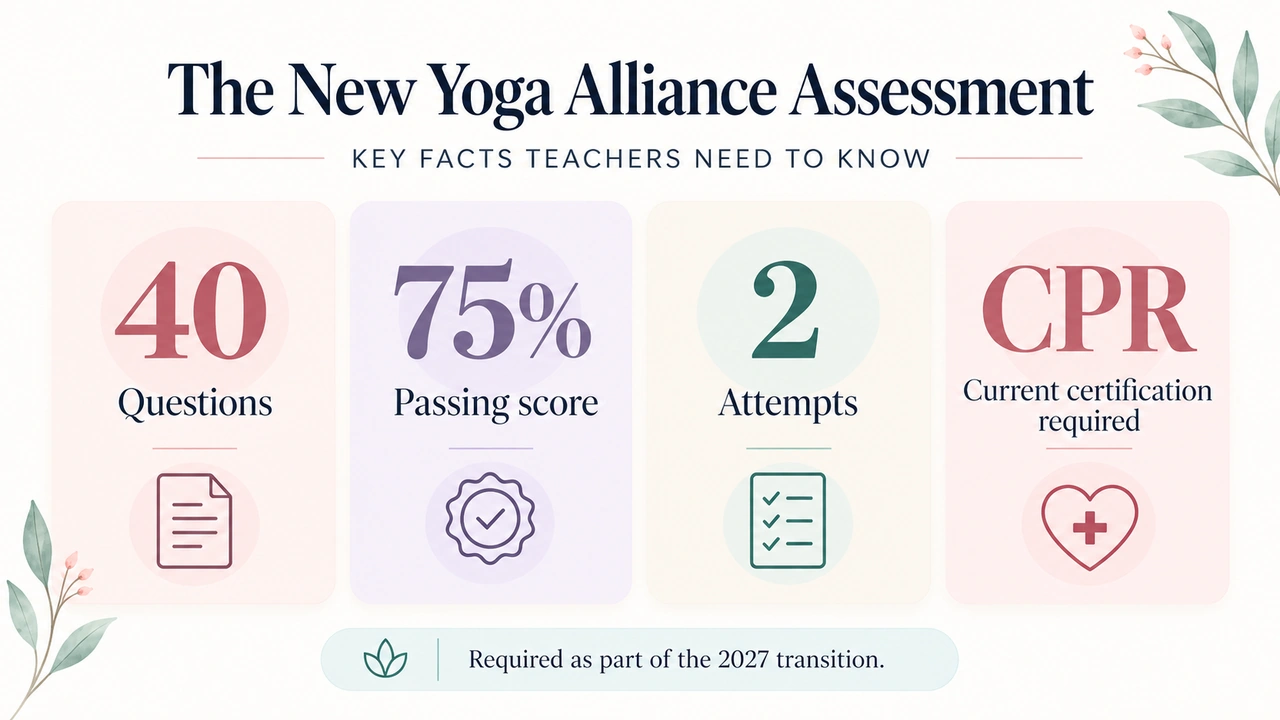
✔️ You’ll also need a current CPR certification. This requirement currently appears in the Yoga Alliance member portal.
✔️ The numbers are disappearing from titles. Teachers will be RYT or E-RYT, not RYT 200 or RYT 500. Schools will hold one RYS credential, and each training (200-hour, 300-hour, prenatal, kids) becomes a “specialty designation.”
✔️ Credential and membership are splitting into two separate products. The new membership is basically Yoga Alliance getting into the online course and content business.
✔️ Everyone has to transition, including current RYTs and schools, by December 31, 2027.
Training hours, live (synchronous) hour minimums and educational categories are NOT changing (yet).
Now let’s unpack how we got here.
What Is Yoga Alliance? (And Why the Money Matters)
Yoga Alliance was founded in 1999. So we’re talking about an organization that has been around for almost 30 years, which makes some of the changes I’m about to describe both really positive and, honestly, kind of amazing that they took this long.
But first, I want you to understand the scale of this organization.
According to Yoga Alliance’s own public Form 990 tax filings:
🗒️ Yoga Alliance brought in about $10.3 million in revenue in 2024 alone.
🗒️ About 96.6% of that came from what it sells: dues and fees from yoga teachers and schools. It received no donations, even though it’s set up as a nonprofit.
🗒️ Revenue peaked at about $12.2 million in 2019 and has been shrinking since.
🗒️ It posted losses three years in a row: about $506,000 in 2022, about $679,000 in 2023, and about $241,000 in 2024.
🗒️ Meanwhile, the CEO’s reported compensation rose from about $283,000 in 2023 to about $473,000 in 2024. Total executive compensation rose from about $548,000 to about $1.34 million.
🗒️ By Yoga Alliance’s own published figures, it serves around 100,000 registered yoga teachers and somewhere between 6,000 and 7,000 registered schools.
Just take in that $10.3 million number for a second. That’s $10.3 million in one year of an organization that has existed for almost 30 years.
In a world where so many yoga teachers are struggling to make ends meet (and schools like mine are working incredibly hard simply to stay in business) it’s eye-opening to realize that this large bureaucratic organization, which I think many teachers would agree has historically done relatively little for the individual yoga teacher, has been bringing in more than $10 million per year.
And I think it’s important to hold that overarching awareness as we look at these changes, because it gives us really important context for what happens next. Revenue has been shrinking. Yoga Alliance has posted three consecutive years of losses. And now it’s simultaneously reinventing its credential and launching a brand-new paid membership.
Keep that in the back of your mind as we go.
Want the basics first? Read my full guide: What Is Yoga Alliance? Do You Need RYT Certification?
How Yoga Alliance Has Worked Until Now: A Registry, Not a Certification
Here’s what most people don’t realize: Yoga Alliance has never certified or tested a single yoga teacher.
Your school certifies you.
Traditionally, Yoga Alliance has been a registry — an intermediary sitting in the middle between schools and students.
Here’s basically how the system has worked:
🔹 Yoga Alliance sets broad educational categories: a certain number of hours of anatomy, techniques and practice, philosophy, professional essentials, and so on. Honestly, I hesitate to call them “standards.” They’re more like obvious educational boxes a training needs to fill.
🔹 A school submits paperwork showing how it will fill those boxes, pays a hefty fee, and becomes a Registered Yoga School (RYS).
🔹 The school trains, tests and certifies its own students, however rigorously (or not) it chooses.
🔹 The graduate uploads their certificate to Yoga Alliance, the school they trained with clicks “approve,” and the graduate pays Yoga Alliance to become a Registered Yoga Teacher (RYT). Here’s how that works step by step: How to Register Your YTT Certificate With Yoga Alliance
And what did that Yoga Alliance fee actually get you? Basically two things.
✔️ The right to use Yoga Alliance’s registered trademarks, like RYT, E-RYT and RYS, and their logos. Stop paying your dues, and you can no longer use them. If I stopped paying, I couldn’t call myself Brett Larkin, E-RYT 500.
✔️ A listing in the Yoga Alliance directory. Is there real value there? Debatable. Plenty of commentators over the years have pointed out that when most people need a yoga teacher, they Google “yoga” plus the name of their town or zip code.
So up until now, you’ve essentially been paying to use a trademark and appear in a registry.
And when you really look at this business model, it’s kind of brilliant. Schools pay Yoga Alliance for the ability to register students. Then those students pay Yoga Alliance to become registered.
But the actual work of determining whether someone is competent to teach yoga? That has always fallen on the school.
How Uplifted Has Always Certified Teachers
I’ve always taken the certification piece so seriously at Uplifted.
For our 200-hour training, that has traditionally meant:
✔️ A comprehensive multiple-choice exam of about 100 questions.
✔️ A video of you actually teaching another person, graded by your lead trainer against a detailed rubric. We give in-depth feedback, and yes, students are sometimes asked to resubmit.
✔️ A full week of exam-prep calls where we review the material and set you up to succeed.
Students sometimes groan about the quizzes, the exam and the teaching video. I get it. Nobody wakes up thinking, I hope someone grades me today.
But here’s the thing: I want Uplifted to mean something.
If we don’t have real graduation requirements and standards that we hold everyone to, what does your certificate actually mean?
And on the flip side, there is so much confidence that comes from knowing you didn’t just buy a certificate. You practiced. You were assessed. You received feedback. You demonstrated that you can actually teach. You earned it.

Myth-Busting: You Don’t Need Yoga Alliance for Insurance (or to Teach)
Before we go any further, two things I’ve been telling yoga teachers for years:
⛔ One: You don’t need Yoga Alliance to get yoga teacher insurance. Most insurers don’t require it. The one exception is Alliant YogaPro, Yoga Alliance’s own insurance partner, which is just one of many options. Compare your options here: Best Yoga Teacher Insurance
⛔ Two: You don’t need Yoga Alliance to teach yoga. Yoga is unregulated. More here: Can I Teach Without a Yoga Alliance Certification? (Yup)
A lot of people assume there has always been some insurance or safety angle to Yoga Alliance registration. Up until now, there really hasn’t been.
Which is another reason the new credentialing changes are actually pretty significant.
Yoga Alliance, Online Yoga Teacher Training and COVID
Here’s a piece of this history I lived firsthand.
Before COVID, Yoga Alliance didn’t sanction online learning in any capacity.
I started certifying yoga teachers online in 2015, five years before the pandemic. Our certificates didn’t carry the Yoga Alliance trademark, purely because we weren’t conducting the training in person.
It wasn’t because we weren’t teaching enough. We met and exceeded their educational categories. We were doing detailed anatomy reviews, pose breakdowns through video and photos, and live calls. We were Zooming before “Zoom” was a verb.
And yes, I got a LOT of hate for brining yoga teacher training online. Some of my students did too, simply for saying they had trained online.
But the school thrived anyway because there were so many people who wanted and needed to learn this way.
Then COVID happened.
And basically overnight, Yoga Alliance went from not accepting online teacher training to embracing it wholeheartedly because every teacher training suddenly had to go online.
What was supposed to be “temporary” became permanent. Those old in-person contact-hour requirements never came back.
(Read more: Are Online YTT Courses Approved by Yoga Alliance?)
Uplifted became a Registered Yoga School right away because we were already meeting the educational standards. Distance learning had simply become allowed.
But then online yoga teacher training exploded.
I went from being one of maybe two companies in the world doing this to watching basically every studio and teacher training on earth move online. It was surreal.
And six or seven years later, the RYT 200 credential has started to mean less and less.
You can now find Yoga Alliance-registered teacher trainings online for $100 or less. This is a training that, before COVID, commonly cost $3,000 or more.
If you’re shopping for a training, this is exactly why I wrote: How to Know If an Online YTT Is Legit
To Yoga Alliance’s credit, it did update its standards in 2020. It created tougher requirements for lead trainers and introduced a new Ethical Commitment.
But there was still no test. No shared assessment. Nothing every RYT had to demonstrate before receiving that Yoga Alliance badge.
And that brings us to ICE…
Why Yoga Alliance Is Changing: The Institute for Credentialing Excellence (ICE)
This is where it gets interesting.
Yoga Alliance wants accreditation from the Institute for Credentialing Excellence (ICE). Not the most fun acronym, I know.
ICE is essentially a credentialing organization that credentials credentialing organizations. Say that ten times fast.
Its job is to look at credentialing programs and ask: Does this credential actually measure what it claims to measure?
Many major fitness certifications, including ACE and NASM, are accredited through ICE’s accrediting arm, the NCCA, and have been for years. That’s part of why gyms, employers and insurers tend to take those credentials seriously.
Uplifted already lives in that world. We hold continuing education approvals with ACE, NASM and AFAA, and I can tell you that getting those approvals required far more paperwork and verification than anything we had ever done with Yoga Alliance. We’re really proud to hold them.

Now here’s where this gets almost comically obvious.
If Yoga Alliance wants to become an accredited credential through ICE, everyone holding that credential needs to pass some kind of shared assessment.
People simply paying to appear in a registry doesn’t count.
A paid listing can’t be accredited. A tested credential can.
Yoga Alliance says openly that it intends to pursue this ICE accreditation.
So when I zoom out and read between the lines as an outside observer, we have shrinking revenue, three years of losses, an explosion of cheap online teacher trainings, and an RYT credential that arguably doesn’t carry the weight it once did.
That’s kind of a perfect storm.
Yoga Alliance needs to reinvent itself. And becoming an actual tested credential (while simultaneously launching a new paid membership product) appears to be a huge part of how it plans to do that.
You’ll also notice that the word “registry” has basically disappeared from Yoga Alliance’s new language and website, despite the fact that a registry has been its business model for almost 30 years.
Because now we’re talking about a credential.
Yoga Alliance Registry vs. Credential vs. Membership: What’s the Difference?
Okay, this part super confused me when I first read Yoga Alliance’s announcement, so if your eyes are glazing over at the words registry, credential and membership, you’re not alone.
Here’s the easiest way I’ve found to think about it:
Yoga Alliance used to be ONE thing. Now it’s going to be TWO.
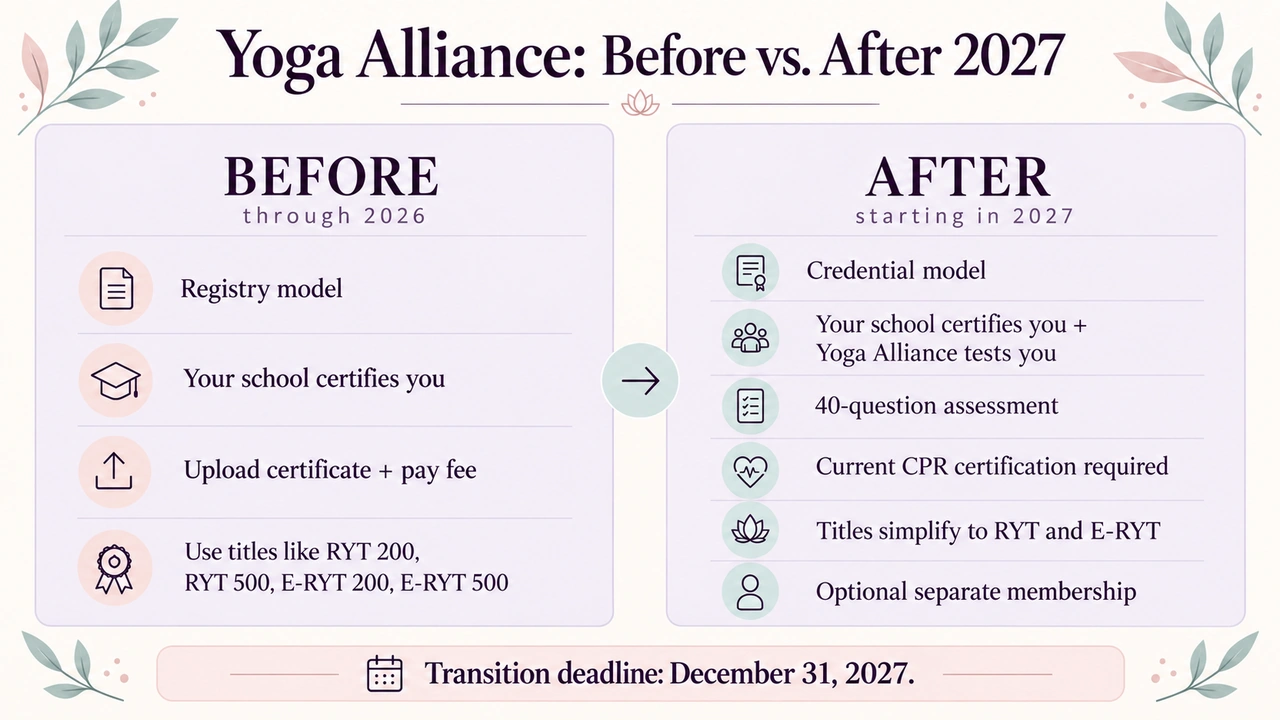
Registry (what Yoga Alliance has been, 1999 to 2026)
You graduate from a school, upload your certificate, pay Yoga Alliance, and get registered. You get permission to use Yoga Alliance’s trademarks and appear in its directory. Your annual dues keep you on that list.
That’s the old model.
Credential (new in 2027)
Now Yoga Alliance itself is going to verify you too.
That means:
- You graduated from a Registered Yoga School, same as always.
- You now must also pass Yoga Alliance’s 40-question online assessment.
- You now must have a current CPR certification.
- You now must sign the Ethical Commitment.
- You log your Continuing Education and Teaching hours, same as always.
- For teachers, the credential alone will cost $150 every three years after the transition period. That works out to about $50 a year (actually cheaper than today’s $65 annual fee).
Membership (new in 2027)
Then there’s the membership. This is a completely separate, optional, paid product.
And the easiest way I can describe it is: Yoga Alliance is getting into the online course and content business.
According to Yoga Alliance, membership includes things like:
💻 On-demand courses, webinars and e-books.
💻 Business templates, forms and waivers.
💻 Community groups and coffee chats.
💻 Mentor matching.
💻 Member discounts, including insurance and CPR courses.
So this is the same general online education/content/community space that many of us who run yoga schools have been serving for years.
And in the future, you could theoretically be someone who isn’t even a credentialed yoga teacher but wants access to Yoga Alliance’s business courses and resources, so you buy the membership.
Or maybe you don’t want any of that. You’ve already completed a great training, you just want your Yoga Alliance credential, so you pay for the credential and skip the membership.
Two different products. That’s the key.
Why Do Current Members Get Both for the Price of One?
This is where it gets a little confusing because during the transition, Yoga Alliance is bundling the two together.
Current RYTs and E-RYTs get the credential AND the new membership at today’s $65 annual rate through their 2029 renewal. Schools get a similar transition deal at their current rate.
I think of this almost like a very long free trial.
It gives existing teachers no reason to let their Yoga Alliance registration lapse while everyone is trying to understand the new system (clever). And it gives Yoga Alliance several years to show you the value of the new membership.
Then, in 2029, you get to decide: Do I actually want to keep paying for these courses, templates, community features and discounts? Or do I just want the credential?
Yoga Alliance’s own FAQ essentially says: not convinced yet? Give us a chance to prove the value.
Curious what members get today? The Only 7 Yoga Alliance Membership Benefits (Some Are Free)
A Note on Yoga Alliance’s Privacy Policy
One other piece I think is worth knowing: Yoga Alliance’s privacy policy allows it to share your information with sponsors, partners and other approved third parties.
So if you’ve ever opened a Yoga Alliance email and wondered why you’re suddenly looking at an advertisement for yoga clothing, props, insurance or another wellness company — there you go.
Many organizations do this. What I don’t love is that there isn’t a simple checkbox where you can opt out. You have to contact Yoga Alliance directly.
I’d love to see that become much more transparent, because in paying to be a Yoga Alliance member, you get more ads. Usually, when you pay for something, you get *less* ads.
The New Yoga Alliance Assessment: What’s on the Test?
Okay. Let’s talk about the actual test, because this is probably the part most teachers care about.
It’s 40 multiple-choice questions.
Topics include effective teaching and leadership, ethics, safety, and diversity, equity, inclusion and belonging.
E-RYTs also get questions on teacher trainer development.
You need 75% to pass.
You get two attempts.
An optional prep course is available.
Can a 40-question multiple-choice test actually determine whether someone is a great yoga teacher?
No.
Yoga Alliance still isn’t watching you teach. It isn’t seeing how you respond to a confused student, how you cue a pose, how you hold a room, or whether you can actually translate knowledge into teaching.
But this is still a huge step in the right direction.
For the first time, everyone who wants this credential has to demonstrate at least some shared baseline of knowledge instead of simply uploading a certificate and entering a credit card number.
Thank goodness.
Why Isn’t Yoga Philosophy on the Yoga Alliance Test?
One thing that immediately stood out to me: yoga philosophy isn’t on the assessment.
Yoga Alliance’s position is that philosophy and lineage should be taught and assessed by the individual school. And there is logic to that because different schools and lineages approach yoga philosophy differently.
But I’ll also say: this doesn’t surprise me.
In the West, we have historically loved a very fitness-friendly version of yoga. We’re very comfortable talking about anatomy, safety and physical teaching methodology, and we tend to get a little more uncomfortable when we move into the deeper philosophical roots of the practice.
If you want my full rant (and I mean that lovingly) about how yoga became commodified as it came West, I go deep into this in chapter two of my book, Yoga Life.
So am I shocked that philosophy isn’t on the Yoga Alliance test? No.
But again: I’m still really glad there is finally a test.
Is RYT 200 Going Away? New Yoga Alliance Titles, Badges and Designations
This is another change that sounds much bigger than it actually is.
The numbers are disappearing from the titles.
Instead of RYT 200, RYT 500, E-RYT 200 and E-RYT 500, there will basically just be:
🤓 RYT (Registered Yoga Teacher): You still need 200 hours of training from a Registered Yoga School.
🤓 E-RYT (Experienced Registered Yoga Teacher): You need 500 hours of training — for example, your 200-hour plus a 300-hour. Yoga Alliance has not yet confirmed what teaching-hour requirements will apply to new E-RYTs, although I’m assuming some version of the teaching-hour requirement will continue.
So: the 200-hour training is NOT disappearing. The 500-hour path is NOT disappearing. The numbers are disappearing from the badge.
Schools are getting a similar simplification.
Instead of RYS 200, RYS 300 and RYS 500, a school will have one RYS credential. Its individual programs then become “specialty designations.”
And no, this does not mean 300-hour trainings are going away. Your 300-hour still counts toward the 500 hours required for E-RYT.
If you want to understand how all these levels have traditionally fit together, read: What Are the Different Levels of Yoga Certification?
Prenatal (RPYT), kids (RCYT) and YACEP also become specialty designations that appear on your profile. Yoga Alliance says the specialty requirements themselves aren’t changing. What’s still unclear is whether those specialties will have their own separate badges.
What’s NOT Changing: Training Hours, Online Training and Continuing Education
With all this new terminology flying around, I think it’s equally important to talk about what is NOT changing.
The 200-hour minimum for RYT stays.
The educational categories stay.
Online and hybrid teacher trainings remain allowed.
The live (synchronous) hour minimum for online trainings stays: currently at least 15% of program hours.
Continuing education requirements stay the same until the 2030 cycle.
After that 2030 cycle, RYTs need 30 continuing education hours and E-RYTs need 40 hours every three years. Continuing education can come from Yoga Alliance, an E-RYT or another qualified expert.
Here’s how to log those hours: How to Log Yoga Alliance Continuing Education Hours
When I finally zoomed out from all the announcements, new terminology, shiny new website and FAQs, I realized the practical change is actually pretty simple:
✔️ Schools have more paperwork and verification.
✔️ Teachers have a 40-question test and CPR certificate.
✔️ And the badges lose their numbers.
That’s most of it.
Yoga Alliance December 31, 2027 Deadline: What You Need to Do
Everyone — including current RYTs, E-RYTs and Registered Yoga Schools — must complete the transition by December 31, 2027.
That is a LOT of people to move through a brand-new system in roughly a year.
So would I be shocked if some dates or details shift? No. Grab some popcorn.
But as of right now, December 31, 2027 is the deadline. Here’s what you need to know depending on where you are in the process.
If You Run a Yoga School (RYS)
Expect extra paperwork. Have your business tax ID ready. Business verification also covers compliance with local laws, staff qualifications, a defined educational framework (your tradition, lineage or methodology), and transparent school policies.
Make sure you and all your lead trainers have current CPR certification.
Take the free online school assessment once it opens on Yoga Alliance’s new learning platform in January 2027.
Pay attention to your reviews. Schools need a rolling average of at least 3.5 stars. Below that, you face a staff review and need to submit a Rating Response Plan. Schools at 4.5 stars or higher earn a Certificate of Excellence.
Plan for ongoing annual requirements: renew your Ethical Commitment, verify your teachers’ credentials and respond to student reviews. Every three years, you’ll also take a refresher course and resubmit your framework and policies.
If you miss the deadline, your RYS lapses, and reinstating costs a $1,000 recertification fee.
So if you run a school: yes, this is more administrative work. There’s no way around that.
If You’re a Yoga Teacher Training Student or Graduating in 2027
Plan to take the 40-question online assessment.
Have a current CPR certificate ready to upload.
Expect a few more boxes to tick than past graduates had. Past graduates basically needed their school certificate and a credit card.
You won’t have “200” or “500” next to your Yoga Alliance title anymore.
And please don’t stress that you somehow chose the wrong year to graduate. You’re not being singled out. Existing teachers have to take the same test too.
Everyone is going through this transition together.
If You’re Already a Registered Yoga Teacher (RYT or E-RYT)
Your credential is yours to keep, but you must transition to the new system by December 31, 2027.
Take the assessment and make sure your CPR certification is current.
If you miss the deadline, your credential lapses, and reinstating costs a $150 recertification fee.
So no, your existing RYT 200 doesn’t suddenly become worthless on January 1, 2027. But you do need to complete the transition.
Should You Register With Yoga Alliance Before 2027? (Ignore the Urgency Marketing)
I want to say this because I can already see where the marketing around these changes could go.
You may see schools telling you to “register now before it’s too late” or implying that you can somehow get grandfathered into the old system.
No.
Nobody gets grandfathered out of the test.
If you’ve been registered with Yoga Alliance for years, you still have to transition and take the assessment.
If you graduate in 2027, you take the assessment.
Everyone takes the assessment.
Registering now does lock in today’s $65 annual rate for the bundled credential and membership through 2029. So there may be a financial reason to register if you’re already eligible and were planning to anyway.
But registering early does NOT allow you to skip the new requirements.
And interestingly, credential-only pricing after the transition is actually cheaper on an annualized basis.
So please don’t make a huge decision about where or when to do your yoga teacher training because someone created artificial urgency around being “grandfathered in.”
Related: How Much Does It Cost to Register With Yoga Alliance? and Do I Need to Renew My Yoga Alliance Membership Every Year?
My Take: Is This a Credibility Play or a Money Play?
So… is this Yoga Alliance trying to become a more legitimate credentialing body?
Yes.
Is it also opening a new potential revenue stream by launching a separate online membership full of courses, resources and community features?
Yes.
I think it’s all of the above.
If I had run Yoga Alliance, I would have done something like this from the beginning, or at least 10 or 15 years ago.
It’s just not that complicated to establish a shared body of knowledge, tell people what they’re expected to know, and then require everyone who wants your credential to pass an assessment.
So I do find it a little mind-boggling that an organization bringing in more than $10 million a year took nearly 30 years to put together an online quiz.
And at the exact same time, I want to be really clear:
Thank goodness it’s happening.
Thank goodness there is finally a test.
A 40-question assessment is not going to magically guarantee that every RYT is an incredible yoga teacher. Of course not.
But it creates a shared baseline where none existed before. It’s a real step toward legitimizing both the profession and Yoga Alliance itself.
I genuinely think that’s a good thing.
Uplifted Has Been Doing This for a Decade
And this is the part where, reading through Yoga Alliance’s announcement, I had this unexpected moment of feeling really proud.
Because I kept thinking: Oh. We’ve been doing this.
Not perfectly. We’re constantly refining it. But we’ve been obsessing over how to assess teachers fairly, how to give meaningful feedback, and how to make sure an Uplifted certificate actually means something for years.
That includes:
✔️ A rigorous roughly 100-question exam in our 200-hour training.
✔️ A video teaching assessment where we actually watch you teach another human being and grade you against detailed rubrics that my team and I continually refine.
✔️ A full week of exam-prep calls so you’re supported and set up to succeed rather than being thrown into a test cold.
✔️ Nervous-system-aware and trauma-informed teaching as a cornerstone of our work for years.
✔️ DEI trainers in many live lectures and recorded curriculum.
✔️ An ethical contract in our 300-hour yoga teacher training for at least five years, where students submit formal written statements about how they plan to handle ethics in their teaching and business.
Why do we do all of that?
Because I want you to leave teacher training feeling confident.
Not confident because someone handed you a badge. Confident because you taught. You practiced. You got feedback. You were challenged. You learned how to work with real humans.
That’s what makes a certification meaningful.
So yes, I have critiques of Yoga Alliance. Clearly.
But I genuinely think it’s wonderful that they’re moving in this direction.
Welcome to the party.
Is Yoga Alliance Still Worth It in 2027? How to Choose a Yoga Teacher Training Now
Here’s the funny thing: with all these changes, my advice about choosing a yoga teacher training hasn’t really changed at all.
Because a credential is only as good as the training behind it.
This new 40-question Yoga Alliance test is a baseline. It is not your education.
So if you’re shopping for a yoga teacher training right now, I would worry much less about whether you can “get in before the changes” and much more about what the school is actually going to do with you for 200 hours.
Ask:
Will someone actually watch me teach and give me detailed feedback?
🔹 Is there a real assessment process — not just checking off hours on a spreadsheet?
🔹 Is there an exam, and will I get support preparing for it?
🔹 Will I practice teaching throughout the training?
🔹 Is the training inclusive, ethically grounded and nervous-system aware?
🔹 Do I have access to real teachers and mentors when I get confused?
Because that’s what creates confidence.
Not the letters after your name.
The letters can be useful. The training is what actually makes you a teacher.
For more help choosing wisely, read: How to Choose a Yoga Teacher Training
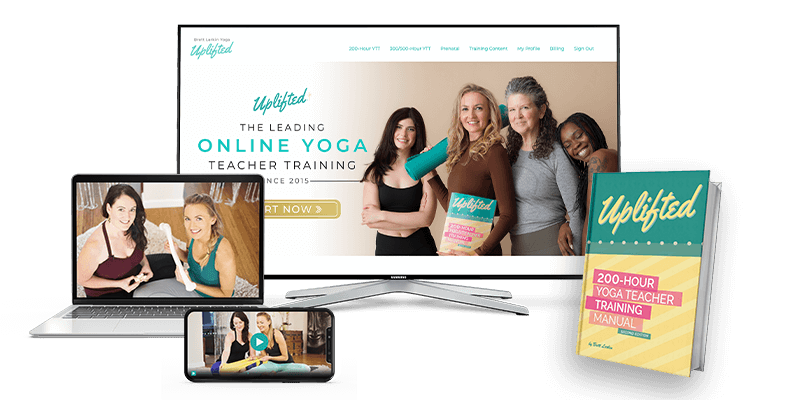
And if you’re looking for a training where mentorship, real teaching feedback and rigorous assessment are built into the experience, explore my 200-Hour Online Yoga Teacher Training. You can also join an info session to see whether Uplifted is the right fit for you.
Experience 3 Training Videos from Inside My 200-Hour Online YTT 👇
Yoga Alliance 2027 Changes: Frequently Asked Questions
What is changing with Yoga Alliance in 2027?
Yoga Alliance is moving from a registry to a tested credential. It’s adding a 40-question assessment and a CPR requirement, dropping the 200/300/500 numbers from titles, and splitting the credential from a new, separate paid membership. Schools get their own assessment and business verification.
When do the Yoga Alliance changes take effect?
The new credential model and learning platform launch in January 2027. Current teachers and schools must complete the transition by December 31, 2027.
Does Yoga Alliance certify yoga teachers?
No. Your yoga school certifies you. Historically, Yoga Alliance has registered graduates of Registered Yoga Schools, allowing them to use the RYT trademark and appear in its directory. Starting in 2027, Yoga Alliance adds its own assessment as part of the new credential.
What’s the difference between a Yoga Alliance registry, credential and membership?
The registry was essentially a paid listing that allowed you to use Yoga Alliance’s trademarks and appear in its directory. The new credential means Yoga Alliance itself verifies additional requirements, including its assessment and CPR. The membership is a separate, optional paid bundle of courses, business resources, community and discounts.
Is my RYT 200 still valid after 2027?
Yes. Your training still counts. But you must complete the transition to Yoga Alliance’s new credential system, including the assessment, by December 31, 2027, or your Yoga Alliance credential lapses.
Do current RYTs have to take the Yoga Alliance test?
Yes. Everyone transitioning to the new credential takes the 40-question assessment, regardless of when they originally registered.
What is on the Yoga Alliance assessment?
The assessment contains 40 questions covering effective teaching and leadership, ethics, safety, and diversity, equity, inclusion and belonging. E-RYTs also answer questions related to teacher trainer development.
What is the passing score for the Yoga Alliance test?
You need 75% to pass and receive two attempts. Yoga Alliance also offers an optional prep course.
Is yoga philosophy on the Yoga Alliance exam?
No. Yoga Alliance leaves philosophy and lineage to individual schools to teach and assess.
Does Yoga Alliance require CPR certification in 2027?
Yes. Under the new credential model, teachers will need to upload a current CPR certification. Schools should also make sure their lead trainers are CPR certified.
Is RYT 200 going away? Is RYT 500 going away?
The training levels are not going away, but the numbers are disappearing from the titles. Teachers will be RYT, which still requires 200 hours of training, or E-RYT, which requires 500 hours of training.
Are 300-hour yoga teacher trainings going away?
No. A 300-hour program becomes a specialty designation under a school’s RYS credential and still counts toward the 500 hours required for E-RYT.
Will there still be Yoga Alliance badges?
Yes. RYT, E-RYT and RYS badges continue, but without numbers. Prenatal and kids specialties will show as designations on your profile. Yoga Alliance has not yet confirmed whether those specialties receive their own separate badges.
What happens if I miss the December 31, 2027 deadline?
For teachers, the credential lapses and reinstating costs $150, covering three years. For schools, the RYS lapses and reinstating costs $1,000, covering three years.
How much will Yoga Alliance cost in 2027?
Current teachers keep the credential plus membership at $65 a year through their 2029 renewal. After the transition period, credential-only pricing is $150 every three years. Current schools keep their current rate during the transition period. Pricing for brand-new applicants in 2027 has not yet been fully published.
Do I have to buy a Yoga Alliance membership to keep my RYT?
Not after the transition period. The membership and credential become separate products, so you’ll be able to hold the credential without buying the membership.
Do I need Yoga Alliance to get yoga teacher insurance?
No. Most yoga insurance providers do not require Yoga Alliance registration. The exception is Alliant YogaPro, Yoga Alliance’s own insurance partner.
Do I need Yoga Alliance to teach yoga?
No. Yoga is unregulated in the United States, and Yoga Alliance registration is voluntary. Many studios and gyms may prefer it, but it is not a legal requirement to teach.
Can online yoga teacher trainings still be Yoga Alliance registered in 2027?
Yes. Online and hybrid trainings remain allowed, with at least 15% of program hours delivered live/synchronously.
Are Yoga Alliance continuing education requirements changing?
Not until the 2030 cycle. At that point, RYTs need 30 continuing education hours and E-RYTs need 40 hours every three years.
Should I register with Yoga Alliance before 2027?
If you’re already eligible and planned to register anyway, doing so now locks in today’s $65 annual rate for the bundled credential and membership through 2029. It does not allow you to skip the new assessment.
Is Yoga Alliance accredited?
Not yet. Yoga Alliance is modeling its new credential around Institute for Credentialing Excellence (ICE) standards and says it plans to apply after collecting data from the new assessment.
How much money does Yoga Alliance make?
According to its public Form 990 tax filings, Yoga Alliance brought in about $10.3 million in revenue in 2024, almost entirely from teacher and school dues and fees.
We’ll Keep This Post Updated
There are still pieces Yoga Alliance hasn’t fully clarified — including exactly when transition applications open, final 2027 pricing for brand-new applicants, E-RYT teaching-hour requirements and what the specialty badges will look like.
I’ll keep updating this post as Yoga Alliance releases more information, because I know there are going to be more questions as everyone actually starts moving through this new system.
But for now, the big picture is pretty simple:
- Yoga Alliance is finally moving from being primarily a registry to being an actual tested credential.
- There are more hoops. There’s more paperwork. There’s a new membership product. And there is finally — finally — a shared assessment.
- I think we can hold both things at once: ask hard questions about the organization, the money and why some of this took so long, while also recognizing that raising the baseline for what the RYT credential means is a positive step.
- If this was helpful, please share it with a yoga teacher, studio owner or school owner who is trying to make sense of these changes.
- And if you’d rather hear me talk through all of this — including my many side comments — listen to the full episode of the Uplifted Yoga Podcast.
RELATED POSTS
- What Is Yoga Alliance? Do You Need RYT Certification?
- Can I Teach Without a Yoga Alliance Certification?
- How Long Does Yoga Alliance Certification Last?
- What Is YACEP?
- What Is the Difference Between RYS 200 and RYS 500?
- How to Upgrade Your Yoga Alliance Designation
- Best Yoga Teacher Insurance
SOURCES
- Yoga Alliance, Membership and Credentials Reimagined
- Yoga Alliance, Find Your New Credential (FAQ)
- Yoga Alliance, Privacy Policy
- Yoga Alliance, Standards and Requirements Compliance Policy
- ProPublica Nonprofit Explorer, Yoga Alliance Form 990s
- J. Brown, What Now Yoga Alliance? (2014)
- J. Brown, The Yoga Police Are Coming (2018)

About the Author | Brett Larkin
Brett Larkin is the founder of Uplifted Yoga, one of the first and most successful online yoga schools. She has over a half a million subscribers on Youtube and is also the author of Yoga Life and host of the Uplifted Yoga Podcast. Brett brought yoga teacher training online in 2015 and has since certified over 4,000 teachers through premium, high-touch programs. Brett helps wellness entrepreneurs grow integrity-driven businesses rooted in yogic wisdom.
Sneak Peak into My 300-Hour YTT - FREE Videos, Info Session, Bonuses!