
The short answer: Yes, you need yoga teacher insurance — and it’s more affordable than you think. Most policies run between $100–$200/year and cover both general liability (someone trips in your class) and professional liability (a student claims your cues caused an injury). Below, I break down the 5 best yoga insurance companies, what each policy covers, and how to choose the right one for your teaching style.
Here’s the truth: nobody gets into yoga teaching because they’re excited about insurance policies. 😄
You got into this to share something that changed your life — to hold space, to guide, to witness transformation. The last thing you want to think about is liability coverage and per-occurrence limits.
I get it. And I’m going to make this as painless as possible.
But here’s what I tell every graduate of my 200-hour yoga teacher training: insurance isn’t just a business formality — it’s an act of self-care. It’s the thing that lets you teach with confidence instead of low-grade anxiety. It protects the sacred space you’re creating for your students. And it costs less than a monthly streaming subscription.
So let’s get you covered — quickly, clearly, and without the insurance-industry jargon. 🙏
What Is Yoga Teacher Insurance? (And Why You Actually Need It)
Yoga teacher insurance protects you financially if something goes wrong during a class, workshop, private session, or retreat. Even if you’re the most careful, attentive teacher in the world — accidents happen. A student could slip on a sweaty mat, reaggravate an old injury, or claim that your adjustment caused harm.
Without insurance, you’d be personally responsible for medical bills, legal fees, and potential settlements. With a policy that costs roughly $15/month, you’re protected.
General Liability vs. Professional Liability — What’s the Difference?
Your yoga insurance policy should include both of these:
General liability insurance (sometimes called “slip and fall” coverage) protects you when a student is injured in a way that’s not related to your instruction — like tripping over a block, slipping on a wet floor, or bumping into equipment.
Professional liability insurance (also called “malpractice” coverage) protects you against claims that your teaching itself caused harm — your alignment cues, hands-on adjustments, sequencing choices, or general guidance.
No matter what style you teach — vinyasa, Kundalini, somatic yoga, restorative, or prenatal — both types of coverage are essential.

Top 5 Yoga Instructor Insurance Companies
I’ve researched and compared the top insurance providers used by yoga professionals. Here’s what each offers, what it costs, and who it’s best for.
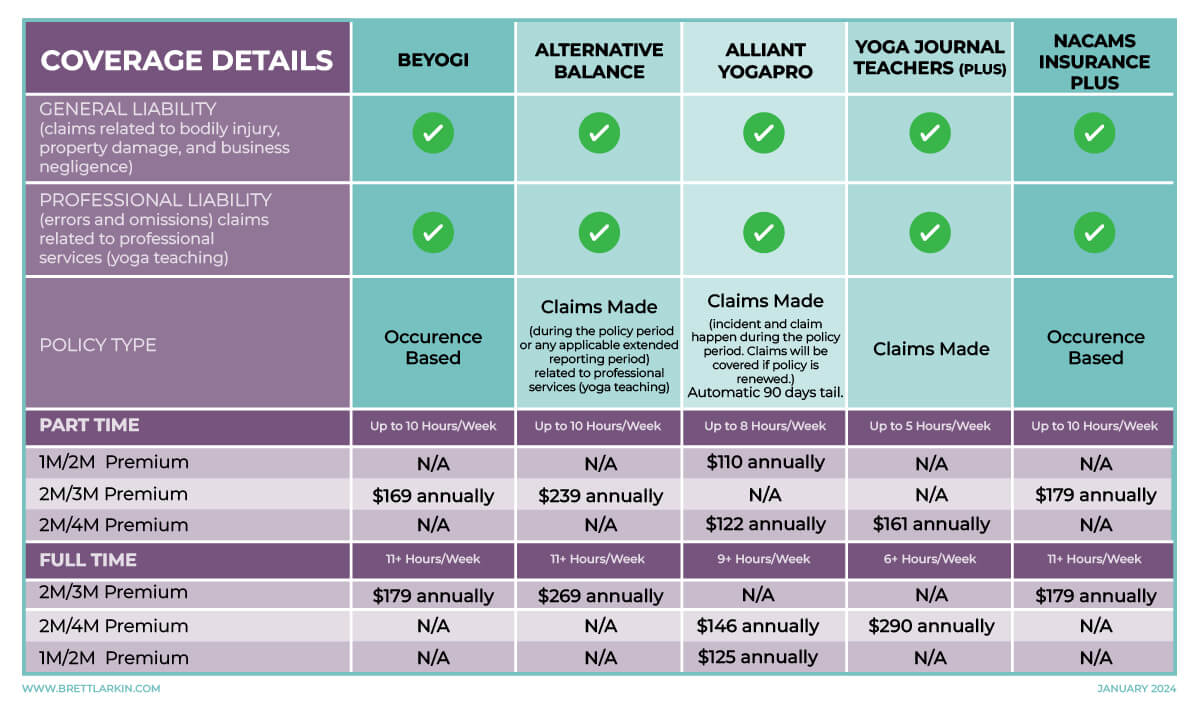
1. BeYogi — Best Overall for Most Yoga Teachers
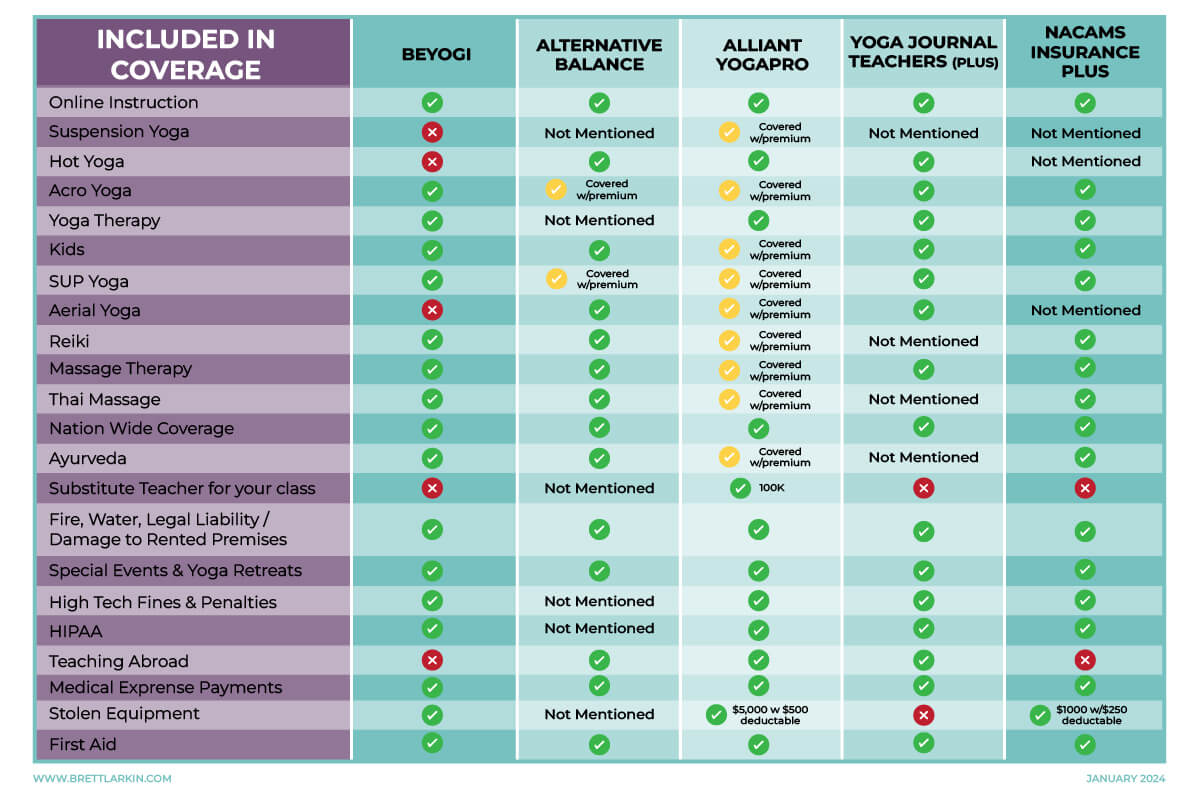
BeYogi offers all-inclusive yoga insurance for full and part-time teachers. Their policies cover you wherever you teach — in a studio, outdoors, at a retreat, or online (including live streaming and pre-recorded videos). They cover over 350 modalities including massage, reiki, acro yoga, and SUP yoga.
Coverage highlights:
- Professional/General Liability: $2M per occurrence / $3M annual aggregate
- Product Coverage: $2M annual aggregate
- Damage to Rental Premises: $100,000
- Identity Protection: $25,000
- Stolen Equipment: $1,000 (with $250 deductible)
Pricing:
- Part-Time (1 year): $169
- Professional (1 year): $179
- Full-Time (2 years): $334
✨ Why I like BeYogi: Comprehensive coverage at a competitive price, plus they cover online teaching — which is non-negotiable in 2026. Learn more about member benefits or sign up to get insurance through BeYogi.

Disclaimer: I am an affiliate with BeYogi and so the link used to their insurance plan earns me a commission, should you choose to sign up for their services. While I believe in the company and insurance policy, I have not written this review with any bias. I have provided all relevant information on each company so that you can make an educated choice for yourself.
2. AlternativeBalance — Best Coverage Limits
AlternativeBalance offers four membership levels for students, independent contractors, and employers. They cover over 500 services and include business tools, waiver templates, and partner discounts alongside your insurance.
Coverage highlights:
- General & Professional Liability: $2M per occurrence / $3M aggregate
- Damage to Premises: $300,000 (highest on this list)
- Third-Party Medical Expenses: $5,000
- Personal & Advertising Injury: Included
- Defense Costs: Included
Pricing:
- Student: $189/year
- Per Diem (under 10 hrs/week): $239/year
- Professional (10+ hrs/week): $269/year
- Employer: $319/year + $99 per employee
✨ Why I like AlternativeBalance: The $300K premises coverage is the best on this list, and the business tools are a nice bonus if you’re building your yoga business.
Interested in learning more? You can find all policy details and sign up with AlterntiveBalance here.
Fall in love with my 300-Hour teacher training or …

3. Alliant YogaPro — Best for Yoga Alliance Members
Alliant YogaPro is a partnership between Yoga Alliance and Alliant Insurance. It’s tailored for yoga teachers working in studios, at private homes, or other venues. They also offer separate coverage for yoga studios and yoga schools.
Note: Only Yoga Alliance members in the US and Canada can apply.
Pricing:
- Part-Time (1M/2M): $110/year (most affordable on this list)
- Part-Time (2M/4M): $122/year
- Full-Time (1M/2M): $125/year
- Full-Time (2M/4M): $146/year
✨ Why I like Alliant YogaPro: If you’re already a registered Yoga Alliance member, this is the most affordable option by far.
4. Yoga Journal Teachers(Plus)
TeachersPlus offers both full and part-time coverage, plus membership benefits including online courses, premium content, and discounts. Both plans include instant coverage and cover all yoga styles, retreats, workshops, and private clients.
✨ Why I like Teachers(Plus): The added educational content makes this a good fit if you’re looking for insurance + professional development in one package.
5. NACAMS Insurance Plus
NACAMS covers 350+ disciplines and provides instant coverage at checkout. In addition to professional and general liability, membership includes stolen equipment coverage, identity protection, a free website, and product discounts.
Coverage highlights:
- Professional & General Liability: $2M per occurrence / $3M aggregate
- Product Coverage: $2M
- Stolen Equipment: $1,000 ($250 deductible)
- Free Website & Teacher Resources
- Identity Protection
✨ Why I like NACAMS: The free website and teacher resources are a nice touch for new teachers just getting started.
Yoga Insurance Comparison at a Glance
| Provider | Starting Price | Liability Limit | Online Teaching | Best For |
|---|---|---|---|---|
| BeYogi | $169/year | $2M/$3M | Yes | Most teachers |
| AlternativeBalance | $189/year | $2M/$3M | Yes | Highest premises coverage |
| Alliant YogaPro | $110/year | $1M/$2M | Check policy | Yoga Alliance members |
| Teachers(Plus) | Varies | Varies | Yes | Insurance + education |
| NACAMS | Contact | $2M/$3M | Yes | New teachers |
How to Choose the Right Yoga Insurance for You
When selecting your policy, consider:
- Where you teach — studio, home visits, outdoors, online, or all of the above?
- How often you teach — part-time vs. full-time pricing matters
- What styles you teach — most policies cover all yoga styles, but check if you also teach massage, reiki, or other modalities
- Whether you teach online — essential in 2026. Make sure your policy explicitly covers virtual classes
- Your budget — prices range from $110–$319/year depending on coverage level
And one more thing — consider using a yoga liability waiver for every class, in addition to your insurance. Belt and suspenders. 😊
Yoga Teacher Insurance FAQ
Do I really need yoga teacher insurance?
Yes, if you teach yoga professionally, yoga teacher insurance is strongly recommended because accidents, injuries, property damage, or student claims can happen even in a thoughtful class. Liability insurance helps protect you financially so you are not personally responsible for legal fees, medical costs, or claims related to your teaching.
How much does yoga teacher insurance cost per year?
Most yoga teacher insurance policies cost around $100–$200 per year, though some providers may charge more depending on coverage limits, location, teaching style, and whether you teach in person, online, workshops, retreats, or private sessions. Always compare what is included, not just the annual price.
What does yoga teacher liability insurance cover?
Yoga teacher liability insurance usually covers general liability and professional liability. General liability protects against accidents like a student slipping or property damage, while professional liability protects against claims related to your instruction, cues, adjustments, or teaching advice.
Can I teach yoga without insurance?
Technically, you may be able to teach yoga without insurance in some settings, but it is risky and many studios, gyms, retreat centers, and corporate clients require proof of coverage. Without yoga teacher insurance, you may be personally responsible for legal costs, injury claims, or property damage connected to your class.
Does my studio’s insurance cover me as an independent teacher?
A studio’s insurance may cover the studio itself, but it does not always fully cover you as an independent contractor or freelance yoga teacher. If you teach at multiple locations, online, privately, or at events, it is safest to carry your own yoga teacher liability insurance and confirm coverage details with the studio.
What’s the difference between general liability and professional liability for yoga teachers?
General liability covers accidents around your class, such as a student tripping over a mat or damaging property. Professional liability covers claims related to how you teach, such as a student saying your cue, adjustment, sequence, or instruction caused an injury.
Do I need insurance to teach yoga online?
Yes, online yoga teachers should still consider yoga teacher insurance because students can still claim injury from following your instruction, even through a livestream, recorded class, membership, or course. Look for a policy that specifically includes virtual yoga classes, online teaching, on-demand video, and the countries or states where your students live.
Ready to take the next step in your yoga teaching career? Explore our 200-hour yoga teacher training or 300-hour advanced training — both Yoga Alliance approved with business training included.
Next Steps:
- Explore my Yoga Teacher Resource knowledge hub for more tips about how to grow your yoga business.
- Download my sequences for a jumpstart on your upcoming yoga classes!
- For more detailed tips, processes, and worksheets to supercharge your yoga business, download my yoga business launchpad course!

YOU MIGHT ALSO LIKE
- How to Become a Yoga Teacher Trainer: The Complete Guide
- What Is YACEP? (Yoga Alliance Continuing Education Provider)
- How to Handle a Student Injury in Yoga Class
- How to Teach Yoga in Schools
- How to Teach Yoga to Athletes
- How to Teach Restorative Yoga Classes
- How to Teach Prenatal Yoga (What You Need to Know)
- How to Teach Chair Yoga (Guide for New Teachers)
- How to Get Hired at a Yoga Studio (What Studios Look For)
- How to Find Your Yoga Teaching Niche: A 3-Question Framework for Building a Signature Program (and Why Generic Vinyasa Doesn’t Sell Anymore)
- The Real Economics of Yoga Teacher Training in 2026: What It Costs, What You’ll Earn, and When the Math Actually Works
- Yoga Teacher Training as a Mid-Life Wellness Sabbatical: Why More Women Are Using YTT to Reset Their Nervous System (Not Change Careers)
- How to Teach Trauma-Informed Yoga
- How to Get Your First Yoga Teaching Job
- How Do I Log Continuing Education Hours with Yoga Alliance?

About the Author | Brett Larkin
Brett Larkin was the first person to bring yoga teacher training online in 2015. Since then, she’s certified over 4,000 teachers and leads one of the most comprehensive yoga education platforms on the internet. Brett and her team regularly take and review other online YTTs to stay up to date on industry best practices—so their own trainings remain the gold standard. She has over a half a million subscribers on Youtube and is also the author of Yoga Life and host of the Uplifted Yoga Podcast.
🎧 Want more like this in audio? Subscribe to the Uplifted Yoga Podcast on Apple Podcasts or Spotify.
Sneak Peak into My 300-Hour YTT - FREE Videos, Info Session, Bonuses!