
You’ve probably searched this question a dozen times. You’ve read the testimonials, watched the YouTube reviews, opened and closed three brochures. And still — the same question keeps looping in your head: is it actually worth it?
Let me be the first person to tell you the honest answer.
It depends on who you are when you walk in.
I’ve been certifying yoga teachers online since 2014 — longer than any other online school I know of. In that time I’ve watched thousands of women complete a 200-hour training. And I can tell you with certainty: the people who get the most out of YTT are not necessarily the ones who walk out and teach professionally.

Who YTT is actually for in 2026
The old story about yoga teacher training was that you sign up because you want to teach. Quit your job, lead studio classes, build a following.
That story is still true for some people. But it’s not the only story anymore. And honestly, it hasn’t been for years.
Here’s what I see in every Uplifted cohort:
- About 40% sign up planning to teach professionally. They want a career change, or they’re already teaching and need a credential. Some go on to teach in studios. More go on to teach online — corporate wellness, private clients, niche programs.
- About 30% sign up to eventually teach, “someday.” They want the credential as a future option. They take YTT now because they have time, energy, or a life transition. The pressure to monetize is off.
- About 30% sign up with no intention of ever teaching at all. They want 200 hours of deep, structured immersion in yoga. They’re not buying a certification — they’re buying a transformation.
If you’re in that last group, you’re not weird. You’re the fastest-growing segment of YTT students, and you have permission to take the training entirely for yourself.
As I tell every prospective student: whether you ultimately use this training to teach, or to extend your own personal practice, I want to take you on this journey.
What you actually get from 200 hours of YTT (whether you teach or not)
Most blogs about YTT skip past this part because it doesn’t sell well. I’ll be specific because being specific is useful.
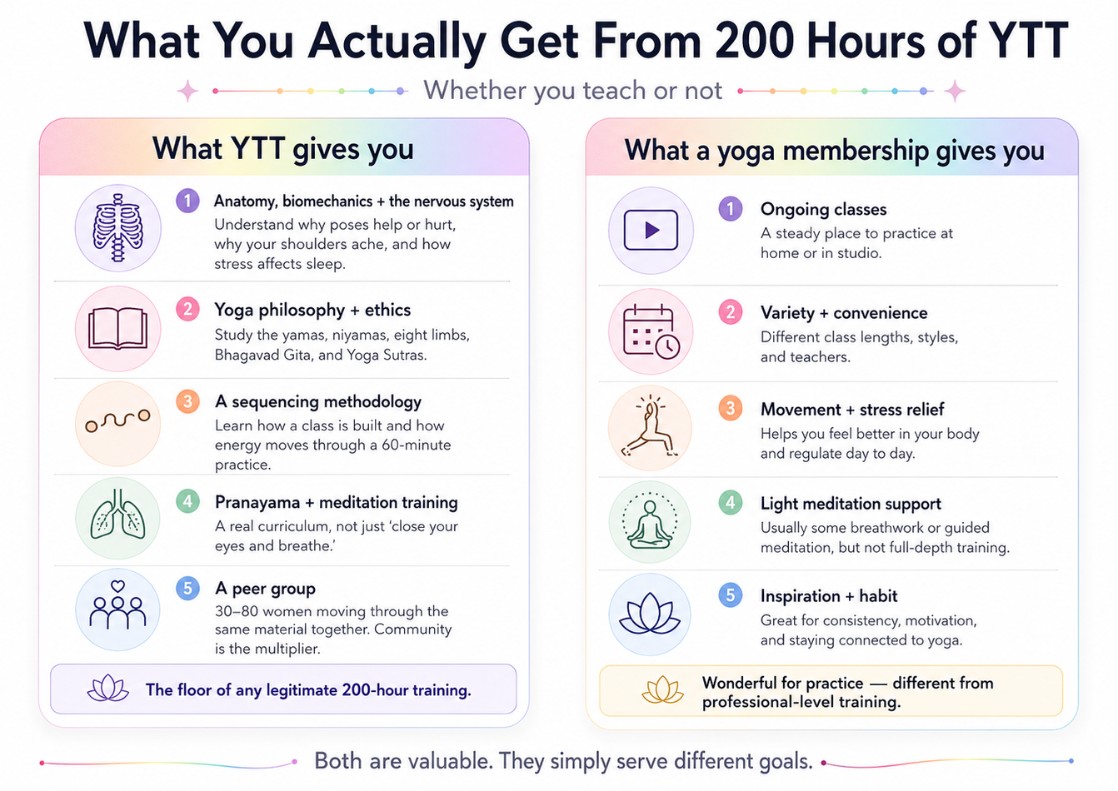
A real 200-hour yoga teacher training gives you:
- 90+ hours of anatomy, biomechanics, and the nervous system — enough to understand why some poses hurt your body and others don’t, why your shoulders ache when you sit at a desk, and why your sleep is wrecked when your sympathetic nervous system runs the show. This is genuinely useful knowledge regardless of what you do next.
- 30+ hours of yoga philosophy and lifestyle ethics — the yamas and niyamas, the eight limbs, the Bhagavad Gita, the Yoga Sutras. Most students arrive having practiced yoga for years without studying any of it. Two months in, they’re using it daily.
- A full sequencing methodology — how a class is actually built. What goes where. How energy moves through a 60-minute container. You’ll never take a yoga class the same way again.
- Structured pranayama and meditation training — not “close your eyes and breathe,” but a real curriculum.
- A peer group — 30 to 80 women in your cohort, going through the exact same material at the exact same pace. This part you cannot get from a self-study course or YouTube. Community is the multiplier.
That’s the floor. That’s what every legitimate YTT should deliver. If the program you’re considering doesn’t, that’s a red flag — not a reason to write off yoga teacher training altogether.
What teaching yoga actually earns (the part nobody writes honestly about)
If you do want to teach, here’s the real picture. I’ll be specific because I get this question constantly.
There are roughly four income paths that work in 2026:
- Studio teaching. $30–$75 per class in most U.S. markets. Build to 8–12 classes a week and you’re looking at $1,500–$3,000/month before expenses. Not a living unless you stack other things on top.
- Online teaching, scaled. Teaching on Zoom, building a small group practice, running a niche membership. My alumni who do this well — like my student Arielle — are earning $10k/month or more. It takes time and a business education most YTTs don’t include, but the ceiling is high.
- Yoga as a supplement. Some of my graduates teach one or two classes a week alongside a separate career. They’re earning $500–$800/month from yoga, and the deeper benefit is the identity shift, not the money.
- Corporate / private / specialized. Trauma-informed yoga, prenatal, yoga for executives, yoga for chronic pain. Higher hourly rates ($75–$200), smaller volume, requires specialization. This is where the “find your niche” conversation matters.
If you sign up expecting path #2 without doing the business work, you’ll be disappointed. If you sign up for path #1 thinking it’ll cover your rent, you’ll be disappointed. Almost everyone who builds a thriving yoga income does it through some combination of #2 and #4 — and they treat it like the business it is.
This is exactly why every Uplifted training has entire modules built around business mindset, marketing, and how to price your work. Money is a massive component of being a successful yoga teacher. When you sign up to teach yoga, you’re also signing up to be an entrepreneur.
How to Make a Living as a Yoga Teacher (Without Burning Out)
What it costs and how to think about ROI
Yoga teacher training is a real financial investment. It also takes time, focus, passion, and energy that aren’t on the receipt.
Most legitimate 200-hour online YTTs in 2026 cost between $2,500 and $4,500. (Uplifted’s 200-hour is $2,850.) In-person and destination trainings range from $3,000 to $8,000+ once you factor in travel and accommodations.
There are cheaper options — sub-$1,000 self-study programs you can find on the internet — and you’ll know within an hour of starting why they cost what they cost. Read the fine print, ask how long the school has actually been online (not just since the pandemic), and check whether there’s a live cohort. (For more on that, see how to choose a 300-hour yoga teacher training.)
Here’s how I want you to think about the math:
- If you’ll teach: YTT is a business expense. Most career-track teachers I know recoup tuition within 6–18 months once they start. The 300-hour and business education investments after that determine the ceiling.
- If you’re taking YTT for yourself: the right comparison isn’t “yoga classes I could’ve bought instead.” It’s “what I would have spent on therapy, retreats, coaching, or wellness immersions over the next year.” Then 200 hours of structured study is a stunning value.
- If you’re somewhere in between: the credential is a real option. Many of my students take it, then sit on it for a year or two before stepping into teaching when life makes room.
When YTT is not worth it
I’d rather say this out loud than have you sign up and regret it.
YTT is not worth it if:
- You haven’t been practicing yoga for at least 1–2 years. You’ll be drinking from a fire hose and resenting the program for it.
- You’re hoping it’ll fix your life. It won’t. It will, however, give you the tools to do that work — if you bring the work yourself.
- You can’t commit to live calls or a cohort schedule. A 100% self-paced YTT sounds appealing and almost no one finishes. The completion rate on those is brutal.
- You’re going to use it as a credential to teach for a brand or studio that already pays poorly, and not build the business skills to do it independently. You’ll burn out fast.
If any of those sound like you, save your money for now. Take a few weeks of dedicated personal practice, audit a workshop, or invest in a smaller course first.

So — is it worth it?
For the right person, at the right time, with the right program: yes. Without hesitation.
For the wrong person, at the wrong time, with the wrong program: it’s a frustrating, expensive 8 months.
The honest filter is this: what changes for you if you go in only for yourself, and never teach a class? If the answer is “I’d still learn anatomy I’d use for decades, philosophy I’d return to, a community I’d value, and a deeper practice than I’ve ever had” — then it’s worth it. The teaching is a bonus.
If the only thing that makes it worth it is the income, slow down. Read how to make a living as a yoga teacher first, and decide if you actually want to build a small business.
Frequently Asked Questions About Yoga Teacher Training
How long does yoga teacher training take?
A 200-hour YTT typically runs 4 to 8 months when done well. Accelerated 3-week intensives exist, but most students get more out of the slower-paced cohorts because the nervous system and the philosophy both need time to integrate. Self-paced programs with no end date sound flexible but have notoriously low completion rates.
Do I have to teach yoga after I get certified?
No. About 30% of my graduates have no intention of teaching professionally and sign up purely for personal growth. The certification is yours to use if and when you want — many students sit on it for a year or two before stepping into teaching. (See our companion post on YTT as a wellness sabbatical for more on this path.)
Is online yoga teacher training as good as in-person?
If the online program has a live cohort, the same teachers and peer group from start to finish, a paper manual, and real interaction (not just pre-recorded videos), then yes — and it’s usually a better fit for working adults. The key is making sure it was built to be taught online, not just a studio program that hastily moved to Zoom during the pandemic.
Do I need to be advanced at yoga to start teacher training?
No — but you should have a consistent personal practice of at least 1 to 2 years. You don’t need to be able to do a handstand or sit in lotus. You do need to know your way around a sun salutation and have enough familiarity with your body to absorb 200 hours of new information.
What’s the difference between a 200-hour and a 300-hour YTT?
The 200-hour is your foundational certification — anatomy, philosophy, sequencing, pranayama, meditation, and how to lead a basic class. The 300-hour is the advanced specialization on top — deeper anatomy, advanced practices, often business mentorship, and the path to RYT-500 status with Yoga Alliance. Most teachers complete a 200-hour first and add the 300-hour 1 to 3 years later.
How much money can yoga teachers actually make?
There’s a wide range. Studio teaching pays $30–$75 per class in most U.S. markets. Online teaching at scale can reach $10,000+/month for the small percentage of teachers who build a real business around it. Most certified teachers fall in between, earning supplemental income of $500–$2,000/month from yoga while doing other work. (Detailed breakdown in the real economics of yoga teacher training.)

Ready to look at the actual curriculum?
Download the Uplifted 200-hour brochure — it’s the most detailed program guide on the internet, and it’ll tell you exactly what 200 hours of training with us looks like, week by week.
Download the Uplifted 200-Hour Brochure → https://www.brettlarkin.com/online-yoga-teacher-training/
You deserve a clear answer before you commit. And whichever way you go, I’m rooting for you. 🙏


About the Author | Brett Larkin
Brett Larkin is the founder of Uplifted Yoga, one of the first and most successful online yoga schools. She brought yoga teacher training online in 2015 and has since certified over 4,000 teachers through premium, high-touch programs. Brett helps wellness entrepreneurs grow integrity-driven businesses rooted in yogic wisdom.
Sneak Peak into My 300-Hour YTT - FREE Videos, Info Session, Bonuses!