
The honest answer: Yes, you can make a living as a yoga teacher. But probably not the way you think. The traditional model — scrambling between studios, teaching 20+ classes a week at $30-50 per class — leads to burnout, not financial stability. The teachers who actually thrive financially have figured out something different.
I know this firsthand. I went from being terrified that yoga teachers were poor to earning 15 times my corporate salary through yoga. But the path wasn’t “teach more classes.” It was “build a smarter business.”
Here’s what that actually looks like — practically, honestly, and without the toxic positivity.
The Income Reality (Let’s Be Honest First)
Before we talk strategy, let’s ground in reality. According to industry data and our own research:
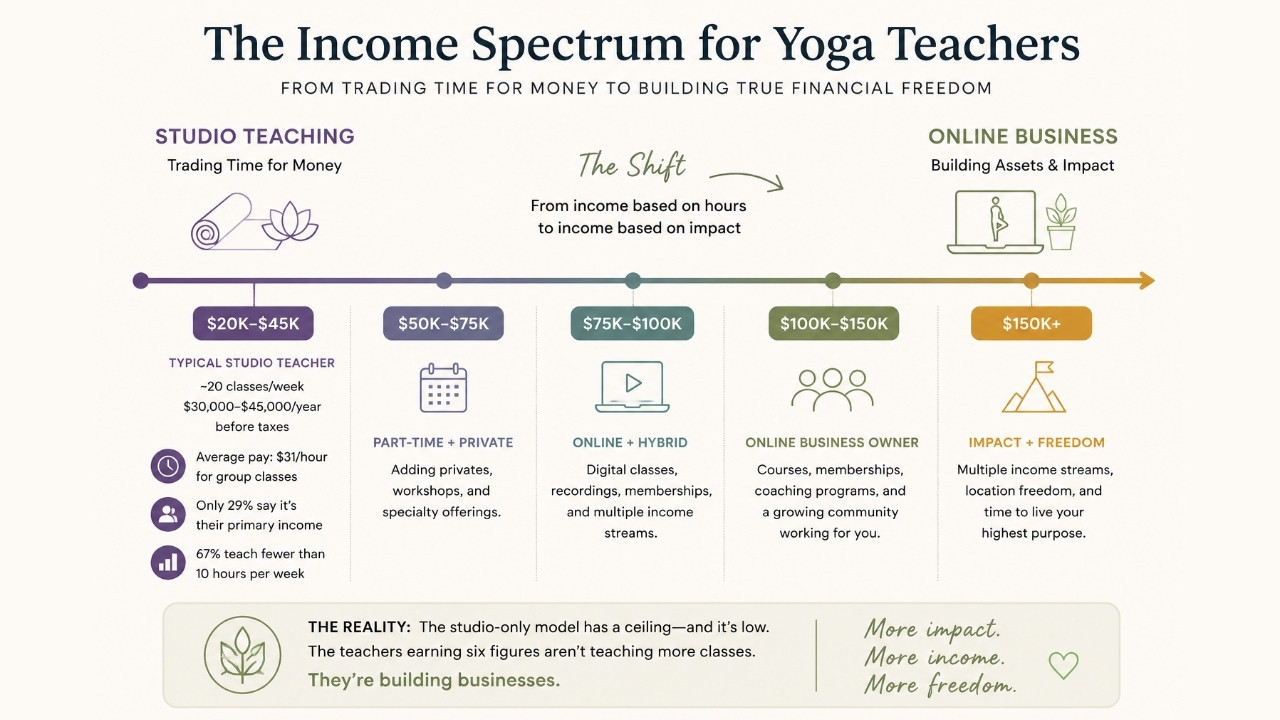
- Average yoga teacher pay: $31/hour for group classes
- Only 29% of yoga teachers say it’s their primary income
- 67% teach fewer than 10 hours per week
- Full-time studio teaching (20 classes/week): roughly $30,000-$45,000/year before taxes
These numbers aren’t meant to discourage you. They’re meant to show you that the studio-only model has a ceiling — and that ceiling is low. The teachers earning six figures aren’t teaching more classes. They’re building businesses.
The Two Paths: Trading Time vs. Building Leverage
Path 1: Trading Time for Money
This is the default: teach classes, get paid per class. More classes = more money, until you hit a physical and emotional wall. Your income is capped by the number of hours in a day and the number of students in a room.
This path works for part-time teaching alongside another income source. It does NOT work as a sustainable full-time career for most people.
Path 2: Building Leveraged Income
This is where things change. Leveraged income means your earning isn’t tied directly to the hours you’re physically teaching. Examples:
- Online classes — reach 50 students instead of 15, from anywhere
- Recorded content — create once, earn repeatedly
- Membership programs — recurring monthly revenue
- Workshops and retreats — premium pricing, concentrated effort
- Digital products — guides, courses, challenges
- Corporate yoga — $75-200 per session
For a comprehensive list, read 20 awesome ways to make money as a yoga instructor.
The 5 Building Blocks of a Sustainable Yoga Income
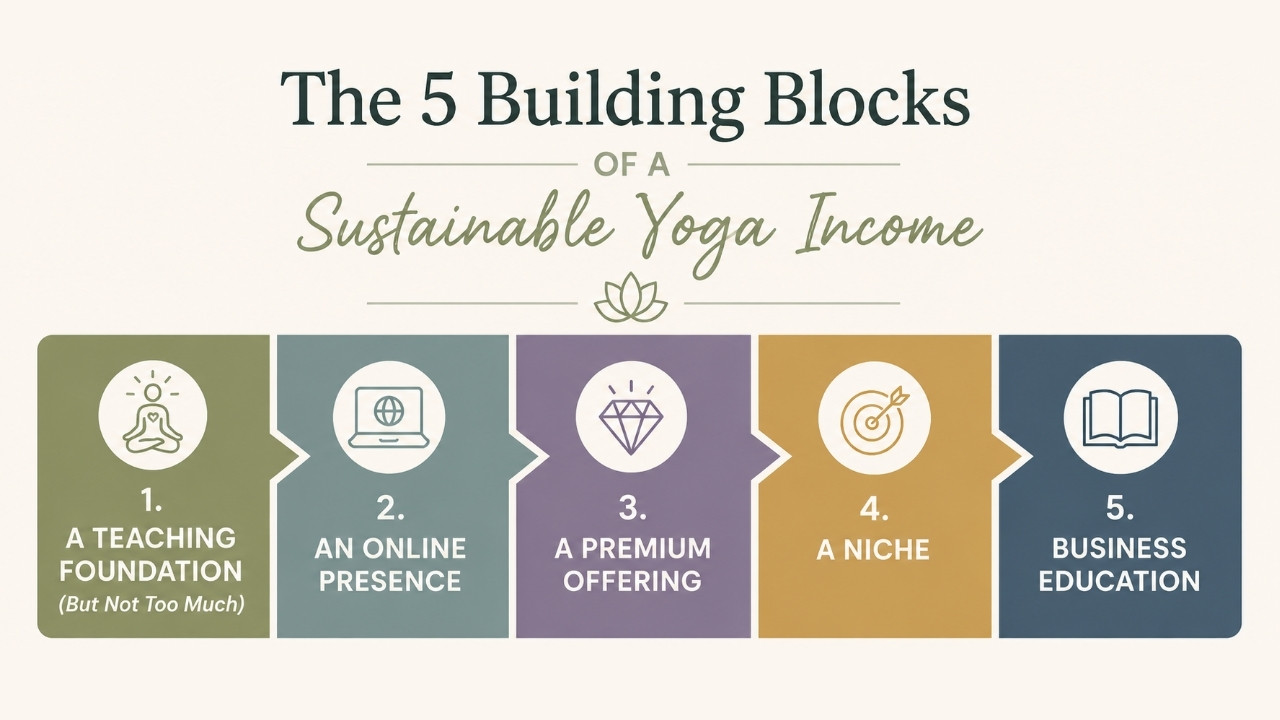
1. A Teaching Foundation (But Not Too Much)
You need to teach regularly — it’s how you grow as a teacher, build a following, and stay connected to your students. But cap it. 8-12 classes per week is the sweet spot. More than that and you’ll burn out, lose your creativity, and have no time to build the other income streams.
If you’re teaching 20+ classes a week and barely making rent, the answer isn’t “teach more.” It’s “teach smarter.”
2. An Online Presence
You don’t need to be an influencer. You need to be findable. A simple website, an Instagram account where you share your teaching, and an email list — that’s the foundation. Social media is how people discover you. Your email list is how you keep them.
Start teaching on Zoom even if it’s just 5 students. Online teaching removes every geographic limitation and opens up income possibilities that don’t exist locally.
3. A Premium Offering
Group classes pay $30-50. Private sessions pay $75-150. Workshops pay $200-500 for a few hours of work. Retreats pay $2,000-10,000+ per event.
You need at least one offering that pays significantly more per hour than group classes. For most teachers, this starts with private sessions and workshops, then eventually retreats or online courses.
4. A Niche
Generalist yoga teachers compete on price. Specialists compete on value. When you’re “the prenatal yoga teacher” or “the somatic yoga teacher for anxiety” or “the yoga teacher for runners,” you can charge more, attract more dedicated students, and stand out in a crowded market.
Your niche doesn’t have to be forever. But having one — even temporarily — accelerates everything. Read more on finding your yoga niche.
5. Business Education
This is the piece most yoga teachers skip — and it’s the one that determines whether teaching is a hobby or a career. Understanding pricing, marketing, cash flow, taxes, and business structure isn’t “selling out.” It’s how you sustain the work you love.
This is exactly why I built business coaching into my 300/500-hour program. It’s 50% yoga, 50% business — because you need both to thrive.

The Mindset Shift That Changes Everything
Here’s the truth I wish someone had told me earlier: earning money as a yoga teacher isn’t the opposite of service. It’s what makes service sustainable.
The first yama is ahimsa — do no harm. And that includes harm to yourself. Teaching 25 classes a week for $30 each while you can’t afford health insurance isn’t noble. It’s self-sacrifice dressed up as devotion.
You can earn well AND serve deeply. You can charge premium prices AND be inclusive. You can build a business AND stay grounded in your practice. These aren’t contradictions — they’re what a sustainable yoga career actually looks like.
I spent years stuck in the belief that “yoga teachers are poor.” A life coach challenged me to look at Deepak Chopra, Kino MacGregor, and other teachers who were thriving financially. He asked me: “Why are you using the struggling teachers as your model instead of the successful ones?”
Game-changer. What we focus on dictates our reality.
A Realistic Timeline
- Months 1-6: Teach part-time (free → paid). Build your online presence. Get your first 50 email subscribers
- Months 6-12: Establish consistent teaching schedule (8-12 classes/week). Launch private sessions. Start teaching online
- Year 1-2: Add a premium offering (workshop, retreat, or online course). Develop your niche. Reach 500+ email subscribers
- Year 2-3: Consider advanced training with business coaching. Scale online income. Multiple revenue streams flowing
This isn’t a sprint. It’s a practice — just like yoga. Some months will be slow. Some will surprise you. The teachers who make it are the ones who keep showing up.
What Successful Yoga Teachers Have in Common
After training 4,000+ teachers, I’ve noticed patterns in the ones who build sustainable careers:
- They treat teaching as a business, not just a passion project
- They teach online, not just in studios
- They build an email list, not just an Instagram following
- They invest in business education alongside yoga education
- They set boundaries around how many classes they teach per week
- They charge what they’re worth without apologizing
- They keep practicing — their personal practice fuels their teaching
68% of our 300-hour graduates report an increase in yoga-related revenue before they even complete the program. 100% feel clear on their next steps.

Your Next Step
If you’re reading this, you’re already thinking bigger than “teach more classes.” That’s the first and most important shift.
Whether you’re fresh out of your YTT, teaching while working a day job, or ready to go all-in — the path to a sustainable yoga career starts with one decision: stop thinking of yourself as “just a yoga teacher” and start thinking of yourself as a yoga entrepreneur.
You can do both. You can serve deeply AND earn well. You deserve both.
Ready for the business education most YTTs skip? Our 300/500-Hour Yoga Teacher Training is 50% advanced yoga, 50% business coaching — designed specifically for teachers who want to thrive. 🙏

How to Make a Living as a Yoga Teacher — FAQ:
Q: Can you actually make a living teaching yoga?
A: Yes, but probably not through studio classes alone. Full-time studio teaching earns roughly $30,000-$45,000/year. Teachers who diversify — combining private sessions, online teaching, workshops, and digital products — can earn six figures.
Q: How much do yoga teachers make per year?
A: The average is about $31/hour for group classes. Full-time studio teachers earn $30,000-$45,000. Part-time teachers (67% of all yoga teachers) earn $10,000-$15,000. Online and diversified teachers can earn $75,000-$150,000+.
Q: What’s the fastest way to increase yoga teaching income?
A: Add private sessions ($75-$150/hour) and start teaching online. These two changes alone can double or triple your income without adding more group classes. Corporate yoga ($75-$200/session) is another high-paying option.
Q: Do I need to teach online to make good money?
A: Not necessarily, but it removes the biggest limitation — geography and room capacity. Online teaching lets you reach hundreds of students per class, create passive income through recorded content, and build a scalable business.
Q: When should I invest in business training?
A: After you’ve been teaching for 6-12 months and feel the gap between your teaching skills and your earning potential. Most YTTs teach yoga but not business. A program that includes business coaching can change your entire financial trajectory.
Q: How many classes per week should I teach to avoid burnout?
A: Cap it at 8-12 classes per week. More than that and you’ll burn out, lose creativity, and have no time to build other income streams. The goal isn’t to teach more classes — it’s to teach smarter and diversify your revenue.

About the Author | Brett Larkin
Brett Larkin is the founder of Uplifted Yoga, one of the first and most successful online yoga schools. She has over a half a million subscribers on Youtube and is also the author of Yoga Life and host of the Uplifted Yoga Podcast. Brett brought yoga teacher training online in 2015 and has since certified over 4,000 teachers through premium, high-touch programs. Brett helps wellness entrepreneurs grow integrity-driven businesses rooted in yogic wisdom.
Sneak Peak into My 300-Hour YTT - FREE Videos, Info Session, Bonuses!