The yoga industry is great at talking about transformation. It’s terrible at talking about money.
I’m going to do the opposite in this post, because pretending tuition and income don’t matter is a disservice to anyone making a real decision. If you’ve been searching for honest numbers about what yoga teacher training costs, what yoga teachers actually earn, and whether the investment pays back — this is for you.
I run an online yoga teacher training school. I have a financial interest in you signing up. I’m still going to give you the numbers straight, because if the math doesn’t work for you, you’ll figure that out within six months anyway, and we’ll both be unhappy.
The market context: yoga is bigger than you think
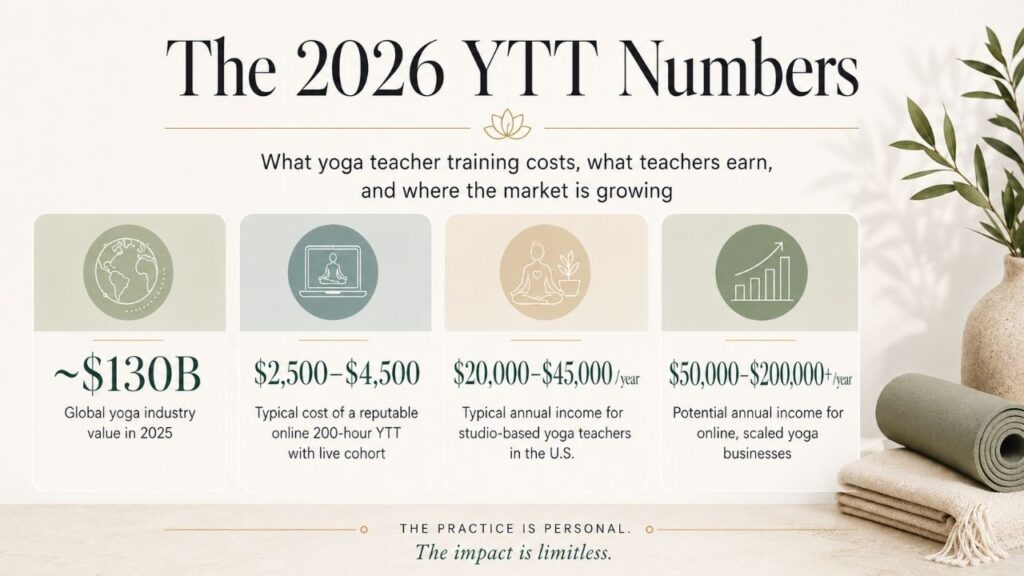
The global yoga industry was worth roughly $130 billion in 2025 and is projected to keep growing through the decade at a high single-digit annual rate. (Fortune Business Insights — Global Yoga Market)
A few things worth noting about that growth:
- The fastest-growing segment is online and hybrid — not in-person studios. Online teaching, niche memberships, and one-to-one programs are pulling growth away from the traditional studio model that most people picture when they think of “yoga teaching.”
- The fastest-growing demographic of practitioners is women 30–55, with the largest segment in their 40s. This is the same demographic doing yoga teacher training.
- The wellness market overall — somatic work, nervous-system regulation, trauma-informed practice — is pulling spend toward specialized offerings, away from generic vinyasa.
What that means in practical terms: there’s more opportunity than ever for yoga teachers, and the kinds of teachers who win in 2026 look almost nothing like the studio-employed teacher from 2014. The income paths have shifted. Most of the discouraging “yoga teachers can’t make money” content on the internet is comparing 2026 reality to a 2010 income model.
✦ ✦ ✦
What yoga teacher training actually costs in 2026
Here are the real numbers, by training type, in the U.S.:
| Training type | Typical 2026 cost range |
|---|---|
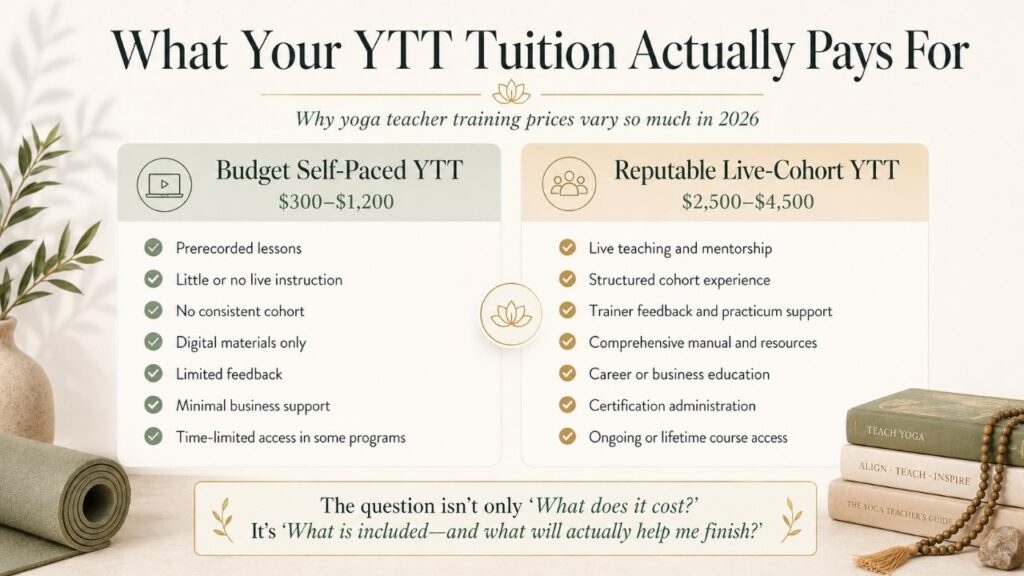
| Cheap online self-paced 200hr (no live cohort) | $300 – $1,200 |
| Reputable online 200hr with live cohort | $2,500 – $4,500 |
| Reputable in-person 200hr (local studio) | $2,800 – $5,000 |
| Destination 200hr (Bali, Costa Rica, India) | $3,500 – $8,000+ (plus travel) |
| Advanced 300hr online | $4,000 – $6,500 |
| Premium 300hr with business mentorship | $6,000 – $12,000+ |
For reference, Uplifted’s pricing in 2026:
- 200-hour online YTT — $2,850. Includes the paper manual, two required reading books (budget ~$75 for those if not included in your bundle), lifetime access to course materials, live calls with a cohort, and the Yoga Alliance certification paperwork.
- 300-hour advanced YTT — $4,897.
- Pregnant and Powerful (CE credit) — separate add-on.
(For more on what to look for at the 300-hour level, including which “cheap” training red flags to avoid, see [how to choose a 300-hour yoga teacher training].)
If you’re sticker-shocked at the $2,500–$4,500 range for an online program, here’s the honest framing: an online YTT done right costs the same as an in-person one to deliver. It has lower student travel and accommodation costs, which is the only place you save real money. The teaching, materials, live instruction, and certification paperwork all cost the school the same to produce.
If the program is genuinely cheap, you’re losing one of: live instruction, real teachers, a paper manual, a structured cohort, business/career support, or lifetime access. Read the fine print.
✦ ✦ ✦
What U.S. yoga teachers actually earn
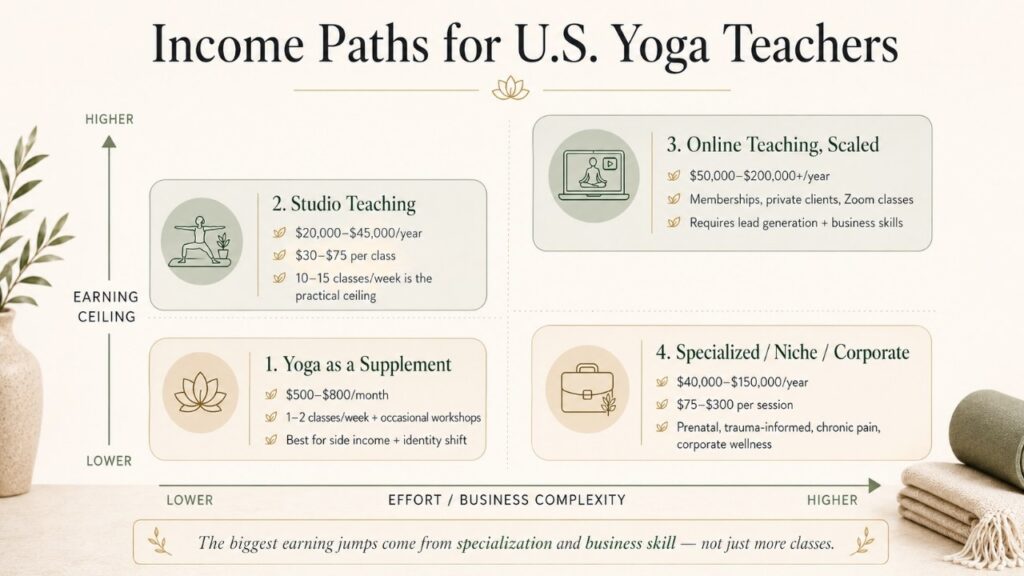
Here’s where most articles wave their hands. I’ll give you four realistic income paths and what they pay.
Path 1: Studio teaching (traditional)
- Pay per class: $30–$75 in most U.S. markets. Higher in NYC/LA ($60–$120). Lower in smaller cities ($25–$45).
- Typical full-time load: 10–15 classes/week is a hard ceiling for most teachers’ voices and energy.
- Realistic annual income: $20,000–$45,000.
- Reality check: Almost nobody runs this path full-time and feels good about it. It works as a stepping stone or as supplemental income, not as a livelihood.
Path 2: Online teaching, scaled
- Pay structure: Recurring revenue from a small membership ($19–$49/month per student), private one-on-one packages ($150–$500/month per client), or a Zoom group class model ($15–$30 drop-in).
- What it takes: 200–500 students or 10–30 high-touch clients. Reliable lead generation. A small email list and a piece of content that draws people in.
- Realistic annual income at scale: $50,000–$200,000+. My alumni who do this well — like Arielle — are earning $10,000+ per month consistently.
- Reality check: This is the path where most of the real money in modern yoga teaching is. It also requires real business skills the average YTT does not teach. (My 200-hour includes business modules; the 300-hour Biz Accelerator goes deep.)
Path 3: Yoga as a supplement to another career
- Pay structure: Teach 1–2 classes a week alongside your day job. Run a small private practice on the side. Lead one workshop a quarter.
- Realistic supplemental income: $500–$800/month, sometimes more.
- Reality check: This is the majority of certified yoga teachers in the U.S. The income is real but not life-changing. The bigger return is the identity shift — you become a teacher, you stop feeling like only your day job — which is genuinely valuable even though it doesn’t show up on a tax return.
Path 4: Specialized / niche / corporate
- Pay per session: $75–$300. Corporate wellness, prenatal, trauma-informed, yoga for chronic pain, yoga for executives.
- Typical load: 5–10 sessions a week is sustainable.
- Realistic annual income: $40,000–$150,000.
- Reality check: Requires post-200hr specialization (300hr, prenatal certification, trauma-informed training). The highest-margin work in yoga, but you have to build the niche credibility first.
✦ ✦ ✦
The ROI math
If you’re investing $2,500–$4,500 in YTT, here are realistic payback timelines by path:
- Studio teaching only: 6–18 months to recoup tuition. After that, you’re earning incremental income but probably not building toward a full-time living.
- Online scaled: 3–12 months to recoup if you put in business work alongside teaching work. Most of my graduates who go this route are net positive by the end of their first year, and significantly net positive by year two or three.
- Supplement: 12–24 months to recoup, depending on how many classes/workshops you teach. The non-monetary return shows up immediately.
- Niche/corporate: Usually 6–12 months to recoup, but the bigger investment is the 300-hour and specialty trainings that follow.
A clean, honest version of the ROI question is this: “What’s the smallest amount of yoga teaching I’d need to do to make this investment worth it on paper, and is that level something I’d actually enjoy doing?”
For most people that comes out to:
- 2 paid classes a week for ~6 months → tuition recouped
- 1 monthly workshop → cushion
- 1 small private client → cushion
If those three things sound miserable, you may want to take YTT for personal development rather than as a career investment.
✦ ✦ ✦
When the math doesn’t work
Be honest with yourself about the conditions where this stops penciling out:
- You’re going to teach yoga at minimum wage in a market where yoga teaching pays minimum wage. It’s a vocation in many places, not a career.
- You’re hoping a $1,000 self-paced YTT will get you the same career outcomes as a $3,000 cohort-based one. Almost no one finishes the cheap ones. You’re paying $1,000 to confirm you didn’t really want to do this.
- You’re investing without learning the business side. I cannot say this enough. Teaching yoga is half the skillset. Running a small business is the other half. Most YTTs ignore the second half, which is why graduates who never get the business education plateau at $1,500/month for years.
- You don’t have any savings runway and you’re betting on yoga income to pay rent in month four. Build a 6-month runway first. Yoga is a slow-build income, especially online.
If your situation matches any of those, don’t do yoga teacher training as a career move yet. Build the financial foundation first, then come back to the decision with more options.
How to Make a Living as a Yoga Teacher (Without Burning Out)
✦ ✦ ✦

Where Uplifted fits in the math
I’ll be transparent because anything else would be weird in a post about money.
Uplifted is on the more expensive end of online 200-hour YTTs ($2,850), and below average for advanced 300-hour with business mentorship ($4,897). The premium relative to the cheap self-paced programs goes to: a live cohort (limited enrollment), the same trainers and peer group from start to finish, a paper manual sent to your home, lifetime access, business modules built into the curriculum, and the longest track record of online YTT (since 2014).
The savings relative to the expensive in-person/destination programs come from no travel, no accommodation, no taking 200 hours off your life all at once, and the ability to study from your living room.
If your career path is teaching online (Path 2 or 4), this is the right structural fit because that’s what we model and teach. If your career path is being a studio teacher in your hometown (Path 1), an in-person local studio YTT may be a stronger fit.
✦ ✦ ✦
Frequently Asked Questions About YTT Cost and Income
How much does yoga teacher training cost in 2026?
A reputable online 200-hour YTT runs $2,500–$4,500. In-person programs at local studios run $2,800–$5,000, and destination retreats are $3,500–$8,000+ plus travel. Sub-$1,000 self-paced programs exist but typically lack a live cohort, paper manual, business modules, or lifetime access.
How much do yoga teachers actually make per year?
The honest answer is “it depends on the path.” Studio-only teaching averages $20,000–$45,000 annually. Online-scaled teaching ranges from $50,000 to $200,000+ for the small percentage who build a real business around it. Supplemental teaching alongside another career typically brings in $500–$800/month.
How long does it take to make back YTT tuition?
For career-track teachers, most recoup $2,850–$4,500 in 6 to 18 months once they actively start teaching. Online-scaled teachers often pay it back in 3 to 12 months. Supplemental teachers typically take 12 to 24 months — but the bigger return is the identity shift, not the income.
Is yoga teacher training tax-deductible?
In the U.S., YTT tuition is generally not deductible as continuing education if it’s training you for a new career. It may be deductible as a business expense once you’re earning yoga income and the training maintains or improves your existing skills. Ask your accountant — this is one of those areas where the right structure matters more than the rule itself.
Do yoga studios pay for their teachers’ training?
Almost never in the U.S., outside of larger fitness chains or wellness companies. If you’re working at a studio, the most you might get is a small discount on training they offer themselves. Don’t count on employer reimbursement.
Are payment plans available for yoga teacher training?
Yes, at most reputable schools. Uplifted offers payment plans for both the 200-hour and 300-hour programs. If cost is the only thing standing in the way, email the school you’re considering directly — payment plans, scholarships, and work-trade are more common than the public pricing suggests.
What’s the difference between cheap online YTTs and the $3,000+ ones?
The cheap programs save money by cutting one or more of: live cohort, real teachers, paper manual, business modules, lifetime access, or the certification paperwork support. Completion rates for the cheapest programs are also brutally low — most students who buy a $300 YTT never finish.
Want the full pricing, what’s included, and the week-by-week breakdown?
Download the Uplifted 200-Hour brochure — every cost is itemized.
Download the Uplifted 200-Hour Brochure → https://www.brettlarkin.com/online-yoga-teacher-training/
The honest answer about yoga teacher training economics is that there’s a wide range of outcomes, and most of the variance isn’t in the program you choose — it’s in what you do for the 18 months after. Choose carefully, build the business skills, and the math works for almost everyone willing to do both. 🙏

✦ ✦ ✦


About the Author | Brett Larkin
Brett Larkin is the founder of Uplifted Yoga, one of the first and most successful online yoga schools. She has over a half a million subscribers on Youtube and is also the author of Yoga Life and host of the Uplifted Yoga Podcast. Brett brought yoga teacher training online in 2015 and has since certified over 4,000 teachers through premium, high-touch programs. Brett helps wellness entrepreneurs grow integrity-driven businesses rooted in yogic wisdom.
Sneak Peak into My 300-Hour YTT - FREE Videos, Info Session, Bonuses!