A few years ago, when someone said “I’m doing my yoga teacher training,” you assumed they wanted to teach yoga.
In 2026, that assumption is wrong about a third of the time.
The fastest-growing kind of student in my Uplifted cohorts isn’t someone planning to quit their job and run vinyasa classes at a local studio. She’s a 42-year-old marketing director who hasn’t slept through the night in two years. She’s a labor-and-delivery nurse coming off the pandemic. She’s a stay-at-home mom whose youngest just started kindergarten and who is realizing — quietly, slowly — that her body has been running on cortisol for a decade.
She’s not searching “how to become a yoga teacher.” She’s searching “how do I feel like myself again.”
And she’s using YTT to do it.

What a “wellness sabbatical” actually means
In tech, finance, and law, the wellness sabbatical is now a known thing. You take 8–12 weeks. You leave your laptop closed. You travel, or you don’t. You spend time on your body and your mental health. You come back changed.
The problem with most sabbaticals is that they’re unstructured. You arrive at the end of three months and realize you watched a lot of Netflix, walked the dog, and feel marginally better. Without scaffolding, the sympathetic nervous system you’ve been running on for years doesn’t actually deactivate. It just goes quiet for a few weeks and then comes roaring back the moment you return to work.
Yoga teacher training is the structured version. It’s 200 hours over 4–8 months, with:
- A schedule that demands you actually practice — not “when I get to it”
- Live calls that anchor you to a community
- A reading list with the Bhagavad Gita, the Yoga Sutras, anatomy, philosophy
- Weekly homework that forces reflection
- A peer cohort going through the same arc at the same pace
It’s the only “sabbatical” I know of that comes with deliverables. Which sounds counterintuitive — you’d think structure is the opposite of rest. But for nervous systems that have been wound tight for years, structure is what allows them to unwind safely.
✦ ✦ ✦
What 200 hours of yoga study does to a depleted nervous system
Let me get specific, because this is the part most articles about YTT skip.
Your nervous system has two main branches: the sympathetic (fight, flight, freeze) and the parasympathetic (rest, digest, restore). The goal is not to live in one or the other. It’s to move fluidly between them — to be able to react to stress and to come down from it.
When that fluidity breaks — which is what burnout actually is — every other system in your body feels it:
- Sleep gets shallow and broken.
- Digestion slows or speeds up unpredictably.
- Your immune system gets less reliable.
- Cortisol stays elevated, which over time impacts thyroid, sex hormones, and mood.
- You develop what’s called faulty neuroception — your body starts perceiving safe things as threats. (You snap at your partner. You can’t relax at a friend’s birthday. You feel anxious in a body massage.)
A real 200-hour yoga teacher training is essentially eight months of structured intervention into this exact system:
- Pranayama (breath work) directly tones the vagus nerve. Specific breathing patterns reliably shift you from sympathetic into parasympathetic in minutes.
- Asana practice done correctly (not as cardio) restores fluidity between the two branches. You learn how to use challenging poses to practice activating, then deactivating.
- Meditation training builds the interoceptive sensitivity to notice nervous-system shifts before they overwhelm you.
- Anatomy education lets you understand what’s actually happening, which is genuinely calming. Mystery is activating; understanding is regulating.
- Yoga philosophy — the yamas, the niyamas, ahimsa (non-violence toward self) — gives you a framework for the lifestyle changes that make the nervous-system work stick.
If you’ve been to therapy, you know that insight alone doesn’t change behavior. YTT works because it pairs insight with daily, embodied practice — for eight months. By the end of a real training, you don’t just know about your nervous system. You have lived in a different version of it.
✦ ✦ ✦
“But I’m injured / dealing with a chronic condition / can’t do half the poses”
This is one of the most common objections I hear, and the answer is: you’re exactly who YTT can serve, if the program is right.
I’ve written two longer posts on this that I’d encourage you to read alongside this one:
- Can I Do a YTT If I Have an Injury? — covers ahimsa (non-violence toward self) as the first principle, when to consult your doctor, how modifications work in a real training, and what to look for in a program if you’re not able to do every pose.
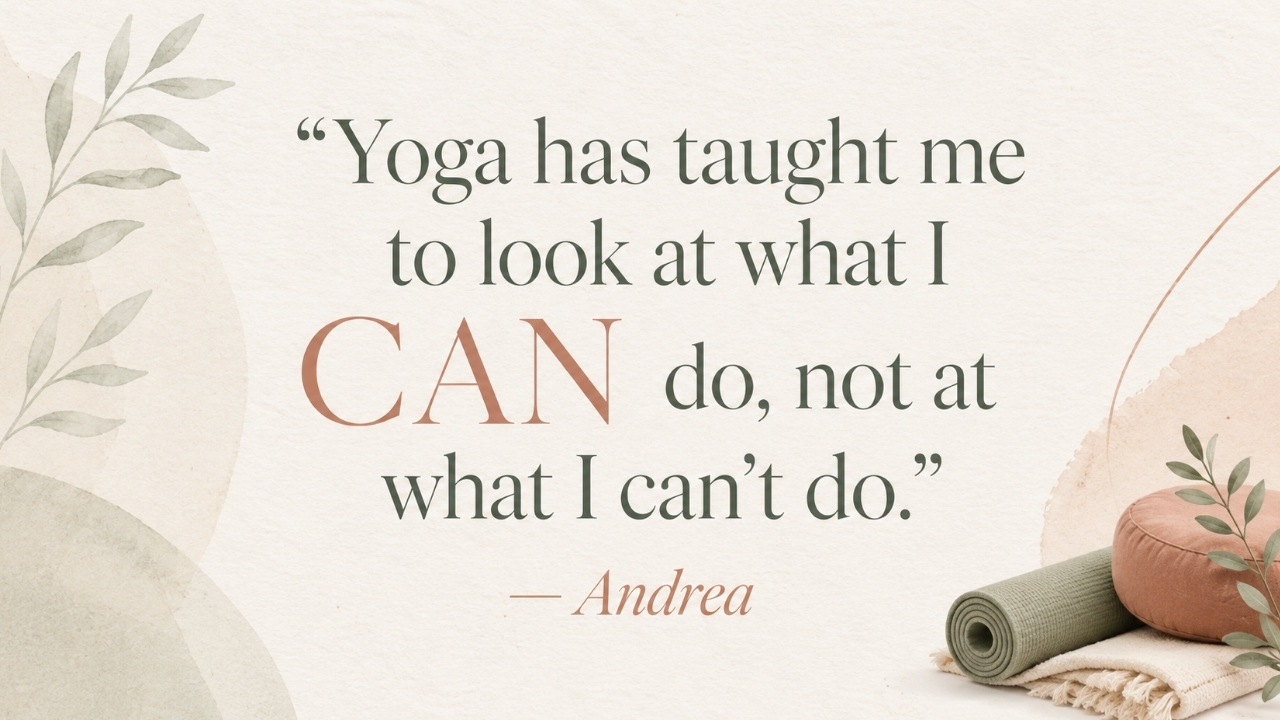
- How YTT Can Help You Cope With a Chronic Condition — features Andrea’s story (multiple spinal surgeries) and the eight specific benefits trainees with chronic conditions consistently report. Andrea said it best: “Yoga has taught me to look at what I CAN do, not at what I can’t do.”
The short version: yoga is not one-size-fits-all, and a real YTT teaches you that within the first month. You will spend more time studying how to modify than you will perfecting any given pose. By month four you’ll be teaching modifications to yourself in real time, intuitively, in a way that took most of us years of injury and stubbornness to learn.
✦ ✦ ✦
Three lineages worth considering for nervous-system work specifically
Not every YTT is built for nervous-system regulation. Some are great asana-focused programs that will make you a stronger physical practitioner without doing much for your sympathetic dominance. If your goal is the sabbatical/reset path, here are the three traditions I’d consider:
- Somatic yoga. The slowest-moving and most directly nervous-system-focused of the three. You’ll work with neurogenic tremors, interoception, the polyvagal model, and breath-led movement. (What’s the difference between somatic yoga and somatic therapy?)
- Kundalini yoga. Highly structured kriyas (set sequences), strong pranayama emphasis, meditation integrated throughout. This tradition is unusually good at producing rapid, felt nervous-system shifts. (Trauma-Informed Kundalini Yoga: A Heart-Centered Approach to Healing)
- Slow / restorative-leaning hatha. A well-taught hatha 200-hour with strong pranayama and meditation modules is the most traditional “general” path. It’s the right choice if you’re not sure which specialty resonates yet.
In Uplifted we offer all three. You don’t need to know which one is “yours” before you sign up — most students figure it out in the first month.
✦ ✦ ✦
How to design a YTT as a sabbatical (instead of as a credential push)
If you’re approaching YTT as personal-development work, design it differently than someone who’s racing to start teaching.
- Pick an 8-month timeline, not a 3-month intensive. The slower you move through it, the more nervous-system integration happens. The accelerated programs are designed for people on a career deadline.
- Skip the teaching practicum’s pressure. Every real YTT requires you to log practice-teaching hours. Approach them as embodiment exercises, not auditions. Teach a friend in your living room. The point is to deepen the material, not to debut.
- Take the philosophy seriously. Most students breeze through The Yoga Sutras to get the credit. If your goal is transformation, slow there. Patanjali wrote the original burnout manual 2,000 years ago.
- Use the live calls for what they are. They’re the highest-leverage hour of your week — community + accountability + real-time integration. Show up live whenever possible.
- Skip the “build my yoga business” modules. Or rather: do them, because the framing matters, but don’t pressure yourself to act on them. Many of my non-teacher graduates come back two or three years later when they’re ready, with the modules saved for when life makes room.
✦ ✦ ✦

Is YTT a wellness sabbatical worth taking?
Here’s the honest test.
Imagine yourself eight months from now. You’ve finished the training. You haven’t taught a single class. You have:
- 200 hours of anatomy, philosophy, breathwork, and meditation under your belt
- A daily practice that’s actually stuck
- A nervous system that down-regulates again
- A peer group of 30–80 women who know the inside of your week
- The yoga teacher certification sitting on your shelf, optional, available if you ever want it
If that version of you sounds like the woman you want to become — then yes, this is worth the time, money, and 8 months.
If the version of you eight months from now needs to be teaching classes and earning income to call it a success, then take a different path. Here’s the honest answer on whether YTT is “worth it” by the income measure.
✦ ✦ ✦
Frequently Asked Questions
Can I do yoga teacher training just for personal growth — without ever teaching?
Yes, absolutely. In our recent cohorts, roughly 30% of students enroll with no intention of teaching professionally. The certification is yours to use later if you want, but you’re never required to teach a class to graduate beyond the practicum exercises.
Will I be required to lead public classes during YTT?
You’ll be required to log practice-teaching hours, but this can be done with friends or family in your living room. Many of my non-teaching graduates approach the practicum as embodiment practice rather than as a debut, and that’s a completely valid way to complete it.
What yoga style is best for nervous system regulation?
Somatic yoga is the most directly nervous-system-focused, with explicit work on the polyvagal model and interoception. Kundalini is unusually good at producing rapid, felt shifts through structured kriyas and pranayama. A slow, well-taught hatha 200-hour with strong breathwork modules is the most traditional “general” path. All three are offered at Uplifted.
How long is a typical online yoga teacher training?
A 200-hour training usually runs 4 to 8 months, with weekly live calls plus self-paced video modules and reading. Eight-month timelines are better for nervous-system integration; three-month accelerated formats work for students on career deadlines.
Can I do YTT if I have an injury or chronic condition?
Yes — but choose your program carefully and consult your doctor first. A real YTT spends more time teaching pose modifications than perfecting any single pose, and many students with injuries or chronic conditions find YTT to be the single most useful health intervention they’ve made. See Can I Do a YTT If I Have an Injury? and How YTT Can Help You Cope With a Chronic Condition for detailed guidance.
Is yoga teacher training good for burnout?
For most people, yes — provided you choose a program with strong pranayama, meditation, and nervous-system focus, and you take it at a pace your body can absorb. YTT is not a substitute for medical care, but it’s one of the few “wellness interventions” that combines structured daily practice with eight months of embodied learning, which is exactly what depleted nervous systems need.
How much does yoga teacher training cost as a sabbatical?
A reputable online 200-hour YTT in 2026 runs $2,500–$4,500. When compared to a comparable sabbatical with travel, retreats, and therapy stacked together, it’s typically a fraction of the cost — with the added bonus of a yoga certification you can use for the rest of your life. (Full breakdown in the real economics of YTT.)

Ready to look at what 200 hours of structured nervous-system reset actually looks like? Download the Uplifted 200-Hour brochure — it includes the full week-by-week curriculum, the philosophy reading list, and what each module covers.
Download the Uplifted 200-Hour Brochure → https://www.brettlarkin.com/online-yoga-teacher-training/
This is your reminder that you don’t need anyone’s permission to take eight months for yourself. The most successful version of you on the other side will be glad you did. 🙏
✦ ✦ ✦

About the Author | Brett Larkin
Brett Larkin is the founder of Uplifted Yoga, one of the first and most successful online yoga schools. She has over a half a million subscribers on Youtube and is also the author of Yoga Life and host of the Uplifted Yoga Podcast. Brett brought yoga teacher training online in 2015 and has since certified over 4,000 teachers through premium, high-touch programs. Brett helps wellness entrepreneurs grow integrity-driven businesses rooted in yogic wisdom.
Sneak Peak into My 300-Hour YTT - FREE Videos, Info Session, Bonuses!