It seems like every yoga class, teacher, and person who practices yoga gives the salutation ‘Namaste’, usually followed by something about divine light, divine love, or some other divine mention.
But what is the translation of namaste and how is it actually used in Hindu culture? And why do yoga teachers get this word wrong so often?
Understanding the translation, both as a definition of namaste as well as a spiritual practice, is an important first step to deepening your yoga practice.
After all, you probably say that phrase enough to finally understand more than just the literal meaning.
So what does namaste mean, anyway?
I decided to give a quick and dirty breakdown of the namaste definition as well as a clear guide on how to use it in everyday life.
Namaste Meaning 101
The Sanskrit word Namaste is a popular greeting and often used throughout India with the “namaskar” hand mudra. The gesture of namaskar is with the hands placed together in front of the heart with palms touching and your fingers facing up. It is also called Anjali mudra and in Hindu culture, is a way of saying “I bow to the divine within you.”
If you want to break down the etymology of the word, namas in Vedic literature means to “worship” or “adore.”
The definition of namaste is not connected to any religious meaning, but it doesn’t mean there is not a deeper meaning. Unfortunately, Western culture has lost its understanding of the meaning through using “namaste” as a slogan on yoga clothing with phrases like, “namaste in bed.”
The spiritual meaning of Namaste refers to connecting to the Divine spirit or light in each person you meet and honoring that within them. It is honoring your soul and the light within each and every being. Namaste is a sign of respect and acknowledgment that means more than just a “hello” or “thank you.”
The truth is that namaste isn’t necessarily a part of yogic philosophy, like something of the 8 limbs of yoga. Instead, it’s a reverential way to greet someone in Hinduism and can be used in your spiritual practice, yoga practice, or just everyday life.
You might also like: 10 Yoga Terms That Every Yogi Must Know (Yes, Even You!)
When Is It Used?
Namaste is used as a salutation to greet and show respect for elders, family members, your yoga teacher, friends and strangers on the street.
At the end of a yoga class after Shavasana, a yoga instructor will usually say “namaste” to their students to thank them for their practice and sharing their energy in the class. Usually, the students repeat it back, and it honors the relationship and spiritual connection between the teacher and student.
It represents that we are all one.
If you want to use namaste with Anjali mudra to go deeper into your heart, this action alone can bring you peace and relaxation in any of the postures, especially during hatha yoga or restorative yoga. It can bring you into a deep union with your soul and teach you how to live from the heart.
How To Namaste
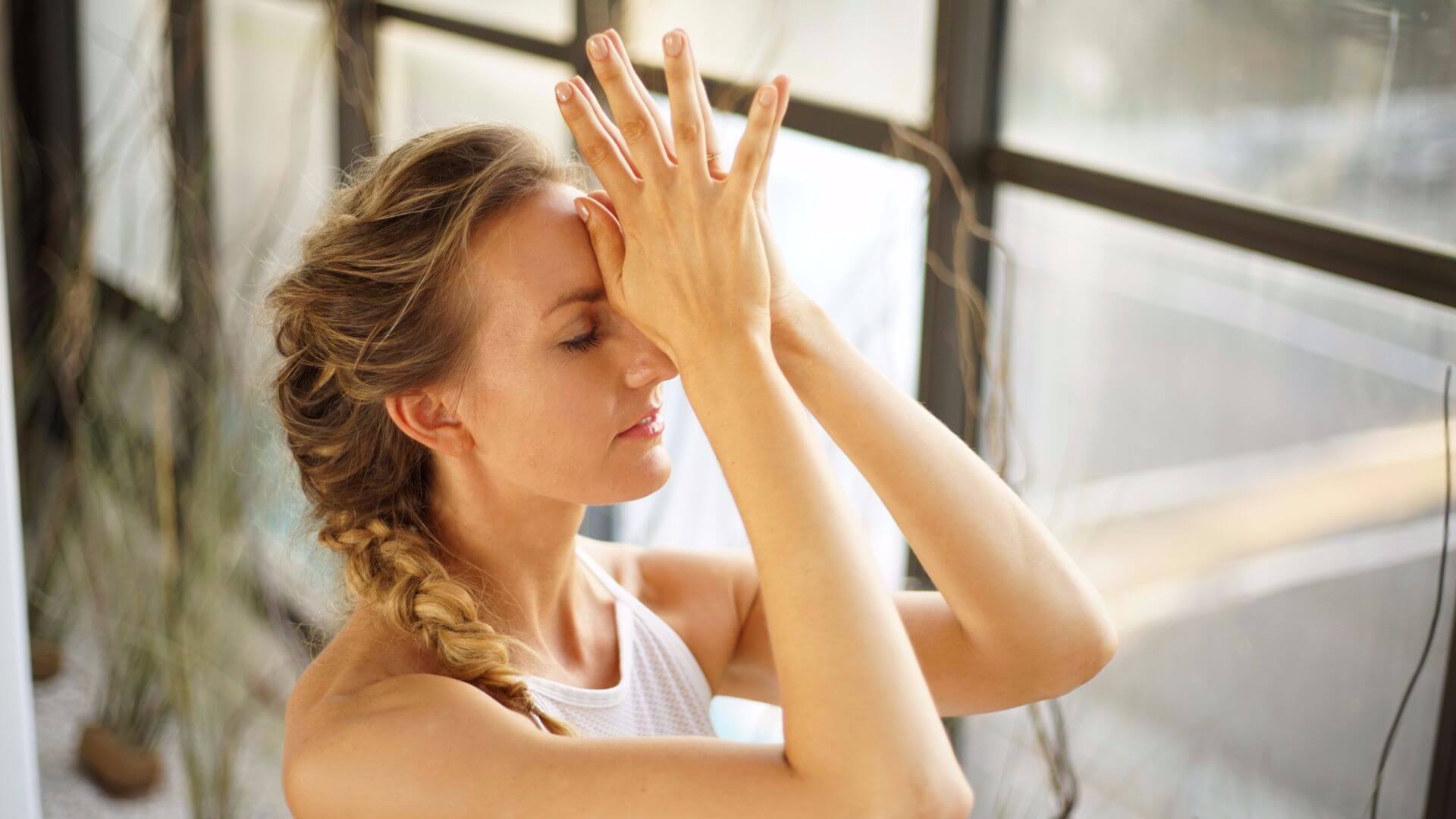
- Bend your elbows and bring the palms of your hands together in front of your heart, with your thumbs pressing into your chest and your fingers pointing upwards.
- When using namaste for greeting you can look the person in the eyes and gently bow your head.
- If you are saying namaste at the end of a yoga practice, you can bow your head with your eyes closed and touch your head to the ground to connect with the earth. In this way, you are acknowledging and allowing your mind (ego) to be below your heart for once. It is also a sign of gratitude.
- If you wish to connect with your Ajna or third eye chakra you can bring your thumbs in between your eyebrows while bowing your head in prayer. This cultivates the feeling of gratitude from within, which radiates outwardly.
Namaste is always used positively and can also be used as an act of forgiveness. Something to remember when greeting a person with namaste is that there is supposed to be no physical contact. This is to keep the energy flowing between you both and to respect the other person’s space.
You might also like: The Complete Glossary of Sanskrit Words Used in Yoga
If you want to start practicing this beautiful heart-centered greeting as a sign of respect, a yoga studio is a great place to practice. If you want to practice saying namaste to your friends and strangers, they might give you a funny look…or you can just go to India where it is considered to be a normal part of their culture!
Namaste yogis and yoginis.
Frequently Asked Questions
What does Namaste actually mean?
Namaste is a Sanskrit greeting often translated as “I bow to you” or “the light in me honors the light in you.” In yoga, it is used as a gesture of respect, gratitude, and recognition of the divine or sacred presence within each person.
Is it appropriate for non-Hindus to say Namaste?
Yes, non-Hindus can say Namaste when it is used respectfully and with an understanding of its cultural and spiritual meaning. Rather than treating it like a yoga slogan, use it as a genuine bow of respect, gratitude, and acknowledgment.
When do you say Namaste in a yoga class?
Namaste is most often said at the end of a yoga class, after Savasana, as a way for the teacher and students to honor the practice and one another. Some teachers may also use it at the beginning of class to create a respectful, heart-centered opening.
How do you pronounce Namaste correctly?
Namaste is commonly pronounced “nah-mah-stay” or “nuh-muh-stay,” with the emphasis often falling gently on the final syllable. Say it slowly and respectfully, allowing it to feel more like a bow than a casual catchphrase.
What’s the difference between Namaste and Namaskar?
Namaste and Namaskar are closely related Sanskrit greetings that both express respect and reverence. Namaste is more commonly heard in Western yoga classes, while Namaskar is often used as a slightly more formal greeting and is also connected to the hand gesture of bringing the palms together at the heart.
Why do we put our hands at the heart when saying Namaste?
When saying Namaste, the hands are often placed together at the heart in Anjali mudra as a symbol of reverence, gratitude, and heart-centered awareness. This gesture helps shift the focus from the mind to the heart and reflects the meaning of honoring the sacred presence in another person.
Is Namaste used in everyday Indian conversation?
Yes, Namaste is used in parts of India as a respectful greeting for elders, family members, teachers, and strangers. In everyday Indian conversation, its use can vary by region, language, and context, so it may feel normal in some settings and more formal or traditional in others.
Next Steps
- If you’re interested in learning the three skills that empower you to embody your yoga off the mat to get the results you desire in your personal life, check out my Yoga for Self Mastery course.
- Explore my knowledge hub for How to Become a Yoga Teacher or consider becoming a Somatic Yoga Coach in my newest certification program.
- Practice yoga with me on my YouTube channel with over a thousand free classes.

YOU MIGHT ALSO LIKE
- What is Kriya Yoga? The Philosophy and Practice
- Uddiyana Bandha: Tapping Into Your Deep Core
- 4 Reasons Hasta Bandha Is Essential To Your Yoga Practice
- Vitarka Mudra: What It Is and How Do You Use It?
- Shakti Mudra: What It Is and How Do You Do It?
- Garuda Mudra: What It Is and How Do You Use It?
- Kali Mudra: What It Is and How Do You Do It?
- Shunya Mudra: What It Is and How Do You Do It?
- Varuna Mudra: What It Is and How Do You Use It?
- Vayu Mudra: What It Is and How Do You Use It?
- Samana Vayu: The Energy of Balance & How to Access It
- Apana Vayu: The Energy of Release & Surrender
- Udana Vayu: The Ascending Wind
- Prana Vayu: The Breath of Vitality
- Vyana Vayu: The Energetic Secret to Flow

About the Author | Brett Larkin
Brett Larkin is the founder of Uplifted Yoga, one of the first and most successful online yoga schools. She has over a half a million subscribers on Youtube and is also the author of Yoga Life and host of the Uplifted Yoga Podcast. Brett brought yoga teacher training online in 2015 and has since certified over 4,000 teachers through premium, high-touch programs. Brett helps wellness entrepreneurs grow integrity-driven businesses rooted in yogic wisdom.
🎧 Want more like this in audio? Subscribe to the Uplifted Yoga Podcast on Apple Podcasts or Spotify.
Learn how to do 11 of the most popular yoga poses correctly. Free video + PDF download.