There’s a moment that happens for many experienced yoga teachers: your students start asking for more.
That was my moment.
I was already teaching in local studios, leading retreats, and running my membership when students began asking whether I would offer yoga teacher training. They didn’t just want another class. They wanted to understand why I taught the way I did. They wanted the behind-the-scenes knowledge. They wanted to go deeper.
If you’re starting to hear similar questions from your own students — or feeling that inner nudge to stop simply teaching yoga and start teaching people how to teach yoga — you may be ready for the next evolution of your career: becoming a yoga teacher trainer.
But teacher training is a very different animal from teaching a great Vinyasa class. It asks more of you educationally, administratively, emotionally, and yes… organizationally. So let’s talk about what you actually need before you make the leap.
The short answer: how to become a yoga teacher trainer in 2026
To become a yoga teacher trainer under Yoga Alliance’s current standards, you need to be an active E-RYT 500 in good standing — that’s 500 hours of qualifying training, at least four years of teaching post-training, and 2,000 documented teaching hours. Beyond credentials, you also need real experience with diverse bodies, comfort holding a group, and a clear point of view that makes your training worth taking. This guide walks through the full path.
What Does a Yoga Teacher Trainer Actually Do?
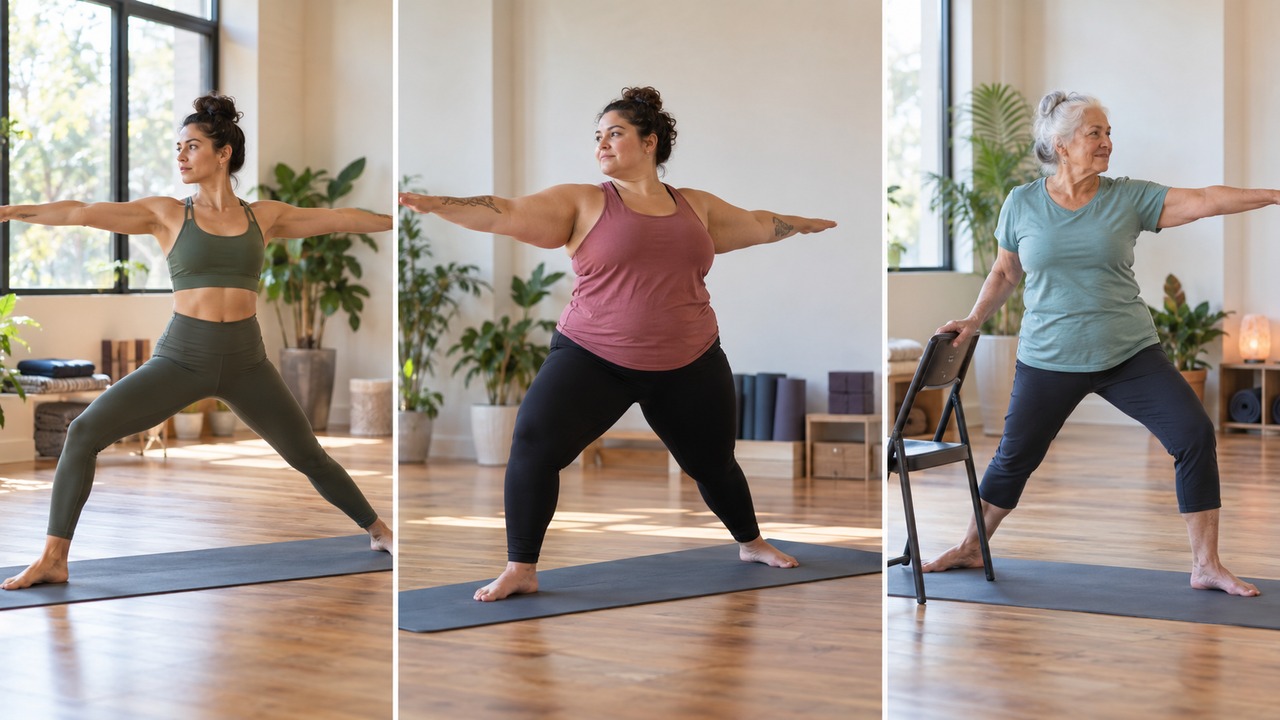
When you teach a yoga class, your job is to teach a great class. When you train teachers, every pose becomes a file folder you can double-click into.
Suddenly Warrior II isn’t simply Warrior II. Why are you cueing the feet that way? What changes for a student whose hip anatomy makes heel-to-arch alignment uncomfortable? What if the student is pregnant, older, practicing in a chair, hypermobile, injured, or simply built differently from you?
Teacher trainers need to help students understand the WHY behind their decisions — not memorize a collection of supposedly perfect cues.
Step 1: Understand the Yoga Alliance Credential Path
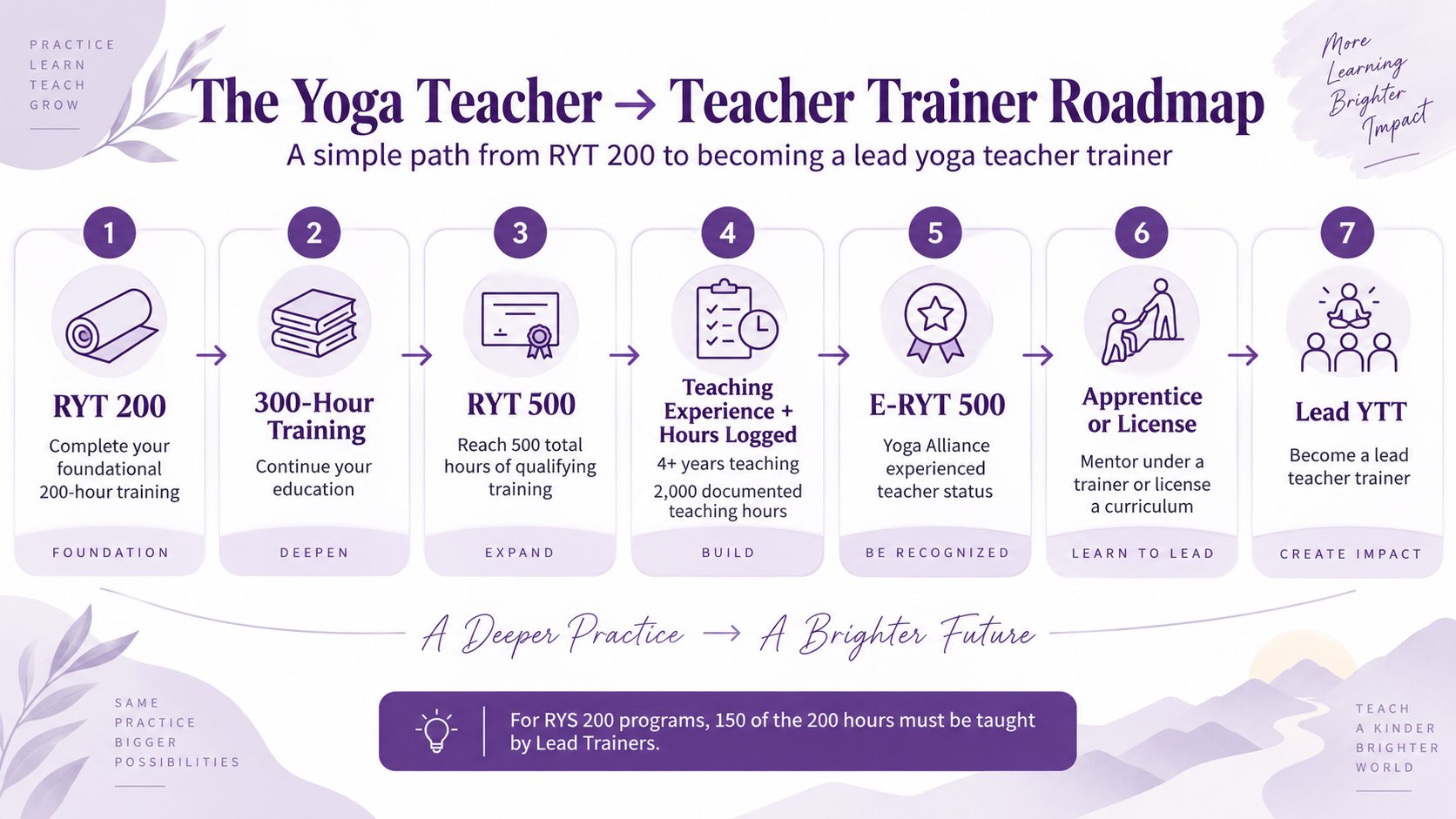
If your goal is to serve as the Lead Trainer of a Yoga Alliance foundational Registered Yoga School (RYS), credentials matter. Under Yoga Alliance’s current standards, all foundational programs must use E-RYT 500 Lead Trainers who are active members in good standing. For an RYS 200 specifically, 150 of the 200 hours must be taught by Lead Trainers.
The E-RYT 500 pathway currently requires:
- 500 hours of qualifying RYS training — either as a single 500-hour program or a 200+300 combination.
- At least four years of teaching after completing your training.
- 2,000 documented teaching hours — split as 1,500 hours after RYS 200 or RYS 500 completion, and 500 hours after RYS 300 or RYS 500 completion.
Yoga Alliance also offers an Experienced Teacher Pathway (ETP) as an alternate route for teachers who didn’t attend an RYS, but the standard route for most future trainers goes through registered training.
Translation: if you’re currently an RYT 200, your first step is not designing a 200-page manual. It’s continuing your own education and experience. You can read more about the credential ladder in my article on 200, 300, and 500-hour credentials, and if you’re ready for the next step, our 300-hour advanced teacher training is designed to move you toward that E-RYT 500 status.
For the full breakdown of what a Yoga Alliance–compliant syllabus looks like, see our article on the Yoga Teacher Training Syllabus: What Every Great 200-Hour Program Should Include
Step 2: Become Exceptionally Good at Teaching Yoga
A credential tells you that you’ve completed certain requirements. It doesn’t automatically make you ready to train teachers.
I want a future teacher trainer teaching regularly — ideally at least a couple of classes each week — and feeling extremely confident with cueing, sequencing, observing bodies, and adapting poses. Exposure matters more to me than an arbitrary number of years. Someone who has taught a wide variety of bodies several times a week for three years may have more useful experiential knowledge than someone who has taught the same small group occasionally for 15 years.
Book knowledge matters. But there is no substitute for seeing hundreds of real bodies.
Step 3: Invest in Continuing Education
Before you become the person answering everyone else’s questions, keep being a student. I love seeing future trainers pursue specialties such as Yin, Restorative, prenatal yoga, anatomy, trauma-informed teaching, nervous system education, or another area that stretches their understanding.
You do not need to personally be the world’s leading expert in every topic. You do need enough breadth to understand the landscape — and enough humility to say, “I don’t know. Let me find out.” Students often trust you more when you honor the edge of your knowledge instead of inventing an answer.
Step 4: Learn to Hold a Group, Not Just a Class
Before leading a full YTT, I strongly recommend leading a retreat or extended workshop. Teacher training can make you part educator, mentor, career counselor, cheerleader, and space-holder. People often enter YTT during major life transitions. They can be vulnerable. Group dynamics emerge. Feedback gets tender.
You need to know how to create a space where students can receive feedback from you — and eventually give thoughtful feedback to one another.

Step 5: Get Experience Inside Someone Else’s YTT
You do not have to jump from “experienced teacher” to “I am personally responsible for 200 hours of education and everyone’s graduation.” In fact, I wouldn’t recommend it.
Guest teach. Assist. Apprentice. Help with administration. Or license an established curriculum for your first training.
I think of licensing as an apprenticeship shortcut: you get to experience the complete machine while learning which pieces you eventually want to make your own.
Step 6: Decide Whether to Build or License Your Curriculum
Creating your own curriculum can be one of the most rewarding parts of becoming a teacher trainer. Writing my first manual forced me to articulate what I believed about alignment, cueing, anatomy, and adapting yoga for different bodies. That process eventually helped me codify the Uplifted Yoga Alignment Method.
It was also an enormous amount of work.
If you already know you want to spend the next 30 years building your own school and body of intellectual property, creating your own curriculum may eventually make sense. But you do not have to begin there. Uplifted offers a licensing pathway in which experienced teachers can use our proven online core curriculum while focusing their own live teaching on the areas they’re most passionate about.

Step 7: Validate Demand Before You Build the Whole Thing
Remember how my own YTT began? My students asked for it.
That matters. One of the strongest readiness signals is that you already have students who trust your teaching and want to go deeper. Before committing to a giant build, start talking about the idea. Create an interest list. Consider a presale. See whether people actually raise their hands.
A teacher training can be lucrative, but “I heard YTT makes money” is not enough reason to build one. If you’re serious about the business side, I’ve written more on starting a yoga teacher training program without burning yourself out.
Step 8: Know What You’re Signing Up For
The beautiful parts are REALLY beautiful. You get to watch students have aha moments, find their voice, and sometimes decide to teach even when they entered training convinced they never would. You get to codify your method and multiply your impact through teachers who may carry your ideas forward for decades.
But there is another side: Yoga Alliance paperwork, payment plans, deferrals, faculty management, certificates, graduation requirements, assessments, student questions, and the energetic reality of being committed to a group for months.
If what you love most is simply putting on your favorite playlist and teaching an amazing class, you are allowed to keep doing exactly that. Becoming a teacher trainer isn’t a promotion. It’s a different job.
The Bigger Reason to Become a Teacher Trainer
At some point in my own career I realized: I can’t be everywhere at once.
I could keep stretching myself thinner trying to personally teach every student the way I believed yoga could be taught — or I could teach other teachers how to see what I saw.
That is the magic of becoming a teacher trainer. You stop thinking only about the students in front of you and begin creating a body of work that can travel through other people. If you have a method, perspective, or way of teaching that you believe matters, YTT gives you a way to codify it, share it, and potentially create an impact that outlives you.

Frequently Asked Questions
What qualifications do I need to become a yoga teacher trainer?
There is no universal government-issued “yoga teacher trainer” license. If you want to be the Lead Trainer of a Yoga Alliance foundational RYS program, however, Yoga Alliance currently requires an active E-RYT 500 Lead Trainer in good standing. You should also have substantial real-world teaching experience, strong cueing and anatomy knowledge, and experience holding groups.
Do I need an E-RYT 500 to train yoga teachers?
Not every yoga education program operates through Yoga Alliance, but E-RYT 500 is currently the key Lead Trainer credential for foundational Yoga Alliance Registered Yoga Schools. If Yoga Alliance registration matters to your students or business model, understand this pathway early.
Can I become a yoga teacher trainer with an RYT 200?
An RYT 200 can continue teaching yoga and gaining experience, but it does not meet Yoga Alliance’s current Lead Trainer requirement for a foundational RYS. Consider a 300-hour advanced training, continue logging teaching hours, and deepen your specialties while you work toward E-RYT 500 eligibility.
How much teaching experience should I have before training teachers?
Look beyond years alone. You want repeated experience teaching diverse bodies, adapting poses, answering unexpected questions, and confidently cueing classes. Yoga Alliance also has specific teaching-hour requirements for E-RYT credentials — currently 2,000 total teaching hours split as 1,500 hours after RYS 200 or RYS 500 and 500 hours after RYS 300 or RYS 500.
Should I create my own YTT curriculum or license one?
For a first training, I often recommend assisting, apprenticing, or licensing before building everything from scratch. You can learn the operational and educational realities of YTT while still bringing your own personality and expertise to the experience.
Can becoming a yoga teacher trainer increase my income?
It can create a higher-ticket revenue stream, but YTT also carries substantial marketing, administrative, faculty, technology, and support costs. Build the economics before assuming the tuition price equals profit.
How long does it take to become a yoga teacher trainer?
From an RYT 200 starting point, plan for at least 4–6 years. You need to complete an additional 300 hours of training, teach for a minimum of 4 years post-RYS 200, and log 2,000 total teaching hours before you can hold the E-RYT 500 credential required to serve as a Lead Trainer for a foundational Yoga Alliance RYS.

About the Author | Brett Larkin
Brett Larkin is the founder of Uplifted Yoga, one of the first and most successful online yoga schools. She has over a half a million subscribers on Youtube and is also the author of Yoga Life and host of the Uplifted Yoga Podcast. Brett brought yoga teacher training online in 2015 and has since certified over 4,000 teachers through premium, high-touch programs. Brett helps wellness entrepreneurs grow integrity-driven businesses rooted in yogic wisdom.
Sneak Peak into My 300-Hour YTT - FREE Videos, Info Session, Bonuses!