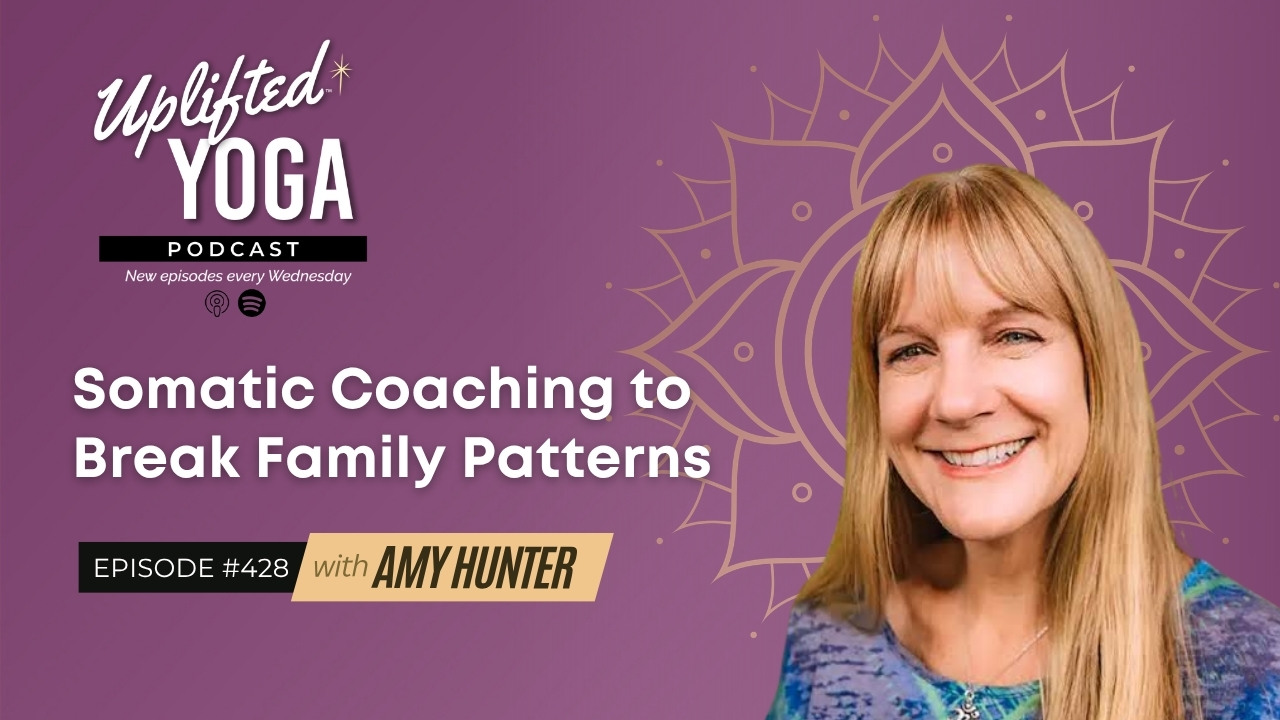
What if the patterns running your life didn’t start with you?
In this conversation, I sit down with Uplifted alum Amy Hunter to talk about the deeper work of somatic coaching, recovery, and healing family-of-origin patterns. Amy has taken multiple trainings inside the Uplifted ecosystem — including 200-hour, 300-hour, Kundalini, Embodied Yoga Life Coaching, and most recently the AI course — and now brings all of that into her own coaching practice.
Together, we explore what it looks like to move from self-awareness into real change.
In this episode, we cover:
🔹 How somatic coaching helps uncover family patterns that still shape your life
🔹 The connection between people pleasing, self-abandonment, and personal power
🔹 Amy’s six pillars of self-recovery and how they relate to the chakras
🔹 Why self-care is foundational if you want to change old patterns
🔹 A simple in-the-moment tool — Amy’s PIVOT process — for catching yourself and choosing differently
If you’ve ever felt like you know your patterns intellectually but still keep repeating them, this episode is such a beautiful reminder that real change happens when awareness moves into the body.
🌀 Check out my Somatic Life Coaching Certification and join before July 10th to get the EARLY ACCESS EXPERIENCE => https://www.brettlarkin.com/somatic-yoga-training-certification/
GUEST EXPERT: Amy Hunter | www.guidebyyourside.coach
Amy is a certified Somatic Life Coach and founder of Guide By Your Side Life Recovery Coaching. Her passion is guiding people through difficult life transitions and easing the emotional and physical pain that comes with them. Her proprietary system—the 6 Steps of Self-Recovery & the 5-step PIVOT Process—combines Somatic, body-based practices with Root Cause Coaching, Hypnotherapy, and Yoga Psychotherapy.
Get your free “5 Steps from People-Pleasing to Personal Power” guide or book a call with Amy at http://www.guidebyyourside.coach
Connect with Amy: connect@guidebyyourside.coach
FREE Practice: YOGA FOR BOUNDARIES | Somatic Exercises to Say No 🛑 | SOMATIC YOGA BOUNDARY WORKOUT WITH MUSIC
Relevant Blog: The Healer Archetype: Characteristics & Challenges
Relevant to Today’s Episode:
✅ 200-hour Online Yoga Teacher Training
🔮 300-hour Online Yoga Teacher Training
🎧 Also Listen to:
#299 – Strategies to Slay Imposter Syndrome and Share Your Gifts
#354 – Redefining “Niche” with Carla Cline Thomas
#386 – Stop Selling Products—Start Selling YOU: Human Design for Visibility & Flow with Juliette Stapleton
© 2026 Uplifted Yoga | BrettLarkin.com
Transcript:
[Brett Larkin]
It’s time for you to walk through the world with the confidence and serenity of someone who’s deeply tethered to their inner wisdom. If you have this insatiable hunger to uplift your personal life and make a bigger impact in your wellness career, leveraging yoga’s ancient wisdom, welcome. I’ve certified thousands of yoga instructors online, I teach to over half a million subscribers on YouTube, but I still haven’t remotely quenched my thirst for more yogic knowledge.
I’m Brett Larkin, founder of Uplifted Yoga, and this is the Uplifted Yoga Podcast. Let’s get started. If you’ve ever felt like you know your patterns intellectually and yet you still keep repeating them, this episode today is such a beautiful reminder that real change happens when awareness drops down into the body.
We’re speaking to today somatic life coach and founder of Guide By Your Side Life Recovery Coaching, Amy Hunter. She guides people through difficult life transitions and eases emotional and physical pain through her proprietary system, The Six Steps of Self Recovery. She combines somatic, body-based practices with root cause coaching, hypnotherapy, and she’s a graduate of my Embodied Yoga Life Coaching Program, which is a somatic coaching certification that I run every year.
And if this is a program that you think you might be interested in, you want to make sure that you book a call and learn more by July 10th. Training doesn’t officially start until October, but we’ve put together an incredible early access experience with lots of bonus live calls and community building and support when you register now. What’s so unique about Embodied Yoga Life Coaching and this curriculum that I’ve put together is that it combines movement and coaching.
See, a traditional life coaching certification, of which there’s many online, is going to give you a life coaching credential, but the coaching you’re going to receive won’t necessarily take somatics or the body into account. You’ll most likely be seated and just talking to people and working primarily on the intellectual verbal level. The Uplifted Embodied Yoga Life Coaching Program is so different because we pair life coaching with therapeutic movement and body-based techniques.
That means depending what’s happening in a coaching session, you might have a client lie down to do certain exercises, stand up for a somatic practice, move through something on a yoga mat, or use movement, sound, or breath to discharge emotion or process something through the body. We go through an extensive somatic yoga curriculum first and then layer the life coaching on top. And we spend a lot of time learning how to pair what someone is telling you with the appropriate somatic exercise and movement so that your client’s just not intellectually processing change, but actually involving the body in transformation too.
Learn more about Uplifted’s Embodied Yoga Life Coaching somatic coaching certification at the link in the show notes. And now let’s dive into today’s conversation with Amy. Hi, everyone.
Welcome back to the Uplifted Yoga Podcast. I have Amy Hunter with me today. Amy, I’m so excited to catch up with you.
Tell our listeners a little bit about the different Uplifted programs you’ve taken because you are like big alum on our campus. You’ve taken a lot of different things. You told me you just finished the AI course, so I want to hear about that.
But how did you start? And take us back to that like initial first steps.
[Amy Hunter]
Yeah, yes, I am definitely so excited to be here as well. Thank you so much for having me on. And so, yeah, I first discovered Uplifted in 2020.
So during COVID, I was teaching at Oregon State University and we all basically had to stay home. And I was like, well, I might as well learn something. I took yoga and always wanted to learn more about yoga and teacher training.
So I jumped into the 200 hour. You know, one of the things I love about all your programs is they’re just super well organized. I felt like I got so much out of the 200 hour.
So then I did the 300 hour. And I was already thinking about pivoting at that point into a third career, doing something different. And I had been thinking about how yoga can help us unwind a lot of our family patterns, behavior patterns.
And so when you started the Embodied Yoga Life Coaching, I was just like right with you. I was like, oh my God, this is exactly what I’ve been looking for, what I’ve been thinking about. And so I did that program.
Anything that uses the body just made a lot of sense to me to help us work out some of the stuff our mind can’t always get to.
[Brett Larkin]
And you’ve come back into Embodied Yoga Life Coaching and done like sample coaching demos for new students, which has been so fun. And I think we have some examples of you coaching in the material now. So it’s really been fun to just, yeah, see your growth journey.
Tell people a little bit before we dive into your work now and the kind of pillars and framework that you’ve put together, as well as the specific audience you address, which I think is one that I relate to and I’m excited for you to tell everyone about. But maybe walk people through those steps of like really deciding to change from being just a yoga teacher to also being a coach, because I think that’s like a place where I had imposter syndrome for so long, where I was like, I feel like I’m coaching people all the time. And of course I did like my first life coaching certification and then I did another one similar to you.
It was like the somatic piece where I was like, okay, like this is what’s missing. And seeing how much movement was missing from coaching and how we really need like body oriented coaching, I think empowered me to be like, okay, not only am I a coach, but I’m actually going to also add a coaching school to my school specifically for yoga teachers who want to hold space for people and work with them in a much deeper way. I know that’s not an easy identity shift because I’ve lived it.
Because I think other people listening might be like, well, I am always helping people or giving advice or feel like I’m really, you know, working in my yoga privates on kind of a deeper level or things are coming up that aren’t relevant to the asana practice that I want to help them with. But like, what did that identity switch look like for you? And what gave you sort of the confidence to do that initial enrollment in body yoga life coaching?
[Amy Hunter]
All the things you just said, definitely for me, I’ve been sort of learning and studying and training for almost six years now. So, you know, I had a lot of imposter syndrome too, thinking like, oh, I just need to know more. I need to know more, you know?
And part of that was true. I have done a lot of training with you and I’ve done some other trainings as well. I’m a recovery coach.
So other things as I decided what I wanted to put into my coaching. And then in terms of just sort of the identity shift, I think for me, I’ve been a university instructor for the past, say, 12 years. So I’ve always been a teacher.
Like, I always felt like teaching was a calling. And so I was ready to shift away from teaching, you know, at the university, but start to do something that was more personal for me. And I think also at this stage in my life, I was really ready to give back.
And I really do believe, actually, my mission is to create more peace in people’s lives so we can have more peace in the world, which sounds kind of lofty, but actually it all begins with ourselves. And so I was just ready to make that move and make that change and it felt right.
[Brett Larkin]
What surprised you, like going through the program?
[Amy Hunter]
I think people’s honesty and authenticity. A lot of coaching is simply guiding through inquiry and helping them discover for themselves what’s underneath their behaviors. And so I think, especially in your sample coaching and stuff, seeing how people kind of have those ahas and they connect some dots and they start to realize, like, I see why this is happening.
I see when it’s happening. And now I have the power to sort of change how things are unfolding.
[Brett Larkin]
Yeah, it’s fun, the intimacy that we get to build, because I think we try to do a lot to make the teacher trainings feel very intimate, but ultimately we’re still teaching each other shapes like yoga poses and breathing techniques and meditation. But once you move all of this into a coaching container, I think it gets very, very personal, very vulnerable because all of a sudden now you’re coaching each other, not just through movement, but through life problems and people are sharing about what they’re struggling with and the challenges they’re facing in a marriage, in a relationship, in a career change. I love teaching in that program because it’s just, it feels like we’re friends and so connected, even on a deeper level, if that’s possible.
I don’t know if that was your experience, but. Absolutely. And lots of practice coaching, just like teaching yoga, everyone.
The only way to be a good coach is to coach a lot. So there’s lots of, lots of partner work and partner opportunities. And that program is also a business mastermind where we’re really helping you get your coaching business off the ground, which means also, of course, niching down.
We’ll link the episode we have about niching down because that’s always a popular topic. It doesn’t really matter what you’re doing, right? Whether you’re like selling jewelry or hot dogs or teaching yoga or coaching, and even within somatic coaching, you know, having that niche, having a particular person that you serve is so incredibly important for being an expert in a particular domain.
So that’s something that I really wanted to celebrate for you and have you tell people about kind of this niche or a particular type of person that you work with. So tell us about ACA, what that stands for, and how you started kind of working with this niche and what your coaching business is looking like these days.
[Amy Hunter]
It took me a long time to really figure out my niche. Honestly, that was a big part of it because I knew this work can almost help anybody because we all have struggles. We’re human, right?
So we all have ways that we can do things probably a little better. So it was really hard for me at first to kind of narrow it down. And then when I discovered the recovery field, and I trained also with Tommy Rosen.
He’s got something called Recovery 2.0 that marries yoga with the 12 steps. And that’s when I was like, okay, that made a lot of sense. And then for me and my personal story, it wasn’t so much a struggle with alcohol or drug addiction or even process addictions.
It was more something that’s called adult children of alcoholics and dysfunctional families. And so then all of a sudden, my story started to make sense. And even though my parents weren’t alcoholics, they didn’t struggle with that or drug addiction, really, my story was a little bit more about neglect.
And neglect is often really hard to notice, you know, because you’re just kind of like, well, nothing bad happened. But on the other hand, it’s kind of, you know, there was a lot of things that didn’t happen that should have. And that’s simply because my parents had their own struggles and, you know, whatever was going on in their adult lives.
So that’s what really drew me into the ACA work. You work a step program, similar to the other AAs and NAs and all that, but it’s more focused on your family of origin, which I, in my training with you, we read that book, which, you know, really opened my eyes up to a lot of universal needs. And when those universal needs don’t get met when you’re little, you wind up developing coping strategies and programming and beliefs about the world.
Yeah, so I’ve kind of combined the ACA program with the embodied yoga life coaching, recovery coaching, and the somatic piece, bringing all those things together.
[Brett Larkin]
So cool. So tell us a little bit about these common patterns that you see, because I think this is one of the most fun things about being in a coaching program is you, you think you have all these habits or tendencies and voices in your head, and then you start coaching other people and you’re like, wait, they have that too. Or this is even like a common archetype.
Like we have a whole archetype module, like these common patterns. And then of course we have a whole thing on the chakras, right? Where we see this at the level of each chakra.
And I know you’ve a little bit broken down kind of how we see the issues that children of alcoholics or like people who’ve been in kind of dysfunctional families tend to have. And I think that might be really interesting for you to walk us through because I think listeners will have some aha moments where you’re like, oh, yes. And it’s like awareness is the key.
That’s like the biggest thing I’m always teaching in the coaching program is like, we’re not coaching and telling anyone what to do. We’re trying to coach them on elevating their own level of awareness. Right?
Like yoga is the stilling of the mind, but in order to still it, we need to witness it. And that’s like a lot of what Patanjali is outlining. So when we can help someone else get an awareness of their own internal part or internal program, it’s the third framework in the program of embodied yoga life coaching.
Right? It’s like we start to help them see that there’s a lot of like undercover patterns running their life, running their decision making. And of course, we can correspond these to the chakras, which I know you have done as well.
So do you want to walk us through kind of what that looks like?
[Amy Hunter]
Yeah, sure. I’d be happy to. So I created what I call the six pillars of self recovery.
And I call my life coaching life recovery. So the idea is that we were all born perfect and happy little babies, you know, and then life happened. And so then we start to just sort of peel it back.
And so my six pillars do relate to the chakras. And the first one is also, you know, rooted in spajaya, to self-awareness, self-study. And that’s kind of the biggest part if it was a pyramid, like you were saying, the awareness of, you know, where they came from and all the patterns and that kind of stuff.
So my first pillar, I call it self-exploration. So all my pillars start with self. And that relates to the root chakra.
Our root chakra is about safety and security and all that. So it can show up as isolation and fear. When it’s blocked, you might not feel safe in your body.
You might not feel safe with other people. There’s a lot of things having to just do with your rootedness, feeling secure in your own self.
[Brett Larkin]
Safe to be in your own skin. Yeah. And I think if we want to break that down a little bit more for people, a lot of yogis are very good at leaving their body and not being safe in their own skin.
We want to meditate. We want to do a lot of pranayama. We want to get high.
We want to meditate on the third eye. We want to do intense kriyas. We want to do all these things that are beautiful and good.
But then when we enter the somatics framework, whether through the somatic self-study course or embodied yoga life coaching, it’s like, whoa, we really start to sort of call ourselves out on exactly what you’re saying, that often it doesn’t feel safe to inhabit our own skin. And we have, you know, coping mechanisms or tools to help us avoid being in the here and now. And that can look like chronic productivity or chronic busyness or perfectionism.
I think I even just saw something about that on your website, right? So, yeah, I think let’s keep giving people practical ideas of what this looks like of how we choose to disconnect from the body. Like, for me, it was definitely workaholism.
So say the first pillar again. Let’s just, like, establish.
[Amy Hunter]
Yeah, so the first pillar, I call it self-exploration. And self is always capitalized, so it’s like self-exploration. And it’s the root of who you are, where you came from, your family, your culture.
And it’s all about the survival mechanisms you might have developed if you grew up in sort of chaotic or, you know, families have all kinds of difficulties, right? It could have been financial. It could have been illness in the family.
It could have been divorce. There’s lots of reasons why families, you know, sometimes have difficulties. And we create those survival.
That’s that root, right? I think a lot of avoidance patterns also could be linked to the root chakra as well. Avoiding certain things, not talking about certain things because they don’t feel safe, not having conversations, not being all the way honest sometimes because it’s just wasn’t safe to be honest maybe in your, you know, family of origin.
So I think a lot of that can be related to the root chakra. So moving up, we have sacral chakra. I relate this to self-care.
So my second pillar is self-care, which I definitely adopted from embodied yoga life coaching. Honestly, even for me, the self-care, like we had to list all the kinds of things for basic self-care and then level two self-care. So helping clients even just make sure that, like, they say, am I tired?
Am I getting enough sleep? Is my physical body okay? To look at the self-care part of the equation.
And it’s also, of course, about creativity. But if you don’t feel well in your body and your mind, it’s very hard to get in the flow of life and let that creative juice come. So sometimes we can have an overdeveloped sense of responsibility here.
We can be addicted to excitement. It can also show up like not being able to do self-care or thinking that you don’t deserve it. Oftentimes it can also show up as thinking you need to take care of everybody else, right?
And neglecting your own needs. You don’t even realize you’re neglecting your own needs, but because you’re so, you know, it’s a codependent trait to be always sort of looking outside yourself for love, affection, approval, all those kinds of things.
[Brett Larkin]
Yeah. So this is about, like, reparenting yourself, essentially, right? It’s where we learn how to be our own mom and dad and take care of the pet that is our body.
Yes. And take care of us. And it’s like, yeah, we spend so much time on that in the program because most of us have no idea how to take care of ourselves and we’re just like these angry blaming machines blaming everyone else, our circumstances, people, for why we don’t feel good.
And it’s really like we just don’t know how to be our own mom and dad and soothe and tend to our own needs or we’re completely numb from our own needs. So there’s a lot of exercises at the start of the program to really help you figure out what self-care looks like because you can’t really be a coach unless you figure out how to do this for yourself in order to hold space for others. So it’s such a process.
I mean, even for me this morning, I was like, I had a huge teaching day. I knew I was talking to you. I was like, how can I take care of myself this morning?
Like, I really had to brainstorm. Like, what are the different things that have to happen? Like, do I need a walk?
Do I need to lie down? Do I need to journal? Do I need to prep for all the calls more to feel more prepared?
You know, it’s a huge skill to figure out that self-care piece and what it looks like in a given day or moment because it’s always a little bit different because we’re always changing. So, yeah, love that relation to Svadhisthana.
[Amy Hunter]
Yes, and what also I wanted to mention that always stuck with me from my training was when you feel resentment, you know that your self-care is low. And so I use that a lot. When I start to get angry, like, nobody’s cleaning up around here, griping about life.
It’s like, oh, okay, that’s a good clue for me that I need to do some self-care and take some time. Usually, for me, it’s time. It doesn’t matter as much what I do, just that I carve out some time, you know, for me.
[Brett Larkin]
Yeah, I love that tip, and I use it all the time. I’m like, anytime I start my, like, inner dialogue, getting pissed at my husband or, like, ranting, I’m like, my self-care is low. Duh!
Like, that’s the actual thing that’s wrong. Like, I need to fill myself up. And then it’s, like, back to the list, you know, those lists we talked about that we made, which eventually you don’t end up needing to look at a physical list of things.
But we do make everyone make that at the beginning of the program and really refine it because, you know, you need to start somewhere. Okay, so love this. Let’s talk about the solar plexus chakra kind of moving up and then how it relates to people in dysfunctional families or alcoholic families.
[Amy Hunter]
I always like to say that, you know, really, we talk about dysfunctional families and people are like, my family wasn’t that bad. Well, there really is no such thing as a functional family. It’s kind of a myth.
Is it, like, all in the, you know, all in the family or is it some kind of, uh, breeding bond situation? You know what I mean? I don’t even love that, that name because it’s just, we all had, everybody had things going on.
[Brett Larkin]
Yeah, and I think that’s so important to call out, too.
[Amy Hunter]
Yeah.
[Brett Larkin]
Like, just to pause for a second because I think that’s another place where people get blocked and they think, well, you know, I wasn’t raped or I wasn’t molested or I, you know, didn’t have anything that traumatic, big traumatic happen. And so they kind of write off a lot of these early family system programming pieces that happened and are kind of, again, like we said, running the show behind all their decisions and what they do. So, yeah.
And of course, we talk about big T and little t trauma in the program as well. But yes, I also, I was like, oh, my childhood was fine. And then when I started digging deeper into it, you’re like, wait a second.
[Amy Hunter]
Right.
[Brett Larkin]
So that’s all of us.
[Amy Hunter]
And a lot of the people, you know, I work with too are super high functioning. But I always say, we don’t want to wait till our hair’s on fire. The house is on fire.
Coaching is like mental wellness before things fall apart. But anyway, so number three for me, I call it self empowerment. And so that relates to the third chakra of, you know, I want to, I don’t want to say willpower, but there is some tapas involved here.
So it’s where our power comes from. It’s also our discipline to implement what we learn about ourselves. And our families.
So we can’t really change the dance of our lives and our interactions and our relationships unless we put this work into action. So it’s, it’s a little bit about your inner drive, as well as your ability to try to do something different that’s kind of uncomfortable sometimes. Sometimes we might live from the viewpoint of being a victim when we are not in our full, you know, power and our, our solar plexus there, we might feel like everything’s happening to me.
I don’t have any choice. We tend to give our power away. I remember the first time somebody said that to me, I was like, I don’t get it.
But that’s, you know, that’s when we’re looking for that outside approval and acceptance and all those things, giving away our power, even giving away our own self love is something that’s associated with the solar plexus. And you be, it’s when you’re a reactor instead of an actor in your life. So as we develop the self-awareness and then the understanding and the self-care, now you get to start to stand in your own power and implement some of the practices.
[Brett Larkin]
Yeah, and this reminds me of tapas in the program, right? We talk about svadhyaya, but you need a very full self-care and self-awareness tank in order to make the changes that Amy is talking about. So if you can’t make changes or make different decisions, well, that’s also because you don’t have enough self-care.
So just like the car needs gasoline, you need a lot of self-care, especially if you want to drive in a different direction or on a new route. So I always love, you know, pointing out that, because I don’t think this gets pointed out enough. It’s like willpower is not enough.
Like if you don’t have high self-care, you’re not going to be able to make different choices and change the dance, which is a fun term from the program, change the dance in key relationships or, you know, things you’re doing yourself. So yeah, I love that.
[Amy Hunter]
Yeah, and I think we default when we’re stressed. And so when our self-care is low, we tend to be, have higher stress. And then we default back because we’re just kind of wiped out.
Exactly. Yeah.
[Brett Larkin]
I see it happen. I mean, what’s beautiful now is like it happens to me, but I can see it. Like I have so much awareness.
So tell us about the heart chakra.
[Amy Hunter]
Okay. So as part of my, my pillar is just called self-compassion. So it works in a couple of different ways.
One is to have grace for ourselves when we do default, right? Because we’ve been operating with these neural pathways for so long, it’s, it’s understandable that we’re not going to just go from zero to a hundred right off the bat. So having grace when you fall, you know, or when you default back to old patterns.
And the heart chakra also, when it’s blocked, that’s sometimes when we have a lot of self-judgment and that sort of self-loathing, lack of self-love, and that can show up like that, the inner critic. Sometimes they even call that the inner parent voice, but I think of it more of that inner critic, right? Which I think we can all relate to.
The one that says you’re not good enough. You gotta work harder, do better. You know, once you do that, once you get better and you do better and all those things, then you’ll be okay.
That can all be, show up with the heart chakra. It’s also to have compassion for others as well. And this is hard.
It’s very, I call it adulting, you know, it’s not easy, but sometimes when you’re in conflict with someone else, a loved one, especially, where you’re, you’re pretty and meshed, is trying to have compassion, knowing they’re doing the best they can. Even if they’re not being that nice, they may be doing the best that they can because they have their own problems. And so compassion for self, compassion for others is the one associated with the heart chakra.
[Brett Larkin]
And then what about moving up to the throat, to the Sudha chakra?
[Amy Hunter]
That one we call self-expression, of course, and that’s all about being seen, heard, valued, speaking up and standing up for oneself. So this is also a lot with ACA. We wind up oftentimes, children, when we’re in chaotic environments or unpredictable even families, and it’s also school as well.
I mean, it’s not just the families, you know, it’s schooling and it’s our society that tells us how we need to be. We kind of lose our voice. We get small because it just was unsafe or unpredictable.
We might’ve got told in school, you got the answer wrong. I remember for me distinctly, you know, you raise your hand and then you get the wrong answer. And then it’s like, oh gosh, I’m never doing that again.
That was way too embarrassing. And, you know, made up my mind in like fourth grade that I wasn’t gonna speak up anymore, right? I didn’t know that.
I just knew that I don’t like to be the first one to raise my hand anymore. So those kinds of things where we get shut down, you know, we might’ve gone to a parent for, we fell and hurt ourselves on our bike or something, but the parent didn’t, for whatever reason, wasn’t there for us. So we thought our needs don’t matter.
So there’s a lot of ways that we should kind of shut ourselves down. And when we’re in our full authenticity, that’s where if you feel confident, you feel like I can say whatever, nothing hurtful, of course, but you can just be free with who you are. And that’s, you know, what we’re striving for is that freedom, right?
That freedom from constriction. And again, this is where body movement, I think helps so much as well. And of course, breath work and mantra for the voice in particular.
[Brett Larkin]
Yeah, it’s making me think of the vocal activation piece of the program where we work with a lot of unstructured sound. And I think this is where somatic coaching is so powerful, right? Because it’s like, you can tell someone, you know, it’s safe to say no, but they actually need to practice that, like in their body.
They need to role play saying no, saying no with a movement, like action. And this is what’s so cool about somatic coaching is you can actually do that kind of role playing with your client and encourage them to be loud or encourage them to, you know, hit or move or do these things that like you think you said, like we can’t intellectualize our way out of these patterns. Just like learning a sport, like you actually have to get on the field and demo it, role play it.
So yeah, I feel like that’s just such an important piece of the throat chakra healing.
[Amy Hunter]
Yeah, and I think particularly for women too, our culture tells us, you know, being loud and big is not a feminine trait or something. So we tend to step back and we let others, you know, and just like men, they also have their own, they used to call it like gender straight jackets, right? They have their roles that they think they’re supposed to be a certain way.
And so I really feel like, especially for women being able to vocalize, like you’re saying, move that energy, you know, be able to actually stand in your own power and speak up and all that.
[Brett Larkin]
Yeah, we have a lot of rage practices in there.
[Amy Hunter]
So if you end up joining, get excited for those. Tell us about the third eye. Okay, so third eye is what I call self-trust.
It has to do with intuition or inner wisdom. Some would call it connection to spirit as well. And I also like to connect it with, from our embodied yoga life coaching, that relinquishing control, you know, and they do build like a pyramid, you know, so they do build upon each other.
And so once you get here, you’re able to trust yourself. You’re able to know like, okay, I know who I am. I know how I am.
A lot of these things, I know when they show up. So it builds and then you have that self-trust and you’re not always doubting yourself, rethinking, was it analysis paralysis over and over, ruminating, wondering, should I buy this? Should I buy that?
All that stuff, you know, you develop your self-trust, right? We might call that intuition. And some people call that also your true self, your higher self, but that’s where that shows up.
And sometimes we’re this in relating it to ACA, the way this can show up when it’s blocked or deficient can be we’re terrified of abandonment. And so we don’t trust ourselves to be able to be or say what’s really true for us. So this can also be very codependent.
Again, looking outside ourselves for approval and should I say it and how should I say it? I mean, the brain is so quick. I know, because I also have lived through this in a relationship where I was constantly trying to people please and appease.
And so I would be, I’d be like three steps ahead wondering how should I say it? How’s it going to be taken? You know, it was crazy making.
It can be very crazy making. So yeah, this reconnects you back to your internal self and your knowing and what’s right for you.
[Brett Larkin]
I love that. Before you go, I want you to kind of give us something that we can put into practice. And I know you have this pivot process, which is like an in the moment tool that we can use anytime listeners catch themselves in an old pattern or maybe they find themselves like getting triggered or annoyed or irritated by something.
What’s this pivot method that we can all use?
[Amy Hunter]
Yes. Yeah. So this is something it’s kind of like, I call it pivot because it’s when you’re in the moment.
As I was just saying, the brain works so fast. So you can just say, is this a pivot point? Like, is this a point where maybe I could just change something, cultivate the opposite, all the different skills that you learn.
So I called it pivot because this is like, okay, this is a pivot point. It’s quick. So the P stands for pause, which is the hardest thing.
And then prioritize self. So looking at the body, like, is my heart beating fast? Am I getting sweaty?
Like, what’s happening in my physical body? And then also, like, am I, what’s happening like with my self-care? Like, am I hungry?
Am I tired? Am I, you know, all those kinds of things that can make us cranky, frankly. Sometimes we don’t know that we’re like a cranky kid.
The I is for identify or maybe investigate. Is there a pattern showing up? Like, am I people pleasing?
Am I, you know, avoiding? Am I doing any of the things that I’ve identified or sort of my natural patterns that I might want to change? And the V is venture into new possibilities.
And that’s where you get to cultivate the opposite, try something different. And I love to tell, I’ll tell a real quick story, but I had a little thing where my partner was helping me build a bookcase. And so he’s doing a lot of the work and I’m kind of hovering it over him.
And I was pretty sure he was, what he was doing was not going to work. And I was so wanting to say, well, why don’t you do the thing instead of that thing? That’s not going to work.
You know, but I had that, that pivot moment. I was like, okay, he’s helping me. If it doesn’t work, you’ll find out.
I don’t need to tell him, you know, it’ll have its own consequence. Then we have that intimacy versus control that you talk about. So we stay intimate on the same team.
He’s doing me a favor anyway. So I got to change the outcome of how that could have gone.
[Brett Larkin]
If I got to change the dance, it sounds like you noticed a micromanaging pattern and you were like, I don’t want to do the micromanaging dance. I’m going to pause. Notice that, you know, I’m identifying with the pattern and then the V, like relinquish control or cultivate the opposite or so good.
[Amy Hunter]
Love that. And then the O is to open your heart. So that’s, again, is part of your pivot going, okay, you know, this person’s probably trying to maybe hurt me on purpose.
You can have a little bit of, just an ounce of compassion sometimes. That’ll help soften that automatic, want to defend yourself or come right back at somebody. And then T is transform.
So change the dance. It’ll change the outcome. It’ll change how you respond.
And then that way we can untangle ourselves, you know, especially in our intimate relationships where we’ve got a lot of patterns, we can just gently untangle and, you know, have a more loving relationship.
[Brett Larkin]
I know there’s just, it’s a million times a day, you know, these little moments. Like I’ve gotten so much better with my husband driving. Like I always used to be like, watch out, stop, slow down, you know, like that, you know, sort of next to him driver.
And, you know, it was killing our intimacy. Like men just want to be trusted when they’re behind the wheel. So I noticed that dance and I was like, I need to just breathe and trust that he’s going to break.
It’s really, really, really hard. But, you know, the car is such a great, easy place to practice things, but it’s this all the time, all the time. I mean, people are, you know, wondering it’s like how they do yoga off the mat.
I’m like, you have no idea. Like literally I’m doing this 24 seven to function. So it’s always fun.
And it’s fun in the, in the program too. We have a, like a channel or a space where we’re, we’re all like sharing what we call these wins together. So those of you, if you end up taking the program, it’s like really fun.
Cause you just get to see like all this real life, like in the moment stuff that people are doing. So I, I just applaud you and thanks. Thanks for getting vulnerable and sharing a story.
Tell people how they can work with you. Like who are your ideal clients? I know there’s many people who identify as being adult children of alcoholics, or maybe they suspect they’re kind of from a dysfunctional family.
Who do you like to work with in particular in your coaching business? And more and more people are asking us actually to refer, they’re like, we don’t want to become a coach ourselves, but I want to experience somatic coaching. So tell us a little bit about your practice and how you work with people.
[Amy Hunter]
So I do work mostly on Zoom, although I’m trying to start to cultivate more of an in-person coaching practice as well. And I work with all kinds of different people. Many of them are in recovery from substance use and abuse.
And you know that word recovery, it’s really a verb. It’s a, it’s a process. So abstinence is kind of the first step.
You got to get off whatever it was. And that could be also things like gambling, sex addiction, technology, food. I mean, there’s a lot of other things.
It’s not just drugs and alcohol. So the abstinence part is sort of phase one. And then phase two is you, you kind of look at your life and when those things show up.
So it’s still self-focused, but then phase three is kind of what I do, which is what we talked about here, this expanding our view out a little bit broader to understand the whole context of our lives. And so I use all kinds of different modalities. So I do mindset coaching or root cause coaching.
I use somatic movements. I use also sometimes hypnotherapy to help people get the conscious mind sort of out of the way. So then the unconscious mind can come up because there’s a lot of stuff.
I mean, they say over 90% of our decisions are from the unconscious mind. So I use some hypnotherapy. I use archetypes too.
I just had a client who was having difficulty speaking up for herself at work. So we got Kali on board and that really helped her. She had a deck of cards and so she took that with her to work and it was like, okay, you’ve got Kali in your back pocket.
So a variety of different methods. And yeah, so I am developing, in fact, this is perfect timing because I am putting together a 12-week program and it’ll incorporate all of this, the six pillars, the pivot process, and then many of the things from embodied yoga life coaching. And yeah.
[Brett Larkin]
That’s so exciting. We’ll put the links to both your website and the resources that you’ve mentioned in the program in the show notes. So listeners, make sure to go down there so you can find those, as well as Amy’s free guide, Five Steps from People-Pleasing to Personal Power.
Love that. And thank you so much for being with us and sharing a little bit about, you know, both your experience as a yoga student, but also going through the different somatic coaching programs we offer and where you are now. So any final words or advice for people listening?
[Amy Hunter]
I’d say coaching is, like I said, it’s really for your, you know, it’s a wellness practice. And so you don’t have to be in dire straits to go get some help. In fact, it’s great, you know, it’s good to go to the gym before you get sick and have to go to the doctor.
So I think of it kind of like that, you know? So yeah, if anybody wants to reach out, it’s Guide By Your Side Life Recovery Coaching. I welcome, would love to support anybody who needs it.
Thanks, Amy.
[Brett Larkin]
All right, my yoga nerd friends, if you liked today’s episode, I am going to ask you, please share it with a friend, but also leave a rating or review. It only takes five seconds and it’s a huge way to pay it forward and show and demonstrate support for the show so I can keep bringing you these episodes. When you leave a rating or review, especially on Apple Podcasts, it indicates to the algorithm that this show is worth listening to and it’s going to promote the show and get it out to more people who love or are learning about yoga.
Right now, we already have over 500 positive reviews and I would love to get to a thousand, but I can’t do it without your help. Thank you so much for taking five seconds today or when you stop driving to show your support for the show.