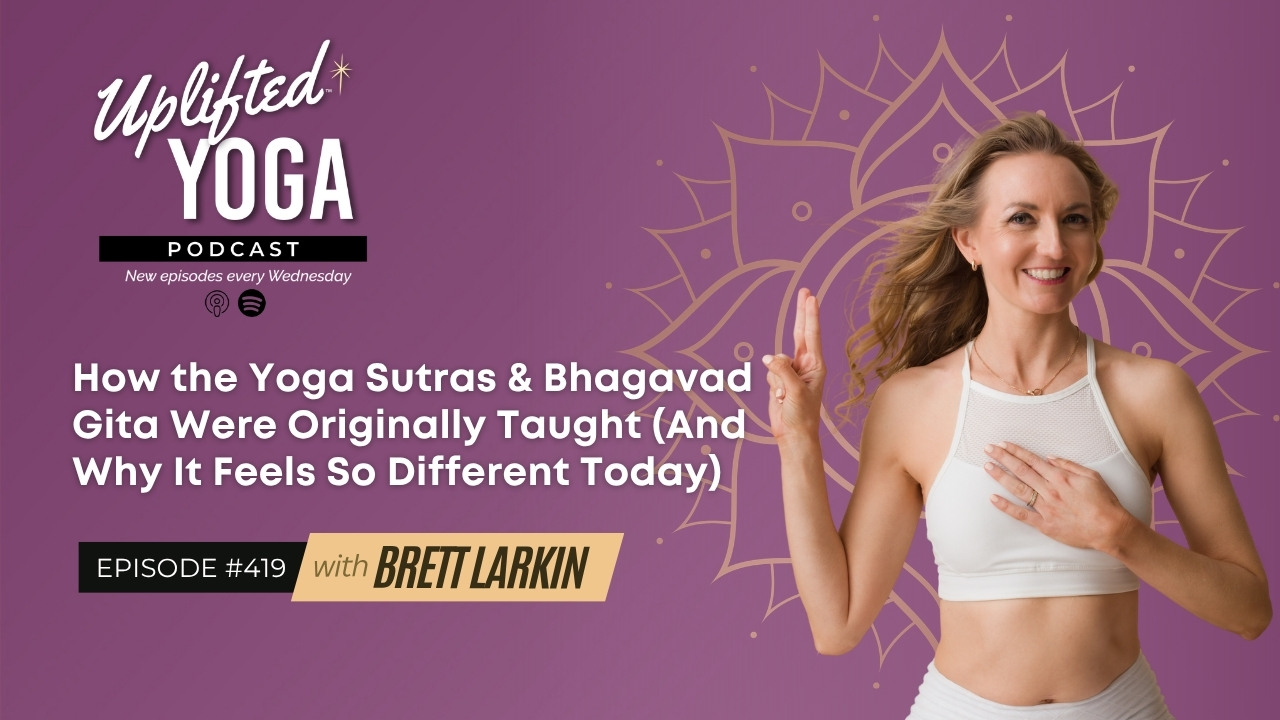
Have you ever wondered what the original learning environment of yoga philosophy actually looked like?
In this episode, I share why texts like the Yoga Sutras, Bhagavad Gita, and Upanishads were never meant to be read alone—and how studying in community can completely transform your understanding.
As I’ve been leading my Yoga Sutras Book Club, I’ve seen how powerful it is to learn this way—and why it might be the missing piece in your own practice.
We explore:
🔹 Why reading alone is actually a modern anomaly
🔹 How sutras were designed to be unpacked together
🔹 Why commentary and conversation deepen insight
🔹 How community supports nervous system regulation
If something feels like it’s missing in your spiritual study, this episode will show you why.
💖 Want to experience this in practice?
Join me inside the Yoga Sutras Book Club where we study these teachings the way they were originally meant to be explored—together, in community, and in conversation → https://www.brettlarkin.com/uplifted/
📘 Want the physical, glossy keepsake journal? Order it here → https://cart.brettlarkin.com/sutras-journal-pada1/
FREE Practice: 15 Minute Power Morning Vinyasa Flow For Strength
Relevant Blog: What Is Santosha? Yoga’s Philosophy of Happiness.
Relevant to Today’s Episode:
🐍 History of Yoga
📚 Healing with Somatic Yoga Book
🎧 Also Listen to:
#297 – What is Samkhya Philosophy and How is it Different from Yoga?
#358 – Intro to The Bhagavad Gita: How Do You Navigate Moral Dilemmas?
#364 – Dissecting The 8 Limbs and Their Origins
© 2026 Uplifted Yoga | BrettLarkin.com

Transcript:
Welcome to the Uplifted Yoga Podcast, where ancient yogic wisdom meets modern business strategy. I’m Brett Larkin, creator of Uplifted Yoga, where I’ve certified thousands of yoga teachers, built a multi-seven figure business, and guided over half a million students on YouTube. Here’s the truth.
You don’t have to choose between embodying deep yogic wisdom and building a thriving, freedom-based business. This podcast is your space to integrate both. Because yoga isn’t just what you do on the mat.
It’s how you show up in every part of your life. Whether you’re here to deepen your yoga practice, grow your teaching career, or align your energy with your purpose, you’re in the right place. Let’s dive in.
What was the original learning environment of yoga philosophy? Have you ever thought about that? There’s something a little strange about how we approach ancient yogic wisdom today. Often we buy a book, we read a few pages alone, maybe highlight a quote, and then often move on to the next thing. But that’s not how these teachings were actually meant to be learned.
The great yogic texts, like the Yoga Sutras, the Bhagavad Gita, and the Upanishads, actually weren’t written as private reading material. They emerged from a living tradition of conversation. Students would gather with a teacher.
They would listen. They would chant together. They would ask questions and reflect.
In fact, the word Upanishad literally means to sit down near. Near the teacher. Near the teaching.
Near each other. In circle. Wisdom wasn’t something you skimmed.
It was something you sat with. And often, a teacher would spend an entire evening unpacking just one line of the sutras or just one line of the Gita. The Yoga Sutras themselves were written as these little threads, these aphorisms, phrases that are short so they can be easily remembered and discussed.
They are intentionally not full explanations. They’re invitations, invitations to contemplate, to question, to hear how the same words land differently for different people. And something really powerful happens when we study together in this way.
Someone hears a verse in the Yoga Sutra and thinks about parenting. And someone else hears the same verse and sees their work life differently. And another person suddenly understands something about their meditation practice.
And suddenly the text is alive. Not just information, but a mirror for us. And that’s why my Yoga Sutras Book Club exists.
So we can sit with these beautiful ancient texts together and actually experience the way these teachings were originally meant to be explored slowly, thoughtfully, in community. And you are invited into this book club, into this experience. And today on the podcast, we’re going to be talking exactly about why you want to study this way.
Maybe you want to do it locally. Maybe you don’t want to do it with me. Maybe you want to assemble your own circle.
You could still use the Yoga Sutras journal that I’ve designed because it has a group discussion guide in the back. I want to show you the value today. And we’re actually going to look at the history of how these texts came together so you can see the many reasons that you want to sit slowly with these texts, but also explore them with other people.
Maybe you’re a teacher. Maybe this is something you end up wanting to offer to others. We live in a world that pushes us to skim, scroll, and move on quickly.
So today’s episode is about why people used to do the exact opposite. They used to take one small thread of wisdom at a time. And we’re going to see today why studying alone from a printed book is an anomaly.
It’s not the tradition. So let’s dive in to this week’s episode where we’re going to explore what the original learning environment of yoga philosophy looked like. Hello, my friends.
Welcome back to the show. As many of you know, I recently started a book club, a book club where we read the Yoga Sutras together and I can even print you and ship you this beautiful journal I’ve created that puts the Yoga Sutras in digestible 10-minute self-reflection prompts, as well as comparing it with poetry and artwork and myth to really help you retrain your attention. And for me, this was really developed from my yearning to be less on social media, less on my phone, less skimming, and going deeper with an ancient text.
But the other piece of this, besides kind of the retraining my attention aspect, was that what I found was that when I started reading ancient texts with my girlfriends here in community locally, it became the highlight of my week. First of all, it helped me complete the different prompts or study guides that we were moving through together because I knew I had someone I was going to go talk to about what we had all read. I think that’s like the basic premise of a book club, right? It encourages you to actually read the book because you know you’re going to talk to someone about it.
But beyond that, I learned so much from these other women, hearing their thoughts, their perspectives. And as I started doing more research, I realized that this way of being in circle together, learning in community, is actually the original learning environment of yoga philosophy. What we do today, where we’re reading something privately as like a book, is actually quite strange.
So the first key point I want us to look at today is that these texts, the Bhagavad Gita, the Radiant Sutras, the Yoga Sutras, the Upanishads, these texts were originally oral, meaning they were chanted. They were sung. They weren’t books to be read privately in someone’s home, first of all, because they didn’t have paper.
That was a huge limitation. They didn’t have paper. You actually, even if you wanted to read it privately, like probably you couldn’t because it was on one scroll that might be the only scroll that had that text within a thousand mile radius.
So these all started as oral traditions that were heard, memorized, and recited in community. The Vedas were transmitted orally for centuries before even being written down and getting on those palm leaves. So students memorize these texts through chanting with teachers in a very precise way.
And oral culture shaped pretty much everything about how these texts were actually written. So if we look at the Yoga Sutras, they’re very short aphorisms that require a lot of work on your part, and the text is inviting you into relationship, to discern the deeper meaning. Many of these texts work with repetition, with rhythmic phrasing.
We see that in the Bhagavad Gita, there’s actually a meter, a different meter and verse at different parts of the book, I believe. There’s also, we see in yoga, like call and response chanting. So these sutras, sutra literally means threads, if we go back to the Yoga Sutras, are memory devices, right? This is a memory device.
It’s not a standalone explanation, which is why if you’re just reading it like you would a novel in your bed at home, it’s not going to make that much sense. Because a sutra is just like a memory device. It’s like a bullet point for a teacher or a commentator to unpack.
So if you’re just reading through one of these texts or reading a sutra without commentary or without discussion, you’re actually missing out on the way it was intended to function. Okay, next big point, the way that yoga was taught back, back, back in the day, and this yoga philosophy was transmitted was student to teacher. Ancient yogic learning happened in what’s called the student-teacher lineage, meaning there was a guru and you as a student would learn from that person in a very personal mentorship model, basically like the opposite of a group yoga class at a studio or a gym like we experience today.
Students would literally move in with, like move into the living room of, or move right next door to their teacher or walk very far to get to them, but then like stay there for the entire day. And the student would learn through being in a relationship with that teacher, through listening, through questioning, through discussion, through repetition, through debate. It’s very similar to like a seminar-style study, like a small seminar, again, not silent reading, not like driving up to core power yoga, running, taking a 45-minute power flow and then running out.
I’m talking about a very intimate relationship with one teacher. And this is so important that the Upanishads have this encoded directly in their name. Upanishad literally means to sit down near.
Upa means near. Ni means down. Shad means to sit.
So philosophically and literally, these texts are assuming that you’re not reading them alone. You’re sitting with other people at the feet of your teacher. Now let’s zoom out and look at the fact that the Bhagavad Gita and the Radiance Sutras as well are literally conversations.
Okay? The Bhagavad Gita is not a manual or a treatise. It’s a dialogue. Arjuna’s asking questions.
Krishna’s responding. Then Arjuna interrupts and is like, what you just said makes no sense. Please expand on these things.
Krishna clarifies. So when we read the Gita, which hopefully you’re doing with me on the podcast, it’s basically an ancient spiritual coaching session happening in real time. And we get to be a fly on the wall.
In the Radiance Sutras, it’s like Shiva and Shakti talking to one another. So the structure of many of these texts themselves assume questioning, reflection, interpretation, mirroring how the text would have been read back in the day. It’s like a study group more than solo reading.
Now this is critical and something that I didn’t understand for years. Commentary was always meant to be part of these ancient texts. What does that mean? There’s the text.
So let’s say there’s the Yoga Sutras. But for centuries, no one studied these texts without another book on their desk or a scroll on their desk or a physical teacher right next to them who would provide commentary. If you’ve been loving all the yoga philosophy we’ve been exploring on this podcast, but sometimes feel like you’re missing the bigger picture, my History of Yoga course is basically your best friend.
It gives you a clear visual timeline of how yoga actually evolved from the Vedas to the Upanishads to the Bhagavad Gita, the Yoga Sutras, Hatha Yoga, all the way through to modern postural yoga. I’m talking slides, printable timelines, a gorgeous manual. Everything finally clicks into place.
If you want context, not just concepts, you can explore it at brettlarkin.com/history or grab the course at the link in the show notes. So as scrolls and papyrus and all the palm leaves became more readily available, big name teachers, famous teachers would write explanations that sat on top of the ancient text. So for example, Vyasa, who’s a sage, you might have heard of that name, wrote the earliest known commentary on the Yoga Sutras.
And then later philosophers kept expanding on that commentary. There are incredible commentaries on the Bhagavad Gita, for example. So I talk a lot about on the podcast how like translation is so important and reading multiple translations is so critical because the way different translators translate these ancient texts can really affect you differently or help you have an aha moment or help you see something in a new way or uncover a hidden meaning.
But what I don’t think I’ve been talking about enough because it’s only really crystallized for me as I’ve been developing the book club and seeing how much we’re craving like human connection and need these ancient texts as opposed to all the algorithm stuff on our phone is that yes, translation is important, read multiple translators, but also read commentary and read different commentators opinions and views. I have a version of the Bible right now that has really, really heavy commentary, but it’s so good. Like the commentary is phenomenal and it’s actually made me have so many aha moments with some of these ancient parables and myths, thinking about them in a totally new way.
And even though I had read them previously, it was like with a different commentator or with a version that didn’t even have commentary. And I wasn’t having the same insight. So if you can find like a great translation and then also a great commentary on whatever ancient text you’re reading, it’s almost like you have this best friend who’s holding your hand and unpacking all the behind the scenes meaning and context that you just wouldn’t be able to pick up on for yourself.
So in a traditional study, if you were studying yoga philosophy as it was meant to be studied, you would encounter, for example, the sutra, right? So that’s like the actual yoga sutras, the commentary. So you’d probably have another scroll of some famous teacher’s very detailed commentary on the sutras. So like 19 paragraphs that they wrote about Sutra 1.1. So you’d have the sutra, number one, you’d have the commentary, number two.
Number three, you’d have your actual gurus, like your actual in-person teachers’ explanation, like they would unpack further. And then number four, you would have discussion with other students who were reading it with you. One of the commentaries that I really love and read on the Bhagavad Gita, which is Eknath Eshwaran’s, is so comprehensive.
It’s like the super thick book, talking about like a nice fat book. And it’s only on the first six chapters of the Gita. That’s how big his commentary is.
It’s an entire extremely large book. And that’s only for the first six chapters. So there’s actually like three more books of commentary.
There’s another book I have that has much shorter commentary, just like two paragraphs per line of the Gita. And that one is great too. So it’s not like longer is better, but just like reading different translations is important, reading different commentaries is important.
And finding a commentator who you love can really change the game. The point is that reading it alone, like a self-help book, is very strange. That’s historically very, very new.
And as we see thematically, as often happens, ancient traditions understood something that modern neuroscience is rediscovering now, which is that understanding deepens through dialogue. Maybe you’ve heard that like, well, if you use a new vocabulary word three times after you’ve used it three times, like used it out loud, you have it. It’s like in your mind forever.
You got it. Often once I’ve verbalized something or taught something, it’s like in me, it’s in my brain in a totally new way. So understanding deepens through dialogue, through saying it out loud.
Neuroscience knows this. And what’s really cool is when we hear someone else’s interpretation or we dialogue with someone else who’s not ourself, often it challenges our assumptions. It might reveal blind spots.
It activates different ways of thinking. And for me, often it like gives insight into the text that is better than something a teacher could have told me because it’s coming from a unique person with a different background than mine, seeing something that I never would have even seen in the words or the meaning. And this is why nearly every wisdom tradition developed study circles.
There’s even a word for it in Sanskrit, satsang. Satsang. That means to gather together in truth, to gather together for a spiritual conversation.
This was another reason I wanted to create the book club because it’s like mostly often when we gather together in conversation in the modern world, what are people talking about? They’re complaining, right? Or we’re talking about politics or we’re talking about things that are 100 percent outside of our control or we’re finding common things to like lament about or we’re talking about other people or, you know, maybe it ends up in a gossip. Now, not not always, but I know for me, I was craving like I want to be talking to people and having deep spiritual conversations like that is my idea of a good time. I think all of us really crave this, even if we’re not aware of it.
And I think that’s why every wisdom tradition has this idea of studying scripture, studying ancient text, studying in community. And the last point I wanted to make about this is that these studies, as they happened in ancient times, were slow. They were slow and they were cyclical.
There was this great teacher, a monk who I used to study with, and it was crazy because he would move through the Gita, he would read the Sanskrit, and then he would lecture on what he read. And depending on his mood, where spirit led him, what questions people happened to ask would maybe only focus on one verse of the 20 that he read, let’s say. Then when we’d all come back next week, he’d read 20 more verses and would get sidetracked and end up kind of talking about, because of the student questions and where spirit led him, something from two weeks prior.
Then we’d all come back next week, read the verses and would actually, you know, holistically cover like the whole set of verses. But then the following week, he’d just end up naturally sort of digressing us to go back to the two weeks before and a verse in there that we hadn’t covered previously. So like, yes, we were like moving forward through the text, but in this like really lazy, meandering, going back, re-exploring, taking as much time as needed to expand on something.
And while I found this frustrating at times, because I was like, I’m never going to get through the whole Gita. I’m going to need to come to this guy’s classes for like three years to make it through the whole thing, because he was going so slowly and so much detail. But like that shows, right, like my Western mindset where the goal was to finish the book as opposed to the goal being to like really savor the nectar, the richness out of the present moment’s lesson.
And the way that he was doing this was much more of that traditional ancient model of study, spending hours on a single line. So the flow was that students would potentially memorize a verse, reflect on it, discuss it, and then also return to it repeatedly. So when I designed the Yoga Sutras journal, the format that I came up with of reading a small portion of the text each day, writing down in your journal the reflections, which you then will get to share with others if you choose, with an additional discussion guide in the back relating to everything you filled out in your journal, this way of moving through is actually much closer to the traditional practice than like either binge reading the entire book or like checklisting your way through some course on the book by yourself.
The bottom line is that these ancient texts were never meant to be consumed alone. They were meant to be heard out loud, spoken, questioned. They were meant to be alive and unpacked in a community.
The Yoga Sutras were mnemonic threads for a teacher to unpack. The Bhagavad Gita, the Radiant Sutras are literally a dialogue. Upanishads mean sitting at the feet of a teacher.
In other words, the original classroom of yogic philosophy wasn’t a quiet, silent library. It was a circle. And of course, we’re not going to end this podcast without talking about the nervous system because there is a nervous system angle to this too.
When we learn in community, what does it create? We get to co-regulate with other people who are on the spiritual path with us. Ideally, the circle is creating a sense of safety and shared meaning, which if you’ve read the How to Live Somatically chapter in my Healing with Somatic Yoga book, it’s like there’s all these lifestyle hacks we can do that are really so easy. Like in the chapter, I talk about loose ties and the power of loose ties and here of being in community because wisdom traditions and in ancient times, they knew that these circles weren’t just about transmitting information.
And yes, it’s like you have to travel to be together to get the information because we didn’t have books and the internet yet. But at a deeper level, they created environments where your nervous system could actually absorb the text, absorb the truth because you’re co-regulating with other people. There’s safety, there’s shared meaning with your teacher.
So group study is historically closer to how yoga philosophy was meant to be learned. Not a course on Teachable, not a checklist, not you reading by yourself in a silent library or trying to figure it out on your own. So if you want to join me to recreate something that’s actually quite ancient, even though we’re doing it online, I would love to have you join us for our next Yoga Sutras book club and I will put the link in the show notes.
And whether you are a student or a teacher, whether you’re reading the Yoga Sutras, the Bhagavad Gita or a totally different type of ancient text, I really hope that today’s podcast, learning more about the original environment of yoga philosophy and how it was transmitted inspired you. Thank you so much for being here all the way to the very end. Until next time, immerse yourself in some beautiful literature, move your body on your mat and take care of you.
Loving what you’re learning on the podcast? Apply the ancient science of yoga to your daily life, surrounded by incredible peers in my uplifted 200-hour online yoga teacher training, or grow into your role as a leader of others in my 300-hour professional program for yoga teachers, which is also a high-level business mastermind. At any time, I would love to welcome you into my Yoga for Self Mastery course to help you uncover your personal blueprint to serenity. Or join my Uplifted Yoga membership for an all-access pass to my most popular yoga courses, thematic class plans and practice calendars.
Don’t forget to prioritize your well-being and get on your mat today. From my heart to yours, namaste.