What happens when your hips can no longer do what your yoga practice asks of them?
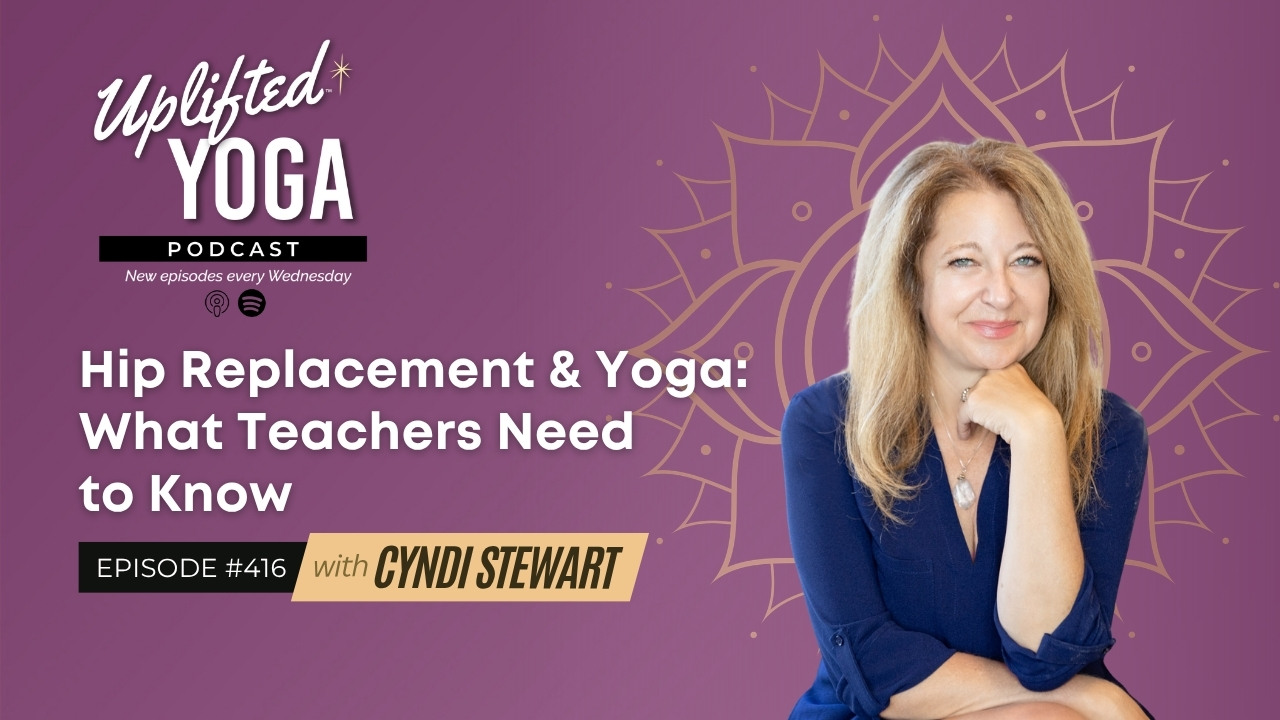
In this deeply honest conversation, Uplifted alum Cyndi Stewart shares her journey toward hip replacement surgery — and the identity crisis that followed. As a longtime yoga teacher, intuitive healer, and movement lover, she opens up about navigating chronic hip pain, reduced mobility, and the emotional spiral that can come when your body no longer “performs.”
We talk candidly about:
🔹 Early signs of hip degeneration and what yoga teachers often miss
🔹 Why strengthening matters more than stretching for long-term hip health
🔹 How overstretching can accelerate instability
🔹 What hip replacement surgery and recovery are actually like (timeline, pain, mobility, surprises)
🔹 Supporting students with hip replacements in class
🔹 The grief, ego, and surrender that accompany physical limitation
🔹 Somatic tools and meditations that helped regulate pain and fear
This episode is for yoga teachers worried about their own hips… for students navigating osteoarthritis or labral tears… and for anyone facing surgery and wondering what it means spiritually when your body says “enough.”
Your body’s breakdown is not your failure. Sometimes it’s an initiation.
🌈 Live Chakra Challenge https://www.brettlarkin.com/chakralive/
GUEST EXPERT: Cyndi P Stewart, PhD. | @stewartcyndi
Root Cause Health Solutions’ founder, Cyndi Stewart, PhD, uses a unique “Mystics approach” to get to the heart of chronic health issues. Through her own healing journey, Cyndi discovered that physical symptoms are often the body’s way of calling for attention. Her process integrates intuitive eating, bioenergetics, kinesiology, and the Akashic Records to uncover the root causes of dis-ease. A Kundalini and Uplifted Yoga teacher, she also uses yoga and meditation to ground her energy. To learn more about her work, including classes on Emotions & Metaphysical Kinesiology, you can visit rootcausehealthsolutions.com
Connect with Cyndi: https://rootcausehealthsolutions.com/
Read about surgery and recovery on Cyndi’s website here: https://rootcausehealthsolutions.com/body-mind-spirit-my-transformational-journey-through-hip-surgery/
FREE Practice: MORNING YOGA FOR TIGHT HIPS & LOWER BACK | Stretches for Flexibility – Unleash Your Creative Energy✨
Relevant Blog: 10 Yoga Poses For Hip Pain That Anyone Can Do
Relevant to Today’s Episode:
📚 Healing with Somatic Yoga Book
✅ 200-hour Online Yoga Teacher Training
🔮 300-hour Online Yoga Teacher Training
🎧 Also Listen to:
#285 – Is Yoga Enough…? with Dr. Jen Fraboni
#300 – Unraveling the Mystery of Chronic Pain for Yoga Teachers & Practitioners with Kim Patel
#369 – Nervous System Masterclass with Kristin Leal
© 2026 Uplifted Yoga | BrettLarkin.com
Transcript:
[Brett Larkin]
Welcome to the Uplifted Yoga Podcast, where ancient yogic wisdom meets modern business strategy. I’m Brett Larkin, creator of Uplifted Yoga, where I’ve certified thousands of yoga teachers, built a multi-seven figure business, and guided over half a million students on YouTube. Here’s the truth.
You don’t have to choose between embodying deep yogic wisdom and building a thriving, freedom-based business. This podcast is your space to integrate both, because yoga isn’t just what you do on the mat. It’s how you show up in every part of your life.
Whether you’re here to deepen your yoga practice, grow your teaching career, or align your energy with your purpose, you’re in the right place. Let’s dive in. What happens when your hips can no longer do what your yoga practice asks of them?
This episode is for yoga teachers and students who are worried about their hips, for students navigating osteoarthritis or labral tears, or for anyone facing surgery, or teaching people who’ve been through hip surgery, and you’re just wondering what it means when your body says, enough. Today’s story is a deeply honest conversation with Uplifted alumni, Cindy Stewart. She’s going to share her journey toward her hip replacement surgery and the identity crisis that followed.
She is a longtime yoga teacher, intuitive healer, and movement lover, and she really opens up about navigating chronic hip pain, reduced mobility, and the emotional spiral that essentially comes when your body no longer performs. So we’re going to talk candidly about early signs of hip degeneration and what yoga teachers often miss, why strengthening is so important, as well as somatic tools and meditations that can help regulate pain and fear. Cindy Stewart has a PhD.
She’s the founder of Root Cause Health Solutions. She teaches on intuitive eating, bioenergetics, kinesthesiology, and the Akashic Records. She’s a graduate of almost all of our Uplifted yoga teacher trainings.
I’m super excited for you to meet her. And before we dive in to this week’s episode, I just want to remind you that my annual Chakra Challenge is happening later this month. If you’re listening to this podcast on the day it comes out, you can sign up right now.
Go to the link in the show notes. This is such a fun way to just reconnect with your body every year, and I’d love to have you join us. Now let’s get into the show.
Cindy, I am so excited to have you on the Uplifted podcast. Welcome to the show.
[Cyndi Stewart]
Yeah. So good to see you, and thank you for having me.
[Brett Larkin]
Well, of course. You are an esteemed graduate of many of our programs, and you teach on kinesthesiology and the Akashic Records. And today we’re actually diving into, we were talking about this actually right before we hit record, and it really gave me the shivers a little bit in a good way, which is that we can do so much work spiritually and on ourselves.
And ultimately, we’re still in this human body that is valuable and that disintegrates. And I think I’ve been reflecting on that a lot because I had a big birthday. And you went through what is quite a big surgery, and I think a lot of people don’t know, actually quite a common surgery for people in the yoga world going through a hip replacement.
So tell us a little bit about you and your background, and then where you want to start with this journey.
[Cyndi Stewart]
Yes. And I feel really passionate about sharing this journey with hip surgery because what I learned through my process and just doing the typical sharing on social media about getting surgery, this is how I’m preparing. I couldn’t believe the amount of people that responded with, thank you so much for sharing this information.
Now, I wasn’t able to find a lot of information myself on preparing for surgery and mindset and physically, etc. But I was also surprised by how many people said, I’m getting ready to have hip surgery, so this is very useful, or I just had hip surgery. So once again, because I talked about post-surgery, this is very useful as well.
So what stood out to me is this information needs to be shared. And I love using myself as a vessel to share the information because not only I know it really well now, and I can speak to it really well, but I love being able to help people through those pieces that just aren’t available. So I’m passionate about this topic.
And then where we started with is that the journey, the transformation, the soul spiritual journey is where most of my work has been. But at the same time, understanding that we have this physical body that sometimes doesn’t up-level as quickly as our capacity around energy or understanding and awareness. And I feel like perhaps that’s where I had a little bit of lack of integration.
And other people, that could be what they’re going through, it could be other things. But I always love bringing to the space a different view or perspective on our physical body, on our spiritual journeys.
[Brett Larkin]
I think there’s also this piece that it’s like, well, if I practice yoga, like I should just be immune to this stuff. Like I shouldn’t need surgeries. And I did this, you know, very intensive yoga for cancer training that was beautiful.
And I learned so much about that. But there’s something particular about a surgery like a hip surgery where it’s not cancer. It’s like there’s actually a joint that one who’s a yogi might think, oh, well, I’m in lunges and I’m in Sukhasana and I’m, you know, why is this going to be an issue?
So I guess walk us through the journey, because when you first found out about this, were you really taken aback? What were the first symptoms? Let’s like do story time.
[Cyndi Stewart]
Yeah. So as someone that practices yoga, more so Kundalini now, but still do, you know, integration of some vinyasa with Kundalini. And I absolutely never felt that I would be at this stage of my life on the path to needing a surgery.
And it was very emotional. It was saddening. I, of course, started wondering how, what did I do wrong?
What did I miss? And so it was having that compassion for myself, starting always down that path. And then really paying attention to the symptoms, because I was, I kind of checked out of awareness because I’m like, this can’t be possible.
I didn’t end up having a tear. I had a labral tear, which took me a little bit of time until I actually went in and got the x-ray. But it was very clear on the x-ray.
[Brett Larkin]
And what were you feeling at that time? Because I think, you know, keep in mind, we have so many yoga teachers listening to this. And I think most people listening to this are probably not like pushing their students aggressively into deeper and deeper lunges and stretches, because that’s not the uplifted method.
But it’s like, what should they be aware of and thinking about that maybe you weren’t even aware of originally when, you know, what were those like early warning signs?
[Cyndi Stewart]
Yes, yes. Great question. And I wasn’t heavily pushing myself.
I did perhaps push my whole life as opposed to wanting to always get better and expand my understanding of my journey. But I wasn’t doing extreme pushing with my yogi practice. And my first symptom was pain in my right hip area.
And I just thought I tore something or bruised something or maybe it was kind of like a lower back pain in my hip.
[Brett Larkin]
And when you say hip, I’m going to stand up and like actually point to my booty for where and then I’m going to like visually describe it to everyone because this is something else I talk about in teacher training is like your students will say something like hip. And then I remember when I’d ask like point to where the pain is, and they’d point to their psoas or they’d point to their sacrum or they’d point to, you know, it like sometimes what your student is telling you. So I always I mean, that’s like I think a good tip.
If you’re a teacher who’s listening, like ask your students, be like, can you point to me where the pain is? Because sometimes they’re using words that aren’t anatomically correct for describing the situation. And if you have them point, it’s like very hard to misunderstand each other.
Or it also like for me, I’m very visual. It would help me understand better how I might need to adapt or modify for them. So are you talking about like back here?
[Cyndi Stewart]
So it’s actually this is actually really important that you’re doing this because that’s where you would think. And it actually was not. It was in the front right along.
[Brett Larkin]
Okay. So everyone, if you’re listening and can’t see the video, like I’m pointing to like where you’d feel a stretch in pigeon pose, like on the back side of my bum. So, okay.
It was not there.
[Cyndi Stewart]
So I’m kind of forward.
[Brett Larkin]
Bikini line. Yeah. Okay.
[Cyndi Stewart]
Right. Okay. That’s why initially I had the same thought as you.
My hips over there. My hips back here. Right.
But the pain, and that is the most common place that people share with me where they feel the pain as well. Specifically, they have a tear, a labral tear.
[Brett Larkin]
Okay. So right where your bikini would be, essentially. Yes.
For you to the left or the right of the pubic synthesis. Right. Right.
[Cyndi Stewart]
So if someone is saying, pointing to that area, really important for them to just be. Yoga is still very, of course, helpful and relaxing. There’s so much we can do.
But there are certain poses they shouldn’t say, let me push a little bit more. That’s when it would be better to.
[Brett Larkin]
So where were you noticing that in like a low lunge, for example?
[Cyndi Stewart]
Yes. So where I actually can sit very easily cross-legged and that’s where I noticed it at first. I was not able to on the right side.
[Brett Larkin]
Okay. So you go to sit down for meditation or just to do seated postures. And on the right side, you’re starting to feel like a little, and do you prop yourself up on a cushion or do you usually just sit on the floor?
[Cyndi Stewart]
Usually just sit on the floor. And I do that every day because I do all the warm ups with Kundalini. So I do the Sufi circles.
I do spinal flex.
[Brett Larkin]
And I hear you. I don’t love doing those on a cushion. I love meditating on a cushion.
[Cyndi Stewart]
Yeah, exactly.
[Brett Larkin]
Okay. And so what did it feel like? Just like pinchy, uncomfortable.
Describe it for us.
[Cyndi Stewart]
Really uncomfortable. And normally my knees are on the floor and my left was and my right wasn’t. I had to prop it up.
And that’s when I first noticed. And first I was like, okay, maybe that’s okay. Like props are, we all need them sometimes and they’re good.
But I just knew, and it was so drastic from how it was.
[Brett Larkin]
All right. So that’s how it started. What happened next?
Like, when did you actually be like, okay, I need to make a doctor’s appointment?
[Cyndi Stewart]
Yes. So I first worked with many different healers and practitioners, which I’m grateful for. I got a lot of great support.
And this is where, before I go down to cycling, the emotional part comes in. I remember one of the physical therapists I work with, she had me, like the second or third session. She picked up my leg and she put it, rested on her shoulder.
And she goes, I just want you to fully let go of your leg and let it rest on my shoulder. So, you know, she wanted to work on my hip. And when she said that, when I fully let go, I just broke out in tears, crying.
And I was like, that’s what it is. I’m just not fully releasing, accepting, letting go what is going on with my body right now. And that was the best, deepest release I had about my hip at that time.
Yeah, it was such a great awareness. And for me, just I have many people in life, right? How many times we keep going, going, going, pushing through, we can do one more thing.
And sometimes it’s just to also sit back and observe and what’s happening here. And I was not giving myself that time.
[Brett Larkin]
Yeah, it feels like a true somatic release.
[Cyndi Stewart]
Yes, exactly.
[Brett Larkin]
And I want to call out too, it’s interesting because I feel like this is what so many of us in the yoga or wellness community do. It’s like the doctor’s appointment is always going to be like our last resort. Like I, for me, I’m like, I’m going to go see my MFR person.
I’m going to go see this person. And so it seems like you had that too. Like in retrospect, like how do you feel about that section of your journey?
[Cyndi Stewart]
I probably could have definitely brought the doctor in earlier than I did, but I still feel all the healers I work with were so integral to my actual healing process after the surgery, because the more your body is built up for the surgery, the quicker the rehab will go after. So it was all needed.
[Brett Larkin]
And was this hurting you as you were walking around and walking up and down stairs as well? Like it manifested not just in a meditation seat. Eventually it was permeating throughout your lifestyle, I’m imagining.
[Cyndi Stewart]
Eventually it got there. So with the healers and the practitioners, I was able to go about a good year and a half with being able to do just about everything, not running. When I was new, that would definitely make it worse.
[Brett Larkin]
Year and a half is a long time. And what was what was like the resounding things they were telling you during that time? Were they like focus on strengthening instead of stretching or like was there any like overarching stuff that they were promoting?
[Cyndi Stewart]
They were. They wanted me to build up the strength, the muscles around the hip area, which makes sense. Right.
Because then it would support the tear.
[Brett Larkin]
So what did that look like doing? Like, was that look like doing donkey kicks or squat? You know, walk us through like what some of that looks like.
[Cyndi Stewart]
Yeah, that’s exactly what it was. So from a yoga therapy perspective, I did work with someone that does yoga therapy. I was doing a lot of cat cows and then exactly putting the donkey with my legs and then in and out.
That was probably the most important exercise that I did. It wasn’t easy for that leg. Easy on the other side.
It was interesting finding something that normally was so simple, very difficult.
[Brett Larkin]
And that’s a really long time. So did you feel like those exercises did help? Clearly they did because it bought you 18 months.
[Cyndi Stewart]
Right. But eventually, and I’m not sure if just the muscle started getting like losing too much, like I wasn’t able to activate it is how I felt. I was just getting too much muscle loss.
Or did I injure it doing something else or just overall inflammation? There’s so many aspects to it. But when the surgeon took the X-ray, I didn’t even have to go to the MRI.
They could see it right on the X-ray and it was bone on bone.
[Brett Larkin]
Yeah. What was that first doctor’s appointment like?
[Cyndi Stewart]
So I first went to a nurse practitioner with the same center, orthopedic surgeon center, and she gave me, you know, the typical, which was fine, the cortisone shot. And it did work. It did help.
And she even said it may, this may help, this may not. But I think it makes sense to start here because you are active. There’s a good chance that it may not get any worse.
And you can go quite 20 years till maybe you need surgery. So my head thought I have 20 years, I’m OK. And then I didn’t.
When I noticed it, my, it was getting more difficult to do the regular activities that I enjoy doing. And then one time I was hiking with my husband because that’s what we do in Colorado. And luckily there was a shortcut back to the car because I, after about 30 minutes, the pain was too much.
And I was like, now my life’s getting small.
[Brett Larkin]
So how much time did the shot buy you, do you think?
[Cyndi Stewart]
Almost six months.
[Brett Larkin]
OK. Yeah. OK, so this is a slow process.
And then after the shot wore off, at what point did surgery get brought up? And then what did that bring up for you emotionally?
[Cyndi Stewart]
That was huge. The fact of someone that, you know, stays in this work of lifestyle management and going through surgery for something that I put so much pride and attention to. It was definitely, I felt not necessarily like a failure per se, but I felt like I missed something.
Like, how could I miss this? How was there not something else I could have caught earlier in getting past that? And actually, the part that got me past it was the way I was able to help and support others from sharing my journey.
That was really integral. That kind of re-motivated me again. It’s like, OK, there’s another purpose and meaning in here for me.
And then it felt good.
[Brett Larkin]
I was so excited to connect with you around this because, again, there were so many things we could talk about, right? But I think so many people miss that, like, so many yogis have hip replacements. I remember the first time, maybe not the first time, but one of the times that I sat down to film with Anadeya Judith, who many of you know is just the most incredible author.
Like, she’s a huge mentor for me and she co-teaches the 300-hour training, the bioenergetics and the chakras with me. I just looked up to her so, so much. And we sit down and she mentioned to me that she had both hips replaced.
And she said she really felt like a failure of yoga in many ways, that it was just constantly promoting like this external rotation, external rotation, this flexibility. I could see that she was very cognizant of, you know, cognizant of that and, you know, caring for her body in a different way now. And I was like, wow, that is so interesting because I never would have guessed that she’s someone who had a hip replacement.
And then, you know, there’s so many non-yogis in our life who have hip replacements, like my stepdad had a hip replacement. I mean, it’s just so incredibly common. But I don’t think people realize how many people in yoga end up with this surgery.
And so I really want to honor you and thank you for talking about it. And again, I think, you know, keeping in mind that we have teachers listening here, like how can we sequence in a way or even just talk more to our students and figure out, like, what are the early ways that we can prevent it? And I know we’re going to get there as well.
But I want to stay with your story for a little bit longer. Sorry to interrupt and we’ll get right back to the show. But if you’re already a yoga teacher and feeling that quiet nudge for more depth, my online 300 hour yoga teacher training is where your teaching becomes embodied, not just technically strong, but intuitive, grounded and truly yours.
It’s open year round and fully online so you can move at your own pace. It’s also supported live. It’s deeply experiential and designed to help you integrate nervous system awareness, subtle body work and your own authentic voice as a teacher while giving you all my best business strategies.
Amplify both your income and your impact. Start treating your business as a spiritual practice. Learn more about the uplifted, advanced 300 hour teacher training at BrettLarkin.com.
Did you fight like we were like, no, I don’t want to do the surgery? How long did it take to kind of come to terms with like this is happening? And then how long, you know, did it take to actually get the surgery scheduled?
Because that’s another thing that’s crazy with medical world now that I’m finding is like if you want something done, it’s like four months before anyone can do anything. I mean, I don’t know if there’s a doctor shortage or if it’s the way insurance has changed, but I just don’t remember it being like that when I was younger.
[Cyndi Stewart]
You’re exactly right with all of that. So I definitely went into the fight part of fight and flight. I was definitely not ready.
I was still like, there’s one more practitioner I could see. There’s one more thing I could do. But the part that really got my perspective in the right place was like, as I mentioned, my activity was getting smaller and lesser what I could do.
And then that was starting to upset my mental capacity because then it’s like, you know, not having the course I could do breath of fire and get a lot of oxygen in me. But just the actual movement of our bodies is difficult when the cells don’t get the oxygen they need. So it was impacting me more so than on a physical level.
And I was able to witness that. So that’s what led me to the research and kind of what you’re saying. What probably takes a bit of time is you want to make sure you have a good surgeon, one that has done a lot of surgeries and someone that has good reviews.
So I had to take the time to do all that. And by the time you get the appointment and get all the other pieces of insurance covered and the doctor’s visits pre and post set up, then surgery is a couple months later.
[Brett Larkin]
Yes. And was this the first major, like major surgery that you had had or had you had prior surgeries with anesthesia and everything before?
[Cyndi Stewart]
I’ve had smaller surgeries with anesthesia, but this was first major. Like the other ones was able to get up and walk out and leave after.
[Brett Larkin]
Which that itself, I think, brings up so much and feels scary and it is just different. So how did your yoga practice look throughout this period? And I’m talking both the physical piece of kind of maybe the maintenance you were doing, maybe like, you know, all the strengthening stuff you’d already learned.
I don’t know, you tell us. But also what did what did the spiritual piece look like leading up to, you know, preparing yourself emotionally and getting your body ready for for this?
[Cyndi Stewart]
Yes. And that was really important to me to make sure like the better I knew I was going in, the better I would be able to heal coming out. So for me, as I mentioned, I already mostly do Kundalini and that was just perfect for what I was going through.
Most of the exercises are on the floor, which made it easier. And for me, focusing on keeping my spine flexible is what helped my hips relax. And it makes sense logically, but it was something I never thought about or talked about before.
I mean, I always am a big fan of spinal flex for all the other benefits, but I really noticed it because that one hip would just be a little bit lower on the prop or get a smaller prop after I did the spinal flexes. So that meant being a big part of the warm ups every day for me just to get going.
[Brett Larkin]
And then were you doing any kind of like meditation or positive visualization or I mean, what did that look like?
[Cyndi Stewart]
Yeah, and I landed up coming up with my own meditations. And for those that have ever struggled with pain, they’ve all experienced this, that you kind of have like a pain cycle. And I’ve noticed there was like a count almost between each like jar of pain.
So maybe the count, like I started counting and this was just a meditation I was intuitively getting, I think it was like 10 counts and then there would be like a jar of pain. And I started challenging myself just intuitively, like, what would it be like if I could get that jar of pain to come to 15 counts? And then I kept challenging myself, like, how can I keep myself in a relaxed state enough with my breath and letting go of the overthinking of the what ifs and just allow myself to just notice this, what I was calling this kind of pain cycle.
And it was really neat how I just landed up coming up with my own approach that I’ve shared with many people afterwards of how that’s helped me kind of relax it. And for those that have ever worked with color therapy, which I work with in kinesiology, it works really good with emotions. There are certain colors that you can just visualize all over your body, specifically on the area of pain, like green is known to be very healing, blue is very calming, and of course, anything white, crystallized white.
So I started bringing in colors to the hip area and that lined up coming into my meditation in addition to the breath.
[Brett Larkin]
That’s amazing what you’re talking about with the counting and then the feeling the pain, because it almost feels like it’s like rewiring the neurons that fire together and wire together in real time in meditation. So, so, so cool, like excited to see what you’re going to continue to do and develop with all of that. And then surgery day, you finish the surgery.
I mean, what is that recovery like? Like, talk to us now through the recovery period or anything you want to mention about the surgery itself.
[Cyndi Stewart]
Not bad at all. Specifically, a lot of people like myself, I think back in the day, if you’ve heard hip surgery, that was probably some of the other challenges that made me hold off. Like you were in the hospital a few days and it was like two weeks till you walk.
Well, of course, times are totally different. You’re up and walking within a few hours and you’re discharged a few hours, literally after you can eat and go to the bathroom, you were discharged. So it happens pretty quickly.
You’re a little bit nervous and surprised how quickly it happens. But physical therapy comes in and shows you how you can walk upstairs and how you can go to the bathroom and take a shower, all the basic activities. So it actually did work out fine.
The one thing that I learned while I was there is that there’s different kinds of pain. The nerve endings are like almost like a stinging, burning feeling. So that was something I was not prepared for.
The actual bone, the cutting of the bone was the least painful. I thought that might be the most difficult, but that didn’t bother me. And then a little bit more challenging is just the muscle loss from that area.
And they cut the muscle. So muscle relaxers kind of what we use for back pain. That was something that I probably needed a little bit longer than I was anticipating just to rebuild.
[Brett Larkin]
Will you describe for people just a little bit like what actually happens in this surgery, like what gets cut away, how the muscles are affected, what gets put in? Because I think it would be helpful to hear that visualized.
[Cyndi Stewart]
OK, I’m going to be honest. I didn’t watch the video on that, which is maybe probably for the best, but I mean, a high level, I need full replacement, like full hip, full socket, full ball. Everything is brand new where I’ve heard for others.
It might have been a partial. They might be able to some of it wasn’t so damaged. They able to hold on to some of the pieces.
Mine is completely. Yeah, the whole area was taken out and replaced. And I could feel it like, you know, as for anyone that does yoga or they’re connected with their body just from whatever activities they do, you can feel the difference between the two hips.
It’s not as pliable and it it just feels foreign. It feels good. It feels much better than it did.
But I can tell that it is not the one I was born with.
[Brett Larkin]
Yeah, it’s a foreign object in your body. Just if you’ve had plastic surgery or anything like it’s a foreign thing. So I think that’s important to to draw awareness to.
And then like how long until you like again, talk us a little bit more through the recovery in terms of like weeks and then like how did yoga get reintegrated and what did that look like?
[Cyndi Stewart]
Yes, common question I get. I would say about two weeks is the period to where you feel like, OK, I could kind of hop around pretty easily. Prior to that, the first two weeks is challenging.
I used a walker. Many use a walker or they use a cane. I wouldn’t anticipate anyone would want to do anything outside of the house for the first two weeks unless it’s something that’s very basic where they can just get in the car and someone can drive them.
But I would say plan to be down for about two weeks and give yourself that time to heal. And especially if you’re an overachiever, maybe give yourself two and a half.
[Brett Larkin]
Everyone listening to this show. OK, perfect. And then did you go right back to the Kundalini and that was sort of your reentry point because you could do a lot of it seated?
[Cyndi Stewart]
Exactly. Yeah. So I had exercises to do every day from my physical therapist, which were similar to yoga therapy, just lifting my leg different ways.
And then absolutely as soon as I could get myself in that state and the meditation was actually really difficult for me in the beginning because all the anesthesia and the medicines kind of altered my brain capacity. But connecting with breath was the savior for me, just being able to count my breaths because that was something I could focus on. My brain was able to like follow the process.
And then you always feel better when there’s energy, oxygen coming into your brain and your body. But an actual meditation took me at least two weeks, maybe even longer. My brain really was that was the longest part for me.
And I shared that in the article I wrote for Substack on my journey. And just for those that know about this, I do have a hindrance with my detox systems. And there’s something called MTHFR, which is genetic in the liver.
A lot of people, if they know what it is, they know what I’m talking about. So you have a slow processing liver. So it takes a little bit longer for medications and things like anesthesia to leave the system.
And they tend to linger around the brain area a little bit longer.
[Brett Larkin]
That’s interesting. So what would you have yoga teachers know if they have someone come into their class who says, I’ve had a hip replacement?
[Cyndi Stewart]
Good question. So afterwards, I was just so excited when I can sit cross-legged again. So that was really special for me.
But with props, like there was no reason to push it, like make sure have the props available. And I think back to my earlier days when I did yoga, I really wanted to do all the poses without any props. And then as you become a teacher and you get more ingrained, you’re like, that is the most ridiculous way.
But we just naturally think that, right? We just want to be able to jump in and do whatever we want to do. And just how important that foundation, that safety is to have the props there.
[Brett Larkin]
So you really use props, not push it. When you sit cross-legged on the floor now, is it still elevated on that side? To normal.
Back to normal. Incredible.
[Cyndi Stewart]
I know.
[Brett Larkin]
And I mean, you’re retrospective on this whole journey. Are there things that you would tell someone like me, even? Like, maybe do less of this and more of this, or maybe focus more on this and less on this.
Like, what would you have us know?
[Cyndi Stewart]
That rotation for people, either if pigeon is difficult, say, or cross-legged easy pose is difficult. Allow yourself the grace to let it be where it’s at. And it will get more flexible over time, but pushing it will only potentially add damage in the future.
It may not be for some time, but those are parts of the way our body is just structured. That if we give it the support it needs and what we say, push it, you know, meet it at its edge, it’s just exactly where it needs to be. It doesn’t need to go beyond that.
There’s nothing to prove in a pose. It’s really, it’s just our own inner journey.
[Brett Larkin]
Yeah, don’t push it. Don’t try to prove. And then I’m thinking, like, maybe we should be doing those donkey kicks, like, now or earlier.
Or, I mean, is there anything you would say to that? Bridge pose was really good. Bridge pose.
Bridge pose.
[Cyndi Stewart]
Yeah. Yeah, those were the two that I felt were most helpful for keeping that area, the muscles around it, as healthy and strong as they can be.
[Brett Larkin]
And the donkey kicks are just like being on all fours or on forearms, like, in the cat-cow position, but just lifting the leg and going to one side of the knee and the other side of the knee and up and pulsing and all of that kind of thing, right? And it’s not a matter of how high, right? It’s activating that area.
It’s strengthening, not stretching. And I think that’s something that we harp on in 200-hour teacher training, right? We’re always like, range is of the ego, form is of the soul.
And, you know, it’s like the older we all get, the more we realize that a lot of us are sensation junkies and we’re chasing sensation. And that pulls us deeper into stretches. And it’s the flexes in our class that the people who are really hypermobile that end up more likely to have an injury than those who are, you know, maybe a little bit more stiff.
And we need to focus on strength. I think that’s like the number one thing that as we all get older or all mature in our practice, it’s like… And the way I deal with this, and I write about this in my book, Yoga Life, it’s like I relax into the lunge.
I enjoy it for one second, how like juicy it feels to be, you know, just like sensation stretch. Yes. And then I’m like, okay, let’s be responsible, right?
Like squeezing our thighs together, activate all the musculature. And props can help us do that as well. Like props are not just a crutch.
I mean, you did 300 with me and you know, it’s like we have a whole module in there of like how we use props to actually make muscles work harder and make poses more challenging by adding additional touch points and feedback points for the body.
[Cyndi Stewart]
And actually, Brad, that was probably one of my favorite parts of the training because I did not see it that way prior. That’s really important.
[Brett Larkin]
That makes me so happy to hear. So tell folks how they can find you, what they can study with you. I know you’re so multi-talented.
As I said, you know, Cindy’s taken so many uplifted trainings. We were together live at the Mastermind in Miami where you taught this beautiful Akashic record meditation that I still think about. So whether someone’s interested in that or all you teach about kinesthesiology, like what’s the best way for them to connect with you now?
Especially if someone’s listening to this and maybe is in a similar situation to you and is, you know, thinking about upcoming surgeries or has someone they know. Do you have some sort of like resource portal or that article you mentioned? Like how can folks best connect with you?
[Cyndi Stewart]
Yes. So my website is called, one word, Root Cause Health Solutions. It’s a little bit long, but probably once you get to like root cause, I should pop up.
[Brett Larkin]
Root Cause Health Solutions. I love it.
[Cyndi Stewart]
Yes. Who doesn’t want to get to the root cause? Like, I love it.
Right, right. That’s exactly how it’s been. So as you shared, I work in a couple of different areas, but they all integrate.
And I would say if someone’s interested in kind of like, because I get this a lot, I have a free consult and there’s just a quick little form you fill out before the consult. And I ask what services you’re interested in and people usually say, I don’t know all of them. It’s the most common, which is totally fine.
But then there’s another paragraph to give a little synopsis of what you’re going through. So I pretty much customize the approach. I work with everyone.
So I work with the physiology through something called bioenergetics. I am trained as a functional nutritionist. So we will look at the basic, just what’s going on with your body and nutrients.
Within that, I work on the energetic side of the imbalances between either systems or organs or muscles, just looking at the whole body. And then within that, I just learn from my journey, like we get so far in the physical, maybe we get a little bit further than we want to get. And then the emotional side starts popping up.
And what are the emotions that are holding us back from getting to the next level? And that’s how I got involved with kinesiology. Initially got certified as a biochemical kinesiologist to work on the nutrition side.
But then I landed adding in the emotional metaphysical side as well. So I could look in each system like, what’s the trapped emotion that’s going on there? And that’s really important.
People understand like, I thought I dealt with that. And it’s like, sometimes we do. And sometimes they get stuck in our body or they reappear when we have a new illness or injury.
[Brett Larkin]
And you have both group programs, group trainings, and you’re working with people privately. Is that right?
[Cyndi Stewart]
Yes, exactly right. So some people, if they’re interested in themselves or they’re interested in like how I always felt, I’m like, I just would love to get trained in it because I can help myself and then help others at the same time. And then lastly is the spiritual, the soul journey, because that is kind of encompassing all the aspects of why we came here at this time to learn and experience everything we’re learning.
And that’s how I got into the Akashic Records. I initially was, I would call myself an intuitive or intuitive development or intuitive coach, which I still fall under that category. But I found the experience for myself working with the Akashic Records, which is the journey of our soul over all our lifetimes, or some people may not feel they resonate with that.
So to me, it’s the journey of the soul through our ancestry line, which is holds, as we know, a lot of power and energy that gets transferred down our line that we’ve proven in science, not just our DNA or emotions and our trauma, right, carry down the ancestry line. So I work with the Akashic Records and understanding that in our journey, the karma, what we came here to experience. And it’s those sometimes karma.
And I think you wrote about this in your book, right? It could be such a big word or misunderstood word. And to me, it’s the patterns that keep showing up for you again and again.
And either we try to squash them or ignore them or get away from them, where I’m like, let’s look into those because that is where the lessons or the blessings are going to be in understanding who you are and what you came here to experience. So just a little different spin.
[Brett Larkin]
Yeah. Well, what I admire about you so much is I feel like you just you’re one of the few people who knows so much about the physical and the anatomical and the nutrition level. And then also, you know, like the soul and the spiritual level.
It’s a really unique combination. So those of you that are interested, I will link up all of Cindy’s links in the show notes. Consider one of her trainings or privates.
Thank you so much for just being vulnerable and sharing today. I hope this was helpful for everyone listening. Whether you have a friend, a family member, yourself, a yoga student, someone in your life, point them to this episode if they’re needing more information.
And Cindy, thank you so much for being with us. Thank you for having me. Let me share the story.
Also, a high level business mastermind at any time. I would love to welcome you into my yoga for self mastery course to help you uncover your personal blueprint to serenity or join my uplifted yoga membership for an all access pass to my most popular yoga courses, thematic class plans and practice calendars. Don’t forget to prioritize your well-being and get on your mat today from my heart to yours.
Namaste.