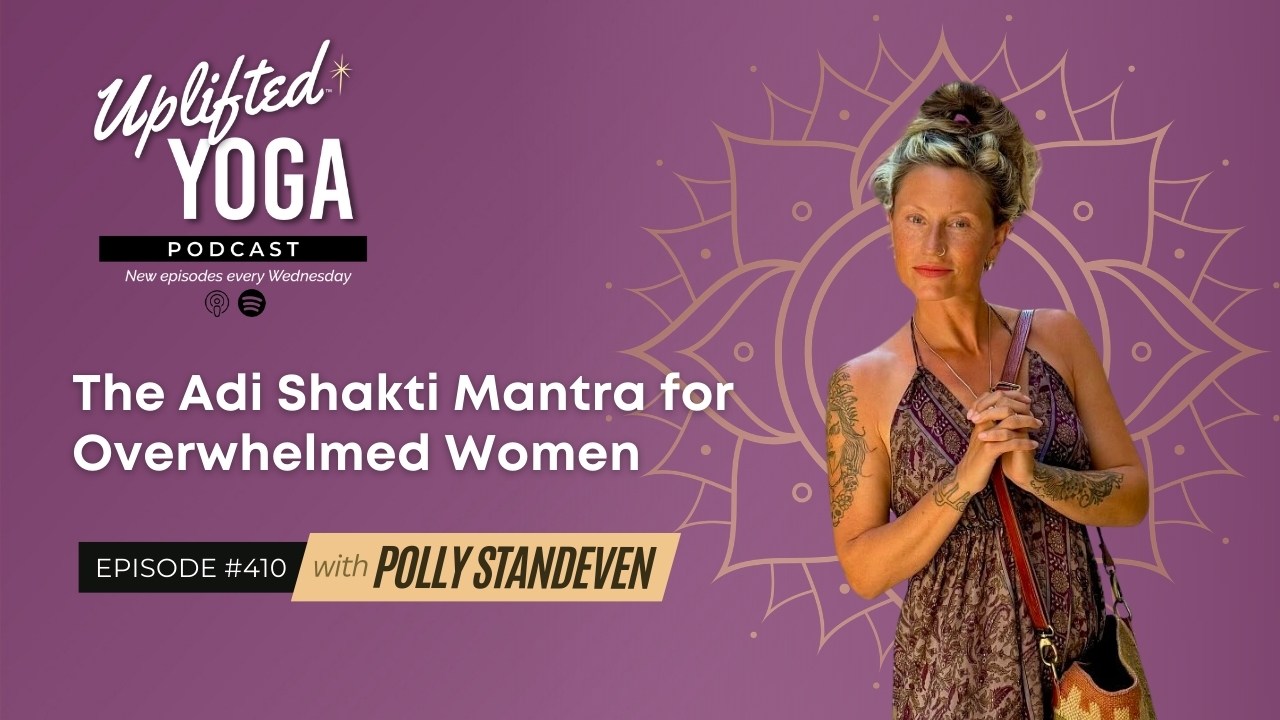
If you’ve been feeling braced, overextended, or stuck in your head — this episode is for you.
In this conversation with one of my Kundalini Yoga Teacher Training graduates, Polly of North & Soul, we explore the Adi Shakti mantra not as theory… but as medicine. This isn’t just a breakdown of Sanskrit.
It’s a conversation about what happens when you stop micromanaging your life force — and allow energy to move again.
In this episode, we explore:
🔹 Living at “two out of ten” versus fully expressed in your energy
🔹 Kundalini as your magnetism — your truest creative essence
🔹 How conditioning and trauma constrict your life force
🔹 Shiva and Shakti as awareness and energy inside the body
🔹 Why surrender feels unsafe when your nervous system learned to brace
🔹 The nurturing frequency of Mata Shakti (Divine Mother)
🔹 How to use the Adi Shakti mantra as an anchor when overwhelmed
🔹 The exact mudra and meditation setup
We also talk about what it means to soften without collapsing.
To allow energy to move instead of clamping down.
To trust that you don’t have to control everything in order to feel safe.
If you’ve been trying to hold it all together — this episode invites you into a different way.
And, if this conversation awakens something in you, my upcoming Kundalini Yoga Teacher Training goes deeper into:
• Mantra & energetic anatomy
• Shiva–Shakti integration
• Nervous system regulation
• Embodied leadership
https://www.brettlarkin.com/online-kundalini-yoga-teacher-training/
GUEST EXPERT: Polly Standeven | @northandsoul
Polly Standeven is the founder of North & Soul, a Kundalini teacher, and community leader devoted to feminine alchemy, energy work, and heart-led living. She is a graduate of Brett’s 200-hour YTT and Kundalini University and has taught inside Brett’s programs.
Connect with Polly:
Instagram: https://www.instagram.com/northandsoul
YouTube: https://www.youtube.com/northandsoul
Community: solcircle.tv
Website: www.theinvinciblewoman.co.uk/lilnew
FREE Practice: 20 Min Kundalini Yoga for the Entire Body | KUNDALINI YOGA FOR HEALTH
Relevant Blog: Adi Shakti Mantra: Manifest Your Divine Femininity
Relevant to Today’s Episode:
📚 Healing with Somatic Yoga Book
🎧 Also Listen to:
#43 – What is Kundalini Yoga and Can it Make You Crazy?
#138 – The Secrets of Kundalini Demystified with Kia Miller
#297 – What is Samkhya Philosophy and How is it Different from Yoga?
#265 – What is the Kundalini Serpent? The Major Misunderstandings Demystified
© 2026 Uplifted Yoga | BrettLarkin.com

Transcript:
[Brett Larkin]
It’s time for you to walk through the world with the confidence and serenity of someone who’s deeply tethered to their inner wisdom. If you have this insatiable hunger to uplift your personal life and make a bigger impact in your wellness career, leveraging yoga’s ancient wisdom, welcome. I’ve certified thousands of yoga instructors online, I teach to over half a million subscribers on YouTube, but I still haven’t remotely quenched my thirst for more yogic knowledge.
I’m Brett Larkin, founder of Uplifted Yoga, and this is the Uplifted Yoga Podcast. Let’s get started. If you’ve been feeling braced, controlling, managing everything so tightly that you’re exhausted, even if you’re practicing yoga and kundalini yoga, this episode is for you.
Today we are diving into the Adi Shakti mantra with my friend and former student Polly of North and Soul. Polly is a kundalini yoga teacher, founder of a thriving global community centered around feminine alchemy and energy work, and she’s a graduate of my very own kundalini yoga teacher training. She’s also taught inside some of my programs.
And what I love about Polly is that she doesn’t just teach kundalini, she lives it. You literally feel it radiating off of her. Today’s conversation isn’t just a translation and deep dive into what is a very powerful mantra, the Adi Shakti mantra.
We also talk about what it means to live life at a two out of 10 versus a 10 out of 10 in your own energy. We explore kundalini as your magnetism, your you-ness. Those of you who’ve been listening to the show or trained with me, you know that’s how I love to talk about this energy.
It’s the essence between all the stories and conditioning that life piled onto us. So as we break down the Adi Shakti mantra line by line, it’s not just going to be philosophical, but really practical and we’re going to get really honest about why surrender feels unsafe, especially if like me, like many of us, you’re living in a nervous system that has learned to brace. If this conversation I have today with Polly resonates with you, I want to invite you into my next kundalini yoga teacher training cohort.
We are starting incredibly soon. This is a feminine form, somatic kundalini yoga teacher training. It’s unlike anything that’s out there.
It’s designed by women for women. We’re going even more specifically into mantra nervous system work, embodied leadership, friendship, and figuring out where we as individual teachers fit inside this larger complex lineage of kundalini yoga. This is going to be an incredible journey and it kicks off incredibly soon.
So make sure to check out that program. You can also book a call to talk it through. Don’t miss your chance to join this new somatic trauma-informed kundalini yoga 200-hour online teacher training.
And now let’s jump in to this super special conversation with Polly. Hello, yoga family. I’m so excited to be here today with Polly of North and Soul.
She has the most incredible Instagram accounts. It’s probably one of my favorite accounts on Instagram. I don’t go on Instagram very often, but what did I do?
I love seeing her content. She’s also a graduate of the kundalini yoga teacher training that I run. She’s also taught inside that program.
She has her own kundalini membership and yeah, this is really a huge success story and inspiration in the kundalini yoga world. So welcome, Polly, to the Uplifted Yoga Podcast. I’m super excited to chat with you today.
[Polly Standeven]
Yeah. Oh, thank you so much for having me, Brett. It’s really a joy to have a chat specifically around the stuff we decided to talk about.
[Brett Larkin]
Yes, we had every topic in kundalini yoga on our plate and we really narrowed it down everyone to talking about the Adi mantra. And I remember my first exposure to this mantra. It was I was really new.
Like I wasn’t really teaching kundalini yoga yet. I was just like kind of dipping my toe in or I felt like super imposter, even wearing white or like trying to teach it. And I went to a local class where this amazing woman teacher and she was legit eight months pregnant.
Okay. And she just full on taught this beautiful workshop that was completely centered around this mantra. She had like 50 people, men and women chanting it.
And I’ll just never forget that moment because I was like, wow, this is full on. And this mantra is so powerful and somehow it coming from this like amazing pregnant woman at the time at the front of the class. It’s something I’ll remember forever.
And then before we hit record, like you were saying how you actually think this Adi Shakti mantra is kind of especially potent for these times that we’re living in. So tell me what you love about this mantra and of course, we’ll break down for everyone what it means if they’re not familiar and actually say the mantra. But why were you like getting excited when we circled around this is the idea of what to chat about.
[Polly Standeven]
So, well, I suppose we’re coming into a time, aren’t we? We’re in the time. We’re in the time where we are coming to a point where we’ve recognized that life has been very, or our culture, our society has been very masculine dominant in the sense of it being very connected to the mind and very connected to goals and outcomes and work and moving forward and all of that sort of stuff.
And there’s this great awakening that’s been going on. And it’s that awakening of our truest nature, of our kundalini, of something inside of us that tapping back into that essence of truth beneath the mind, beneath what society I suppose has sort of conditioned us to believe that we’re only one element, mind and body maybe. And so the mantra very much, I feel, directly connects you straight back to a softer side, that feminine side, that divine mother, that side, that part of us that is all about our true creative potential, the kundalini.
So the mantra for me is something that instantly connects me back to my heart space, back to that infinite space beneath the noise of the mind, beneath the noise of the world, if you like. So it’s that rising of the feminine, that understanding that we are more than the mind. And it’s important in this day and age and it cuts you straight back in there as a mantra, I think.
[Brett Larkin]
I love what you’re sharing. I think it would be interesting for listeners to hear, like, how do you define kundalini and how do you define shakti? And those things are obviously interrelated.
So before we, like, keep double clicking into this mantra in each line, I think that would be fun for us to nerd out on a bit.
[Polly Standeven]
I’m going to say it in two different ways for me. One of them is the way in which I might embody life. And one of them is the way in which it might be taught in, for example, a kundalini yoga class or something like that, or in yoga in general.
And essentially kundalini is our life force, right? It’s our truest creative potential. It’s our truest creative essence as a being in that sense.
And it’s our life force and it’s an inner life force. Whereas prana is obviously a life force that connects us directly to life. We breathe in, we breathe in prana and that’s us in life.
Whereas kundalini is more of our inner life force. And it’s often related to as our truest creative potential. Or when we’re talking about the raising of kundalini, essentially we’re talking about the raising of awareness in some sort of way, the raising of consciousness.
And so in yoga, any yoga practices works with kundalini, right? Not just kundalini yoga, but all yoga works with kundalini. All yoga works with our inner energy and our life force.
But not just yoga, all sort of conscious movements really, all conscious movement is working with that inner life force, that inner truth, that inner potential that we hold inside of ourselves. And they call it dormant, don’t they? Because I suppose it’s not fully emerged into its full wave of potential because that’s the adult’s journey in some sort of way, right?
But what I tend to call kundalini or what I tend to sense, let’s say we take yoga out of the picture and just explain it for people in day to day life, maybe. Kundalini is like this tapping into our true essence beneath the stories of the mind. Sure, it’s an inner life force, but it’s also an experience of life when we are aligned in life’s truth.
That would be a way in which I would probably explain it, if that makes any sense.
[Brett Larkin]
Oh, it’s so cool. Like, what would just your pure creative channel be, right? And I feel like this is so similar to how I also describe and think about it, which is basically like kundalini is you at your most potent.
It’s your magnetism. It’s you, your unique you-ness, like what makes you Polly. And I think that’s why your Instagram is so popular, because it’s like, I feel that from you on Instagram, right?
I feel like you’re being, with your kundalini awakened, full on, full out, Polly volume 10 out of 10, not like the two out of 10, which most of us are living. And why are we living most of us like two out of 10? Well, because we learned programs and patterns and behavior in our childhood and from our family dynamics that we need to be small or that certain behaviors earn love and other behaviors deny us love.
And we start shape-shifting and molding and then maybe trauma happens. And so I always like to talk about, you know, this kundalini awakening as a reawakening, right? Because it’s like the kundalini was free-flowing at birth.
It was this beautiful, healthy orbit. If we look at kids, like even before I hit record, it’s like one of my kids just walked in here and he was like, hey, what’s up? I want this like thing on your desk.
You know, he didn’t have any self-consciousness about like, maybe I shouldn’t interrupt. Is that right? Or is that wrong?
Or like, you know, like there was none of that, right? Those patterns and programs and that self-consciousness, all of that, like hasn’t kicked in yet. And then as we go through, you know, this process of growing up and becoming an adult, even if we have the most well-intentioned caregivers, maybe it’s a teacher being like, you know, no, that’s wrong.
And we spoke in front of the class, like all these little things start constricting that orbit, that flow of kundalini energy. And I think, you know, I love hearing like how other people speak about this. I think kind of we’re saying like the same thing.
It’s like it’s who you were without the constrictions of life and society and market value and right or wrong constrained and tackled on top of you. Totally.
[Polly Standeven]
And I always like to teach as well in exactly the same way as what you’re saying, Brett, is when we were children, we were all sort of crown chakra in the sense of we were all this awe and wonder. We’d open our eyes and everything was curious and we’d see a tree for being a tree and we’d see a person for being the person. And as we grow into adults, we see all the stories that come with the tree, the person, ourselves, et cetera, as that energy drops back down into the root and creates and then starts to move through the identity story, if you like, which is important, right?
We have to be individual beings as part of this ecosystem. But like you say about your lovely boy coming in, he comes in with this awe, wonder, no stories, narratives attached to this, his little toy, whatever he brought in earlier. And adults, we drop out of that space, we come into the root, we make that journey as adults through our life and we collect, we hoard stories and narratives and beliefs and conditions and all of that stuff that you were talking about, which I suppose in yoga we might call a samskara, right?
Something that is like an imprint, a mental imprint that makes up the personal psyche, if you like, and then dictates our life. Whereas kundalini is the true essence beneath all of the narratives and all of the stories. We always use the artist’s analogy because it’s like the artist can paint from the stories of I’m not good enough or is someone going to like this?
Is it like so-and-so’s art, et cetera? And then the rigidity comes in or the artist can drop beneath the mind and go, I’m allowing my life force to actually move me through this painting, for example. So it’s that reclaiming of one’s true authentic self somewhere along the lines, isn’t it?
[Brett Larkin]
Yeah, I love what you said, the essence beneath all the stories. And you use that word samskaras or I know Brene Brown talks about it as like our meaning maker, where all of a sudden, you know, certain object or type of person means something. We have all these stories, we have all these preconditioned thoughts about it.
So I love this. And one other thing I wanted to touch on before we kind of go through the mantra, because I think it’s really important, like this is called the Adi Shakti mantra, meaning that this mantra is specifically to this Shakti aspect. So I think we should also dive into this word.
And I thought a good way to open it up for listeners would just be to talk about that in yogic philosophy, we have two opposing complementary forces of Shiva and Shakti. And many of us might be familiar with this term polarity. If not, Samkhya philosophy is a great doorway into that.
And I’ll link the Samkhya philosophy podcast below for anyone who’s interested. But the idea is that if you’re on this plane of consciousness, you have two main archetypal energies that need to be integrated. So in yogic philosophy, Shiva and Shakti aren’t gods that are sitting up in the sky somewhere.
They’re actually principles inside us. And Shiva represents awareness, right? Like the part of you that can notice your thoughts, your emotions, your breath.
And then Shakti is representing that pure energy, your life force, your creativity, your emotions, your movement. So Shakti would be like the lightning, the electricity, and Shiva would be like the sky that that lightning or electricity is happening in that awareness. And when we’re scattered, when we’re overwhelmed, you know, that’s Shakti without awareness, right?
We need awareness of the moment as well as being able to be fully present in the moment. But when we’re numb or disconnected, that’s awareness without embodiment. So I often talk about these in some of my somatic programs as like two lovers.
All right, quick pause because I need to tell you something exciting. My new book, Healing with Somatic Yoga, A Six-Week Journey to Release Emotions, Rewire Your Nervous System, and Reclaim Your Body is finally here. If you’ve been listening to this podcast and thinking, I wish I could go deeper, I wish I had all this information about the nervous system and somatic yoga and healing in one place, well, this book is the nervous system guide I wish had existed when I was struggling.
It’s practical, it’s gentle, it’s nervous system healing designed for yogis and filled with the exact tools I teach inside my trainings. And because you’re part of this podcast community, I’m giving you something special. If you leave an Amazon review for the book, I’ll ship you my 2026 Somatic Desk Calendar for free.
It’s gorgeous, filled with month-by-month reminders and nervous system grounding cues to support your whole year. Enjoy the book, then screenshot your review, submit it at barrettlarkin.com forward slash somatic review. Thank you for helping this book reach the yogis who need it.
And now back to the episode. Two lovers who need to fall in love with each other again. And in the myth of Shiva and Shakti, Shakti actually wakes Shiva up.
So many of you might have heard me tell the story on the podcast many times, but the myth goes that Shiva was in deep meditation for thousands and thousands of years, totally, you know, just blissed out in deep meditation. And Shakti knew that they were meant to be in love and to generate and create kind of like the Big Bang, the whole universe together. And so she danced in front of him for, again, thousands of years, trying to wake him up out of this deep meditative state.
And when she finally did, they had this union of love and the whole universe got created. So this mantra that we’re looking at today, the Adi Shakti mantra, is a mantra that is invoking the dynamic, creative, feminine force. We might contrast this to a mantra like Om Namah Shivaya.
Om Namah Shivaya, that’s a totally different mantra. That’s a Shiva mantra. So it’s a mantra more about invoking pure consciousness.
This Adi Shakti mantra that we’re looking at today is about that. I love how you described it, like the essence beneath everything, that dynamic, creative force. What do you want to add on here or share about like this idea of Shakti?
Because I know this can be really confusing to people, even longtime Kundalini yogis, because they’re like, well, what’s Shakti as compared to Kundalini? Or we often hear the term like Kundalini Shakti. So how do you think about it?
[Polly Standeven]
Yeah. So, I mean, Shakti, when we’re explaining it, for me, it’s this creative power of the Kundalini, the creative power of the Divine Mother, Kundalini. And it’s that somewhere in the mantra, somewhere along the lines of the actual mantra, it is invoking this Divine Mother.
It’s invoking this beautiful feminine power beneath all of existence. So it’s this sort of, it’s this emerging earthly power that’s very, very, I want to say the word free in its way in which it might want to move through life, but like the soul, almost like the soul, it’s got this free way in which she wants to move through life. But that free way needs this sort of form, like you’re talking about maybe with Shiva, this formation to be able, almost like bringing form to the soul in a way, so that life can be this play between flow and discipline in order for that flow to be able to move through its mission.
So Shakti, the Divine Mother within this mantra was sort of, yeah, it’s evoking this really deep, primal, creative, and all-encompassing power and energy of the Divine Mother and life in general, like life at whole, the interconnectedness between all things.
[Brett Larkin]
I love the mantra. Let’s start breaking it down.
[Brett Larkin]
NERABHA SHAKTI NAMO NAMO PRITAM BHAGVATI PRITAM BHAGVATI PRITAM BHAGVATI NAMO NAMO KUNDALINI MATA SHAKTI MATA SHAKTI NAMO NAMO If you’re listening, probably know, but in case you don’t, Namo means I bow, I honor, and the first opening lines of this mantra are Adi Shakti, Adi Shakti, Adi Shakti, Namo, Namo.
[Brett Larkin]
So Adi means primal, first, like original, and then Shakti is exactly what you just talked about, this creative power, this dynamic energy. I love how you use the word free, because not to be like cliche, but sometimes I feel like cliches help us. It’s like, you know, they always, I feel like there’s that cliche of like a woman can never make up her mind, right?
Or she changed her mind again or whatever. And I always think about that with like, yeah, because the feminine just wants what she wants when she wants it. And she wants to be in flow.
And, you know, she just is changing her mind all the time because she just wants, you know, what feels life giving and what feels good. That’s like a, I love how you use the word free, because when we’re saying like Adi Shakti, right, Adi Shakti, Namo, Namo, like it’s like, I’m bowing to that primal, creative, dynamic energy. Dynamic means it’s always changing, right?
And it’s actually never fulfilled, right? Like the feminine can have so much love and she’s still going to want more love, right? She always wants more.
She’s always changing her mind. Like it’s so pure. It’s so powerful.
It’s so potent. And so the first lines of the mantra, I think, are really like acknowledging that saying, I bow to that creative force, which is, I mean, let me know if I’m taking this too far, but it’s kind of like my desires, my primal impulses, like they matter. I acknowledge them and I bow to them.
Absolutely.
[Polly Standeven]
It’s this, it’s a remembrance, isn’t it? It’s a remembrance that actually beneath all of the stuff, all of the finite, I want to say finite world that we live in, there’s this infinite potential that’s nature really. And we often view ourselves as very separate from nature and we are nature, right?
And like you said, Brett, that dynamic, the dynamic movement of nature, it’s always going through this blossoming, containing, contracting, expanding all of these different continuous motions and notions. And it’s this going, actually, I bow to that part of me that is already whole. It knows where it’s going and I’m allowing it.
I’m allowing it. It’s like a surrendering maybe as well, that bowing. It’s like a surrendering, isn’t it?
So yeah, I think that I totally agree with you with that one.
[Brett Larkin]
Oh, I love the bringing in of the surrender because I love to, every morning that I can, I walk in the woods because it’s so healing and it’s so grounding for me. And I always look at the trees and they’re moving. I’m lucky to live near this very beautiful woods and the trees are always really swaying back and forth and you’re hearing the birds, but the trees have the stability of the roots and you’re just kind of seeing, especially this forest that’s near me, there’s a lot of, because I live in the Pacific Northwest, it’s very wet.
It’s almost like a little bit swampy. So there’s all these mushrooms. So you’re seeing like the decay and all these trees that are being destroyed and the mushrooms kind of eating them.
And you’re seeing, you know, like buds and birds. And there’s a place that I can sit there because I also started noticing, like, I was kind of power walking through the woods. Like, girl, you got to slow down, you know, let’s sit, you know, and there’s actually like one place where there’s a bench and I’m like, I need to sit in this woods and just watch how much nature is always moving, right?
How much nature is always moving and being surrendered to that. And when I was sitting on the bench, I was just like, God, fill me. God, fill me.
God, fill me up. You know, I was thinking of shunya, right? This concept of empty, emptying yourself out so you can be more of the divine and less of yourself.
And I promise this relates back to your point because being in the chaos of nature or seeing like last night in my bathtub, I can see, I saw the sunset and it was crazy how fast the sunset changed. You know, you’re just like, whoa. And all of a sudden, boom, it’s dark, right?
And so when we see the chaos of nature, how quickly it’s changing, nothing is permanent. The birds are moving, the trees are swaying, the sun is setting, everything, it’s just like this chaos, but there’s this beauty behind it. And when you surrender to that and fill yourself up with that, it’s like, that’s actually what we’re looking for.
I want you all to notice how this is like the opposite of like having a plant in your modulated pen greenhouse, looking at it being like, grow, grow. I’m going to control you. I’m going to constrict you.
I’m going to pour more water on you. I want you to grow now and I’m going to watch you. And it’s like this constricting, controlling energy.
And I mean, I’m just being silly right now, but it’s like if you look at your life, like that’s likely the energy that you’re in most of the time, like trying to make things happen yourself, trying to force stuff, you know, thinking that you’re so self-sufficient and that you can make it all happen on your own and that you’re going to force it and that you’re going to fix it. And again, like most of us, we’re doing this because we’re traumatized. Like we’ve been through trauma and we think that by being really controlling and constricting stuff and trying to orchestrate and boss everyone around us, we think that’s like what’s going to create safety for us.
Right. It’s like the biggest lie. But, you know, often many of us are there, myself included, because we’re like, oh my God, if I could just control everything and control this plant and control how much the sway is happening and all this stuff, then I’ll be safe.
But it’s fictional. It’s a lie.
[Polly Standeven]
So true.
[Brett Larkin]
I got here from surrender. I’m handing the mic back over to you. This idea of surrendering to this, like, it’s like so annoying because we say creative primal force.
And it’s like, well, what does that actually mean? You know, and I think we’re trying to pull out what that actually means. It’s nature.
[Polly Standeven]
It’s chaos. That’s and that exactly what you’ve just said there is such a great point to make. It’s that we always want something to mean something, don’t we?
From a cognitive space in that sense. And I always, when I am trying to surrender, if that makes sense, I want my surrendering to mean something. And then I go, OK, that’s the mind coming back and going, what am I trying to obtain out of this surrendering session?
Do you know what I mean? Surrendering then is then this allowing ourself, allowing ourself without any expectations of the allowing ourself to just be beneath the stories for a moment, even just for a moment. And what you said then, Brett, that was really interesting, which reminds me in general of feelings and emotions that we experience as well, is we always want everything to be controlled or held onto like the plant in the greenhouse.
We do the same thing with our feelings and our sensations that arise in the body and we hold onto them. They go to the mind and we hold onto them and we create stories out of them. We go, I must be anxious because of what happened to me in my past or I’m going to have to be feeling like this because this might be happening in the future.
And we create these stories and it stops the energy from flowing like nature, moving in its dynamic, receptive, embodied, creative force of nature. And it’s that allowing ourself to flow without having to have outcome attached to it. You know, so I’ve been trying to practice recently just resting, not doing any meditation, not doing any mantra, not doing any kundalini yoga, not doing any reading whilst I’m resting, not doing any nidra.
Do you know what I mean? And just resting sometimes in nature like a druid and just going, I’ll sit here now. And the more I sit there, the more I notice that whatever feelings are there, whatever sensations are there, what any lack of surrender that is there just starts to move because I’ve sat there in present and whatever we’re present with, we sort of allow, it allows it to move, doesn’t it?
Because everything just wants to move like you’ve said with nature.
[Brett Larkin]
100%. I think there’s so many women listening to this. Hi, women, we see you, right?
And it’s like you’re exhausted and we’re exhausted because being in the greenhouse and tending to every little plant, trying to control everything and you’re constricting your body as you try to control and make things happen and push and all this stuff. And it’s such a waste of energy, right? When I say a waste of energy, it’s like the energy instead of flowing, it’s like you’re braced.
You’re subtly braced because you’re controlling and orchestrating everything. And then when you think about like in contrast, just to go with this like fun analogy that we’ve randomly come up with, sitting in the woods, right? Like when I was sitting in the woods on that bench, right?
The sky is above me. It’s huge. And there is like an energy frigging current through this whole forest, right?
It is so alive, right? Like there’s birds that are doing stuff. There’s mushrooms that are eating things.
There’s mud that is, you know, soaking things. There is, you know, there’s wind that’s flowing through all of it. Like there’s just so much, so much energy.
And we have that annoying, again, cliche of like you have to feel to heal. But like I think what the premise behind that is like if you feel the pure chaos or be willing to feel the emotion or willing to relinquish control and like get into a forest instead of your greenhouse, right? Instead of feeling so tired and exhausted all the time, it’s like you’re going to feel this life force that is huge.
It’s almost like I know I’ve had that feeling of like I really truly think that like stress and anxiety is just like your resistance to feeling an emotion. And if you just were brave enough to like feel the emotion, it’s like the floodgates open and it’s intense for a moment. But then you get so much energy back because we waste so much energy trying to clamp down and control everything.
We’ll move on to like line two of this mantra momentarily. But like is there anything else you want to just like say about that? Because I think this is really, this is really important.
Definitely.
[Polly Standeven]
I suppose it’s about tapping back into presence again, isn’t it? Some people might not even know what that is even an experience of tapping into presence and it might not even feel safe to tap into presence. When we’ve moved through stressful experiences in life, when we’ve gone through traumatic events, once we’ve gone through negative experiences, our energy tends to go in one of two ways.
We try and run from the situation or we try and withdraw from the situation. And in that space, obviously, our nervous system starts to create patterning around those things. And when we start to become present, we go, I need to latch onto something other than this present sensation because it’s not safe here.
So, you know, even the functionalities of our body biologically and energetically, etc. And the way in which we’ve been taught things in life, in all the different conditioning circles, has been not ever been about being. It’s always been about, like you say, bracing or following patterns from the nervous system, which are only just trying to keep us safe.
But if we are not aware of those patterning, our life gets dictated by them. So it’s coming back to presence, isn’t it? It’s coming back to life as it is.
That is a tree as it is. In this moment, even if it’s not comfortable, it is what it is instead of it being a story around what it is. And just that isness, just that isness, which is not a word, but it is not, feels so unsafe for people.
[Brett Larkin]
Yeah, it can. It can feel very unsafe. And it’s so interesting because like it feels so unsafe.
But once you surrender into it, you realize it’s so beautiful, right? And it’s almost like the energy beneath running the whole forest, right? It’s like every emotion you’re afraid of feeling and all this stuff you’re afraid to let go of or these emotions that feel frightening.
It’s like all of them at their base roots are just pure energy, right? Like hate and love and passion, like they’re two sides of the same coin. Like they’re all they all have that.
It’s like they have pure Shakti and then like constraint on top in different flavors, right? But if we can like get down to the base notes, but I agree, it can be really scary for people, which is why practices like Kundalini Yoga or working with this mantra could be a great first step, like the next line of the mantra. So for those of you, if anyone is still following along, Adi Shakti, Adi Shakti, Adi Shakti, Namo Namo, right?
Our second line is Sarabha Shakti, Sarabha Shakti, Sarabha Shakti, Namo Namo. So we know Namo means I bow to, so it’s how every line closes. Sarabha Shakti, Sarabha means like all encompassing power.
It’s like literally what we’re talking about, like the all pervasive power, the electric grid under the forest. It’s the intensity that’s like the base notes of every big emotion. This expands from source and it’s available to all of us.
We can drop into this at any time. To do the next line as well, Pritam Bhagvati, Pritam Bhagvati, Pritam Bhagvati, Namo Namo. So Pritam is like another word for first or before.
Bhagvati means like divine creative essence. So again, you’re just essentially saying in this mantra, you’re bowing to the creative channel through which manifestation arises. Do you want to, before we go into the last line, like did kind of hearing that spark anything for you or is there a particular piece of this mantra that you really love or wanted to click into?
[Polly Standeven]
No, well, yeah, just this Sarabha Shakti is obviously this bowing to the all-encompassing is the word that I always think about with that is that we always see ourself as so separate. We all see ourselves as such separate individuals and that we have to really manage ourselves sometimes, or I certainly do a lot of the time like, oh, I need to manage myself. But this all-encompassing, bowing to this all-encompassing energy that resides through all of life reminds us a little bit of the bigger picture, the divine picture that holds the finite world together.
And for me, it’s very, very grounded. You know, when you hear people say spiritual people need to do more somatics, well, spirituality and somatics are the same thing. The body is an instrument of which we experience our spirit.
We move through the body to experience spirit. It comes through this divine instrument, right? Otherwise, it wouldn’t be there.
But essentially, for me, that line specifically, Sarabha Shakti, I bow to the all-encompassing power, energy of everything. It just grounds me into the reality that I’m not alone. We’re not alone in this.
We’re not separate. We’re all one. And I think that’s powerful.
[Brett Larkin]
Yeah, it helps you surrender, right? When you realize, like, we’re all part of this big tapestry weaving, right? That you’re not alone, right?
So I love that aspect of it that you’re saying. We’re not alone. We can drop into this.
So beautiful. The last line of the mantra is Kundalini Mata Shakti Mata Shakti Namo Namo. So Kundalini, there we go.
We got our word, you know, the divine feminine energy rising in every being. And then Mata is mother, right? We talked a little bit about mother right at the top of this episode, or you had mentioned something about the mother energy.
So here we have it. Mother. I bow to the creative power of Kundalini, but also the divine mother power would be like the literal translation.
But let’s hear from you like a little bit more of what that actually means. Because I think this is invoking not just the transformational force that lives within each person, but also there’s an element of nurturance here. There’s an element of respect here in the mantra.
So let’s talk a little bit. What about this line and what you like about it?
[Polly Standeven]
Well, yeah, I suppose, again, it taps back into, on a broader sense, mother nature. When I always feel divine mother, I feel mother nature, the supportive earth frequency of mother nature, right, with Kundalini residing in the root. And it’s this very grounded, nurturing, supportive force that is in every individual and in that true, that full essence of life as well.
So just even the word, when we’re tapping into Mata Shakti, tapping into the divine mother, instantly, when I’m personally chanting this, it instantly makes me feel like I’m having a hug, you know? It’s got this protective, loving sort of essence to it that is within all mothers. And I believe that I’m not a mother, but we are all mothers in the sense that we are women and men as well.
But the feminine energy is a creative force. It’s the force of creation in the sense of we give birth through our human bodies, but we’re constantly giving birth to life in every single day, in every single moment. We are natural creators in that sense.
So it really reminds me of the divine mother as the creative force of creation, giving birth to life, giving birth to existence. And every little moment of us actually giving birth to a new day. So for me, it’s a very comforting line that feels like a hug from a mother or a hug from mother nature or just a hug from the universe.
It’s very, very, very grounding in its force.
[Brett Larkin]
Yeah, the word that comes to mind for me is like nurturing, nurturing, right? Because it’s like the mother creates exactly like you’re saying, but then she also nurtures. She nurtures.
And it’s easier, I think, to surrender when we know we’re surrendering to a mother, right? A great, a great mother. It’s easier to relinquish control.
I want to ask you a little bit, because I know that, you know, you lead workshops and classes and all of these things, like for the people who are like, can you get a little bit more practical? Like, when do you love to teach this? Like, are there certain times of the year?
Like, do you open with it in class? Do you close with it in class? Is there a way that you’ve worked with it in a 40-day practice or worked with it personally?
Like, I think before we close, just hearing like a couple nuts and bolts from you or tips about how you either teach this mantra or integrate it into your own personal practice would help everyone out who’s listening.
[Polly Standeven]
I quite like to use the mantra as a reconnector. Like, if I’m using the mantra, I use it at a time, you know, we’ve been talking about surrendering and all of that stuff. I use it as a time if I’m feeling overwhelmed, if I’m very in the mind, if I’m very much in the stories and the narratives and I feel disconnected from myself and the Shakti and all of the things that we’ve been talking about, that creative force of nature.
So, I’ll use it as a very potent practice that just allows me to drop straight back into the truth beneath the noise because the noise is always rattling on us mentally and in the collective mental bodies as well. So, for me, it’s an anchor. I use it like an anchor and it’s specific like the mantra meditation where we, you know, with the mudra, we’ve got the right hand below, left hand above at the heart space, palms facing down.
You’re relaxing the shoulders, you’re relaxing the elbows a little bit here. Light tuck of the chin, like holding a little baby crab apple underneath the chin and just relaxing down through the shoulders and you’re simply chanting it, right? So, you go through this nice rhythmic process or you can listen to your favorite recording of it as well and yeah, we’re chanting the whole mantra, Adi Shakti, Adi Shakti, Adi Shakti, Namo Namah and we go through the whole mantra like this and you can chant it for three minutes or 11 minutes and that’s it.
That’s all we do throughout the whole mantra and I just use it when I really need to anchor back in. I need some nurturing. I need some sort of reassurance from God, if you like, that all is well and it very quickly taps me back into number one, self-trust, number two, trust in the divine plan where my little ego is trying to figure out and control all these other plans and it just makes me feel like I’m supported by the greater whole.
And so, that is how I would teach it in my communities. We do live classes. We have a library, obviously, of Kundalini Yoga practices.
We have other teachers working for us as well and I tend to teach this like live every now and again on a mini session. Sometimes, I’ll bring it into at the end of a kriya, if I’ve done a kriya, an exercise practice that sort of like works along with that specific theme or if it works with that practice, then I’ll bring it in there. I use this meditation very often when it comes to that specific mantra, reconnecting.
[Brett Larkin]
So, to recap for listeners, you have the left hand over the right. So, it’s like your left forearm is over your right forearm at the heart center, not with the hands touching, but just a little bit apart and slight neck lock. Correct, Polly?
[Polly Standeven]
Yeah, and a little relax at the shoulders and a light dip of the elbows. It’s not like, you know, sometimes a little bit more formed and rigid. There’s a little bit of softness.
I find that it’s more nurturing. So, yes, you’ve got that hovering over the top of the other palm and there’s a softness then in the shoulders and there’s the light tuck of the chin and you can listen to a mantra. I always like to say, listen to it or chant it because sometimes it’s very nice, isn’t it, to be receptive with that feminine energy and actually go, actually today I might receive.
And so, just listening to somebody’s beautiful recording of the mantra and then chanting along if you feel called to chant along to the mantra.
[Brett Larkin]
So, we’re just slowly rhythmically doing it. I love what you said because often when we don’t chant and we just listen, we feel like we’re like not doing enough or you’re like, I’m taking a break. Like, you know, it’s like a rest day.
But it’s like, no, you’re actually choosing to receive and that’s so beautiful. And I love the specificity of the elbows because there’s another Kundalini meditation I love where the forearms are actually crossed and you’re very, very strong and structured here. And so, I think this is nice to really emphasize for people like this has value, but that’s not what this is.
Like, you’re allowed to like, show me the shoulders, relax the shoulders, relax the elbows. It’s a totally different energetic quality. Yeah, more nurturing.
More nurturing. So, I love the idea that we can just listen to it and receive. I also feel like even if you’re just in your car or walking around, like this is something you could just repeat in your head.
Like, even if you’re not full on belting the mantra, like it’s something you could whisper under your breath or just say as you’re driving. So, I think lots of beautiful ways we can pull this in. And hopefully for everyone listening, like if this was a mantra you kind of forgot about or learned at one point in teacher training, but then didn’t use again.
I know I’m very reinvigorated and re-inspired after everything we’ve talked about and going through it line by line. So, Polly, thank you so much for being here and for coming on. Tell listeners just like where they can find you, where they can connect with you.
We’ll put all your info in the show notes as well.
[Polly Standeven]
Yeah, thank you so much for having me, Brett. I’ve loved chatting about it. Like I say, it’s inspired me to get back into chanting as well.
So, you can find me on Instagram. So, North and Soul Instagram handle and you can find me on YouTube now. And yeah, I suppose I’m on all them things.
TikTok, all those things. North and Soul on TikTok as well. Yeah.
And if you want to look into my community, it is called soulcircle.tv. Perfect.
[Brett Larkin]
We’ll put all those links in the show notes. Thank you so much. I’ve had a lot of fun nerding out on Kundalini Yoga with you.
Until next time, everyone, practice the Adi Shakti Mantra and take care of you.