You want to become a yoga teacher — or maybe you want the education for yourself, without ever teaching a class. Either way, you’re staring at the same decision. Should you go all-in on an in-person yoga teacher training, or do it online?
I’ve been running online yoga teacher training since 2015 — longer than nearly any other online school. And I’ve also trained in-person, taught retreats, and watched thousands of students take both paths. So let me tell you what I actually believe, because it’s more nuanced than either camp usually admits.
The short answer: online vs in-person yoga teacher training in 2026
For most students, a well-run online yoga teacher training is the better choice — not because in-person is bad, but because in-person YTT tries to do something the format can’t sustain: cram 200 hours of physiologically demanding, emotionally complex information into a short, intense window while you’re also away from your daily life. Online done right gives you lifetime access to lectures, structured live community, and the ability to actually integrate the practice into your real life over months. In-person yoga experiences are magical — they should be saved for retreats, not for the format that determines the depth of your professional education.
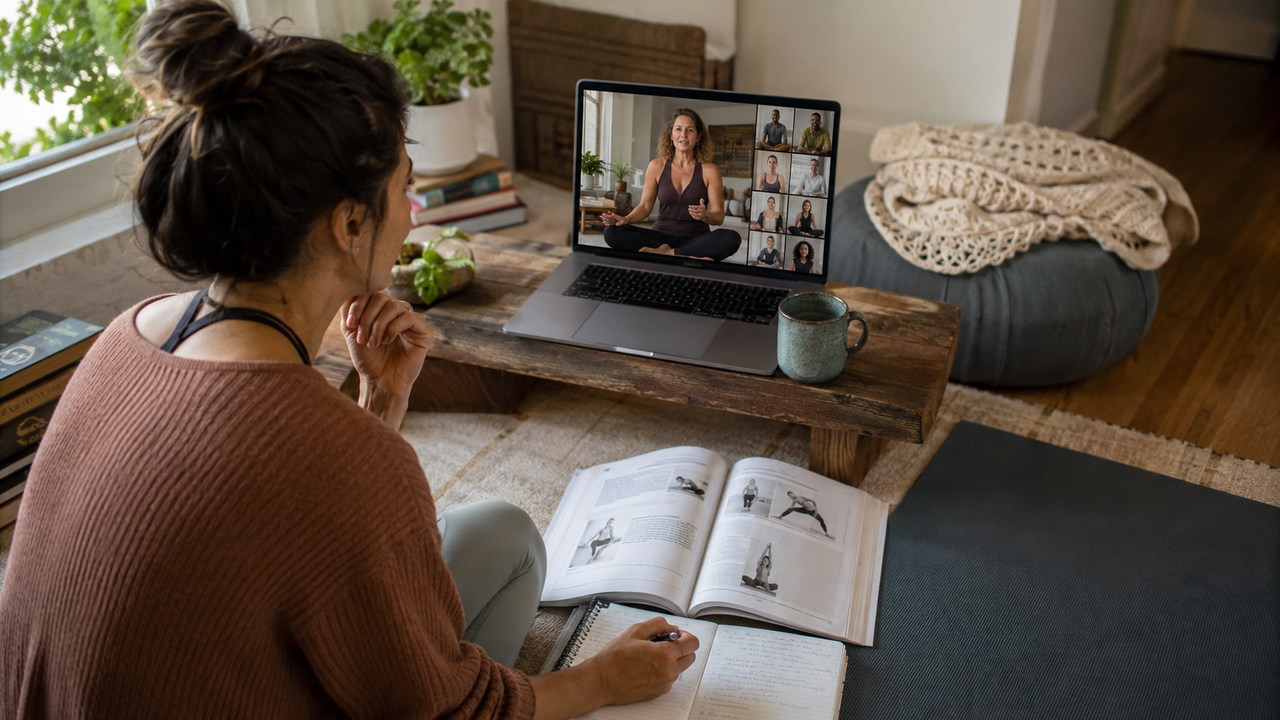
Why in-person yoga teacher training is genuinely magical (and why I still recommend the experience)
Let me say this clearly, because a lot of online-yoga-training marketing pretends in-person doesn’t matter. It does. There is something irreplaceable about walking into a studio with a group of humans committed to the same thing you are. The energy of a room. The way a teacher can see your alignment in three dimensions. Meals together. Sunset practices. The physical container of a place devoted to the work.
If you can afford it, you should absolutely have this experience in your life. My honest advice? Save your money for a yoga retreat, not a training. A retreat is the format where in-person truly shines: you show up, you’re taken care of, you relax into the container, you enjoy the potentially expensive hotel room you’re paying for, and you leave changed. That’s what in-person yoga is built to deliver.
Where in-person yoga teacher training falls short (the retention problem)
Here’s the honest problem with the in-person YTT format for most people. In-person trainings compress 200 hours into a matter of weeks — sometimes into an intensive month, sometimes across scattered weekends spanning six months. Either way, you’re drinking from a fire hose.
Barbie, our senior sales advisor, has a line she says on almost every call. Students who did their first yoga teacher training in-person and then come to Uplifted for their 300-hour always say the same thing: with in-person, there’s no way I could retain all that information. The lectures pass, the notes get half-written, and by the time you’re back to your normal life, the deep material — the anatomy, the philosophy, the sequencing methodology — has evaporated. You have a certificate and a warm feeling. You do not necessarily have a body of knowledge you can build a teaching practice on.
The other real cost of in-person YTT for most modern students is what it takes from your life. Weekends away from your family. Travel expenses stacked on top of tuition. If you have young children, that time isn’t just inconvenient — it’s genuinely disruptive to your household. And you don’t get to implement any of the curriculum in real time. You’re learning nervous system regulation in a studio where nothing challenging is happening; you’re not learning it while a three-year-old melts down at your feet, which is where the practice actually gets forged.
✦ ✦ ✦
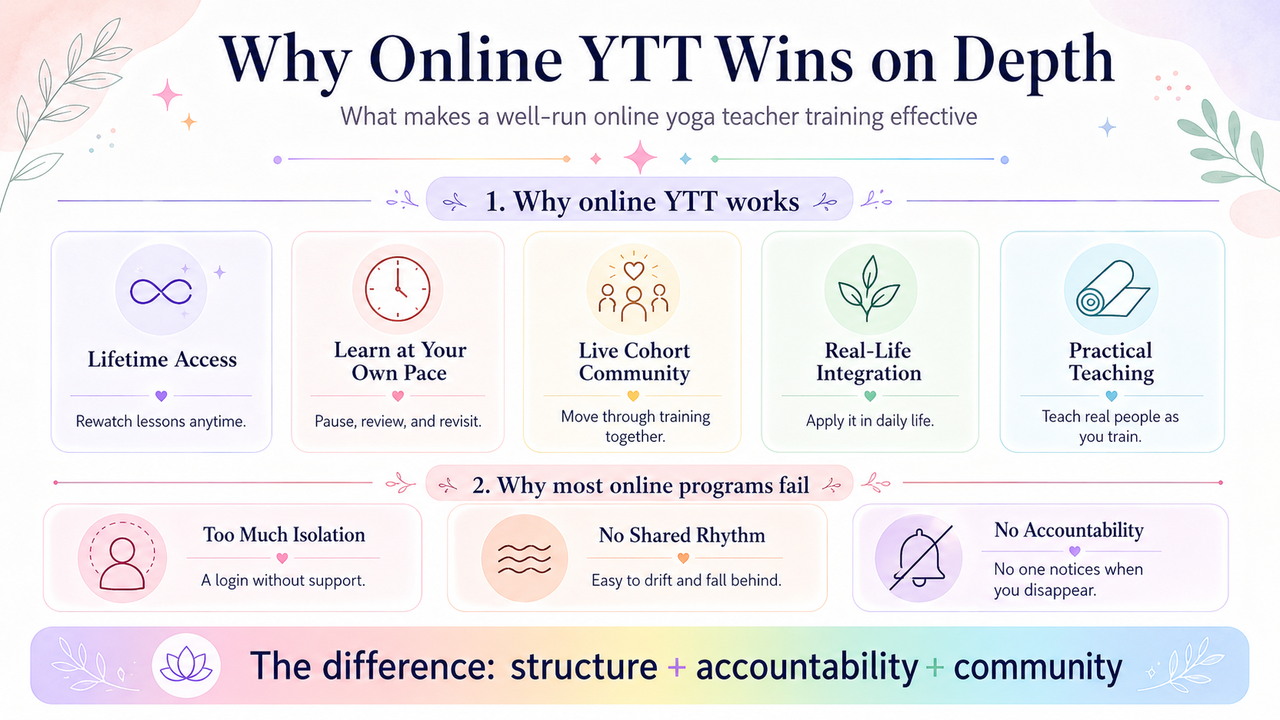
Why online yoga teacher training, done right, wins on depth
The single biggest advantage of a well-run online yoga teacher training is that you can actually retain, integrate, and apply what you’re learning — because you get to live it, not just witness it.
Here’s what that looks like in practice at Uplifted:
- Lifetime access to every lecture. Watch it once, watch it three times, come back a year later when a specific topic clicks. Depth of knowledge is a function of repeat exposure. In-person can’t give you that.
- Recorded and downloadable content. You retain more when you can review at your own pace. Barbie routinely hears from 300-hour students that they went back to their 200-hour material years later and finally got the pieces they missed the first time.
- Small group live calls with the same cohort start to finish. This is where the community magic happens, and where the 96% graduation rate comes from (industry average online: about 20%).
- International friendships that continue for years. One of my recent graduates, in Yugoslavia, made an outside study group with a woman in Germany and a woman in the U.S. Two years later they’re still meeting weekly — and half the time they’re not even talking about yoga. That is what a real community produces.
- A paper training manual shipped to your door. Because you’re going to want to write in it, dog-ear it, and pull it off the shelf a year from now. The physical anchor still matters.
- Practical application in your real life. You’ll get to teach real people while you’re in the training, come back to the group with actual questions, and refine your voice against real students — not just a scripted practicum in a studio bubble.
Where online yoga teacher training goes wrong (and why 80% of students never finish)
The most-quoted stat in the online yoga education space is that about 20% of students actually complete their online yoga teacher training. That’s not because the programs are bad — there are plenty of solid online curricula. It’s because most online programs leave you alone.
You get a login. You watch video 1. Life happens. Video 2 sits unwatched. Something else comes up. And after a month you have a folder on your desktop labeled “YTT (Later)” that stays labeled that way for two years.
This is why the online yoga teacher training I built has three anti-drift mechanisms baked in:
- A live cohort schedule you attend with real people. Not open enrollment. Everyone starts and finishes together. There is a rhythm.
- Weekly live calls with our senior faculty. You have accountability. You are seen. If you’re falling behind, someone reaches out.
- A community of women moving through the same material at the same pace. You forge friendships. You form outside study groups. You do not want to be the one who ghosts on the group. The social contract is the retention mechanism.
✦ ✦ ✦
The specific comparison: 10 factors side-by-side
Here is the honest breakdown, factor by factor:
| Factor | In-Person YTT | Uplifted Online YTT |
|---|---|---|
| Time flexibility | Rigid schedule, weekends or intensive block | Self-paced video + weekly live calls |
| Retention of material | Low — compressed timeline, note-based | High — lifetime access, revisit anytime |
| Community depth | Strong during the training window; often fades after | Small cohort, lasting international friendships |
| Travel + accommodation cost | Often thousands of dollars in addition to tuition | None |
| Body-type diversity of students | Whoever is in the local room | Global cohort — many more body types to observe and adjust |
| Ability to integrate into daily life | Almost none — you’re away from real life | Constant — you practice in your actual life |
| Practical teaching experience | Scripted practicum with classmates | Teach real people between calls and refine with the group |
| Post-graduation community | Usually ends when the training ends | Ongoing — alumni stay for years |
| Physical training manual | Sometimes provided | Paper manual shipped to your door + lifetime digital |
| Best comparable in-person experience | The training itself | An in-person yoga retreat (highly recommended — different purpose) |
Who should choose in-person YTT (and who should not)
There is a specific student for whom in-person YTT is the right call. Namely: you have no dependents, you have three-plus weeks of clear runway, you have significant disposable income, you already have a strong personal practice, and you learn best by physical immersion. If all five things are true, in-person can be phenomenal.
If any of those five aren’t true — and for most of the working women I train, at least two of them aren’t — in-person becomes a formidably expensive way to end up with less integration and less community than you would have gotten online. Save your in-person budget for a retreat instead.
Who should choose online YTT (and who should not)
Online yoga teacher training is right for you if you want depth, retention, real integration into your daily life, ongoing community, and the ability to refer back to your training years later. It’s especially right if you’re a mother, a working professional, a caregiver, or anyone whose life doesn’t pause on demand.
Online is not right for you if you refuse to make time for live calls, if you can’t commit to a cohort schedule, or if you’ll only feel legitimate walking around in yoga clothes in a studio setting for weeks. Those are honest disqualifiers. Most people, though, are not those people. Most people are people whose life makes it much easier to integrate 200 hours of practice over months than in a weeks-long intensive.

✦ ✦ ✦
Frequently Asked Questions About Online vs In-Person Yoga Teacher Training
Is online yoga teacher training as good as in-person?
For most students in 2026, a well-run online yoga teacher training is actually a deeper educational experience than an in-person one. The reason is retention: online means you can revisit lectures, refer back to your training manual years later, and integrate the practice into your daily life. In-person is magical in-the-moment, but retention rates are notoriously low when you cram 200 hours of complex material into a short window.
Why do so many online yoga teacher trainings have low completion rates?
The industry average completion rate for online yoga teacher training is around 20%. This is not because the programs are bad. It’s because most of them leave you alone with a login and expect you to self-motivate. Programs with a live cohort, weekly calls, and real community — like Uplifted, which has a 96% completion rate — solve for this by making the social contract itself the retention mechanism.
Can you become a real yoga teacher through an online training?
Yes — and often a better one than through in-person. Online allows you to practice teaching real people during your training, come back to your cohort with actual feedback from those experiences, and refine your voice in a way in-person practicums (where you teach classmates who already know the material) cannot. Yoga Alliance certification is identical for online and in-person 200-hour programs.
What’s the biggest downside of in-person yoga teacher training?
Two things: retention and cost of life disruption. Retention is low because you can’t revisit lectures or notes years later the way you can with a recorded online curriculum. Cost of life disruption includes travel, accommodation, weekends away from family, time off work, and the fact that you can’t apply the material to your actual daily life until the training is over — by which point much of it has faded.
Is Yoga Alliance certification the same for online and in-person training?
Yes. Yoga Alliance changed its rules during the pandemic to fully recognize online yoga teacher training programs at the RYT-200, RYT-300, and RYT-500 levels. The certification you receive from a Yoga-Alliance-registered school is identical whether the training was delivered online, in-person, or hybrid.
Which is better if I want to teach in a physical studio afterward?
Both work for physical studio teaching. Studios care about your certification and your teaching ability, not the format of your training. The bigger differentiator when you audition to teach at a studio is the confidence and specific voice you’ve developed — which online training with a live cohort often produces more effectively because you get more chances to teach real students during the program itself.
Should I do a retreat instead of an in-person yoga teacher training?
If you’re deciding where to spend your in-person yoga budget, my honest recommendation is: do a retreat, not a training. A retreat is the format in-person yoga is genuinely built for — you show up, relax, receive teaching, and integrate. A training is professional education, and professional education benefits more from repetition, self-paced integration, and real-life application than from time-locked intensity.
✦ ✦ ✦
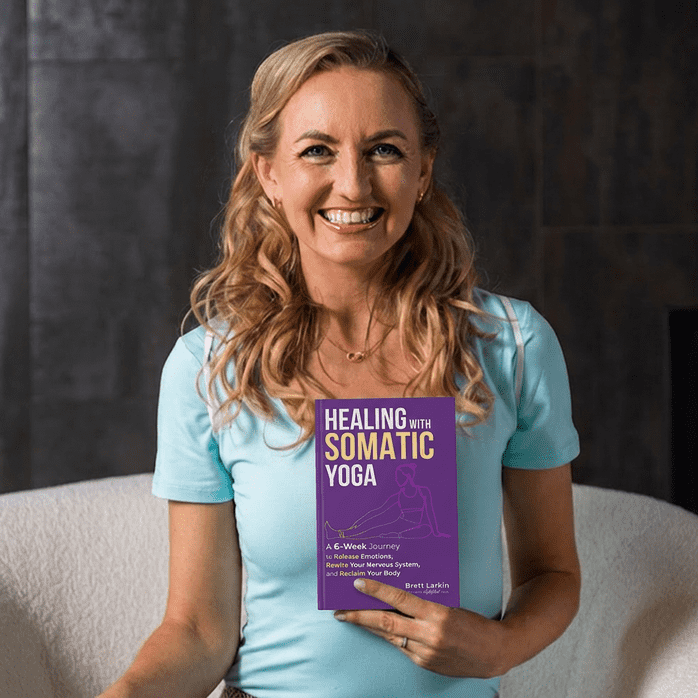
About the Author | Brett Larkin
Brett Larkin has been integrating somatic therapy with yoga for over 14 years. A certified body-oriented coach and longtime student of somatic psychology and myofascial release, she weaves nervous system healing into all her trainings. Her Somatic Yoga programs blend movement, breathwork, and trauma-conscious practices to help students reconnect with their bodies. She has over a half a million subscribers on Youtube and is also the author of Yoga Life and host of the Uplifted Yoga Podcast.
Experience 3 Training Videos from Inside My 200-Hour Online YTT