I’m going to start with the part nobody wants to hear.
The reason your yoga classes aren’t filling — the reason you’ve been certified for two years and you’re still cobbling together $800 a month from a studio gig you don’t love — is not that you’re a bad teacher.
It’s that you’re trying to be everything to everyone.
You’re “a vinyasa yoga teacher.” You’re “an alignment-focused hatha teacher.” You’re “a yin teacher in San Diego.” That’s a description. It’s not a position.
In 2026, descriptions don’t sell yoga. Niches do. And almost every YTT in the country sends you into the world without teaching you how to find one.
Let me fix that.

Why the “I’m a yoga teacher” identity stopped working
When I started teaching yoga in 2010, you could call yourself a yoga teacher and that was enough. People searched for “yoga classes in [my city].” Studios were the gatekeepers. Differentiation didn’t matter much because the supply was small.
In 2026, the supply is not small. Yoga Alliance has registered hundreds of thousands of teachers. Online platforms made every certified teacher a potential competitor for every other certified teacher. Generic vinyasa is the most oversupplied product in the wellness market.
The students haven’t disappeared. They’ve gotten more specific.
A 38-year-old woman with chronic pelvic floor tightness doesn’t want “a yoga class.” She wants a yoga teacher who understands pelvic floor anatomy and who has worked with women in her exact situation. She’ll pay $150 for a 60-minute private with that teacher and skip the $20 community vinyasa class entirely.
A 52-year-old man in tech recovering from a stress-related cardiac event doesn’t want “yoga for relaxation.” He wants someone who teaches breath-led, slow-pace, nervous-system-focused movement specifically for high-achieving men coming back from burnout.
Both of those teachers have built waitlists. Both of them started where you are now.
The difference is they stopped describing themselves and started positioning themselves.
What “niching down” actually means
A real niche has three layers:
- Who specifically you serve. Not “women.” Not “women in their 40s.” Try: “women in their 40s perimenopausal with anxiety and disrupted sleep.”
- The exact transformation you offer. Not “feel better.” Try: “Sleep 7 uninterrupted hours, regulate your cycle’s energy, and stop crying in your car after work.”
- The method only you (or your lineage) deliver. Not “yoga.” Try: “A 90-day combination of restorative hatha, vagal breathing, and somatic tracking, taught in a small group on Zoom.”
Notice that “yoga” doesn’t actually show up in the positioning until layer 3. Layers 1 and 2 are about the person and the result. Layer 3 is the delivery system.
This is what every successful niche-yoga business gets right and every struggling generalist gets wrong. People don’t buy yoga. They buy “I want to be the version of myself who sleeps through the night again.” Yoga is the vehicle.
The 3-question niche framework
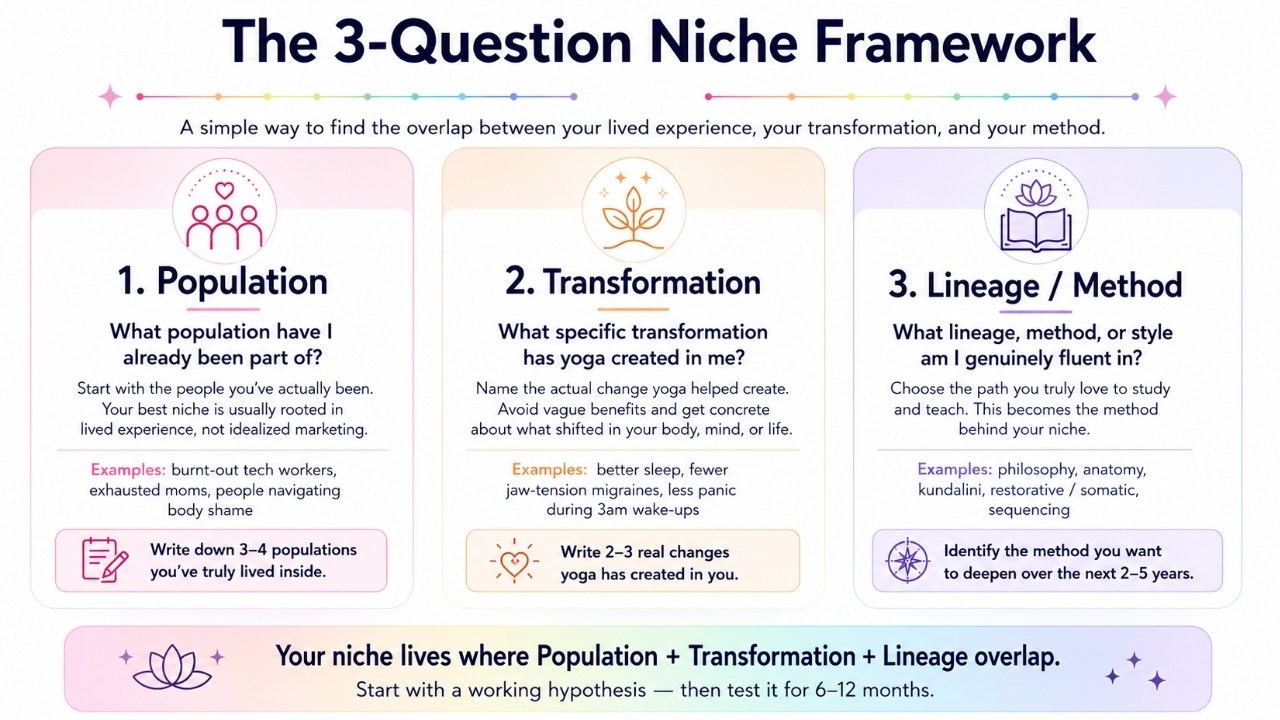
This is the same framework I teach my YTT students in Module 22. Sit with each question. Don’t try to answer them fast.
Question 1: What’s the population I’ve already been a part of?
Not the population you want to help, idealistically. The population you’ve actually lived inside.
If you’ve worked in tech for 15 years before yoga, you understand burnt-out engineers in a way I never will. If you raised three kids through the pandemic, you understand exhausted moms with no time. If you’ve lost 80 pounds, you understand the relationship between the body and shame in a way most teachers haven’t lived.
Your most authentic niche is almost always the population you came from — not the one you idealize.
Write down the 3–4 populations you’ve actually been a part of (by life stage, profession, identity, struggle, or experience).
Question 2: What’s the specific transformation I’ve personally experienced through yoga?
What did yoga actually do for you? Not what it does in the abstract. What changed?
For me, the honest answer in my 20s was: yoga gave me permission to be in my body without judging it constantly. In my 30s, after motherhood, the honest answer was: yoga gave me a way to come down from sympathetic-nervous-system overdrive that nothing else touched. Both of those are specific. They’re not “yoga makes you feel better.”
The transformation you’ve personally experienced is the one you can teach with conviction. Everything else, you can teach intellectually, but you can’t sell it from the gut.
Write the 2–3 actual changes yoga has produced in you. Be specific. “Better sleep” is fine. “Stopped getting migraines from clenched jaw” is better. “Stopped catastrophizing during my 3am wake-ups” is best.
Question 3: What’s the lineage / method / style I’m genuinely fluent in?
Be honest. You can probably teach a halfway-decent vinyasa class because that’s what most YTTs cover. But what do you actually love and study?
- Is it the deep philosophy / texts? You may be heading toward a yoga-as-life-leadership niche.
- Is it the body — anatomy, biomechanics, modifications? You may be heading toward a therapeutic / chronic-condition niche.
- Is it the energy — pranayama, kundalini, chakras? You may be heading toward a spiritual/embodiment niche.
- Is it the slow / restorative / somatic? You may be heading toward a nervous-system regulation niche.
- Is it sequencing and skillful teaching? You may be heading toward training other teachers.
Most YTT graduates are weakest at Question 3 because their training was broad. That’s normal. You don’t have to know your lineage on the day you certify — you have to be willing to specialize in the 2–5 years that follow.
The intersection is your niche
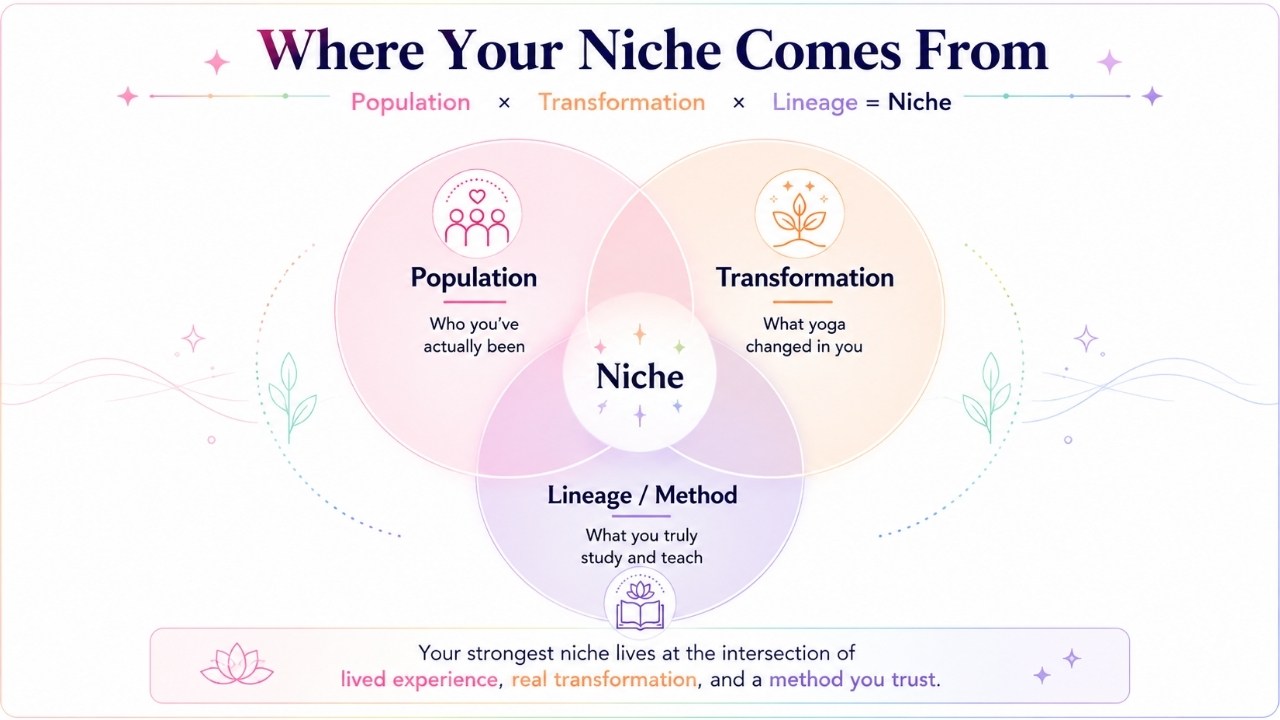
Your niche lives where your three answers overlap.
Brett’s example: I came from a corporate tech background (population), spent my 30s recovering from postpartum nervous-system dysregulation (transformation), and went deep into Kundalini and somatic work (lineage). The overlap created a niche I didn’t see coming: online yoga teacher training for analytical, high-achieving women who want to use yoga to regulate their nervous system and build a small business doing the same for others.
That sentence is what every piece of my marketing — emails, brochures, sales pages, books — is positioned around. It’s why generic “online yoga teacher” content doesn’t resonate with my list, and why my niche content (Kundalini University, Somatic Yoga, Feminine-Trauma-Informed) sells out.
I didn’t have that sentence on day one of teaching. It took 4–5 years to find the overlap.
What you should walk away with from this exercise is not your final niche. It’s a working hypothesis — the niche I’m going to try on for the next 6–12 months.
How to test your niche before you commit
Most teachers never commit because they keep testing in their head. Better test: in public, in small.
- Write 6 social media posts in your niche voice. Not “5 reasons to do yoga.” Try: “5 hidden ways perimenopause is wrecking your sleep — and 3 breathing techniques that helped me.” See what lands.
- Run one workshop. $45 ticket. 90 minutes. Title it exactly to your niche. Sell it to your email list and your circle. Don’t aim for a sellout — aim to see who shows up. The people who buy are your niche.
- Make one private offer. “I’m taking on three new private clients in [niche] for the next 8 weeks. $300/month.” Even if no one buys, the conversations you have will sharpen the position fast.
- Listen to language. When your students or prospects describe what they want, write down the exact words they use. Your sales page should be 80% their words, 20% yours.
Six to eight weeks of this and you’ll know if the niche has legs or if you need to iterate.

From niche to signature program
A niche is what you say. A signature program is what you sell.
Once you know your niche, package it as a single, named offer with a defined timeline and outcome:
- The Perimenopausal Sleep Reset: 90-day program. Live group calls + at-home practice. $1,200.
- Yoga for the Burnt-Out Founder: 8-week private container. 1:1 coaching + practice prescription. $2,500.
- Feminine-Form Kundalini Starter Pack: evergreen funnel, $97 lead-magnet bundle that opens into a $1,800 group program.
A named, packaged program is dramatically easier to sell than “drop into my classes anytime for $20.” It has a beginning, middle, and end. The student knows what they’re buying. You can charge real money for it.
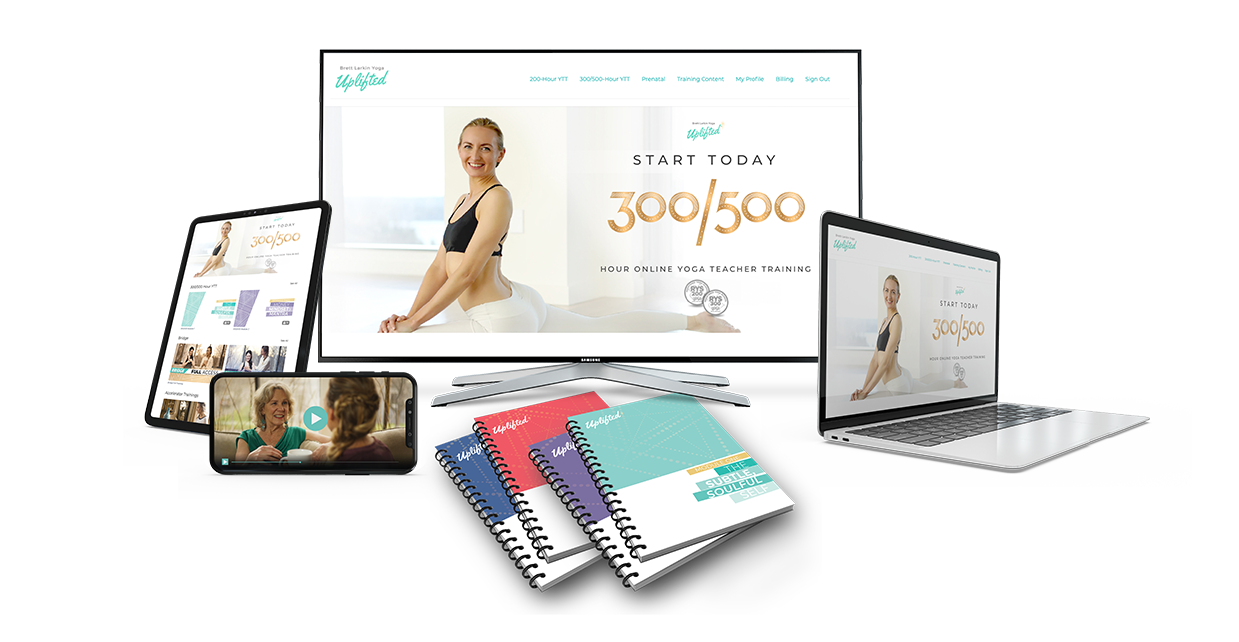
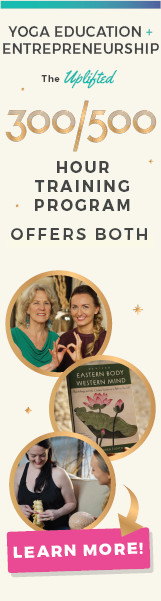
Signature programs are also what graduates of my 300-hour Biz Accelerator build during the training. (We literally workshop them, week by week.) The 200-hour gives you the teaching foundation. The 300-hour turns it into a business.
A note on niche fear
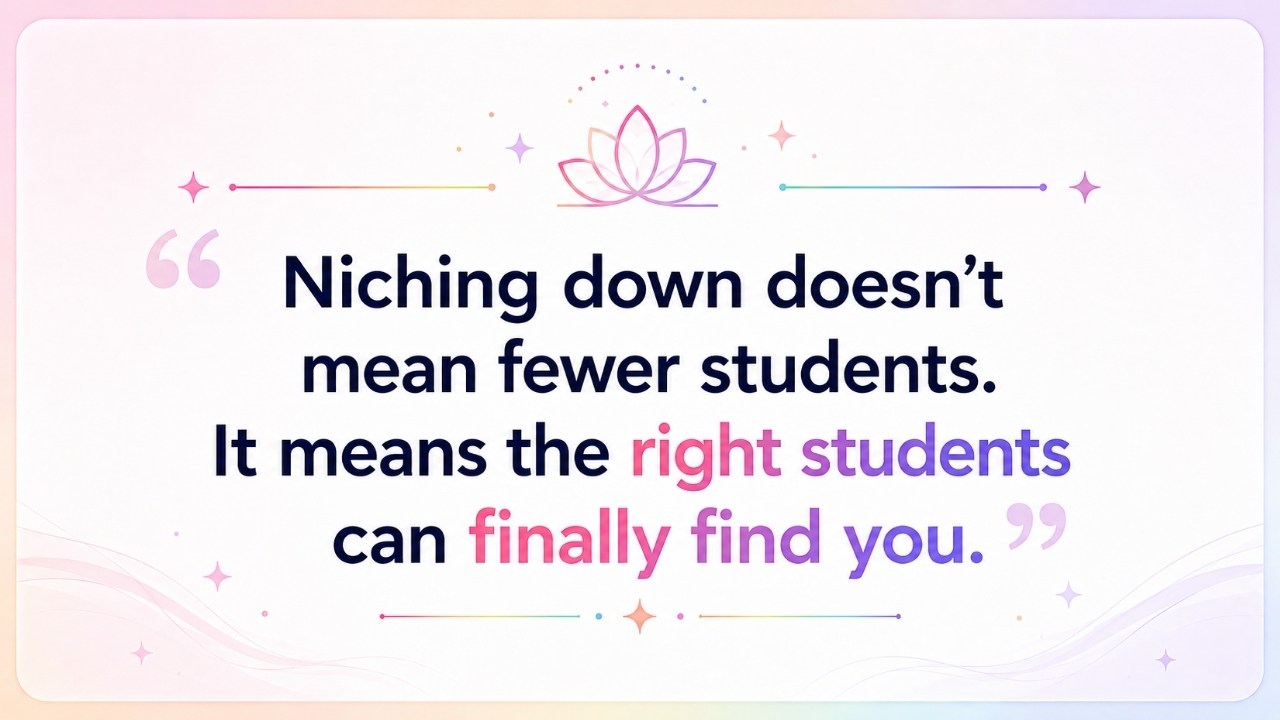
Most new teachers won’t niche because of one specific fear: if I narrow my audience, I’ll have fewer students.
Backwards. You’ll have more of the right students, because the right people will be able to find you. Try advertising “general yoga classes” against any of the niche teachers I named in this post and watch what happens to your CPM. The niche teachers convert 5–10x better because their messaging is sharp.
Branding is differentiation. It’s really hard to market yoga (or anything) generically. This big branding issue is not something you solve in an afternoon — it’s something you solve over a year of consistent micro-tests.
You don’t have to know your final niche today. You have to be willing to commit to a working hypothesis for the next 6 months and test it in public.
Frequently Asked Questions About Niching as a Yoga Teacher
What is a yoga niche?
A yoga niche is the specific intersection of who you serve, the exact transformation you offer, and the method you deliver it through. It’s not a yoga style (“vinyasa”) or a location (“San Diego”). It’s positioning — for example, “perimenopausal women with disrupted sleep” or “burnt-out tech founders learning to regulate their nervous system.”
Do I have to niche down right after my 200-hour YTT?
No, and trying to often backfires. Most teachers find their authentic niche 2 to 5 years post-certification, after teaching enough general classes to notice which students they connect with most and which transformations they help create most reliably. Use your first year to teach broadly and pay attention.
What are the most popular yoga niches in 2026?
The fastest-growing niches right now are trauma-informed and somatic yoga, yoga for perimenopause and women’s hormonal health, corporate wellness for burnout, yoga for chronic pain and chronic conditions, and prenatal/postpartum work. The common thread: each one solves a specific health concern that generic yoga doesn’t directly address.
Can I have more than one yoga niche?
You can teach multiple niches, but you should market one primary niche. Trying to market three at once dilutes every signal you send. Pick the niche with the strongest overlap of your population, transformation, and lineage — that’s your hero offer. Add adjacent offers later, once the first is converting.
How do I find my yoga niche if I have no idea where to start?
Use the 3-question framework above: (1) What populations have I actually been part of? (2) What specific transformation has yoga produced in me? (3) What lineage or method am I genuinely fluent in? The intersection of your three answers is almost always your niche — and it’s usually narrower than you think.
Do I need a website or Instagram following to niche down successfully?
A small, sharp email list and one clear landing page beats a large generic Instagram following almost every time. Your first 30 niche students will come from people who already know you (or know someone who knows you), not from cold reach. Build the offer and the language first; build the audience after.
What if my niche doesn’t work after I commit to it?
Treat your first niche as a 6-to-12-month hypothesis, not a marriage. If after 6 months you have zero traction — no workshop signups, no private clients, no community traction — iterate. The students you do attract during that period will tell you what your real niche is. Listen to their language.
Ready to actually build your signature program with structured coaching? The Uplifted 300-Hour Biz Accelerator workshops a real, named, ready-to-sell signature program over the course of the training. You leave with a teaching certification and a business you can run.
Learn About the 300-Hour Biz Accelerator → https://www.brettlarkin.com/yoga-business-certification/
The yoga teachers winning in 2026 stopped trying to be yoga teachers and started being specifically useful to specific people. That’s the work. And it’s worth doing. 🙏

About the Author | Brett Larkin
Brett Larkin is the founder of Uplifted Yoga, one of the first and most successful online yoga schools. She has over a half a million subscribers on Youtube and is also the author of Yoga Life and host of the Uplifted Yoga Podcast. Brett brought yoga teacher training online in 2015 and has since certified over 4,000 teachers through premium, high-touch programs. Brett helps wellness entrepreneurs grow integrity-driven businesses rooted in yogic wisdom.
Sneak Peak into My 300-Hour YTT - FREE Videos, Info Session, Bonuses!