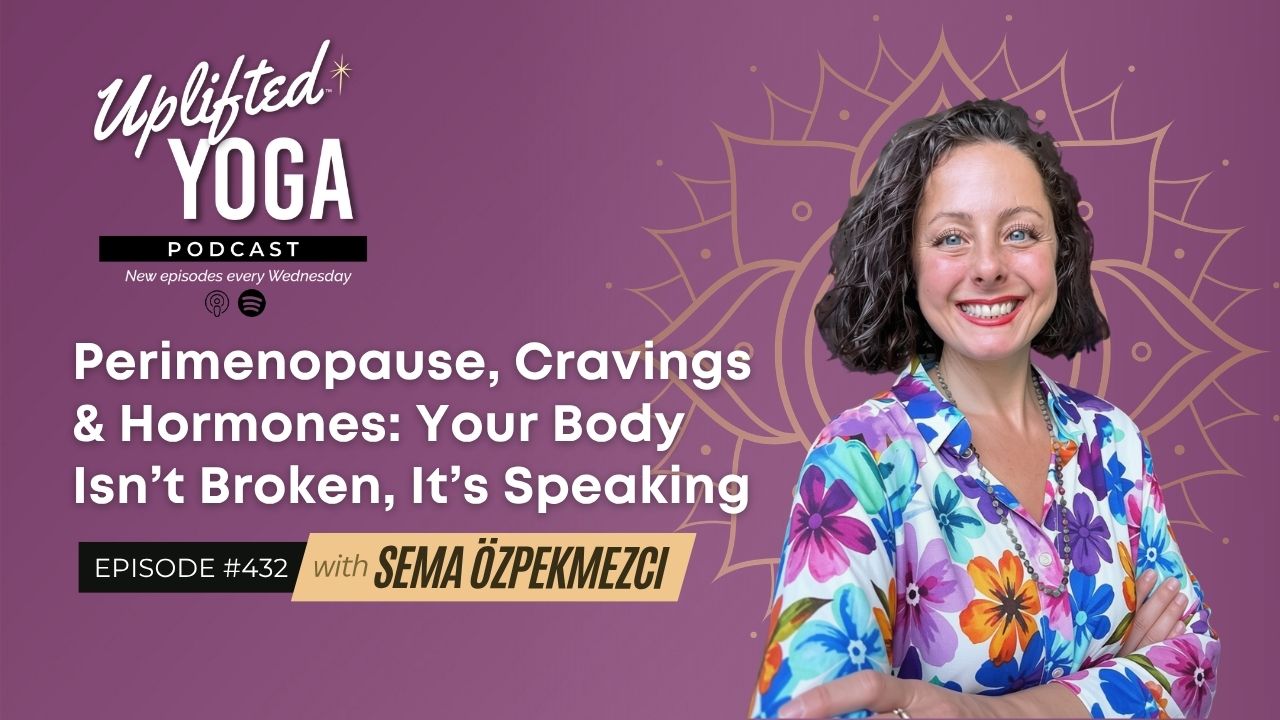
Do cravings, fatigue, or hormonal shifts have you feeling like a stranger in your body?
In this episode, I’m joined by Sema Özpekmezci for a grounded, compassionate conversation about chronic illness, women’s health, perimenopause, hormones, and what it really means to listen to your body.
We explore how midlife changes can feel confusing and how symptoms like cravings, energy dips, mood shifts, and inflammation can become invitations into deeper self-understanding.
Sema also shares a powerful way to think about your hormones as the “CEO” of your body—and why food, stress, blood sugar, sleep, and nervous system regulation all play a role in helping you feel balanced again.
Inside this episode, we explore:
🔹 Why perimenopause symptoms, cravings, and inflammation may be body signals, not personal failures
🔹 How hormones, stress, cortisol, and the nervous system influence women’s health
🔹 Why chocolate cravings and blood sugar patterns can reveal what your body actually needs
🔹 How to respond to your changing body with curiosity, compassion, and practical support
My hope is that this conversation helps you stop fighting your body and start listening to it. Because your body isn’t broken. It’s speaking.
💗 If you want to keep exploring this connection between the nervous system, embodiment, and women’s health, come practice with me: https://www.brettlarkin.com/ffy
GUEST EXPERT: Sema Özpekmezci | @semaozpekmezci
Sema is a certified Clinical Nutritional Therapist and Functional Medicine Health Coach. She is a Yoga and Mindfulness Trainer and yoga/meditation enthusiast. She believes that nutrition, mind, and spirit are inextricably linked to our health and overall well-being and spreading and explaining this is her life’s purpose.
Connect with Sema and find her programs here → https://www.semaozpekmezci.com/
FREE Practice: Somatic Exercises to Reduce Cortisol & Get Out of Freeze Response | Full Body Somatic Yoga Flow
Relevant to Today’s Episode:
🐍 Kundalini 200-hour YTT
📚 Healing with Somatic Yoga Book
🎧 Also Listen to:
#366 – Is Trauma Actually In Your Hips? The Impact of Stress on Hip & Pelvic Health with Dr. Brianne Grogan
#369 – Nervous System Masterclass with Kristin Leal
#384 – Do Less, Heal More: 7 Invitations to Resolve Trauma from Organic Intelligence
© 2026 Uplifted Yoga | BrettLarkin.com

Transcript:
[Brett Larkin]
It’s time for you to walk through the world with the confidence and serenity of someone who’s deeply tethered to their inner wisdom. If you have this insatiable hunger to uplift your personal life and make a bigger impact in your wellness career, leveraging yoga’s ancient wisdom, welcome. I’ve certified thousands of yoga instructors online, I teach to over half a million subscribers on YouTube, but I still haven’t remotely quenched my thirst for more yogic knowledge.
I’m Brett Larkin, founder of Uplifted Yoga, and this is the Uplifted Yoga Podcast. Let’s get started. If you have been waking up in the middle of the night, this podcast interview gives an amazing tip that I learned here from this guest that has really been helping me sleep better.
If you didn’t know, after teaching kundalini yoga teacher training online for over five years, I completely changed and revamped the curriculum to make it a somatic, trauma-informed kundalini certification that’s grounded with practices for nervous system safety, that includes science-backed anatomy and sequencing, and I designed it specifically for women who want to transform lives and awaken energy without dogma or hierarchy or bypassing the body. But one of the unexpected surprises in running this training that I don’t think I was expecting, how incredible the different women are who’ve joined.
Teachers are kundalini enthusiasts who are also passionate about feminine energy somatics and nervous system science, who want to design and adapt their own kriyas to support personal growth, and who are tired of the rigid, one-size-fits-all approach in kundalini yoga. And who you’re about to meet in this podcast episode is one of the incredible experts who joined this training last spring. Seema joined me for this conversation from all the way across the world to talk about chronic illness.
Her story is so powerful, women’s health, perimenopause, and hormones. We really get into it at the end of the episode about hormones and midlife and how many of these changes can feel confusing, but she gives actual tips that I have since used to help me sleep better. I hope you enjoyed today’s conversation with Seema as much as I did.
And if you want to join us for the next round of online kundalini teacher training or just keep exploring this connection between the nervous system, embodiment, and women’s health, I’ve also linked up a free class for you below in the show notes. Now let’s dive into this week’s episode. Seema, welcome to the Uplifted Yoga Podcast.
I’m so excited to have you here. Thank you so much. Thanks for inviting me.
You just told me before we hit record that you’re Turkish, but living in Greece. And Seema is right now a part of our kundalini yoga teacher training. And it’s so cool because it’s amazing what this technology of online trainings have done for us.
Like we can connect with people all over the world. And how are you finding that training and your different classmates?
[Sema Özpekmezci]
Just recently, I was thinking the same thing you said. Oh, my God, the online world, you know, it gives us a very big luxury. Normally, I wouldn’t get this training.
I cannot travel to the United States just to get this. And I can reach you, I can reach other people. So that’s amazing.
And the training is going so well, too. I really love it.
[Brett Larkin]
I really enjoy it. Well, I know you have such an incredible background. So for those of you who are passionate about like combining different modalities, which I know so many of our students are, that’s something they crave.
Seema has done this. She’s a clinical nutritional therapist, a functional medicine health coach. She specializes in mindfulness and, of course, yoga.
And she’s blended all of these things together to really help women specifically in all stages of life with different hormone imbalances. So how did it work for you to bring all these things together and then start really helping women one on one?
[Sema Özpekmezci]
I didn’t start with planning, coming here and combining all these things. When I started 20 years ago, there were no holistic approach at all. You know, just dieting or some and some approaches to cure the symptoms.
And that’s how life was going in medicine world or nutrition world. But my own diseases and my own difficulties brought me here. And I tried to find deeper approaches because the current approaches didn’t help me too much.
When I was 25 years old, I was diagnosed with type 2 diabetes and I was kind of obese and I was eating everything you can imagine. Everything. I mean, I don’t want to I’m not going to count everything one by one, but everything you can imagine.
So eventually I had type 2 diabetes and I was smoking. I was having all kinds of drinks and all the alcohols and everything. And I changed my life in one day.
My type 2 diabetes became normal. I quit pills and everything only with changing my eating way and my lifestyle. I start exercising.
I start eating good. And at the end of fifth year, my type 2 diabetes was totally fine. But I start seeing different things on me.
You know, when you start giving attention to your body and then you realize other things. I always had some weight issues. Doesn’t matter how much weight I lose.
I had still my thighs and my hips, let’s say. Always I had fat there. So I’m doing my best.
But why and how? And I start searching.
[Brett Larkin]
Well, I want to pause you for a sec because you said that you it sounds like you had this like radical turnaround from being overeating, smoking, drinking, like everything. That’s kind of the opposite of what we’d imagine when we picture like a yogic lifestyle. So what was the catalyst that like changed it all of a sudden?
Like what happened?
[Sema Özpekmezci]
I changed everything in one night. Yeah. So I want to talk about that.
That sounds really interesting. Because I was diagnosed with type 2 diabetes and a doctor and I was sitting in a doctor’s office. And he told me, if you continue living like this, you cannot see your 40s.
You know, it was like a bump into my head. I said, what? I’m just 25 years old.
What are we talking about? What chronic disease? You know, it was like a shock for me.
And during my therapies with my psychologist, I got some therapies later. We figured out I lost my dad when I was eight years old. So he passed away because of cancer.
And my therapist says, I’m very sensitive to diseases or I want to cure everything. You know, I want to fix everything. Of course, I cannot fix everything.
But if there’s possibility, let’s fix it. Because people can die on their 40s. My dad was passed away when he was 43 and I was eight years old.
So now, she says, it’s something in my head, you know. But of course, I didn’t do this connection. But as soon as doctor told me, you cannot see your 40s.
That night, I went home. I trashed everything. Cigarette, the beers and everything I have and the pastas and the bread and everything you can imagine.
I put it in a big bag, big trash bag and I trashed it. And next day, I woke up. I start cooking.
I carried my food everywhere and all these things are happening. I realized there’s a word calling holistic approach to health. And I start reading books.
I couldn’t stop reading. I said, I want to educate myself. So and then I found a school.
I started everything from the beginning of my 30s. So I left my first degree and then I did my second degree.
[Brett Larkin]
And that’s another scary point, I think, for so many students who come to us where they are starting over in some way. And they feel like they’re behind and it feels very irresponsible to leave behind maybe a college education or a degree that they’ve pursued earlier. And there’s a lot of tension there.
So I just yeah, acknowledging like how many amazing things I’m hearing in this story from like this wake up call with the doctor to making such sudden changes. It seems like that was very dietary. Right.
And then kind of discovering how to combine different things for this holistic approach. And then saying, you know, I’m actually going to make this a career and kind of start start over. But it’s interesting because even when I say start over, I think for so many of us in that position, it’s like inevitable.
Right. It’s like we want this new path, this new career. We’re not the same person anymore who did those prior degrees.
So trying to stay with them. It’s it just doesn’t it’s like round, you know, trying to put a round thing in a square thing like it doesn’t work.
[Sema Özpekmezci]
When we choose our first degrees, you know, we were just playing. We’re kids. We’re 17 years old and 16 years old.
I choose business administration, for example. So it can give me a wide area to play. But at the end, I found myself in some chronic diseases and my God, body can cure itself.
And then that was a magical for me. But when I realized it, doctors told me, no, you will have a chronic disease for all your life. And I was just 25 years old.
And in five years, my body really knew itself. So why why do they call it that’s a chronic disease and you cannot cure it? So this is how all my attention went to that side.
So then I start reading and everything, the other approaches. And I lost myself there. And then I have a knowledge and I have experience.
So I want to give it to other people. So those years, the first years we start hearing holistic approaches everywhere in the world. So I just catch that train.
Let’s say I was the first one in my country in Turkey. I was the first functional medicine health coach.
[Brett Larkin]
Well, let’s define for listeners. What is functional medicine? Because I’m sure there’s people listening who are like, you know, it’s like we have this idea of what we think it is.
But we have you here to actually tell us. So how do you define that?
[Sema Özpekmezci]
Functional medicine is an approach in medicine. Of course, there are functional medicine doctors. There are functional medicine dietitians.
There are functional medicine health coaches. It’s an approach to taking a person as a whole person, body, spirit and mind. So it’s not whooping, you know, it’s a real medicine.
Doctors are doing it. Doctors are practicing it. Dietitians, health coaches.
So, for example, I have a headache now. The modern medicine gives you a pill just to suppress this headache. But functional medicine digs it and tries to find the root reason, root cause.
Why? When it was started. Maybe we look at the health history or whole history when we start with a person.
So we start from the pregnancy, from her mom’s diseases, let’s say, that the father diseases. So because we carry all these things, the traumas. If you look at the autoimmune diseases, every autoimmune disease, before every autoimmune disease, there is a trauma.
It doesn’t have to be a very big trauma. When we say trauma, sometimes we think it’s so big. But moving another house, it’s a trauma.
Or changing a city, changing a school, it’s a trauma for 10-year-old kids. It doesn’t have to be, you know, shocking things. So we look at a person with every aspect.
Body and what they eat, how they sleep, how they breathe, what kind of water they drink, what kind of relationship they are in, what kind of environment they live. So this is functional medicine approach. We just don’t write one pill or just drink a water and you will be fine or just go sleep and your migraine, your headache will be fine.
So that’s the functional medicine approach.
[Brett Larkin]
It makes me think of a detective. It makes me think someone is really going to go in and look at the whole ecosystem of the person and then the ecosystem that they’re in, which actually just makes a ton of sense. I really wrote down and loved what you said.
Before every autoimmune disease is a trauma. And it seems obvious, right, when we say it that way. But I’ve never heard it put that way.
So, so powerful. So talk to us a little bit about, you know, you’re bringing this idea of being a functional medicine coach to Turkey. When do you end up specializing, working with women, bringing in yoga and then ultimately narrowing down to look at hormone balances and hormone imbalances?
[Sema Özpekmezci]
Actually, my first mind approach is started with mindfulness. After I was trained in Institute of Functional Medicine, I heard mindfulness term for the first time in my life there. It was almost more than 10 years ago.
So I said, what is it? Because I’m a person, everything needs to be explained to me in a scientific way. But mindfulness was the first scientific approach to understand how mind works.
So after I finished my functional medicine training, I got a mindfulness training just for myself. You know, it wasn’t a trainer training, but it changed my life. This is the first time in my life I had this spiritual practice, listening my mind, seeing my mind, seeing my emotions.
Maybe not get in it, but just see it. I start that training. I said, no, I don’t have any stress.
Life is so good for me. I just want to see what that mindfulness is. And after I start watching my mind, my God, I couldn’t believe it.
You know, this is the first time I saw the thousand of thoughts are running through in our head every day. And that’s normal. That’s normal.
But we lost ourself in it. This is the first spiritual or let’s say mind approach I started thinking. And after I practice it, of course, I couldn’t stop.
And I said, OK, I will get a teacher training and I will be mindfulness trainer. And then I took two years. It was before Corona, thank God, because it was face to face and because it’s a very deep training.
And it was two years. And then at that moment, I start combining mindfulness with my nutrition programs. Because before that, I was just teaching eat this good stuff.
Look, I have good recipes. You can try this, you know, that kind of stuff. And after mindfulness training, I start teaching people to connect with their meals, with the food.
And at the same time, listening their bodies, how their body reacts, that meal they eat. How do they feel, you know, feeling your body. Sometimes we eat something and we forget.
And two hours later, we say, oh, I have headache or I have gas. Or sometimes we have next day we have some skin issues. But we never put a relation with that reaction with the food we had a day before.
So mindfulness brings that kind of perspective. So I start combining it with my nutrition programs, you know, that feeling the taste, what we eat. Sometimes we finish one big package of chocolate with no realization.
But if you eat just one piece of chocolate with mindfulness, you know, feeling the taste, the smell, they get slow. And then sometimes it’s tastier than one big package. Because when you eat one big package, you don’t even realize it.
Because you just watch TV or watch something or lose yourself in social media and we just eat it. And then we don’t realize we finish a package. So it was a big enlightenment in my programs and for my participants and for my clients.
Realize how big or how small you eat and the taste awareness.
[Brett Larkin]
Yeah, I hear you defining mindfulness as kind of two things. And one is like that ability to watch our thoughts, which I think everyone listening has had that moment. That’s why we love yoga, right?
Because all of a sudden we realize like, whoa, there’s a horror film going on in here and I need to, you know, get out of it and start watching it. You know, I just so remember that moment in my journey, too, where I was like, whoa, I can observe these thoughts but not be in the current of them or believe that they’re true. You know, that’s such an amazing moment.
It’s such a standout moment for all of us. So mindfulness gives us that. But I think you’re also talking about mindfulness as like a relationship with your body, right?
Like thinking about how it can help us connect the dots. I love what you said about how a lot of times you have a headache and then we don’t realize it’s like, well, I ate all these potato chips earlier in the day. Or, you know, suddenly I’m breaking out.
You know, what happened a couple of days ago? It reminds me of, you know, in the somatic book I wrote, like in the intro, I just talk about how you’re in this love story with your body. And like any love story, you need to tend to that relationship and pay attention to that relationship.
And it’s like, what am I giving in this relationship? What am I getting in that relationship? And I love how you’re talking about how mindfulness is like a way that we tune into that.
Really beautiful. So, okay, let’s layer in the hormone because I know that’s what you’re known for now.
[Sema Özpekmezci]
How it started? Life. Life brought me perimenopause.
After 42, I’m 48 now. 42, 43 years old, I start some changing in my body. Now it’s so hot topic in social media.
Every woman knows, but say seven and eight years ago, we didn’t know it. So, and I start seeing some changes on my body. It’s not only my menstrual circulation has changed.
So many things are changed. But if somebody tells me it’s a menopause, I said, no, I’m just 40 years old. What are you talking about?
What menopause? I have years for menopause. But I look at myself as a client sometimes.
When a client sits in front of me, what questions I ask to her or him. So I ask these questions to myself and I say, oh my God, I’m having hormonal imbalances now. And at the same time, I started a second degree in UK.
It’s a naturopathy, a nutritional therapist. So hormones were the hottest topic in it. And I was in the time in my life, I need that information.
So, and then I see imbalances are sex hormones and all other hormones. They are all in a relationship. But at the same time, our sex hormones get affected by all other hormones.
And then I change my direction, let’s say a little bit to this side, again, because of my own stuff. And I start sharing on Instagram. And at the beginning, I got some reactions.
Again, what menopause? What are you talking about? Something.
And then lots of more. I have thousands of followers and we are like a family. It’s been 10, more than 10 years.
I’m in social media. And everybody starts sharing their own stories with me. Everybody starts putting dots together.
It gave me a new direction, let’s say, in the hormone world. And I start searching how we can manage our hormone with the right diet, with the right movement. And I’m sitting in thousands of women.
So I listen to them and their experiences are helping me to grow, actually. Yeah, this is how it started.
[Brett Larkin]
So what are the key hormones that you want people who are listening to know about? Because I think you said something interesting about how all of our hormones are affecting our sex hormones. But can maybe you define some of the key players in our body for folks who might not be as familiar with how that relationship is working?
[Sema Özpekmezci]
It’s cortisol. Unfortunately, everybody is missing it, skipping it.
[Brett Larkin]
Hey there. Sorry to interrupt and we’ll get right back to the show. But if you’re curious about Kundalini Yoga but want an approach that’s grounded, trauma aware, and relevant for modern life, my online Kundalini Yoga teacher training honors the roots of the tradition while teaching it in a way that’s safe, embodied, and deeply human.
You’ll learn how to work with breath, mantra, movement, and energy without bypassing the body or overwhelming the nervous system. This training is for practitioners and teachers who want an integration of anatomy with energetic systems, know how to design and adapt kriyas to support personal growth, prioritize nervous system regulation, as well as feminine energy, somatics, and nervous system science. This training is open year-round and fully online so you can move at your own pace.
It also has an interactive live component so you can get supported. Explore the curriculum at brettlarkin.com.
[Sema Özpekmezci]
It’s cortisol, the most important. All the hormones are important, of course. Let’s say what hormone is.
Hormone is a chemical messenger, brings messages from our body to brain, from our brain to body. It’s like a rail, you know. So we have lots of hormones.
Every hormone is very important. But if we think it’s like a big company, let’s say, cortisol is the president. And there are some other departments.
Fertility is one department. Metabolic system is one department. Lots of departments.
But each department has their own hormones and they all report to president, you know, as every organization. And whatever president says, it happens. If cortisol is not balanced, it manages all other hormones.
Because what is cortisol? Cortisol is a stress hormone. But it’s at the same time, in our nervous system, when we are in fight and flight status, let’s say, we secrete cortisol.
So if we stuck in fight and flight all the time, and if we never go to parasympathetic system, which is rest and digest, if we never go to that side, our body feels like there’s alarm is on and there’s fire 24 hours in the body. So when there’s fire, do you mind working the other departments, other parts? Good?
No, you don’t need to. You have to deal with the fire first. So when the cortisol is high, this is how body feels.
It affects our thyroid hormones, our insulin, which is related with appetite. Everybody says, I have very big appetite, but everybody has insulin fluctuations in modern life. It’s so difficult to run away from that.
Because all these foods, everything is processed. It has lots of sugar in it, all the refined flours. And so it’s made the insulin up, down, up, down the whole day.
And it is related with cortisol too. So if we are so stressed, our insulin is upside down. And if our insulin is fluctuating all the time, it affects cortisol.
Same thyroid, same our sex hormones, which is estrogen, progesterone, and testosterone. But they’re at the bottom and cortisol is here. So we cannot close our eyes to cortisol and the stress factor in life.
[Brett Larkin]
So what’s happening in perimenopause or menopause in terms of cortisol?
[Sema Özpekmezci]
In perimenopause, the first hormone we start losing is progesterone. It is the hormone we secrete our second part of our menstrual cycles. And it is the hormone makes us relax.
I call it the meditator hormone. It’s like meditation, you know, it’s a cool, it’s the calm. It makes us calm and it gives us inner peace, let’s say.
So we start losing this hormone first after 40. And when we start losing it, estrogen becomes dominance. Because we still have estrogen.
And this hormone imbalances is the biggest stress reason for body. No matter what happens in our life, let’s say we have very stressless life. Everything is so good.
I’m laying down on the beach, no responsibilities, nothing at all, nothing. But even these changes is a very big stress. Our cortisol is getting affected naturally.
You know, we don’t have to do anything. But I hope everybody would have this kind of calm life. But unfortunately, all of us has responsibilities, financial responsibilities, family responsibilities.
And when I watch a woman, I see the woman, especially after 40, we have more family responsibilities. Like, you know, and we have some carrier, let’s say worries. When the parents are getting older, you know, that age, it’s like something is coming.
And the kids and the parents are getting older. And maybe we have a good career or we are building a career. But obviously, we are not like our 20s.
At 40s, our responsibilities are higher. And our body is already stressed. And we have other stresses.
Our cortisol loses its balance automatically. So normally, we have a high cortisol in the morning, which is normal. This is the hormone wakes us up.
This is how we open our eyes and get ready for the day. And normally, it should go down until night. And when we come to night, it’s a circadian rhythm when we lose the sun.
But now in that current way of modern life, let’s say, we wake up with the high cortisol. And normally, it was supposed to go down, but it cannot go down. It’s always high.
So it brings anxiety. Or in other story, after some, you know, staying at high, it becomes an exhaustion stage. After exhaustion stage, we cannot secrete cortisol.
It’s always down. So it is deep. We cannot get out of the bed.
We have to drink four or five coffee to get up to do our work. And we are always sleepy. So cortisol is a kind of energetic hormone too.
But there is a balance. Everything is balanced in the body. So if it’s either high, it’s anxiety.
If it’s very deep, it’s depression. But it must be somewhere in the middle.
[Brett Larkin]
Yeah. Well, just to recap some of the things you said, I love this image of the cortisol kind of being the CEO of the company that’s affecting all these other departments, your metabolic system, your fertility, interrelationship with your thyroid, insulin. And then we have what you said, like the sex hormones at the bottom, right?
So we have estrogen, progesterone. But then obviously these things are an interconnected system. So then in menopause or perimenopause, as we get older, it’s like our lifestyle is squeezing most women at both ends.
Kids, parents, you know, being elderly, high moment in your career, potentially other health issues cropping up. And all of a sudden, you’re losing the progesterone that helps relax you. And estrogen is becoming dominant.
That’s going to keep the cortisol higher. And then I like how you talk about, you know, cortisol being it’s often gets villainized, right? So it’s like, it’s not, it’s not evil, and it actually helps us get up in the morning.
But it’s like those extremes when it’s either too high or too low. So as we start to close out, like what, what are like the big, just easy shifters or like lifestyle adaptations that you would want a woman listening to this show to maybe do or consider? Just like big, big ticket, like easy things like go to bed earlier, or I don’t know, like stop eating this type of food or that can maybe help with keeping cortisol more balanced.
[Sema Özpekmezci]
Let’s say just three things. I just want to make it simple because it can be very complicated if we go in so much details. The first thing to balance the cortisol is blood sugar balance.
If our blood sugar is balanced, our cortisol is more balanced. It affects each other. So if we eat more whole food, less sugar, less soda, like acid drinks, you know, that kind of stuff, less sweets.
These are, these are very stressful foods for body. The body doesn’t know how to deal with that. So it’s making our cortisol high.
Only with cutting the sugary stuff and the very processed food, it’s going to take a big weight from the cortisol. That’s the first thing. I have so many women I work.
They wake up at three o’clock in the middle of the middle of the night and perimenopause. It’s a, you know, it’s every between three and three thirty. It shows me two things.
This woman has needs to balance her blood sugar. So and the cortisol will be balanced. So as soon as I balance their blood sugar levels, they start sleeping nonstop.
And sleep is the biggest issue in perimenopause. These two things. First thing is the balancing the blood sugar.
And the second thing, definitely screens. I say to everybody, every woman I know, please stop using screens two hours before you go to sleep. It will make a very big difference in your sleep hygiene, in your sleep quality.
It’s so difficult. I know these are like addictions. It’s so difficult to live it.
And it’s so difficult to escape. Sometimes I leave my phone. I go to my Kindle.
I found that, you know, it’s more, maybe it’s better. I mean, it’s not so bad Kindle, but everything is screen and very bright lights and nonstop information, nonstop information. As a human, we have to stop, rest and digest the day to start a new one.
This is how we refresh ourselves. And the screens and the social media and nonstop watching the movies and the series, that kind of stuff. Okay, we can still do it.
But during day in the evening, let’s say two hours before we go to sleep, please stop. And the third thing, I know they will not be very happy to hear this, but this is very, very important. Please don’t make coffee the first thing in your day.
I don’t say quit coffee. I’m just saying, don’t start your day with coffee. Have your breakfast first and then have a coffee.
Why? Because when we have high cortisol in the morning, and if it’s the first thing in the morning, we get one coffee and drink it. Our cortisol is already high and we move it to higher point.
And then they bring things, the traffic and the work and everything. So it keeps staying up. And the biggest thing I hear from women in this perimenopausal years, I have anxiety.
I have heart palpitation. So all these things are triggering it. So please have your coffee after your breakfast.
[Brett Larkin]
I love this. This is so practical, very practical tips. So to review everyone, less sugar.
Number two, no screens before bed, no screens two hours before bed. Three, don’t have coffee first thing. I’m curious for number one, the less sugar, how do we know if our blood sugar is balanced just because we’re sleeping through the night and feel good or is there an actual measurement or like when you’re working with someone on that, like how do you know if you’re improving?
[Sema Özpekmezci]
First, I see their waist. If you have fat on your waist, it means it is a biggest sign we have unbalanced blood sugar because it means unbalanced insulin and insulin always makes fat on the belly. But it doesn’t mean thin people will not have imbalanced blood sugars.
They will have to. Majority, if you have belly fat first, if you wake up at three o’clock at the night, in night, and the other thing, as soon as you finish your meal, if you feel unsatisfied and if you crave a dessert, that’s the biggest sign we have blood sugar imbalances and craving sugary things all the time, but real craving. I’m not talking about emotional.
I like the taste, real craving. If our body’s craving dessert like crazy, if we cannot go to sleep, if we cannot focus on our work without eating a sweet, it means we have unbalanced sugar. This is not appetite.
This is metabolic syndrome. This is metabolic imbalances. And everybody says, oh, I have appetite.
I need to eat. But if we balance the blood sugar levels, you can see that crazy appetite flies away immediately in two months and in one month sometimes. And the other thing, there are devices to measure blood sugar.
You know, CGMs we put on our arms. So it gives 24 hours blood sugar results in our phone, in the app, or there are little needles if we don’t want to put anything on. CGM is a little bit expensive, maybe a more approachable thing is just little devices, just a pin, get a little bit blood and there’s a strip, we can measure our blood sugar.
And this is the most secure way.
[Brett Larkin]
I love the other instances you gave us, though, because I think we can all self-identify with some of those, the cravings or the waking up or so, you know, needing a dessert even after we’ve eaten. I’m curious, what are your thoughts based on all of your knowledge on the GLP-1 drugs that are out?
[Sema Özpekmezci]
At the beginning, I had so much bias. But after some time, I read some articles, some research, I watch people, I work with people, if we have only a few pounds, a few kilos to lose, we don’t need to use these injections. Because if we don’t change the way of we live, our diet, our movement and sleep, these ways will come as soon as we leave the injection, because we cannot take the injection forever.
But for some people, obesity is a disease. We cannot say it’s a hormonal and a metabolic disease. And it’s so difficult to change it.
And for that kind of people, if they change their lifestyle with the right professional, with the right direction, with the right movement and the nutrition plan, it works very good. Because there are some points people cannot do these changes alone. They need a support and GLP-1 gives that support.
I feel them. I really feel them. It’s so difficult because I’ve been there too, 25 years ago.
I was putting a dessert next to my bedside. I was opening my eyes during my sleep. I was getting a few spoon of dessert and I was continuing my sleep.
It is unstoppable desire. So that’s the metabolic issue. And for that people, we needed the support.
But I would like to highlight it again. It must be a right nutrition plan, right exercise plan. And these people has to know life will continue like this.
So if we, when we stop the GLP injections, if they don’t change their life, all these weights will come and more will come. The research shows us 75% of the people regain the weights. Actually, it’s a mindset again, because it stops the appetite, but people crave craving bread, because this is a mindset, you know.
So with the right professional, with the right doctor, with the right nutritionist, it would be lifesaving.
[Brett Larkin]
Yeah, it seems like it’s if it’s part of this larger coming back to functional medicine, like if it’s part of this larger holistic plan. So I appreciate hearing about that. Thank you.
And then there’s people here who are like, OK, we’ve heard these ideas, but I’m not doing them yet. And I’m waking up at 3 a.m. like tonight or I did yesterday. Just before you go, like what’s what is your advice for folks who are like in the transition or in the journey, but they are waking up at 3 a.m. Like, what is your advice on them on what to do or not to do? Like, for example, I have heard like don’t get out of bed, like stay in bed. That’s the number one thing to do. But I’ve heard other people say, like, no, you should get up and then go back to bed or, you know, should you go to the bathroom or have some water or…
So I’m just curious, since you have such a wealth of knowledge, if there’s anything you’d want to share with folks listening about that.
[Sema Özpekmezci]
I would be happy to share. Now it will make you laugh. Do you know what I do?
Let me share what I do. I am like this. Sat nam, sat nam, sat nam, sat nam, sat nam.
Because when we wake up at 3 o’clock, all the unfinished thoughts come. I have to do this. I have to do that.
So we have to shift our mind. But that was a joke. I will tell all the woman who listens, please don’t do long fastings, like 18 hours, more than 16, 17 hours.
Fasting is good. I love fasting too. But if our life is very stressful, if our cortisol is very unbalanced, fasting is triggering it.
So during our sleep at 3 o’clock, we squeeze cortisol like it’s morning. But it’s not morning. That’s the problem.
That’s why we wake up at 3 o’clock. It’s not morning. It’s, it’s, it’s 3 o’clock.
So in order not to come to that point, I suggest woman, please get one teaspoon of good fat before you go to bed. It can be coconut oil. It can be one spoon of tahini, one spoon of 100% no sugar added peanut butter.
If you don’t have anything, olive oil. That little fat will tell our body everything is safe. If they do long fastings, we need that little, which will say to our body, it’s safe.
You can continue sleeping. It will help our liver and cortisol connection, let’s say. I see this on myself and with all the woman I work.
When we put that little thing, it makes a big difference. It gives a little balance to our nervous system and our metabolic system. When we sleep.
[Brett Larkin]
So are you saying this is something if I wake up at 3 a.m. and I’m feeling wired, I should just go have this tablespoon of olive oil, coconut oil, whatever it is, and then try to go back to bed? Or is it that and also do it before you go to bed, like preventatively?
[Sema Özpekmezci]
Before you go to bed. If you go to bed at 1130, let’s take it at 11 o’clock, something like that. But when you wake up at 3 o’clock, we are awake.
It’s so difficult to go back to sleep. But my suggestion is don’t get up. Stay in the bed.
Anchor to your mind. Like my Sat Naam.
[Brett Larkin]
Yes. For those of you listening, Sat Naam is like the classic Kundalini mantra. If you don’t know, it’s like we say it all the time.
[Sema Özpekmezci]
Give something to your mind because our mind is wild and it can go everywhere in the middle of the night. It can be counting, you know, counting the one, two, three, or something very efficient counting from hundred to one. One, two, three, you know, it’s mindlessly we go.
But from hundred to back, it needs effort. So it doesn’t let our mind go to other problems. And maybe before you’re reaching 50, you’re in the sleep again.
[Brett Larkin]
My favorite Yoga Nidra, which is in the Uplifted app. It’s actually me teaching, but I use it all the time to fall asleep or just relax. Even though technically Yoga Nidra, if you take the Yoga Nidra course, is not supposed to be for falling asleep.
But it’s kind of an interesting one because it combines some like myofascial release breathing techniques with some other visualizations before it gets into the Nidra. And one of the key things is that I do in that meditation is I cue you to count backwards from 12. And with all the other relaxation going on, like usually that after that point, I’m so relaxed and it really helps me fall asleep.
So that particular Yoga Nidra in the Uplifted app, it’s really, really effective, even just for a little nap. I use it multiple times a week. Yeah.
So counting backwards. Well, Sema, thank you so much for all you’ve shared. Tell people where they can find you or where they can work with you.
[Sema Özpekmezci]
They can find me on Instagram, Sema Ospekmazci. I’m very active on Instagram, but I will take a break this summer. So I will take care of myself a little bit.
Usually I’m very active and my website, www.semaospekmazci.com. These are the places they can reach me always. I’m very active.
But it’s in Turkish, but there’s a translation buttons, you know, in posts now. So yeah, my website has English.
[Brett Larkin]
Yeah. Amazing. Well, thank you for joining us all the way from Greece and sharing all your incredible knowledge and background.
It’s so fun to hear how you’ve pulled all these things together and I’m excited how Kundalini will play a role in it next. As you graduate from that program in the coming months.
[Sema Özpekmezci]
I’m hoping all the perimenopausal and menopausal women will love Kundalini yoga. So I’m very excited to start teaching. Amazing.
Thank you so, so much. Thank you so much for the invitation. It was a pleasure for me.
[Brett Larkin]
Loving what you’re learning on the podcast? Apply the ancient science of yoga to your daily life, surrounded by incredible peers in my uplifted 200-hour online yoga teacher training. Or grow into your role as a leader of others in my 300-hour professional program for yoga teachers, which is also a high-level business mastermind.
At any time, I would love to welcome you into my Yoga for Self Mastery course to help you uncover your personal blueprint to serenity. Or join my uplifted yoga membership for an all-access pass to my most popular yoga courses, thematic class plans, and practice calendars. Don’t forget to prioritize your well-being and get on your mat today.
From my heart to yours, namaste.