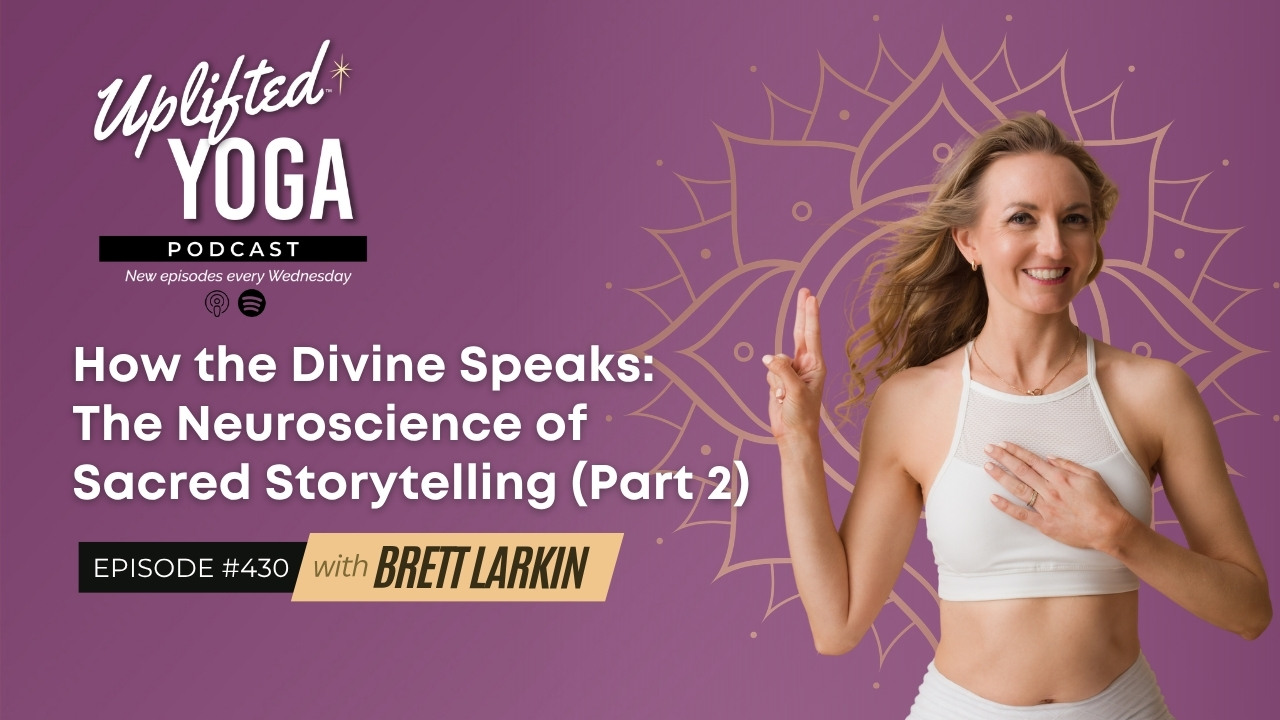
Why do the world’s great spiritual traditions teach through stories, imagery, and metaphor instead of simple instructions?
In this episode, I’ll explore why metaphor changes us in a way facts alone cannot and how imagery bypasses the analytical mind to speak directly to the nervous system, imagination, memory, and body.
Building on Part 1, we’ll dive deeper into Tantra’s vision of awakening as a love story between Shiva and Shakti: awareness and energy, stillness and sensation, consciousness and embodiment.
I’ll explore:
🔹 Why metaphor activates the nervous system differently than information
🔹 The neuroscience behind stories, imagery, and embodied learning
🔹 How yoga philosophy, Christianity, Buddhism, and Tantra all teach through metaphor
🔹 Why metaphor is essential for trauma-informed yoga teaching and meditation
🔹 Practical ways to use imagery, cue layering, and storytelling in your yoga classes
🎓 Want to become a more confident, creative, and impactful yoga teacher?
Grab my free Sequencing & Cueing Bundle and learn how to structure classes, layer cues, and use metaphor and imagery in a way that truly lands with students → https://www.brettlarkin.com/teach
FREE Practice: 10 Min Beginner Morning Meditation | EASY GUIDED MEDITATION
Relevant Blog: Yoga Cues 101: Everything You Need To Teach Yoga
Relevant to Today’s Episode:
📚 Healing with Somatic Yoga Book
🔮 300-hour Online Yoga Teacher Training
🎧 Also Listen to:
#300 – Unraveling the Mystery of Chronic Pain for Yoga Teachers & Practitioners with Kim Patel
#422 – What Happens When You Die? Bhagavad Gita Chapter 8 Explained
#425 – Why the Divine Speaks in Metaphor: Sacred Stories from the Gita, Bible & Upanishads Part 1
© 2026 Uplifted Yoga | BrettLarkin.com
Transcript:
Welcome to the Uplifted Yoga Podcast, where ancient yogic wisdom meets modern business strategy. I’m Brett Larkin, creator of Uplifted Yoga, where I’ve certified thousands of yoga teachers, built a multi-seven figure business, and guided over half a million students on YouTube. Here’s the truth, you don’t have to choose between embodying deep yogic wisdom and building a thriving, freedom-based business.
This podcast is your space to integrate both, because yoga isn’t just what you do on the mat, it’s how you show up in every part of your life. Whether you’re here to deepen your yoga practice, grow your teaching career, or align your energy with your purpose, you’re in the right place. Let’s dive in.
Have you ever noticed your body responds to a story in a way that it never responds? To an instruction manual? You can read step-by-step directions all day long, like a toaster manual or a car repair guide, and nothing in you comes alive. But hear a story, or tell a story, paint an image, invite the senses in, and suddenly it’s like your whole body comes online and is listening. For most of human history, wisdom wasn’t passed down through bullet points or checklists or definitions.
It was passed down through stories, through myths, through metaphors, through imagery. Because that’s how our nervous system stores and remembers things. In a previous episode, the part one of this episode, we explored how the divine is described again and again in these different ancient texts through metaphor.
God or the divine or awakening is described as a charioteer, a shepherd, a witness, a lover, a river returning to the sea. And today in this episode, we’re going to ask why do great spiritual traditions rely on metaphor instead of literal instruction? Why does an image change us in a way that an explanation never could? And what does all of this have to do with the nervous system, embodiment, and how we actually learn? We’ll begin today by finishing a story we didn’t quite get to last time. Tantra’s radical teaching that awakening itself is a love story between consciousness and love or consciousness and energy.
From there, we’ll explore the science, the somatics, and the teaching wisdom behind metaphor, why metaphor bypasses the thinking mind, why it’s remembered long after facts fade, and why it’s one of the most powerful tools you, if you’re a teacher, can be using in healing and meditation and even standing at the front of the yoga classroom. So expect lots of practical cuing and teaching tips as well. Settle in and let’s begin.
To kick us off, I’m going to read a passage from the Radiant Sutras. This is a text we study extensively in Embodied Yoga Life Coaching. In the tantric tradition, awakening begins with a conversation, a conversation between Shakti, the energy of life, sensation, movement.
She turns towards Shiva, who is pure awareness, and asks to experience what he has, the infinite, this pure awareness, from inside her body. And what follows are not explanations, but more like poetic doorways. Here’s one passage I want to read aloud for you.
When breath flows out and turns to flow in, stay with that turning. In that moment where breath becomes breath again, awareness and energy meet. When the body moves, know the one who is moving.
When the body rests, know the one who is resting. Feel how sensation arises in awareness and dissolves back into awareness. The breath is from Shakti, moving through form.
Awareness is Shiva, holding space. When movement and stillness recognize each other, the heart opens without effort. Enter that opening.
This is the meeting place of the lovers. Oh, this passage is so beautiful. So this passage clearly establishes this polarity that exists on this plane of consciousness.
We talk a lot about that in 300-hour training, right? This idea that we are here on earth school. It is a polarity planet. We have sun and moon, day and night, tall and short, love and hate.
And we are governed by these two major polarities, which is that there’s part of us that’s divine and connected to the infinite. Part of us that will always be, always was, that’s still and is witnessing everything that’s happening. And then there’s part of us that’s connected to sensation and connected to our emotions and connected to our thoughts and connected to the here and now.
And then, of course, there’s that which is experiencing the here and now. So we have this love story of Shiva, who is pure awareness, sitting, meditating, and Shakti, his lover, who is dancing and trying to wake him up to be part of the physical world. And the tantric tradition says that this cosmic love story is happening inside each of us as humans.
In fact, that’s actually the nature of being human, is that we have these two contrasting energies within us. But when we learn to have them have awareness and respect and actually fall in love with each other, we get to live as whole embodied beings on this earth, knowing and being fully connected to our human experience, but not forgetting and also having an awareness and being fully connected to an infinite experience. We also see the analogy here of the breath.
The breath is a metaphor. Shakti is in motion in the breath. Shiva is witnessing it.
And what I love about this passage is instead of awakening being this thing we have to achieve or master, it’s about a relationship. It’s about meeting in relationship with these two different parts of ourselves. It reframes awakening as something we have to achieve to instead being something that’s relational, something that’s intimate.
In Tantra, awakening is described as a love story, a literal cosmic love story between these two forces inside you. So here we’re seeing the analogy as divinity being an intimate relationship. And if you listen to the part one, which you don’t need to, but if you want to, of this episode, you know, we explored how divinity looks in other forms, right? Like divinity as protective, like the shepherd and the sheep and shepherd analogy.
Divinity as belonging with that idea of the rivers flowing into the ocean. Divinity as witness with the Upanishadic bird story we looked at. Divinity as guidance with the shepherd.
Divinity as discernment. That’s what we saw in the Gita with the charioteer. But here we have divinity as intimacy, as like the relationship between two lovers.
In a different passage, Shakti, the goddess says to Shiva, Oh, beloved, the nature of reality is beyond form, beyond space, beyond time. Teach me the way by which one may enter this boundless state and abide there fully. So Shakti’s not ignorant.
She’s curious. She’s asking, what is this infinite, unbound, you know, God-like consciousness? How do I experience it? And then Shiva responds with 112 experiential doorways in this particular text. So we have Shiva representing pure awareness, stillness, consciousness.
Shakti representing energy, sensation, movement, creation, everything on this plane of consciousness. And we’re learning that creation and awakening can only happen in relationship. And that’s why Tantra uses breath and sensation and pleasure and pauses and awe as gateways to understanding the divine.
Radiant Sutra 49. In the pause between breaths, when the breath turns from out-breath to in-breath, realize the grace of that moment. Enter.
So Tantra really reframes the divine as responsive, as intimate, as participatory. Awakening is not transcendence. It’s union.
It’s union between both of these energies, integrating both of these energies. And a big takeaway here is that, like, divine in this framework responds to desire. And that’s why we work so much on desire in the Yoga for Self-Mastery program, sleuthing for desires, figuring out your desires.
Because according to this framework, it’s like your desires are actually the way in to awakening, your way into the divine. So Shakti poses the question in this text, and then Shiva doesn’t answer with philosophy. He starts answering with experience.
He starts talking about breath, sound, sensation, stillness, pleasure. And this is the big difference between Tantra and traditional yogic texts, because it’s saying that awakening doesn’t happen by leaving the body. It happens when awareness meets sensation.
It happens when Shiva meets Shakti. And in many ways, Tantra, I think, understood a lot of what neuroscience is now confirming, which is actually that the body learns really well through imagery, story, and sensation, not through abstraction. So you’ve heard this story if you listened to the, you know, part one of the episode, which you can absolutely do after the fact.
But we looked at a lot of different examples of this, a lot of different examples of how imagery, metaphor, analogies are used throughout different texts across all wisdom traditions. And what I want to explore now, it’s like, why do great teachers rely on metaphor so much? Why is literal language not enough? And what can we learn from it as practitioners? Or what can you learn from it as a yoga teacher or a healer, if you’re listening to this, someone who’s helping others? So literal instruction is needed. We’ll actually talk about that.
But it’s not enough. It’s just literal language is not enough. Jesus didn’t say, here’s a list of theological principles.
He would use parables or he’d say, the kingdom of heaven is like, you know, and then he’d go on and describe something. Krishna didn’t give Arjuna a checklist. He actually placed him in a story on a battlefield inside a chariot in a particular situation that would force him to learn what he needed to learn.
So the first big principle I want to introduce is this idea that metaphor actually bypasses the thinking mind. So when we use literal analytical language, which has its place, but we’re primarily activating the prefrontal cortex of the brain, and that part of your brain is excellent at analysis and logic and categorization and sequencing things. It’s the part of the brain that really likes instructions and lists and explanations.
And we tend to be very much in this part of our brain and are in our Western culture. But unfortunately, it’s not the part of the brain that changes our behavior. It’s not the part of the brain that changes our sensation or our belief patterns.
Metaphor does something different. So when you hear a metaphor, when you hear a description of an image, a shepherd, a river, a battlefield, a snake undulating through the spine, all of a sudden what that’s doing is it’s activating the sensory regions of your brain. It’s activating your emotional memory.
It’s activating your imagination. And it’s activating what we call in the somatic training, your interoception, your felt sense. So metaphor is actually inherently somatic.
Those of you that have my book, Healing with Somatic Yoga, one of the chapters, I actually break down each of the senses, sight, smell, sound. And I talk about how especially smell bypasses the thinking brain entirely. It goes straight to the limbic system, straight to memory, straight to emotion, straight to, you know, is this safe or not safe? And metaphor works really similarly.
It’s not asking the mind to intellectually figure something out. It’s asking the body to recognize something. It awakens the senses.
So when I have this visual of the river and it flowing into the ocean, like that’s doing something to me because I have a sensory concept of water. Like I’m imagining it and I’m seeing and kind of visualizing that. Or if I think of my desire as being something that has to dance and wake up consciousness, wake up my devotion, right? That evokes something in me that a checklist or a list of instructions, like how to operate my toaster or operate my car, is never going to be able to do.
The next piece or element of this is that story is remembered 22 times more than facts alone. I talk about this a lot in my Embodied Yoga Life coaching program because I love to coach and teach often through storytelling and actually teach like a teaching superpower is to tell stories because people are going to remember them and they’re going to resonate deeper. So a fact says like, do this, do this thing.
And a story is literally giving people a world that they can step into and context that is so much more interesting to the brain, to like your whole brain, to your whole person rather than just like an instruction manual that’s activating only the prefrontal cortex. And metaphor almost always turns information into a story. Think about it.
That’s what it does. Like that’s what metaphors do. All information was passed down through stories before we had books, before we could even write things on palm leaves or whatever.
Like we talk about the oral tradition, right? The oral tradition is so powerful. And the oral tradition was pretty much always what? Myths, stories. Because that’s how the human brain kind of interprets the world.
This beginning, middle, end of a story. All of a sudden, if something’s a story, we’re interested. And this is why Jesus taught in parables, right? Buddhists, Buddha, another great teacher, he uses images like rafts, arrows, mirrors, moons reflected on water.
We see him teaching a lot using that imagery. Jesus, the parables, I mean, it’s so funny because I’ve been listening to the Bible as in audio form, as well as reading it again this year. And it’s almost comical how much you hear the phrase, and then he told his disciples this parable.
It’s like, that’s just what Jesus is constantly doing. Like they ask him all these really hard questions. And then it’s like, and then he told them this parable.
And then it’s like, we go into a story that often is hard for us to understand. Because if you go back to, you know, ancient Israel, he was talking about things that would make much more sense to them. Right? That’s why we spent a lot of time in the last episode, like dissecting, like the biology of sheep, because he was talking about sheep, the way we’d talk about like cars or like a common thing that we see and use all the time.
So often when we’re looking at these ancient texts, we have to do a little more legwork to understand the context of the time period. And that can help these metaphors and analogies come to life. But he always taught in parables.
He was never just like giving them the answer. Almost always it’s like, here’s a parable. And then they’re all kind of scratching their heads confused.
This is what’s beautiful too about parables and stories and metaphors. It’s like, it’s forcing you to participate. Instead of being told something, you’re like invited into an image.
You’re invited into a parable or a story that you have to think a little bit more about. So Jesus just taught in parables. And then the other thing you hear him saying, like all the time, besides, you know, the whoever wrote the gospel being like, and then he told this parable and he tells the parable, he just says, follow me, come with me, follow me, emulate me, right? Live like me, follow my values.
It’s really fun because instead of telling people what to do, he just said, follow me, emulate what I’m doing. And then he’d just give them these, you know, super interesting parables that would like leave them head scratching. And then Buddha, yeah, using images like wraths, arrows, mirrors, lots of nature.
And then yoga philosophy itself, when we’re looking at something like the Gita, for example, like it’s literally living inside a story, right? The Gita takes place inside the epic of the Mahabharata and it’s a dialogue, right? So, and then of course we have all the Hindu myths. So similar to a story, when we speak in metaphor or see metaphor, it’s creating, a metaphor creates sequence. It creates emotion.
It creates meaning. It creates context. Instead of us just being like a passive observer, it pulls us into the scene and forces us to participate, which means our brain is activated in so many more ways, which means the information sticks.
If teaching yoga lights you up, but also sometimes drains you, I made a free bundle of my own real life yoga sequences and playlists to support you, the teachers who give a lot. It includes my warmups, cooldowns, a full class written out pose by pose, plus a bonus training on how to sequence yoga to music, as well as a lot of my music playlists that I use to teach with. This bundle is completely free and when you download it, you’ll also get the option to upgrade to my queuing masterclass, if that’s calling to you.
You can grab all this now at brettlarkin.com/teach. And now back to the show. And this is why you, if you’re listening to this, if you’re a parent, if you’re a coach, if you’re a teacher, if you’re a healer, you need metaphor.
You need metaphor and storytelling in your life. When my kids are going through something hard, I don’t be like, you should do this. I’m like, well, when I was a little girl, right? And then I try to tell them a story that is related to maybe something that I want them to see or learn in a new way.
Let me tell you, this is a much more effective teaching strategy than just like telling people what to do. And then I try to live my life in a way where it’s like, come with me, follow me, right? Where they can emulate, hopefully, and I’m embodying the principles that are relevant in these stories that I’m teaching them. And sometimes the stories are times where I struggled or made a big mistake.
And, you know, that’s a valuable story to hear too. And I can reflect on that with them. We have a whole storytelling little kind of day and week that we do in embodied yoga life coaching, because I think rather than telling someone what to do, illustrating a story shows them another way to look at the situation, lets them be participatory in the work of seeing like, oh, yeah, okay, I get how that relates.
It’s why I put so many stories of, you know, like student stories and compilations of like student profiles and different issues that I’ve seen in the somatic book that I wrote, Healing with Somatic Yoga, because I think the stories really helped certain key points about the nervous system come to life when we like saw it in the example of a story in someone’s teenage years or childhood. So let’s make this practical. If you happen to be a yoga teacher, in my trainings, I teach this cueing framework called the BVA method, which stands for breath, verb, anatomy, analogy.
And it’s really important if you’re a yoga teacher to, and you’re teaching physical asana to start with clarity, right? So the full method, you cue the breath, you cue a verb, you cue anatomy points and how those anatomy points are moving in certain directions to get people into a certain shape. For example, as you breathe in, that’s the breath, root, that’s the verb, your sits bones down. That’s the anatomy, right? As you exhale, lengthen.
As you exhale the breath, lengthens the verb through the crown of your head. That’s the anatomy. So I have a sequencing class and a cueing class that I will link up for you in the show notes.
But this BVA method, I love. I’ve been teaching it for over a decade. So we have this breath, the verb, the anatomy, and that gives the body orientation.
That helps us get students into shapes. But then, and this is key, once people are in a shape, you can layer a metaphor on top. And now the spine becomes a sword, a stalk of bamboo, a river of light.
So it’s like the first layer of your cue gets people organized anatomically in the shape you want them to be in. But the second layer of cueing brings the shape to life. Now, don’t get me wrong, what we don’t want to do, and I talk about this in the cueing masterclass, is you don’t want to only speak in metaphor or analogy because that’s going to be vague, disorienting, and confusing for your students in your yoga class.
But when we have a metaphor that’s layered on top of really precise anatomical cues, that’s where the magic happens because it gives your students permission, once they’re in the shape, to feel instead of perform, to start exploring and personalizing instead of just executing what you’re saying, and to really inhabit the pose in a way that’s unique to them through the imagery that you’re evoking. And this kind of cue layering, again, is something I teach deeply inside all my teacher trainings, both the 200-hour and the 300-hour level. And I honestly don’t see it taught this way very often anywhere else.
I don’t think I’ve ever seen someone talk about cue layering and the precision of cues the way I do. So if you want to grab that cueing masterclass, we will link that in the show notes. So if you’re a yoga teacher and you’re not using the power of analogy and imagery after your great anatomical cues, I would say that’s a place you can grow.
And it’s also a place you can let your personality shine a little bit because I know when we first start teaching, we think we need to be all professional and all perfect and we need to be the yoga teacher caricature or whatever. But really, your students want to see you. They want to see your authenticity.
They want to see your vulnerability. They want to see your personality. They want to see your quirks.
And the more that you can let all of that shine and put it out front and center, the more you’re going to have that loyal, devoted following because they feel connected to you. They feel like they know you and they trust you because they’re like, this isn’t someone who’s putting on a show. This is someone who’s just being themselves.
And so through the different metaphors or analogies that you use, you can also reveal part of yourself, right? Things that you like or think are silly or that resonate to you. Like maybe you love paddleboarding and you say to your class in a balanced pose, it’s like you’re on your paddleboard and we’re looking at this beautiful lake and it really makes moments come alive in a new way. It takes away that stiff formality.
Metaphor is also fantastic in trauma-informed teaching, which is also a key pillar of all of our trainings at Uplifted, this trauma-informed teaching methodology. And metaphor can be a really great portal to trauma-informed movement. So sometimes pain, if a student or a private client is experiencing pain, often it’s not coming from the body itself.
It’s coming from association. And we’ll link up for you a great podcast we did with an Uplifted 300-hour alumni because a huge benefit of training is getting to meet all the incredible, insanely smart people who want to be at the table having all of these conversations. But she was an expert in pain management in the brain.
So I had her onto the podcast and this was something she talked a lot about, especially in relation to teaching yoga privates. So we’ll link that episode for you in the show notes. But she talked about how pain lives in the brain, right? So a lot of times pain isn’t coming from the tissue.
It’s coming from an association or a pattern in the brain. So someone might’ve been told like, I can’t do forward folds, right? Something like that. And the idea of a forward fold triggers a threat for their system.
But if you say something like, let’s just let the spine undulate gently forward and back like a snake, right? They actually are coming into a bit maybe of a gentle forward fold. But so the same type of movement is happening, but without the cognitive label that created the fear, right? Cause I didn’t say forward fold. I was just like, let’s just let our spine undulate forward and back like a snake, something like that.
So often metaphor can bypass the alarm system that we might have in our brain. And it allows the body to experience certain movements and movement is medicine, like pretty much unless you’re recovering from something acute, like a surgery or an acute injury, when we’re in that longer term recovery phase, pretty much movement is good, right? So often metaphor and analogy can help someone explore their body, explore their body in new ways without the preloaded meaning of something that they like think is contraindicated. So this can be huge for chronic pain, for injury recovery, for trauma healing, for reclaiming mobility.
It lets movement become playful too. That’s really, really important. And metaphor and imagery lets people become curious and self-directed.
And often it’s like pain can decrease, not because the body itself changed, but because someone’s relationship to a certain movement changed. The next idea I wanna invite you into is that if you’re a teacher, you can use metaphor intentionally in your teaching. Maybe you wanna think about some signature images that you already use, that you’re already maybe referring to.
Think back to your past couple of classes. Are there like signature images that you always use? Or could you push yourself maybe to use imagery? I always think back, and I know I’ve talked about this already at some point on the podcast, but this somatic yoga class that like trended and kind of went viral on YouTube that I had. And it was the class where I was being the most myself, being the most goofy, and actually using a lot of metaphor and analogy in extreme ways that showcase my personality.
Like we did this movement with what I called swan arms. I was like, what are swan arms? I described it anatomically, the movement and demoed it, right? Like it’s like elbows up to the ceiling and then you take your elbows back behind you. And then I was like, and you’re lifting it up and down like a swan.
And it’s just, it’s like swan arms, right? Like I have the stance background. It’s kind of like the Swan Lake Girls Movement that you see all the time in that ballet. And when I recorded it, I was like, is this totally gonna confuse people? And so many people have told me like, oh, I love swan arms.
It was the favorite part of that class. So this is, I’m just trying to give a practical example of how like you can use a signature image like swan arms that is really fun and brings a movement alive for people, lets it feel playful for people, lets them personalize it, helps them remember it and be like, oh, I wanna do that class again. And it’s also like revealing a little bit about you and your personality.
There was a man I was talking to in our Kundalini teacher training the other day, and he was talking about a move and using like a Star Wars analogy. And he was like, well, that’s really weird. I’m like, no, that’s so cool, right? Like the way he used that Star Wars analogy for the thing he was talking about in Kundalini yoga, it really made it click for me in a new way, even though I probably don’t know as much about Star Wars as him.
So you really need to trust that like images are incredibly powerful. And even if they don’t maybe exactly land for your student, they’re gonna make your student feel more connected to you as a teacher through what imagery you choose to reveal and talk about. Of course, I invite you to choose like metaphors that align with your theme.
Maybe you’re teaching a class on the chakras. Like that’s very easy to pull certain imagery for. The chakras have this elemental correspondence.
Review the elemental series and the uplifted membership, right? We talk about earth, fire, water, like so much imagery you can do with the elements. In fact, that entire series of classes is an exploration of elemental themes through the body. And you can actually write down and choose some of these metaphors ahead of time, right? This isn’t like something you have to improvise.
This is something that can be very beautifully and deliberately planned when you write out your sequence. And always be asking like, what sensation do I want this image to evoke? Great metaphor, great stories usually aren’t random. They’re usually very intentional.
They’re usually by design. And my last big tip is to really think about metaphor in meditation, setting that inner scene for yourself or for your students, because metaphor is one of the most beautiful tools that you can use in meditation. And I think my favorite part about teaching meditation is getting to call on this imagery that’s relevant to something that I want people to feel, sense, or experience, right? So having them think about walking through a field, floating in warm water, sitting by a fire, opening a door, watching the clouds pass.
We had one of our embodied yoga life coaches. There’s sort of like a nervous system regulation script that I give people in that program to use for themselves, but also to talk their clients through. And she had this great idea.
She said that she taught the script, but before teaching it, she gave her client this image of descending in an elevator, like down, down, down, down, down to like this place where there she was then gonna, you know, calm down and regulate. And that image, that imagery, that metaphor of like descending down an elevator, like really made the nervous system regulation script like land so much deeper for that particular client. So often we have a technique or alternate nostril breathing or a breathing technique, Satali, something like that.
And if we can marry it with a metaphor or an image at the beginning, it just takes the technique so much deeper. So imagery can really orient the nervous system, create safety, help people focus their attention without like, but not in a forceful way because you’re not telling the mind to stop thinking. You’re giving them something else to focus on.
You’re giving the mind a different place to rest in a story, in an image, in a scene. So to close it out, I think maybe the divine speaks in metaphor and we see metaphor across all these different wisdom traditions and all these different stories cross-culturally is because there’s something different about how our body listens when we’re hearing story and imagery evoked. And this is such great news because if you’re a teacher, it’s like, yes, we need clear explanations, but you’re more than that.
That’s not all that’s needed. Awakening isn’t just about clear explanations. It’s also about resonant imagery and imagery is a way that you can help your students feel guided instead of controlled.
It’s a way that you can help them feel curious and often depending the image, like safe, safe enough to maybe soften. So as we come to the end of this episode, I want to leave you with an image, the image that Tantra offers us that this image of a love story, of awareness, meeting sensation, stillness, meeting movement, Shiva, listening as Shakti speaks. And maybe a deeper reason why metaphor works so powerfully isn’t just because it’s poetic or somatic, but because it mirrors how life actually moves through us.
You know, we don’t experience ourselves as a bullet point or as bullet points. If I asked you to tell me about your life, you probably won’t start with a checklist. You’d start with a story.
We experience ourselves as sensations, memories, stories, images. And when teaching, healing, meditating speaks in that same language, the nervous system doesn’t have to translate it, often just understands immediately. So as you move through the rest of your day, think about what metaphors or imagery are related to how you’re thinking about the moment or relating to your body.
And if you’re a teacher or a guide, sometimes you don’t have to explain more. Sometimes all it takes is the right image offered at the right moment. Thank you all so much for being here and for listening all the way to the very end.
Loving what you’re learning on the podcast? Apply the ancient science of yoga to your daily life surrounded by incredible peers in my uplifted 200-hour online yoga teacher training. Or grow into your role as a leader of others in my 300-hour professional program for yoga teachers, which is also a high-level business mastermind. At any time, I would love to welcome you into my Yoga for Self Mastery course to help you uncover your personal blueprint to serenity.
Or join my Uplifted Yoga membership for an all-access pass to my most popular yoga courses, thematic class plans, and practice calendars. Don’t forget to prioritize your well-being and get on your mat today. From my heart to yours, namaste.