I have two sons. When my oldest was a toddler, and he started having the kind of full-body meltdowns that toddlers have, my body would react before my brain could catch up. I’d tense. My breath would get short. My voice would tighten. I’d want to fix it, or shush it, or make him stop.
I now parent very differently. Not because I’m more patient or more evolved than I was, but because a 200-hour yoga teacher training changed the way my nervous system operates in the middle of a meltdown.
This is a piece about that, and about why every mother I know who has done a 200-hour YTT says the same thing afterward: I wish I had done this before I had kids.
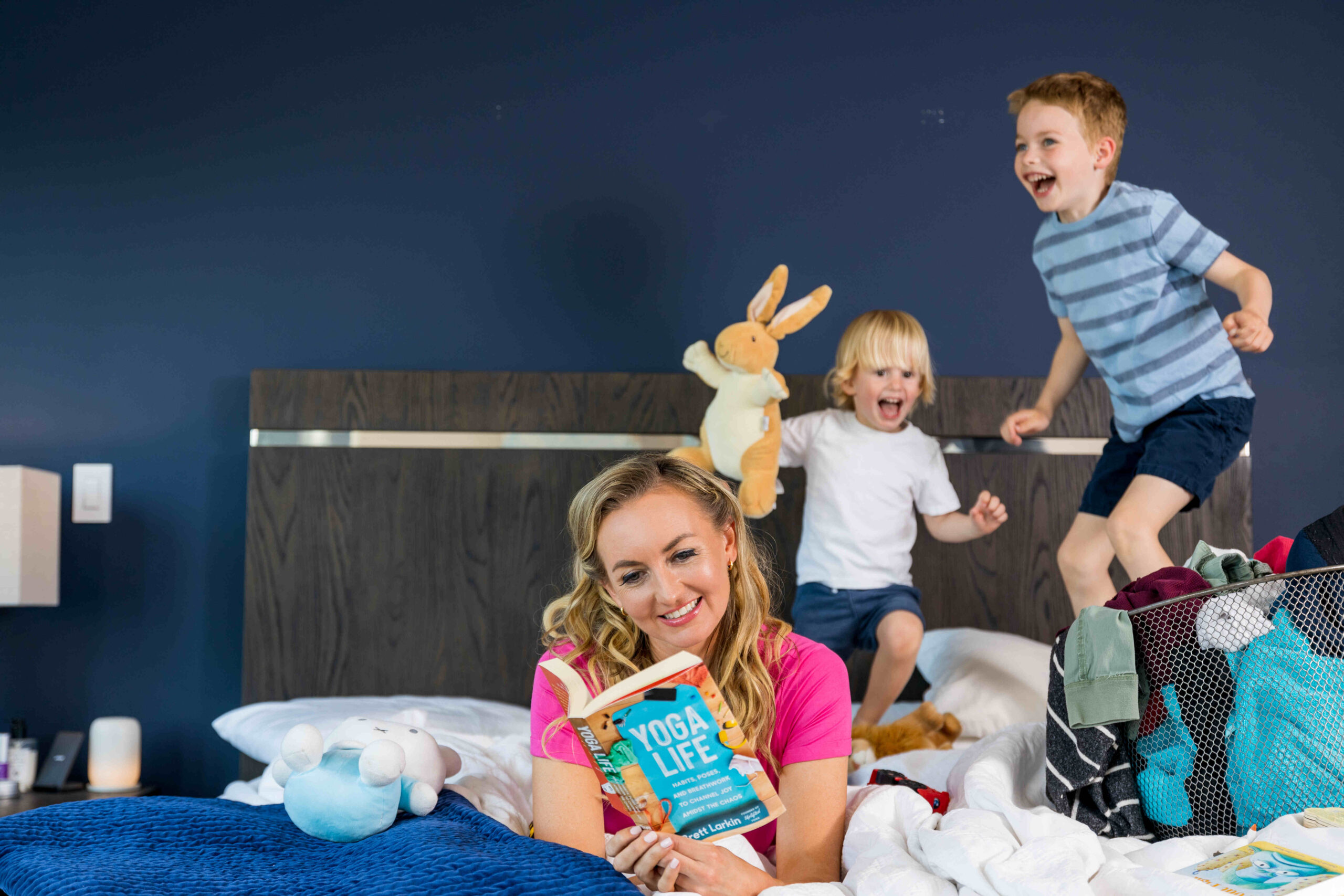
The short answer: I parent from a different nervous system now
Yoga teacher training didn’t teach me discipline strategies, and I don’t use them. What it taught me was how to regulate my own nervous system in real time — which turns out to be the single most powerful parenting tool I’ve ever encountered. Because your child’s nervous system mirrors yours. If you can stay grounded while they’re melting down, they will slowly meet you there. If you match their dysregulation, you both stay stuck. The training gave me the tools. Motherhood gave me the daily lab.
Before YTT: reactive parenting during meltdowns
Let me be precise about what I used to do, because a lot of moms will recognize it.
My son would start to escalate. Maybe he was tired, maybe hungry, maybe just three. My chest would tighten. My shoulders would rise. My voice would sharpen without my choosing to sharpen it. I would try to manage the situation, which really meant I was trying to make his uncomfortable state stop so I could feel comfortable again.
This never worked. He would escalate more. I would escalate more. The whole household would become a small storm of activation. And afterward I would feel guilty, because I knew somewhere in me that I had contributed to the storm, but I didn’t yet have the tools to have done anything differently.
What I didn’t understand yet was that his tantrum wasn’t the problem I needed to solve. His tantrum was information. His nervous system was overwhelmed and it was doing what dysregulated nervous systems do — it was throwing off signals in the form of screaming, kicking, whatever — hoping someone in the room would help it come back down.
The teddy bear on the belly
Here’s a story I told on a recent podcast, and it captures the specific weirdness of what yoga teacher training does to how you parent.
When my sons were toddlers, before they could really have a conversation, I would put a small stuffed animal on their belly at bedtime. Not for cuteness. I was teaching them their diaphragm.
I would say, watch the teddy rise. Now watch it fall. They would watch it, mesmerized, riding their own breath. Their bellies would slow. Their bodies would soften. They would understand — at two and three years old — that their breath and their belly moved together, and that this movement felt good.
You do not know to do this as a mother unless someone teaches you your own diaphragm first. Nobody teaches you your diaphragm in normal school. Nobody teaches it to you in prenatal classes. You learn it in yoga teacher training. And then — if you’re a mother — you use it every day for the rest of your children’s lives.

✦ ✦ ✦
Why your kids are a mirror of your nervous system
This is the thing I wish I could hand every mother on Day One of motherhood.
Your child’s nervous system reflects yours in real time. Their capacity to regulate is developing across their first decade of life, and until it’s fully online, they borrow yours.
What that means, mechanically, is: when you’re activated, they’re activated. When you’re calm, they slowly meet you at calm. Not immediately — they might spike higher first, testing whether you’ll stay. But if you hold the ground, they will eventually come down to meet you.
This is not a metaphor. It’s a well-documented neurological phenomenon called co-regulation. Before children can self-regulate, they regulate through their primary caregivers. Your steadiness is literally the ground they stand on.
There’s a saying I use constantly now: the strongest nervous system in the room wins. Whoever is the most calm, the most grounded, the most regulated — everyone else in the room will eventually meet that person. Yoga teacher training is where you become that person on purpose, not by accident.
The moment a child’s tantrum becomes a nervous system practice
These days when one of my sons melts down, my body does a completely different thing than it used to. My breath drops. My shoulders soften. I anchor into my feet. I get quiet.
Some of this is time-earned. But most of it is the training. I have specific, embodied practices for coming into my own body when someone else is coming out of theirs. I know what to do with my breath, my exhale, my posture, my gaze. And when I do it, the whole texture of the interaction changes.
A tantrum is now, essentially, a small mini yoga class. My job is to witness. My job is to hold the space. My job is to remain regulated while my child works through the wave of feeling that’s moving through their body. When I do this well, the tantrum ends faster, connection comes back sooner, and both of us learn that dysregulation is survivable.
This is not a skill I brought to yoga teacher training. It’s a skill YTT taught me. And it’s the one I use most, more than anything I ever learned about a pose.
✦ ✦ ✦
What I teach my sons that most kids never learn
Because I have this training, my children get a body-and-nervous-system education just by being in my house. It’s not intentional curriculum. It’s the byproduct of a mother who speaks a certain language.
- They know their diaphragm. They knew what it was before they could tie their shoes. They can locate it, breathe into it, and feel the difference between shallow chest breathing and deep belly breathing.
- They know how to reset their nervous system with breath. When my youngest was five, he came to me after school one day and said his heart was going too fast. I said, do you know what to do? He put his hand on his belly and did four long exhales. He went from panicked to calm in under a minute.
- They know that big feelings aren’t dangerous. This is the biggest one. They know feelings move through and pass. They don’t think a strong emotion means something is broken.
- They know how to name what state they’re in. They can tell me they’re activated, tired, overwhelmed, cozy, or curious. Naming a state changes the state. This is nervous system regulation as a life skill.
None of this is because my children are special. It’s because I learned this vocabulary, and they absorbed it from the atmosphere of the household. That’s what YTT does when a mother takes it. It rewires the whole family.

The case for 200 YTT if you’re a mom (even if you never teach)
If you are a mother, and you are thinking about a 200-hour yoga teacher training, and part of you is wondering whether it’s worth the money and the time when you have no intention of teaching yoga — let me answer you as directly as I can.
You will parent differently. Your children will benefit for the rest of their lives. The training will pay for itself in your household nervous system alone.
You will be able to be with your child’s biggest feelings without contracting. You will teach them things about their own body that no school will ever teach them. You will become the calm anchor in your household, not because you’re naturally patient (I’m not) but because you have skills, and the skills work.
You do not need to teach yoga to have this be one of the most valuable things you ever do for yourself and your family. In fact, most of the mothers in my training don’t teach. They just parent better. That’s the point.
🎧 Want more like this in audio? Subscribe to the Uplifted Yoga Podcast on Apple Podcasts or Spotify.
✦ ✦ ✦
Frequently Asked Questions
Can yoga help me be a calmer mom?
Yes, and specifically — yoga trains you in nervous system regulation, which is the actual mechanism behind “calm parenting.” Rather than teaching you to suppress your reactions, yoga teaches you to notice your state, work with your breath in real time, and stay grounded while your child moves through big feelings. Most mothers who take a 200-hour yoga teacher training report significant change in how they respond to tantrums within weeks.
How does yoga teacher training benefit stay-at-home moms?
It gives you a nervous system, a language, and a daily practice — all three of which change the atmosphere of your household. You’ll be able to co-regulate your children through big feelings, teach them about their own bodies from a young age, and build a consistent morning practice that carves out something that’s just yours. It’s also a real intellectual container in a season of life that often lacks one.
What’s the most important thing yoga teaches you about parenting?
That your child’s nervous system mirrors yours in real time. Before children can self-regulate, they co-regulate through their primary caregivers. That means your steadiness — or lack of it — is directly shaping how they process difficulty. Yoga teacher training gives you the tools to hold that steadiness on purpose.
Can I teach my child yoga at home?
You don’t need to formally teach yoga to your child — you just need to speak the language. Show them how to breathe into their belly. Let them see you practice. Name your own nervous system states out loud. Children absorb the atmosphere of the household, and the atmosphere changes when a parent has done a yoga teacher training.
What’s the best breathing technique to calm my child?
Extended exhale breathing. Have them place a hand on their belly, breathe in for a count of four, and breathe out for a count of eight. Do it together — don’t just prescribe it. Their nervous system will follow yours. Within about a minute, both of you will be measurably calmer.
Is a 200-hour YTT worth it for a busy mom?
For most busy moms, yes — provided it’s an online format that lets you integrate the material into your actual life rather than pulling you away from your family for weekends and intensives. Online YTT with lifetime access lets you practice while your children play nearby, watch lectures at nap time, and apply nervous system tools during the actual daily situations you’re trying to change.
How do I stay grounded when my child is having a tantrum?
Drop into your body first. Feel your feet on the ground. Slow your exhale. Soften your shoulders. Do not try to make the tantrum stop. Your only job is to remain regulated while your child rides the wave. When you do this consistently, tantrums shorten, connection returns faster, and your child learns that difficult feelings are survivable. This is a skill yoga teacher training teaches directly.
✦ ✦ ✦
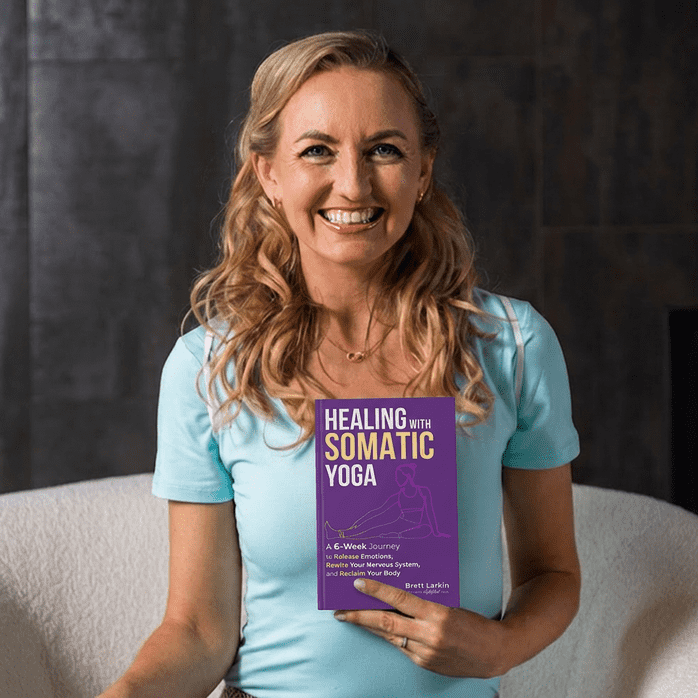
About the Author | Brett Larkin
Brett Larkin has been integrating somatic therapy with yoga for over 14 years. A certified body-oriented coach and longtime student of somatic psychology and myofascial release, she weaves nervous system healing into all her trainings. Her Somatic Yoga programs blend movement, breathwork, and trauma-conscious practices to help students reconnect with their bodies. She has over a half a million subscribers on Youtube and is also the author of Yoga Life and host of the Uplifted Yoga Podcast.
Experience 3 Training Videos from Inside My 200-Hour Online YTT