If you’ve been anywhere near modern yoga in the last two years, you’ve heard the phrase nervous system regulation. It’s on Instagram, in every wellness podcast, and increasingly in the conversations Barbie has with prospective students on the phone. Prospects have the vocabulary. They know their nervous systems are involved somehow. They just don’t have the framework.
Here is the framework.
The short answer: yoga is nervous system training
Yoga was originally, and remains fundamentally, a practice of nervous system regulation. Everything else — the poses, the philosophy, the community — is supporting infrastructure for the actual work, which is teaching your autonomic nervous system to move fluidly between states of activation and rest. Modern research on polyvagal theory has finally caught up to what yogis have known for thousands of years. The tools yoga uses — breath, movement, awareness, meditation — are precisely the tools that regulate the vagus nerve, the parasympathetic branch, and the whole autonomic system.

What “nervous system regulation” actually means (in plain English)
Your nervous system has two main branches you need to know about. The sympathetic branch is the gas pedal — alertness, activation, movement, fight-or-flight. The parasympathetic branch is the brake — rest, digestion, healing, connection.
A regulated nervous system is one that can move between these states easily. It ramps up when it needs to. It comes down when the threat passes. It rests deeply and activates cleanly.
A dysregulated nervous system is one that gets stuck. Stuck in activation looks like anxiety, insomnia, chronic tension, racing thoughts, digestive issues, autoimmune flare-ups. Stuck in shutdown looks like depression, fatigue, dissociation, and the feeling that nothing matters. Most people who arrive at yoga teacher training are somewhere on this spectrum.
Yoga is the practice of teaching your nervous system to move again.
The vagus nerve, polyvagal theory, and why yoga works
The vagus nerve is the longest cranial nerve in your body. It’s the primary information highway between your brain and your organs. It’s also the main pathway of the parasympathetic nervous system. When you strengthen your vagal tone, you can down-regulate stress faster, recover from difficulty more resiliently, and access rest and connection more consistently.
Polyvagal theory, developed by Dr. Stephen Porges, describes three states the vagus nerve mediates:
- Ventral vagal (safe and social). This is the state of connection, curiosity, and calm alertness. This is where you actually want to live.
- Sympathetic (mobilized). Activation — useful in a threat, exhausting when chronic.
- Dorsal vagal (shutdown). The freeze response. Numbness, disconnection, collapse.
Almost every technique in a real yoga teacher training is a targeted intervention on one of these states. Breathwork tones the vagus nerve directly. Slow flow moves you from sympathetic into ventral. Meditation reveals what state you’re actually in. Restorative practice retrieves you from dorsal shutdown. When you understand this map, yoga stops feeling like a random collection of poses and starts feeling like a precision instrument.
✦ ✦ ✦
The single biggest lever: your breath
There are a few ways to influence your nervous system state. You can move. You can change your environment. You can eat. You can sleep. You can seek connection.
But the single most direct, most immediate, most conscious lever you have is your breath. Breath is the only autonomic function you can consciously override. When you change how you breathe, you change your nervous system state within seconds. Everything else takes minutes or hours.
This is why pranayama — the breath work that a 200-hour yoga teacher training goes deep into — is the most practically useful thing you can learn about your own body. And this is why “just close your eyes and take a deep breath” from a wellness Instagram post is a shallow version of a genuinely powerful skill.
The nostril-breathing hack most yogis never learn
Here’s one thing I love teaching in the 200-hour, because students always freak out when they realize it works. You have a dominant nostril at any given moment, and it swaps roughly every ninety minutes. Try it right now. Close one nostril and breathe. Now the other. One is more open than the other. Yes. That’s it.
This isn’t a hippie observation. This is a documented physiological phenomenon called the nasal cycle. And it matters because your left and right nostrils are connected to different hemispheres of your brain — and therefore to different qualities of nervous system activation.
- Right nostril breathing. Activates the sympathetic nervous system, the left brain hemisphere, and the qualities of alertness, logic, and focus. Use it before you need to be sharp.
- Left nostril breathing. Activates the parasympathetic nervous system, the right brain hemisphere, and the qualities of calm, receptivity, and rest. Use it before sleep or when you need to come down.
You can practically hack your own brain chemistry by choosing which nostril to breathe through. Yogis have known this for a very long time. It’s just now that modern science can explain the mechanism. There are all of these secret levers built into your body, and yoga teacher training is where you learn to pull them.
Why your kids are a mirror of your nervous system
Here is the piece nobody ever writes about, and it’s the one that changed the way I parent.
Your children’s nervous systems mirror yours. If you’re activated, they’re activated. If you’re shut down, they get either louder or more withdrawn. And there is a saying I use all the time now that I’ve come to believe deeply: the strongest nervous system in the room wins.
What that means is: whoever is the most calm, the most grounded, the most regulated — everyone else in the room will slowly fluctuate back to meet that person. This is why parenting during a tantrum is a nervous system practice, not a discipline strategy. If you can hold your own nervous system steady when your child is dysregulated, they will eventually meet you there. If you match them, you both stay stuck.
None of this is theoretical. Yoga teacher training is where you learn to hold that steadiness on purpose.

✦ ✦ ✦
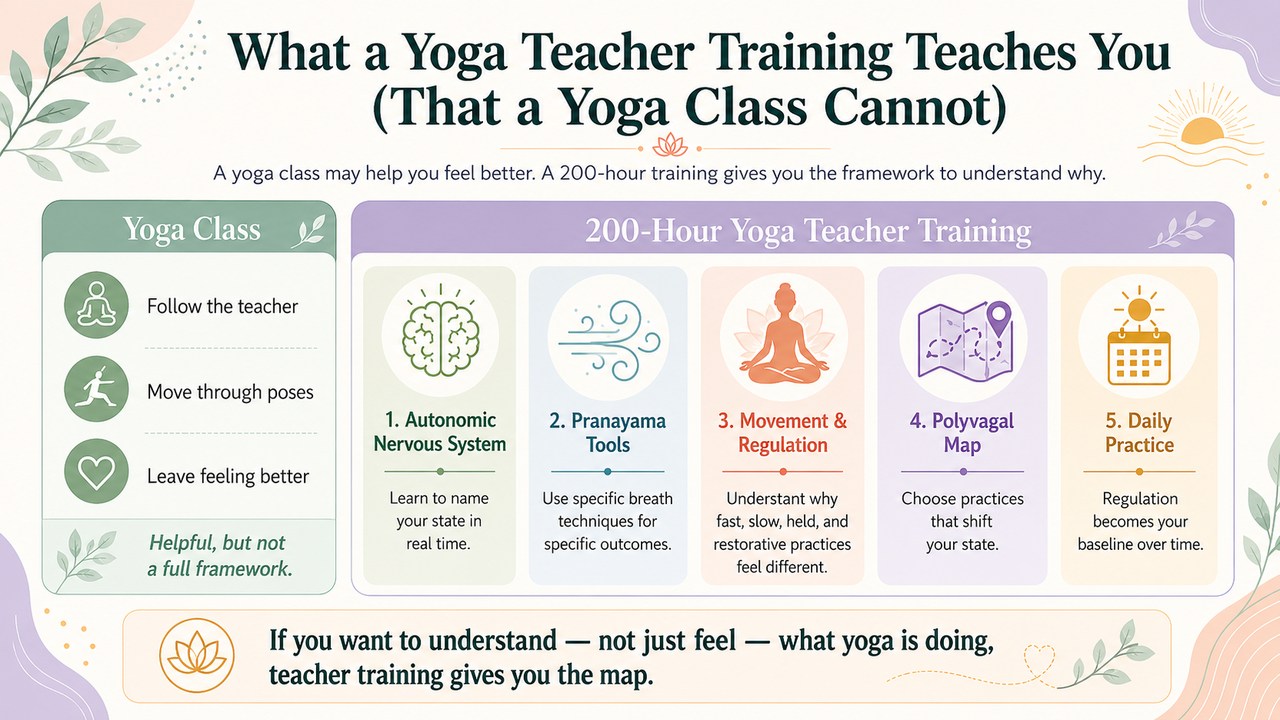
What a yoga teacher training teaches you (that a yoga class cannot)
You can take a yoga class for ten years and still not understand your own nervous system. I’ve watched this happen thousands of times. Studio classes are performance environments — you follow the teacher, you go through the poses, and you leave feeling better. But you don’t leave with a framework.
A real 200-hour yoga teacher training gives you the framework. Specifically:
- A working model of the autonomic nervous system. You’ll be able to name your state at any given moment.
- Specific pranayama techniques for specific outcomes. Not “breathe deeply.” Instead: nadi shodhana to balance, kapalabhati to activate, bhramari to soothe, ujjayi to focus.
- An understanding of how movement affects the nervous system. Why fast flows are activating and slow ones are regulating. Why long holds work on the parasympathetic. Why restorative is neurologically different from sleep.
- The polyvagal map as a daily-life tool. Once you can name what state you’re in, you can choose a practice that shifts it.
- A daily practice that reinforces regulation over months. One breath session doesn’t change your baseline. Eight months of practice does.
If you’re the kind of person who wants to understand — not just feel — what yoga is doing to you, this is the container. And the 200 hours is worth doing whether you ever teach a class or not.
✦ ✦ ✦
Frequently Asked Questions
Can yoga actually regulate your nervous system?
Yes — and it’s the most well-researched benefit of the practice. Yoga’s breathwork, movement, and meditation techniques directly influence the vagus nerve and the autonomic nervous system. Consistent yoga practice has been shown to increase vagal tone, reduce cortisol, and improve heart rate variability. It’s one of the most reliable non-pharmaceutical interventions for chronic nervous system dysregulation.
What’s the difference between yoga for stress and yoga for nervous system regulation?
Yoga for stress addresses the moment — you feel tense, you take a class, you feel better. Yoga for nervous system regulation addresses the baseline. Regular practice retrains your autonomic system to move more fluidly between activation and rest, so your default state shifts. Nervous system regulation is what happens when you’re consistent, not what happens in a single class.
What is polyvagal theory in yoga?
Polyvagal theory, developed by Dr. Stephen Porges, describes three states of the autonomic nervous system: ventral vagal (safe and social), sympathetic (mobilized), and dorsal vagal (shutdown). Yoga practices map cleanly onto these states — breathwork tones the vagus nerve, slow flow moves you from sympathetic into ventral, restorative retrieves you from dorsal shutdown. Understanding this map makes yoga much more targeted.
How does alternate nostril breathing work on the brain?
Your left and right nostrils are connected to different hemispheres of your brain. Right nostril breathing activates the sympathetic nervous system and the left hemisphere (alertness, focus). Left nostril breathing activates the parasympathetic system and the right hemisphere (calm, receptivity). Alternate nostril breathing (nadi shodhana) balances both, creating a state of centered clarity. This is not folklore — it’s documented physiology.
Can I learn nervous system regulation without doing yoga teacher training?
You can pick up individual techniques from books, apps, and YouTube — and you should. But you’ll get to a plateau. What a 200-hour yoga teacher training gives you is the full framework: how the pieces fit together, how to sequence techniques for specific states, and how to sustain daily practice long enough to shift your baseline. It’s the difference between owning a few tools and having a workshop.
What’s the fastest way to calm my nervous system?
Extended exhale breathing. Inhale for four counts, exhale for eight. Do it for two minutes. This activates the parasympathetic branch of your nervous system directly through vagal tone. It works within seconds and is the fastest, most reliable, most portable regulation tool you have. Yoga teacher training goes far deeper, but this alone will change your life if you use it daily.
Why do I feel emotional during certain yoga poses?
Poses that open the hips, chest, or throat can release stored physical tension patterns — and those tension patterns are often organized around unprocessed emotional experiences. The body doesn’t distinguish between physical and emotional holding. When the tension releases, the associated feeling can surface. This is one of the deepest teachings yoga has to offer, and it’s a major reason people who start practicing seriously end up in yoga teacher training.
✦ ✦ ✦
About the Author | Brett Larkin
Brett Larkin has been integrating somatic therapy with yoga for over 14 years. A certified body-oriented coach and longtime student of somatic psychology and myofascial release, she weaves nervous system healing into all her trainings. Her Somatic Yoga programs blend movement, breathwork, and trauma-conscious practices to help students reconnect with their bodies. She has over a half a million subscribers on Youtube and is also the author of Yoga Life and host of the Uplifted Yoga Podcast.
Experience 3 Training Videos from Inside My 200-Hour Online YTT