Let me name something you might not want to say out loud: you’re thinking about doing a 200-hour yoga teacher training, but you don’t actually want to teach yoga.
You’re almost embarrassed to admit it. When you look at yoga teacher training programs, they all seem built for people whose plan is to quit their jobs and lead studio classes. And that’s not you. You just want the education for yourself — a deeper practice, a better understanding of your own body, a container to actually integrate what you already sense yoga is doing to you.
If that’s you, you’re not alone. And you are not the exception. In 2026, you might actually be the average.
The short answer: you don’t have to want to teach yoga to do a 200-hour YTT
No — you do not have to want to teach yoga to take a 200-hour yoga teacher training. In fact, in the last two years, roughly 40% of my Uplifted students have enrolled with no intention of ever teaching a class. They come for a deeper personal practice, for nervous system education, for a container to actually integrate yoga into their real life. The certification is a byproduct, not the point.

Who’s really enrolling in 200-hour YTTs in 2026
Barbie, my senior sales advisor, spends her days on the phone with prospective students. She recently told me that in almost every conversation now, students say some version of the same defensive line: “I don’t want to be a yoga teacher. I never see myself working in a studio.” Three years ago, this was the exception. Today it’s the norm.
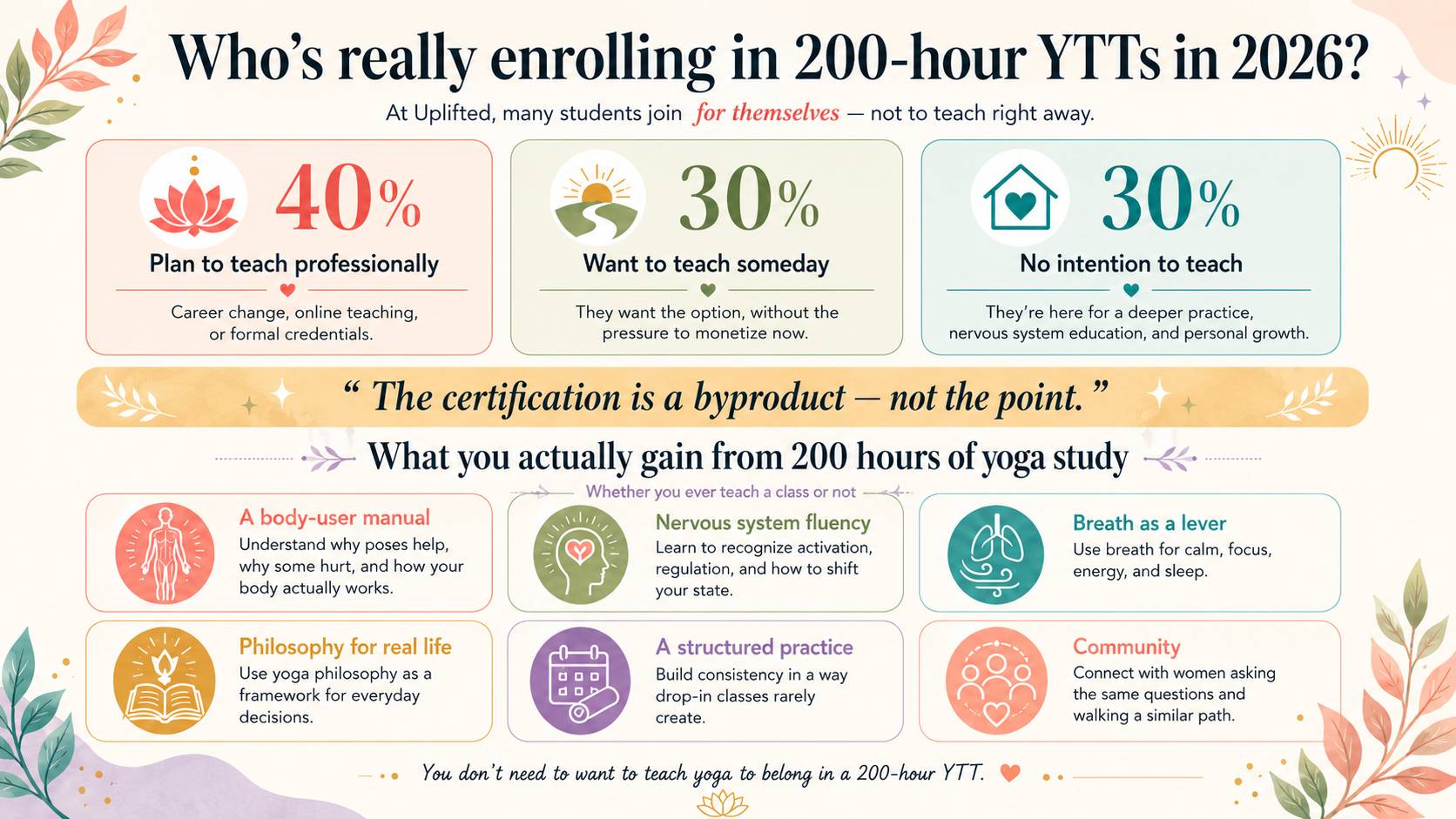
Here’s the breakdown of who’s enrolling in an Uplifted 200-hour yoga teacher training right now:
- About 40% sign up planning to teach professionally. They want a career change, a credential to teach online, or they’re already teaching in some form and need real training to back it up.
- About 30% sign up to eventually teach, “someday.” They want the credential as a future option. They take YTT now because they have time, energy, or a life transition. The pressure to monetize is off.
- About 30% sign up with no intention of ever teaching at all. They want 200 hours of deep, structured immersion in yoga. They’re not buying a certification — they’re buying an education for their own body and life.
If you’re in that last group, you belong here. And you might actually get more out of the training than the students who arrive with a business plan, because you have nothing to prove and nothing to sell. You’re just there for you.
What you actually gain from 200 hours of yoga study (whether you teach or not)
Let me be specific, because “personal growth” is vague and unhelpful. Here is what a real 200-hour yoga teacher training will give you, whether you ever teach a class or not:
- A body-user manual. You’ll finally understand why certain poses feel great and others hurt. Why your shoulders ache when you sit at a desk. Why your sleep gets wrecked when your nervous system is stuck in overdrive. Most of us walk around in our bodies for decades without anyone teaching us how they actually work. YTT is where you get the manual.
- Nervous system fluency. You’ll learn to name what’s happening in your body, moment to moment. You’ll know when you’re sympathetically activated, when you’re parasympathetically resourced, and how to move between them. This alone is life-changing.
- Breath as a lever. You’ll learn breathing techniques that produce specific effects: alertness, calm, focus, sleep. These aren’t tricks — they’re skills. And they work every single time.
- Yoga philosophy that actually helps you live. The yamas, niyamas, and the eight limbs give you a framework for daily decisions. Most of the students who arrive at YTT thinking they want the physical practice end up saying philosophy was what changed them most.
- A structured relationship to your practice. You will practice more consistently in eight months of YTT than in five years of drop-in classes. The structure alone is transformative.
- A community of women asking the same questions. You’ll finish YTT with friendships that outlast the training. Half the value of an intensive is the peer group.
Real stories from graduates who never planned to teach
Barbie tells prospective students two stories on almost every call, because both of them are more persuasive than any brochure copy I could write.
The first is about a woman in the UK, in her 20s, with a bad back. She enrolled in the 200-hour training with no intention of teaching. A few weeks in, Barbie checked in on her. The student said, “I can’t walk up to my front door anymore without thinking about how I put my feet down. I realized I’ve been walking on the outside of my feet my whole life. Now I understand, and I’ve changed the way I put my foot down, and my back doesn’t hurt anymore.”
This is a woman in her 20s who no longer has back pain — because of a 200-hour yoga teacher training. She may never teach. It doesn’t matter. She changed her life.
The second is about another UK student — an experienced practitioner who had been going to yoga classes for ten years. She could not get her knees close to the floor when sitting cross-legged, no matter what she did. Her teachers had been telling her for a decade to try harder.
In her 200-hour training, she finally learned the truth: her hip anatomy simply does not allow her knees to reach the floor. The way her femur fits into her acetabulum makes that pose physically unavailable to her. She had spent ten years being subtly shamed by teachers who didn’t understand anatomy. When she found out, she cried. Because the answer was not try harder. The answer was you’re perfect how you are, and now you learn to adapt.
These are the transformations you don’t need to teach yoga to receive.
How to know if YTT-for-personal-growth is right for you
Answer these honestly. If you’re a yes to three or more, YTT is the right move for you even if you never teach:
- You have a consistent yoga practice but feel like there’s a whole layer of the tradition you haven’t touched.
- You want to understand what’s happening in your body, not just move through poses.
- You feel called to nervous system regulation, and you don’t want to piece it together from Instagram.
- You want a structured, months-long container to actually integrate practice into your life.
- You want a community of women moving through the same material at the same time.
- You’re at a life transition (empty nest, career change, health inflection, divorce, grief) and you want the tools to meet it consciously.
- You want to learn about your own body before it starts breaking down.
Common fears (and why they’re wrong)
- “I’m not advanced enough at yoga to take teacher training.” You do not need to be advanced. You need to have a consistent practice and the willingness to learn. Advanced posture ability is not what teacher training tests. Understanding is.
- “I’ll feel out of place if I don’t want to teach.” You will feel exactly the opposite. A meaningful portion of your cohort is there for the same reason. You’ll find each other in the first two weeks.
- “It’s a waste of money if I don’t use the certification.” The certification is worth pennies compared to what you learn about your body. If the tuition is a fraction of what most people spend on therapy in a year, and you leave with a better nervous system — nothing was wasted.
- “200 hours is too much of a commitment.” It’s eight months at 6–10 hours a week. That’s less than half the time most people spend on Instagram in the same period. The commitment is real, but it’s proportional to the transformation.

Frequently Asked Questions
Do I have to teach yoga after finishing yoga teacher training?
No. About 30% of Uplifted graduates have no intention of teaching yoga professionally, and another 30% consider it a possible future path. The certification is yours to use if and when you want. The knowledge, the community, and the transformation of your own practice are the primary reasons most modern students enroll.
Is a 200-hour yoga teacher training worth it if I only want to deepen my practice?
Yes — arguably it’s the best possible container for that. You get a structured, months-long immersion in yoga philosophy, anatomy, pranayama, and meditation with a live cohort of women asking the same questions you are. Most students report that this format transforms their practice more than a decade of drop-in classes did.
What percentage of yoga teacher training students never end up teaching?
In our recent Uplifted cohorts, roughly 30% of students enroll with no intention of teaching professionally, and another 30% might teach someday but haven’t committed. So around 60% of students are not on a hard “become a yoga teacher” track when they enroll.
Can I use my YTT certification later even if I don’t teach now?
Yes. Your Yoga Alliance certification does not expire, and Uplifted graduates have lifetime access to the training materials. Many students take the training for themselves, then step into teaching one to five years later when their life allows for it.
What will I actually learn in a 200-hour YTT that helps my personal life?
You’ll learn functional anatomy so you understand why your body hurts or moves the way it does. You’ll learn breathwork techniques that reliably shift your nervous system state. You’ll learn yoga philosophy that gives you a framework for daily decisions. And you’ll develop a consistent daily practice that outlasts the training itself.
Am I “wasting” the training if I don’t teach afterward?
No. Yoga teacher training is professional-grade education about your body, breath, and nervous system. Using that education on yourself — to move through life with more skill, more understanding, and less suffering — is exactly what the practice is for. The teaching option is a bonus.
Should I tell the program I don’t want to teach?
Yes, but expect them to smile. Programs like Uplifted hear this daily. Being clear about your intentions doesn’t disqualify you from anything. It actually helps your teachers meet you where you are and design your experience around personal integration rather than teaching prep.
About the Author | Brett Larkin
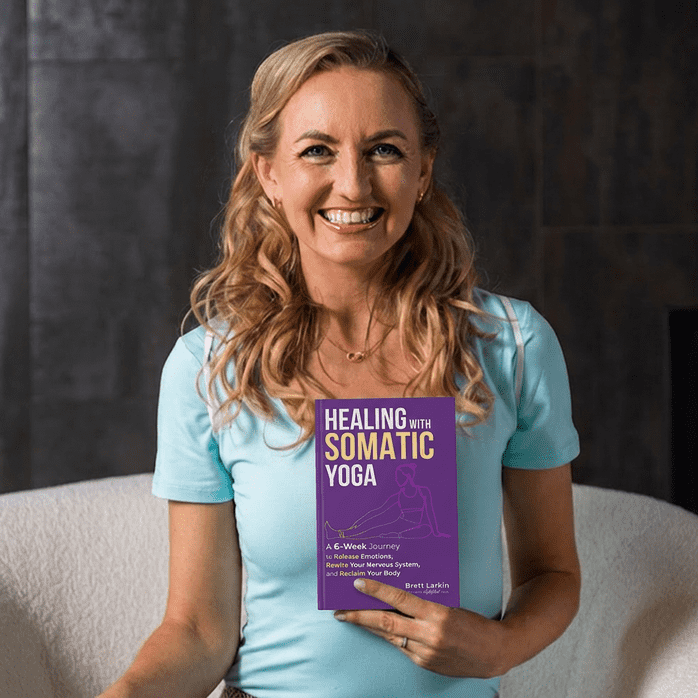
Brett Larkin has been integrating somatic therapy with yoga for over 14 years. A certified body-oriented coach and longtime student of somatic psychology and myofascial release, she weaves nervous system healing into all her trainings. Her Somatic Yoga programs blend movement, breathwork, and trauma-conscious practices to help students reconnect with their bodies. She has over a half a million subscribers on Youtube and is also the author of Yoga Life and host of the Uplifted Yoga Podcast.
Experience 3 Training Videos from Inside My 200-Hour Online YTT