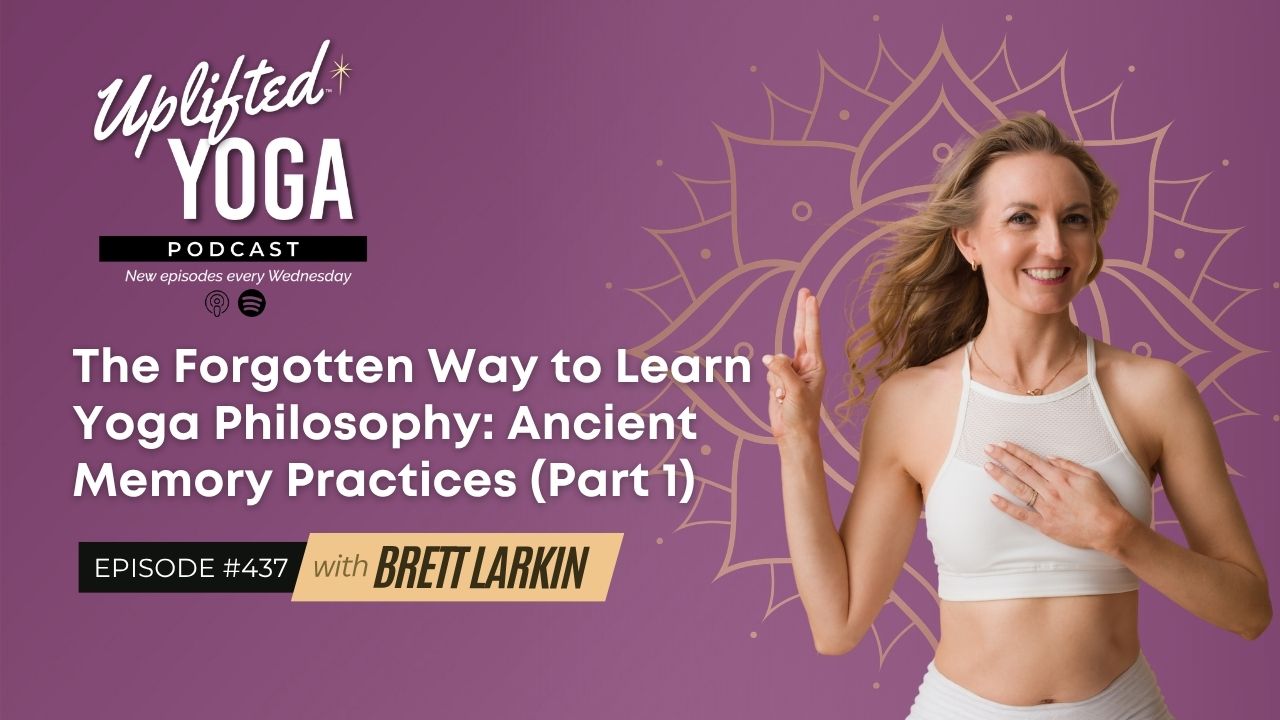
When was the last time you memorized something on purpose?
Not a password, grocery list, or directions, but a piece of poetry, a prayer, a mantra, a sutra, or a verse that you carried with you in your mind.
In this episode, I’m exploring why memorization was once the original way ancient wisdom was passed down, and why it still matters now. We’ll look at how memorizing meaningful words can train your attention, support your nervous system, strengthen your brain, and help wisdom become something you can actually return to in real life.
Inside this episode, I explore:
🔹 Why ancient texts like the Yoga Sutras, Bhagavad Gita, Vedas, Psalms, and Torah were designed to be remembered
🔹 How memorization turns passive reading into active spiritual practice
🔹 Why sacred words can become tools for nervous system regulation
🔹 How memorization becomes a countercultural act in the age of scrolling and endless information
This is part one of a two-part conversation. For now, I’m planting the seed: What words, prayer, poem, mantra, or verse might you want to carry in your heart?
💖 Want to shift what you’re practicing and paying attention to? Join the Uplifted Membership: https://www.brettlarkin.com/uplifted/
FREE Practice: Anti-Anxiety “Get Grounded FAST” Yoga Sequence (8-Min) – ALL LEVELS – Quick Yoga (10 Minute Yoga)
Relevant Blog: 15 Life-Changing Yoga Books To Deepen Your Yoga Practice
Relevant to Today’s Episode:
🔮 History of Yoga
🎧 Also Listen to:
#370 – Yoga’s Messy Origins: Understanding Yoga’s Historical Context
#401 – Who Has Your Attention? Attention Economy vs the Ancient Path
#425 – How the Divine Speaks: Sacred Symbolism in the Gita, Bible & Upanishads Part 1
© 2026 Uplifted Yoga | BrettLarkin.com

Transcript:
Welcome to the Uplifted Yoga Podcast, where ancient yogic wisdom meets modern business strategy. I’m Brett Larkin, creator of Uplifted Yoga, where I’ve certified thousands of yoga teachers, built a multi-seven figure business, and guided over half a million students on YouTube. Here’s the truth.
You don’t have to choose between embodying deep yogic wisdom and building a thriving, freedom-based business. This podcast is your space to integrate both. Because yoga isn’t just what you do on the mat, it’s how you show up in every part of your life.
Whether you’re here to deepen your yoga practice, grow your teaching career, or align your energy with your purpose, you’re in the right place. Let’s dive in. When was the last time you memorized something on purpose? Not a password.
Not a grocery list. Not directions somewhere. I mean, really memorize something.
A piece of poetry, a prayer, a mantra, a verse that you carried around with you in your mind. For most of human history, this was completely natural. People memorized sacred texts.
They memorized stories. They memorized philosophy. Wisdom wasn’t something you read once and moved on from.
It was something you learned by heart. And that phrase is actually really important, by heart. Because when you memorize something, you’re not just understanding it intellectually, you’re letting it live inside you.
The words start to show up in unexpected moments. When you’re walking, when you’re stressed, when you’re trying to meditate, or when your mind is racing, they become something you can return to. But today, well, most of us live in a world where we barely remember anything anymore.
And why would we? Our phones remember everything for us. Phone numbers, directions, quotes, entire libraries of information at our fingertips. However, there’s something beautiful, even radical, about slowing down enough to really internalize one line or one verse of wisdom.
And that’s what today’s episode is about. By memorizing sacred words, whether it’s a mantra, a psalm, a sutra, a verse from the Gita, can completely change your relationship to your spiritual practice. And why this ancient practice might actually be one of the most countercultural things you can do in the age of the attention economy.
Let’s dive in. Hello, my friends. So if you’ve been listening to the podcast this year, by now you know that I’ve been a little bit obsessed with this idea of diving deep into an ancient text.
So much so that I actually, without expecting it to happen this year, designed an entire Yoga Sutras journal and book club with study guide questions and 10 minute reflection prompts that you can do each day. Now today, I’m going to go a step farther beyond just asking you to, you know, get off TikTok and get off your phone and go deep with an ancient text, which I feel like has been like my rallying cry this year for myself. And again, I just really talk about what’s working for me here on the show.
So I’m inviting you along, too, because I’ve seen how much this has transformed my life to go really deep with an ancient text instead of, you know, always wanting to read more and more and more or like the next book or the next best career or the next thing to just go really deep and get really still with one ancient text. But today I’m asking myself, you, to go even deeper because this is another thing I’ve done and it’s been really beautiful. And that’s not just to go deep with an ancient text, but to actually memorize.
I know. I know. Memorize.
Memorize portions of it. And if you’re like, I can’t even remember where my house keys are right now. I am so with you.
Like, I don’t know where where those are either. However, isn’t it funny that so many of us can like remember our childhood phone number, for example. I can recite that off the top of my head because back in the day, well, depending how old you are, back in the day, we had to memorize things.
There was no Google Maps, potentially, depending how old you are. There was no even MapQuest. Right.
So we really relied on memory in such a more powerful way than we do now. And today we’re going to unpack kind of why this is valuable, why I want to just sort of talk you into maybe thinking about doing this and why it can actually be really fun and really deep in your spiritual practice. OK, so number one, memorization was the original way ancient wisdom was passed down in the ancient world.
Memorization wasn’t optional. It was the only technology of preservation, kind of like I was just saying, right. You weren’t able to look stuff up on your phone.
So you actually had to remember your best friend’s address. You didn’t have your mom’s phone number stored in your pocket on a technical device. You had to know it by heart.
And in the ancient world, they didn’t have paper. It was very hard to come by. Eventually they had scrolls and they wrote things on palm leaves.
Those things were incredibly hard to come by and incredibly expensive. So the way that any normal person accessed ancient or spiritual wisdom was through, you guessed it, memory, memorization. So, for example, the Vedas were transmitted orally for centuries before they were even written down.
Right. And then students trained for years to memorize the Vedas with astonishing accuracy. And there’s even people today, like traditional reciters of the Vedas, who memorize thousands and thousands of verses.
Now, some good news, the structure of many of these ancient texts, like the Yoga Sutras of Patanjali, for example, reflect this, right. The sutras, sutra means thread, each sutra, each line of the text is short, is rhythmic, is condensed. You know why? Well, because they were designed to be memorized.
They function like a like a mental seed that you plant in your brain and you carry that seed inside you. And if you memorize it and think it to yourself or say it to yourself, it’s like you’re watering it. And then it unfolds over time and bears what? Bears fruit, changes your mind, changes your life.
So people had no choice except to study this way. And most of the texts were written understanding this. The Bhagavad Gita is very melodic.
It’s written in verse. Even if we look at the Radiant Sutras, let’s say, and the phrases are short. They’re incredibly poetic.
This is because a lot of this started as oral tradition and because the text wants you to engage with it. I mean, imagine if Patanjali didn’t have a word count and the book was just like, hey, I’m going to tell you everything about how the mind works. Yoga is the stilling of the mind.
And here’s, you know, my 80,000 word like treatise on this telling you exactly what to do. Like, no, that’s not what the text is, right? That’s not what the text is. Instead, it’s like a living mystery of these short little phrases that A, are designed for memorization and chanting.
B, like because they’re so short, they’re inviting us into relationship with it to figure the thing out. And memorizing is one of the ways to do that, to sit with it, to be in relationship with it. The Bhagavad Gita is often translated as God song, song.
It was like a catchy tune for people to think about and pray on. We see these also with the Psalms in the Bible. So we need to have the lens that when we’re looking at these ancient texts or studying these ancient texts, like we’re looking at things that were designed for memorization, that were coming down from an oral tradition, and that it’s so powerful if you plant that seed inside you by memorizing a key verse.
Now, I’m not asking you to memorize the whole thing. We’re going to talk about that, what you might want to choose to memorize in a little bit. Okay.
So every wisdom tradition uses memorization. It’s not unique to yoga. By the way, across cultures, memorization has always, always, always been a part of spiritual training.
Many Christians memorize certain Psalms, like I memorized Psalm 23 this year, and it is just so, so beautiful. Many Muslims memorize large portions, and actually sometimes the entirety of the Koran. Jewish children are actually asked to memorize passages from the Torah as part of their bar or bat mitzvah.
And if we want to look at the yoga tradition specifically, practitioners memorized mantras and verses from texts, like the sutras, like the Bhagavad Gita, and it wasn’t about intellectual performance. Okay. That’s not what it was about.
It was about imprinting wisdom into their consciousness. How good does that sound? Imprinting wisdom into our consciousness. Like, did you want to do that? I want to do that.
That sounds really great. Let’s imprint wisdom into our consciousness, and let’s do it, potentially, through memorization. That’s my invitation for you this week.
Okay. So here’s some other really interesting news. Memorization, and I’m sure this is not going to be a big surprise for you.
Memorization changes the way the mind works. Yeah. Science, everybody.
Memorization activates deep cognitive processing. And there’s been a lot of research around this, but it basically shows that memorizing meaningful texts, maybe for you that’s a Robert Frost poem. Maybe for you it’s something religious.
Maybe it’s a Mary Oliver poem. People love that wild geese that she wrote. Maybe it’s working with the sutras, or one of the texts that we’re exploring here on the podcast, like the Gita.
Whatever it is, memorizing a meaningful text engages your long-term memory network, number one. It improves your auditory processing. It activates the emotional centers of your brain, and it improves your pattern recognition.
So when you do this kind of memorization, all of a sudden, instead of doing passive reading, you’re doing active mental training. And studies on memory training show that people who deliberately memorize stuff, obviously, duh, have strengthened neural connections and have increased mental flexibility. And it improves their recall and their attention.
So in other words, memorization is strength training for your brain. It’s like taking your brain to the gym. Next big point, it protects the brain as you age.
Who is getting older? I am getting older. That’s why I’m podcasting more and doing YouTube videos less. My body and brain aren’t like they were 10 years ago.
And research on cognitive reserve basically says that people who do mentally stimulating activities protect the brain against decline. This is so obvious, right? I think of my grandmothers, and one didn’t really exercise her mind towards the end of her life. She was absolutely wonderful, and I loved spending time with her.
But I often compare her to my maternal grandmother, who she would do the Sunday New York Times crossword puzzle, which those of you who maybe don’t live in the U.S. is like the hardest crossword puzzle of the week. Every single week, she learned Esperanto. She was part of like numerous, numerous book clubs.
She loved Latin and ancient Greek. Like basically, she was taking her mind to like a gym that I can’t even go to. Every day, even when she was in her 80s, and she was sharp as a wit until the moment she passed.
In fact, on her deathbed, she was so cognitively with it that she apparently told my aunt, I have had a great life, and I’m ready to die. Like this is so inspiring. I mean, compare this to many other people that I’ve unfortunately had to see pass away.
You know, they’re often very, very disoriented in those in those final days or final moments. Anyway, the point is people who regularly engage in activities like memorizing texts, crossword puzzles, learning languages, reciting poetry, build stronger neural pathways that help their brain stay resilient. And then there’s people who do research just on memory.
And they actually say that the brain changes structurally when we repeatedly retrieve information from our memory, like the childhood phone number, like the scripture or verse that I’m going to invite you to memorize. So again, it’s not about knowledge. It’s about brain health.
Are you tired of bouncing between random yoga videos and trying to figure out what to practice? If you’re craving depth, consistency, and a real educational progression plan, My Uplifted Membership might be exactly what you’re looking for. Inside the Uplifted Members app, you get structured weekly schedules, guided training plans, journaling workbooks, and philosophy courses that build on each other. It’s designed to help you create a devoted practice, one that strengthens your body, steadies your nervous system, and deepens your understanding of yoga over time.
You get over $2,000 worth of practice tools for just $29 a month. Access 14 yoga philosophy courses and two years worth of Yoga Alliance education credits through my courses on Yoga Nidra, the Eight Limbs of Yoga, Embodying the Yamas, the Knee Yamas, and so much more. Reclaim your body and rewire your nervous system as you find strength, peace, and results across all styles of yoga, somatic, kundalini, restorative, fascial fitness, Hatha Vinyasa, chakra studies, yin, meditation, each with PDF journaling guides and prompts that make everything come together and stick.
Whether you’re a beginner or a yoga teacher, there’s a plan for you inside the Uplifted Membership. Go to brettlarkin.com/uplifted to sign up today. Now, of course, we’re not going to get through any podcast on this show without talking, of course, about the nervous system, right? So memorized words, believe it or not, have actually also been shown to regulate your nervous system.
So all my somatic yoga friends, hands up, right? When a verse or mantra is memorized, it actually becomes available to you during moments of stress that otherwise it would not be available, right? So instead of spiraling into anxious thoughts, the mind can actually anchor into rhythm, into meaning. And this is why mantras calm the nervous system. Prayer, repetition regulates your breathing.
Chanting synchronizes your brain’s activity. Mantra, that word, the etymology is like a wave of the mind. And I always like to describe the mind as like a cacophony of thoughts, kind of like an orchestra before it’s warming up, right? It’s like violin, piccolo, chaos.
You’re just like hearing various noises. And then what happens? The conductor comes in and he waves the baton and all of a sudden everyone’s synchronizing and making music together. And that conductor and the baton is mantra, right? It’s like getting all the waves of the mind to suddenly work together and make music instead of being like this cacophony of unwanted distraction and sound.
And recitation, recitation of anything, again, we’re talking like poetry, quotes, biblical passages, yoga material, like recitation of anything that you find meaningful naturally slows breathing and stimulates the vagus nerve. So these words that you choose to memorize become tools for nervous system regulation. They become tools for your self-regulation.
The other reason I think memorization is so radically cool right now is because it’s just such a great way to stick it to the man, to stick it to culture, right? That wants us totally dependent on our phones and is constantly trying to steal our attention towards ads, towards getting, you know, sucked into like the more and more and more consumer culture that we’re all steeped in. We’re living in a culture of scrolling, skimming, and endless novelty. Like what’s the new thing? What’s the new thing? What’s the new thing? And then all of the algorithms we experience every day on our phones and computers as well reward this constant consumption and have brilliant people behind them designed to really not just capture our attention, but like do whatever it takes to keep our attention in a way that’s highly, highly addictive.
More on that on the first podcast I uploaded this year about the attention economy. So saying like no to all of that and to say like, you know what, actually, I’m just going to stay with one thing and not just go deep with it, but I’m actually just going to repeat it and sit with it and internalize it and memorize it and just work with that. It’s actually like memorization is this kind of countercultural act.
Instead of collecting more and more and more information or looking outside yourself, you’re digesting wisdom, right? It’s like you plant this seed in your mind and then you water it yourself and let it grow and blossom yourself. And then this is the most exciting part. Get you ready for the most exciting part.
When you memorize a text, it actually starts speaking back to you. So a verse that you memorize is going to change meaning over time. The same line is going to mean something different at Christmas time compared to the summer, compared to when your kids just started school, compared to when you’re stressed, compared to when you think of it walking in the woods, compared to when you recite it to yourself near a beach, compared to a moment of heartbreak, compared to a moment of joy.
And this is why spiritual traditions memorize text, because the wisdom is growing inside the practitioner and the text becomes something like an inner teacher or a crystal or a prism that’s reflecting different things to you as your life shines through it, as different experiences and moments and places shine through it. I read this very interesting book on prayer this past year, and it was pretty dense and hard to get through, but it was talking about, you know, Augustine’s mode of prayer and Ignatius contemplative prayer, imaginative prayer, meditative prayer. And one of the techniques I really loved, which is actually in the Uplifted Membership for those of you that have access to the Uplifted Membership and the Yoga Sutras Journal book club and collection of meditations that goes with it, there is this meditation that I recorded on Sutra 1.33 inspired by this.
And that Sutra 1.33 is the one about the four attitudes where Patanjali is saying, well, when you encounter people who are happier than you, you should cultivate friendliness. Encounter people who are suffering, you should cultivate compassion. He even says that when you encounter people doing harmful things, you should cultivate equanimity or impartiality, which a lot of people struggle with.
And it is often a hot topic in 200-hour yoga teacher training. But I really wanted to go deep and do this kind of contemplative meditation with this sutra. And I modeled it after the same way that I work with scripture I’ve memorized, which is where I essentially say the line or the first verse to myself, either aloud or silently, and then I reflect on its meaning.
I’m like, and this means, you know, what, blah, blah, blah, blah, blah, to me today. And it’s incredible, like often working with this, you know, day after day, week after week. Sometimes I’m like, yep, that still means to me this, right? Like, this still means to me that I need to feel compassion for those who are suffering.
But sometimes it ends up meaning something else, right? Or it makes me think, my friend Julie’s really having a hard week this week. I should go check in on her. I should ask if she wants me to sit with her because I know her daughter’s going into surgery.
And then you take the next line, right? And then you let yourself kind of digest and sit and interpret that. And so it’s a very active contemplation where you’re going verse by verse of the thing that you’ve memorized. But you pause after each verse to reflect on it and what it means to you today.
And your meaning is often incredibly fresh and giving you so many more insights. And you’re like, wow, how could this one nugget or this one verse or this one prayer give me so much insight? And I usually do this walking in the woods with different things that I’ve memorized. And then Amanda on my team, who’s brilliant and probably also editing this podcast.
Hi, Amanda, I love you. She was like, you should make this a walking meditation. This should be a walking meditation in the Uplifted Membership.
So those of you who, yes, there are also seated meditations on different sutras, but this Sutra 1.33, just as an example, we recorded it as like a walking or driving meditation. So if you want to be sort of guided through what this process looks like, that would be a really great one to check out. Back to our point, it’s like when you memorize a text, it starts speaking back to you.
And it starts being this prism that is inviting you into relationship and reflecting different things that you can think about that then actually concretely changes how you move through your day. So if memorizing sacred words can strengthen the brain, regulate your nervous system, deepen your relationship to ancient wisdom and actually help it become more actionable in your daily life, the question that arrives is, OK, what do I choose to memorize? What do I choose to memorize? And then how do I actually memorize it? Like, how do I do this without it feeling like homework? And those practicalities are exactly what I’m going to cover in part two of this episode. How to choose what to memorize and then the tips and practical techniques to actually do it.
And spoiler alert, what I might suggest is to memorize something that speaks to a struggle you’re going through, expresses some sort of truth that you want to embody, something that you just love and brings you peace and steadiness, or something that you find is especially helpful in redirecting your mind when it’s spiraling. So between now and when that part two episode airs, like, use this time to start flipping through some books, poetry books, ancient texts, yoga sutras, the Gita. If you’re doing the Yoga Sutras Book Club, like, obviously, I think probably there’ll be something in there that’ll stand out to you or like a section of little verses where you’re like, whoa, I like these.
Or you can start working with that meditation on Sutra 1.33 as a first step. So I’m planting the seed. We’ve talked a lot about seeds today.
I’m planting the seed with you right now to just to just get curious. What might I want to memorize? Again, like, maybe it’s a Robert Frost poem. I don’t know.
Maybe it’s something like a parent or a grandparent you knew, you know, like had memorized. What’s something that you think you might want to dedicate to memory? Think about this and then we will reunite to refine what you choose and all the tips and techniques to actually do it in part two of this episode. In the meantime, take some time to slow down.
Find time to breathe. Move on your mat. Ideally journal.
And until next week, take care of you. Loving what you’re learning on the podcast? Apply the ancient science of yoga to your daily life surrounded by incredible peers in my uplifted 200-hour online yoga teacher training. Or grow into your role as a leader of others in my 300-hour professional program for yoga teachers, which is also a high-level business mastermind.
At any time, I would love to welcome you into my Yoga for Self Mastery course to help you uncover your personal blueprint to serenity. Or join my Uplifted Yoga membership for an all-access pass to my most popular yoga courses, thematic class plans, and practice calendars. Don’t forget to prioritize your well-being and get on your mat today.
From my heart to yours, namaste.