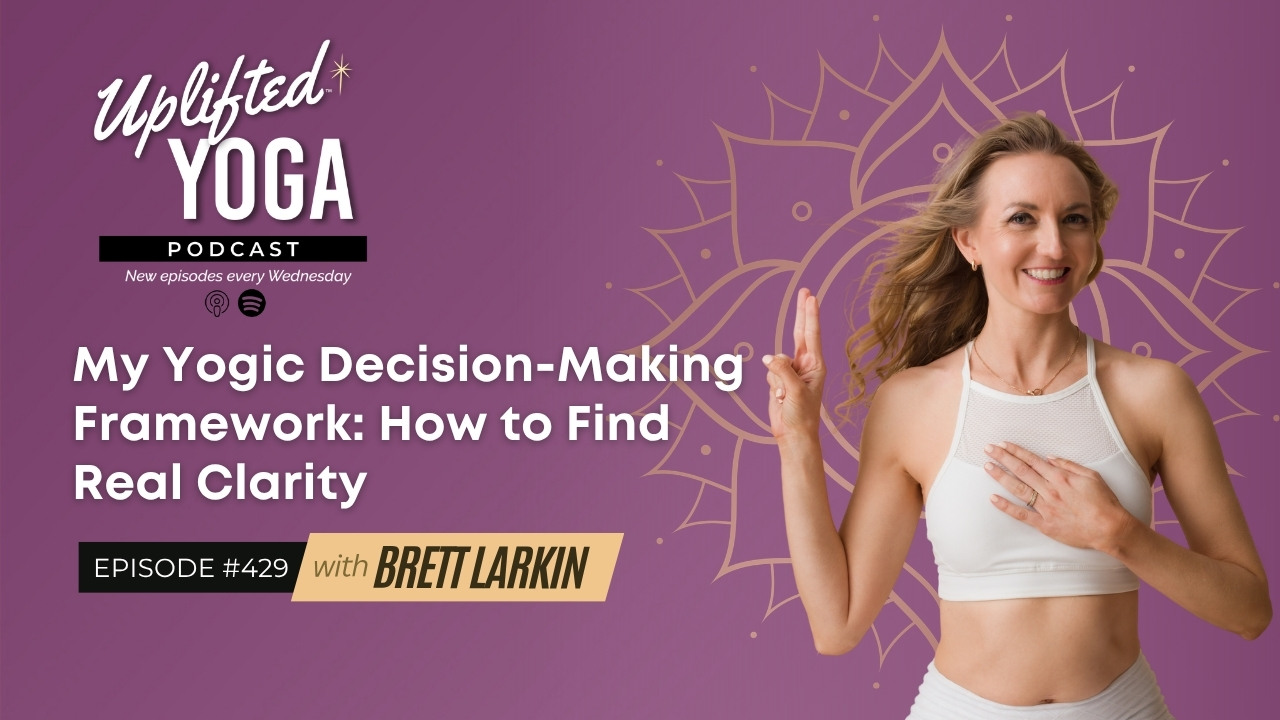
How do you make a big decision… yogically?
In this episode, I explore what happens when you deeply desire something — a new job, a baby, a retreat, a training, a relationship — but don’t actually have the capacity to hold it right now.
This is a conversation about desire, capacity, and the real conditions for clarity. Because so often we think we’re confused, when really what’s happening is that one part of us wants something badly, and another part of us knows we don’t have the bandwidth.
In this episode, I explore:
🔹 The difference between desire and capacity and why both matter
🔹 Why high desire + low capacity creates pain, burnout, and resentment
🔹 A yogic framework for understanding hard decisions through polarity
🔹 Simple somatic practices to help you feel what your body is actually saying
🔹 Four different decision-making archetypes and how stress changes the way you choose
If you’ve been stuck in a decision, this episode will help you stop forcing clarity and start listening for what’s actually true.
✨ Make your yoga practice 2x more potent in 1/2 the time with my Free Yoga Transformational Portal
💗 Get Yoga for Self Mastery => https://www.brettlarkin.com/yoga-for-self-mastery/
FREE Practice: Kundalini Yoga Meditation To Empower Your Decision Making (18-min) Guided Meditation Full Class
Relevant Blog: 15 Feminine Energy Traits And How To Cultivate Them
Relevant to Today’s Episode:
📖 Yoga Life Book
🎧 Also Listen to:
#297 – What is Samkhya Philosophy and How is it Different from Yoga?
#314 – Stop Abandoning Yourself By Leveraging Yoga & Meditation
#350 – Do a “Yoga Life Makeover” with Corinne Maples
© 2026 Uplifted Yoga | BrettLarkin.com

Transcript:
Brett Larkin:
Welcome to the Uplifted Yoga Podcast, where ancient yogic wisdom meets modern business strategy. I’m Brett Larkin, creator of Uplifted Yoga, where I’ve certified thousands of yoga teachers, built a multi-seven figure business, and guided over half a million students on YouTube. Here’s the truth.
You don’t have to choose between embodying deep yogic wisdom and building a thriving, freedom-based business. This podcast is your space to integrate both. Because yoga isn’t just what you do on the mat.
It’s how you show up in every part of your life. Whether you’re here to deepen your yoga practice, grow your teaching career, or align your energy with your purpose, you’re in the right place. Let’s dive in.
Do you struggle with making big decisions? Do you desire things deeply, but then when you get them, it’s not exactly what you imagined? Today on the show, we’re talking about desire, capacity, and the real conditions you need for clarity. A lot of times we’re saying, I’m confused. But what that actually means is that one part of us wants something badly, while another part of us knows we maybe don’t have the bandwidth or the resources to hold the thing even if we really desire it.
Enter my yogic framework for understanding big, hard decisions. I’m going to be walking you through simple somatic practices so you can figure out what your body is actually saying when it comes to making a big decision, as well as talk you through my four different decision-making archetypes and how stress, if it sneaks in, can actually change the way you choose. If you’ve been stuck in a big decision, I’m so excited for you because I think this episode might really help you stop forcing clarity and instead start listening for what’s actually true.
And if you enjoy the ideas that I talk about in today’s episode, I want to make sure you know my Yoga for Self-Mastery course is happening right now. It’s on sale. Move through the three steps of Kriya Yoga, the three simple skills to embody your yoga practice off the mat to get the real results you desire in your life.
Yoga for Self-Mastery alum Caitlin said that she learned more in this course than she ever did in years of talk therapy. I’ve had students tell me it saved their marriage, finally figure out ways to make them happy. Jill, my past student, said it helped her really rediscover what she wants in the next phase of her life.
And so many yoga teachers think they’re already living their yoga practice, so they don’t take this course. And then when they do, their mind explodes. The 12-week video curriculum helps you unleash your confidence, your sensuality.
We transform everything from your self-talk to your relationships and even your wardrobe. We have a yoga of dealing with other people section of the course that helps you really skyrocket the intimacy or resolve issues with family, friends, or partners. You get a weekly skills tracker.
You get a paper manual that serves as a journal mailed to you, a coaching vault, seeing me coaching other students in this method, as well as the live Zoom calls that are happening this summer. And yes, it comes with yoga practices, meditation, somatic classes, so you can also embody everything you’re learning as part of your daily practice. Go to brettlarkin.com/ysm that stands for Yoga for Self-Mastery to learn more.
And now let’s dive into this week’s episode on yogic decision-making. Have you ever noticed that you can want something deeply, desire it deeply, and yet also not be able to handle it or hold it right now? I found myself in this exact situation. So I wanted to do an episode about decision-making because what is life if not a whole bunch of decisions? And how do we make decisions yogically? Because here’s something I do know.
When we don’t make the right decision for us, it ends in dukkha, disease, or suffering. We often don’t put the kind of thought we should be putting into a certain decisions or whatever framework we do use to make decisions is somewhat outdated. So this episode is an invitation to upgrade your decision-making process with some yogic ideas.
The framework I’d invite you to think about here is this idea of polarity. So in yogic philosophy, our true nature is bliss. However, through a process of coming into form, into being, and becoming a human, we went through a division process, which is detailed in Sampkya philosophy, and I will link the Sampkya philosophy podcast episode for you, resulted in us being here with this cute human outfit on and our cute preferences and desires and things we want.
And because we are essentially a spiritual being having a human experience here on earth school where polarity governs everything, night and day, love and hate, up and down, decision-making becomes difficult because we have desire. And in this episode, I’m going to talk about desire as the limitless part of you. And those of you who’ve done my somatic coaching training know that the polarity framework is one of the deepest, I think, and most profound, often the most complex.
But the idea is that we all have, instead of just thinking of us as two things, the part of us that identifies more with our physical body and the part of us that identifies more with our spirit body or our bliss consciousness. In the polarity framework, we call those energies masculine and feminine energies because they relate to Shiva Shakti in the Hindu tradition. But I just want to make that connection for those of you who are listening, because I know many of you are listening, who do know what I’m talking about, who have done that program.
So think of desire. And if you do know that program, desire is like the feminine. Feminine, we talk about, always wants more love.
She always wants more love and she’s never satiated. And this is like what’s so beautiful about this desire energy, what we’re calling in this podcast, the desire energy. It’s the part of you that just always, always, always wants more.
Meanwhile, there’s your very human capacity. And your capacity, for the purposes of today’s episodes, let’s talk about that as like the limited part of you, the part of you that’s more human, like in a meat suit. Capacity is real.
Like we all only have 24 hours in a day. We all need to sleep. We all need food.
That means you can’t just work 24-7, get your desires. Like you have to stop to pee and eat and sleep. Like capacity is real.
And what often happens, I think, when we have a decision that’s a difficult decision is that desire and capacity are at odds. So think of desire as the sky, limitless, imaginal, calling. And think of capacity as the earth, body, time, money, support, sleep.
And yoga is literally this bridge, this rainbow colored bridge of the chakras, if you want to think of it that way, that helps sky and earth talk to each other without bullying one another. Or in the polarity framework, like helps masculine and feminine energies fall in love with each other and live harmoniously together. But rubber hits the road often when you have a very real decision like, should I quit my job and teach yoga? Or should I take this job to supplement my teaching yoga income? Or should I break up with this person? Or should I get married? Or should I have another baby? Right.
All of a sudden, this these kind of big decisions where we often say we’re confused, quote unquote, is where we really need to look at desire compared to capacity. And often I think this like people do pro con lists or something. And I think that’s a little bit maybe getting at the same idea.
But I like this framework so much more. So desire, that part of us that is limitless, is asking the question like, is there something in me that wants this? So if you have a decision right now, ask yourself that question. Is there something in me that wants this? And if the answer is yes, you should be getting a little bit turned on right now because there is something in you that wants whatever the thing is.
Desire is about meaning. Like, what would it mean for you to have another child or to be in a committed forever relationship or to be a full time yoga teacher? Desire is about pull, curiosity, love, expansion, maybe like long term identity. And desire usually lives in images that we create in our mind, like this sense of tenderness and also a sense of like rightness or unfinishedness, like this just like fits with my identity.
So I want it. I always saw myself as someone who’d have done blah, blah, blah. And I want it.
Right. Desire does not care about logistics. It doesn’t care how you’re going to go to school to get that thing or how you’re going to get the support to have the extra baby or how you will probably end up not sleeping and be miserable.
Desire doesn’t care about that because that’s not desire’s job. It doesn’t ask how tired you’re going to be or how the calendar works. No.
It just has this language of like image and longing and tenderness and sense of rightness or unfinishedness that’s tied to your deep, deep identity. And desire is so beautiful in that way. So is there something in me that wants this? And a lot of the time, I think when we’re immature decision makers, like the story just stops there.
We’re just like, OK, I’m going to do it. Right. And then it’s like disastrous because you’re doing night classes and also have a second job or you’re, you know, don’t have the support with the baby or whatever it is, like the consequences happen.
And it’s because you didn’t think through the other half of this equation, which is capacity. And capacity is answering the question, do I have the resources to hold this desire without breaking? And this is a very important question to ask, my friends. Capacity includes your health.
Like, how healthy are you? Your nervous system resilience. How much support do you have? Mental, physical, emotional. How much money do you have? How much time do you have? How much energy do you have? And this is the kicker.
So write this one down if you’re not driving. How much margin for the unexpected do you have? That’s capacity. And capacity lives in your very physical, very human body.
It’s not up out there like desire is. Although we could say desire is like in the heart, too, for sure. But capacity 100 percent is like your physical meat suit, your humanness, your body that needs to sleep and eat and take breaks.
It’s in your stress patterns. Capacity lives in your stress patterns. Capacity lives in your recovery time.
What’s your recovery time like? Capacity lives in your personal history of burnout, right? Compared to being able to be resilient. And low capacity doesn’t mean low love. Like if I don’t have the capacity to be in a committed relationship right now because I’m in med school and working 24-7, it doesn’t mean I don’t have desire and love within me.
It just means like I don’t have the here and now 3D world type of logistical situation that would allow for that desire to happen. And this is the critical mistake that people, me in the past, make. Right.
They assume that if I desire something, I should do it. I want to lead a yoga retreat. So I should just go for it.
Right. I want to have a membership site and like reoccurring revenue. So I’m just going to leap for it.
So that’s one avenue people go down. They assume if I desire something, I should do it. The other avenue people go down is that if I lack capacity, it means the desire is wrong.
That often sounds like, well, I don’t know tech stuff or I don’t know email software. So my desire to be a yoga teacher just can’t be. It’s just wrong.
Or like my physical body is just not that flexible. So that means my desire to be in front of a room and teach others yoga is wrong. Or I’m a single working mom and I have very little spare time.
I don’t have a lot of capacity. And that means my desire to do yoga teacher training is wrong. And the reality is like neither is neither is true.
Basically, this becomes a matrix where it’s like you can have desire and you can have capacity. And in that case, it’s like an easy aligned yes to whatever your decision is. Because the soul kind of astral part of you and the very human 3D on this plane of consciousness part of you are in aligned.
And that’s like the best. That’s like green light. Right.
Like that’s like I just quit my job. I have a huge vacuum of empty space and I’m going to have that fourth baby or whatever it is. Right.
It’s like I have the desire. I have the capacity. Yes.
So that’s quadrant one. Green light. Love it.
Let’s look at quadrant two. High desire. Low capacity.
This is painful tension, folks. That’s when you say yes to the thing. Yes to the training.
Yes to the baby. Yes to the leading the retreat. And then you realize you’re totally overscheduled.
You have no time. You can’t take it in. You have students complaining.
You’re thinking about whether you should cancel. Right. There’s this like super painful tension or you’re just not able to sleep and take care of yourself.
Well, because you’re so overextended. So that ends up in pain. So when you have high desire and low capacity pain.
Let’s look at quadrant three. You have low desire, but you have capacity. This is what I call the hollow.
Yes. When it’s like, you know, I have no desire to take on like additional teaching slots at the studio. But they asked me to and they want me to.
And I’m not doing anything on Saturday. So I guess I will because like I have the capacity to do it. But like my heart’s not in it.
Right. Like I don’t really have the desire. Like it’s basically saying yes, because you can.
Like there’s space in your literal physical calendar, but your heart’s not in it. So we don’t want that. And then the fourth quadrant is when you have low desire and low capacity.
And then we don’t have to talk about that quadrant because it’s like a red light. So most of us are stuck in quadrant two or three when we have a difficult decision. It’s like we have high desire, but low capacity or we have low desire, but high capacity.
And let’s be real. Most of us here probably aren’t saying yes to things with our heart not being in it. So I’m going to argue that the most interesting of these quadrants is quadrant two.
When you have high desire, because most of us, especially if you’re listening to the show, I imagine you have a lot of desires. I have a lot of desires. I have insatiable, never ending desires.
And you probably do, too. So many things that we want, like whether it’s to teach or share or help others or lead retreats or lead trainings or get more credentials or all these things. But most of us have a capacity problem.
We’re also moms. We’re also caretakers of our elderly parents. We also have a full time job.
So I’m going to go out on a limb and say that when you have a problem, and this is interesting, view your current problem through this lens or your current decision through this lens. It’s usually like high desire. I would love to go to Italy on vacation, but constrained capacity, like my kids have activities right before and after that week where I could go with my friend.
And I don’t know if I want to be jet lagged and tired and all the other things that come with that. So if you have constrained capacity, it’s really good to be honest about that. And here’s some good news.
Capacity is not a thing that is fixed. It can change with time. So this is where you being the designer of your life, which is an affirmation we work with a lot in Yoga for Self Mastery, my online course, capacity can change with you being the active, involved, excited, enthusiastic designer of your life.
Like you can schedule in slowly over time, more support, more systems, more boundaries. You also have to be realistic with capacity of like, what season of life are you in? So with whatever decision you are facing, think about like, am I trying to make desire answer a capacity problem? Sorry to interrupt, but quick pause. If you’ve ever felt called to go deeper into yoga, not just practicing it, but actually understanding it.
My uplifted 200 hour teacher training is open year round and fully online. So you can move at your own pace, no pressure, no burnout. It’s for people who love yoga, want a strong foundation and care about teaching safely, ethically, and with heart.
Whether or not you plan to teach right away, you’ll learn anatomy, sequencing, philosophy, cueing, and how to actually hold space for real humans. You can find all the online 200 hour teacher training details at barrettlarkin.com. And if it’s meant for you, you’ll feel it. Desire is saying, I want this, I want this in my life, but capacity is saying, like, can I actually hold this right now? In yogic terms, desire is a force, it’s shakti, it’s direction, but it’s not a plan.
It doesn’t take into account capacity. And capacity is more of like a somatic reality, right? Because it’s like about your energy, sleep, your nervous system, resilience and money and time. So a couple somatic exercises I wanted to give you that you can do and that might help.
One is like a quick body bandwidth scan. So just checking in and you can do this right now while you’re listening, like with your jaw, your chest, your belly and asking yourself, you know, how long does it really take you to recover after a day that’s very full? And thinking about like, what’s your real answer to that question? And then asking the question that often never gets asked, which is like, what’s my current margin? Meaning like if something went wrong tomorrow, like, I don’t know, my kid couldn’t go to school because they were sick or suddenly my mom called and needed me to fly down to San Diego to help her with something or my husband lost his job or like how, how well am I set up to deal with like the random things that life throws at us? Like, do I have a little bit of breathing room and just listen to your body for these answers? So that’s one exercise, just kind of tuning in, getting honest with yourself about your bandwidth. And I’m passionate about this because what I see is so many women who come into either coaching with me or come into our coaching program and they think something’s wrong with them because they went after desire without taking into account capacity.
And now they’re totally burnt out and they think it means something wrong about them. It’s like, well, I can’t get my yoga business off the ground. And it’s like, well, but didn’t you just tell me you have like a newborn and aging parent, a full time job and like a side gig? Like, but they’re so mad at themselves that their yoga business isn’t further along yet.
And it’s like, but but how could it be? You don’t have the capacity realistically. Now, that doesn’t mean you can’t design for the capacity to change. But I just see so many people beat up on themselves about not being further along with their dreams or whatever it is they want to do.
So doing this kind of like somatic body scan of how much margin do I actually have, how much recovery time do I have built into my current schedule can really help your body tell you the truth about where you are capacity wise. A different somatic exercise I really love is just about noticing how your body responds to different futures. So if you have a decision and it’s kind of like, well, I’m going to move across the country and go to this university or stay in Boston and go to this university, like let’s say it’s like UCLA versus Boston College or whatever.
Basically, you would just sit or lie down comfortably. Again, getting the hands on the body is great. Taking a couple slow, deep breaths and without using your analytical mind and some longer meditations I teach like this, I often even talk about thanking your brain for all of its useful information, but telling her she can have the day off.
Like, thank you, but you work so hard for me and I want you to have some time off and telling your brain that it’s safe to shut down and you’re just going to listen to body sensations and then sense into life at Boston College. You could say silently or aloud, like I’m enrolled at BC and imagine your future self, your daily life, your energy, your body, your studies, your major, and just see, you know, what’s tightening or softening. Is there relief there or is there grief? Is there neutrality? And you’re just observing.
There’s no interpretation yet. And then I often like to, you know, just reset with some diaphragmatic breathing or sometimes depending on where I’m doing this, I’ll even like do a little shake, like a somatic shaking stash to just like shake, shake off one energy and put on the next. And then you’ll do the same thing, but this time you’ll sense into life in California at UCLA and just imagine what your day-to-day routine would be like.
What’s your major? What’s your energy? Like really try to make it as real technicolor as you can and then notice what’s happening in the body. Relief, grief, tightening or softening. Where? What’s going on in your chest, your belly, your shoulders, your jaw? Is there excitement or heaviness or is there warmth or maybe fear? And you just want to start naming sensations instead of being like, this means I should, shouldn’t, what? Just as you’re in this process, if you need to, you know, analyze, just say things aloud like my chest feels tight, my belly is softening, I feel calm but flat, right? So you’re just gathering data.
And then after you’ve kind of lived into both situations, you can ask your body, not your brain, you know, which future feels more honest to live in? Notice I didn’t say which one feels better, but it’s like, which is more honest? Keeping into account my capacity, which was sort of like what the first somatic exercise I talked about was, like, how much margin do I have? How long does it take to me, take me to recover after a really tough day? Which future feels more honest? And it’s important to know going into an exercise like this, if you choose to do it, that for most of us, the body is going to give you mixed signals, okay? Like one option might feel really emotional and full, but like heavy at the same time. Maybe another option feels calm, but like with a tinge of sadness. So this doesn’t mean you’re stuck.
It just probably means both your desire and your capacity are speaking through the body, and neither is wrong. But that’s why knowing that desire capacity kind of matrix that we went over at the top of the episode is so important. And I think when we make decisions, we’re like, okay, well, I’m going to get to the answer because and the answer is going to be like a yes or a no.
And it’ll be clear in that way. But it’s often more nuanced than that, right? Usually clarity is a timing decision, not a yes or no. It’s like a boundary decision, not a clear yes or no.
It’s a support decision, not a yes or no. It’s a kind of like peace with closure, like I’m not going to have more kids type of moment that might need to unfold over the course of like months or a full year. So instead of thinking about like getting to a yes or no decision, realizing that your decision is probably going to have something to do with an aspect of capacity, timing, support, season of life, boundaries.
Emotion that needs to be processed, I think can be so helpful. Regret doesn’t come from choosing the wrong thing. Regret comes from overriding your capacity or silencing your desire without properly grieving it.
Okay, because this is the other thing we do. We’re just like, okay, well, I won’t have that thing. Fine.
And then we get in like a victim martyr complex instead of being like, yeah, I’m not going to have that thing because my life is just not set up for that fourth baby right now. And I’m probably only going to have three kids. And that is so sad.
And I need to give myself some space, like what we do in the somatic training, like the conscious grieving ritual. Like I’m going to need to make grief a part of my practice. Because if you silence desire without honoring and grieving it, that’s just numbing.
So much of this is about being honest with yourself and taking your body into the equation. Like most of us, when we ignore capacity, it’s like we’re ignoring our bodies, which is why I’m so passionate about somatic yoga. Because it’s great to like vision and daydream and do breath of fire and get in our third eye and I don’t know, map out a vision board and see into the future and project and all of that great stuff.
But a lot of times it’s like our body can’t hold that. It can’t hold. Like I could not hold a retreat right now.
Being honest, I can podcast right now. I couldn’t lead a retreat for like a ton of people right now. I still have two young kids.
Like I don’t have the capacity. Last thing I want to say about all of this is that I thought was really interesting is that it also can help to know your decision making archetype. OK, so most of us have one dominant style and one backup style when the stakes are high and we have a big decision.
So I’m just going to share these with you just so you have them. This is a little bit more intellectual than what we’ve been talking about. But just to close this out, because I think sometimes seeing an archetype or pattern, we can be like, oh, yeah, I’m guilty of that.
So and it ties into everything we’ve been talking about. So the first archetype is the designer, the designer, and that’s the capacity first decision maker, meaning if I can design the correct conditions, I can decide. And this is someone who cannot decide in abstraction.
They ask, like, what would need to be true for this to feel sustainable? And then they test out scenarios before committing. I wish I were this type of decision maker. OK, but basically they’re going to like make the they’re going to kind of solve the capacity problem, being the empowered designer of their life like we talk about in Yoga for Self Mastery.
And they’re totally honest about their limits. They have really good long term outcomes. The problem is they can feel a little bit stuck if the conditions never feel perfect and they can delay decisions by over-optimizing systems.
So this very much reminds me of my husband in some ways, because he’s extremely analytical in the sense of like this needs to happen before this other thing. So the telltale sign that you are this archetype, the designer, which means capacity first decision maker, is if you’re the type of person who’s always like, what would make this workable? Right. What would change my capacity? God bless if that is you.
OK, the second archetype is the threshold decider. This is the signal based decision maker who basically is saying, I’ll know, I’ll know when it’s the right time. Right.
But they’re the person who’s like, something hasn’t clicked yet. I’m not there yet, but I might be. So how they decide, and it’s actually like kind of embodied in a way, like they’re waiting for like a stronger pull or a stronger resistance.
Like decision for them happens when something crosses a line. Obviously, this is deeply intuitive. It honors their emotional truth, but they can kind of be in limbo for a long time and it can feel annoying to other people who are like, why don’t you just make a decision already? Because it can feel passive because you’re just kind of like waiting for the signal being like, I’ll know when it’s time, like I’ll know when it’s time to cross the threshold.
And that’s that signal based decision maker. It’s like something inside me will just know. OK, the third type of decision archetype is the peace with closure decider.
So this is the relief oriented decision maker and their kind of MO is like, OK, I’ll decide when I can let go without tension. So what you tend to do is imagine not doing something and notice how you feel like I’m not going to do yoga teacher training or I’m not going to ever lead another retreat or I’m not going to have another baby. And then how do you feel? You’re like, oh, OK.
Or do you feel disappointed or do you feel like a sense of ease? So the key with this one is they don’t wait for a yes. They wait for relief around a no. It sounds weird, but like, have you ever had something happen and you were really excited that it happened and then all of a sudden it got undone? But then you were like, actually, phew, because I don’t think I could have handled that.
It’s kind of like that sensation. So it’s a decision making style that’s kind of quiet and a little bit sad, but also peaceful. And then archetype four is the commit and align decider, which is the action first decision maker, which is I’ll choose it and then I’ll make it work.
And they just like decide they feel best. Like once the decision is already made and then they’re like, OK, now I’m going to spring into action and know what to do. So they kind of decide first and then they get the troops in order and figure out the capacity and the resources.
And for them, the decision itself generates a lot of clarity. So they have a lot of momentum and confidence and adaptability. And this is me.
Spoiler alert. I’m very strong through chakra action first. So strengths are like momentum and confidence and adaptability.
But the failure in this strategy is that you can override capacity quite easily and you can risk burnout or resentment. All things that I have experienced. And here’s the thing.
You don’t have one style. Like most of us have a style that we take when we’re grounded and regulated. And then a lot of us have a stress style, a style of decisions that we tend to take when we’re under pressure.
So, for example, if you’re the designer archetype, that was our capacity first decision maker. They tend to become over analytical when they’re stressed. And then we have the threshold decision maker, right, where they’re just like waiting for a sign.
They tend to become avoidant when they’re stressed because they just like don’t have any answers until they get the feeling, the sign, the thing. And then the commit and align decision maker, which is me, comes impulsive when stressed. Right.
I can be very impulsive. When you’re making a decision, try to think about, like, are you deciding from your grounded style? And like my grounded style would be a combination of the designer and the commit and align. Right.
Like I actually need to think about capacity a lot more first. And this is why my husband’s so great, because he’s such a good partner for me, because that is his natural decision making style. But it’s also why it often feels like conflict, because I come to him with a desire and I’m not thinking about capacity.
And he just goes into the logistics and how it’s all going to work. And I take that as, you know, an insult, like he doesn’t care about my desire, my dream. But really, it’s just like we have completely different decision making styles, which can either cause a lot of conflict in our marriage or become like a source of huge strength.
When I go to him knowing that he’s probably going to be over analytical about the thing and not be able to, you know, like want to take action first, desire decisions the way I do, that he’s going to have a different approach. If I’m resentful of that, it’s going to cause a lot of conflict. If I can be appreciative of that and see that as an asset and see that as something that actually can help me get into a more grounded decision making style for myself, then I am in a really good place.
So if you feel stuck, this is where I’ll leave you. Make sure to ask, like, what version of me is trying to decide this right now, the grounded version of me or the pressured version of me? And you guys are yogis. So if you’re feeling like you need to make an urgent decision and you’re flooded and it’s like you feel pressured, you know, downshift your nervous system.
You extend your exhalations. You know, all the different yogic tools and practices, long, slow, forward folds, like all of this is in my book, Yoga Life and the Uplifted Membership. If you feel numb and stuck, right, like you’re maybe the threshold decision maker and you’re just like you’re just not feeling it yet.
You don’t know what to do. Gentle mobilizing practices are going to be great for you. Maybe walking, hip circles, shaking, Kabbalah Bhati.
And if you want more nervous system first tools, I would love to go deeper with you on all of these things inside the Uplifted Membership or in my Yoga for Self Mastery course or in my somatic yoga teacher training. No matter what, I hope you are feeling like you have more awareness, more tools with which to make a decision and to go back to where we started. Like you are a spiritual, spiritual entity having a human experience.
So you are going to have infinite desire, love, craving. And that is so beautiful. And you want to like write poetry around your desires.
But you’re also living in a human body that has very real limitations in terms of sleep. You have a very real nervous system, which can only handle so much. And so you need to think about that human side of the equation, too.
And that’s going to look like not writing a poem. That’s going to look like maybe pulling out a spreadsheet or having a really honest conversation with your body. I would love to hear what kind of decision you’re struggling with.
And if this podcast helped you at all, you can always find me on Instagram at LarkinYogaTV. If you liked this episode, please share it with a friend. Thank you so much for being here all the way to the very end.
And until next week, take care of you. Loving what you’re learning on the podcast? Apply the ancient science of yoga to your daily life, surrounded by incredible peers in my Uplifted 200-hour online yoga teacher training. Or grow into your role as a leader of others in my 300-hour professional program for yoga teachers, which is also a high-level business mastermind.
At any time, I would love to welcome you into my Yoga for Self Mastery course to help you uncover your personal blueprint to serenity. Or join my Uplifted Yoga membership for an all-access pass to my most popular yoga courses, thematic class plans, and practice calendars. Don’t forget to prioritize your well-being and get on your mat today.
From my heart to yours, namaste.