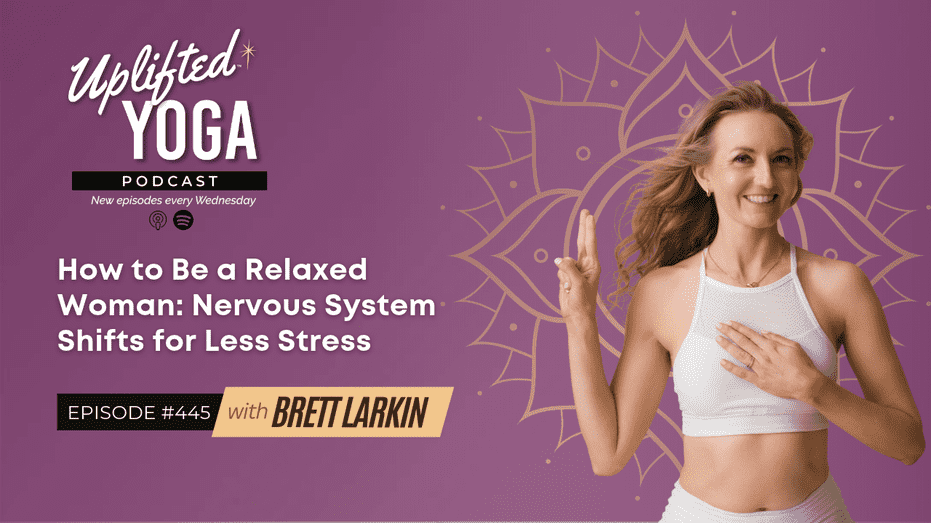
What does it actually take to become a more relaxed woman?
It might not be another meditation, bath, or reminder to get eight hours of sleep. Today I want to share some of my favorite takeaways from The Relaxed Woman by Nicola Jane Hobbs, and the ideas I’ve been experimenting with in my own life.
In this episode:
🔹 Why we need a “rest ethic” as strong as our work ethic
🔹 A surprising facial expression and simple mantra for shifting how you feel
🔹 The journaling prompts “I remember, I feel, I need” for working through overwhelm
🔹 How resilience mapping can help you decide what deserves a yes, and what now gets a no
We’ll also talk about play, nervous system capacity, and why becoming more relaxed may require doing less, not finding one more practice to add to your list.
Want to go deeper? My book Healing with Somatic Yoga includes guided practices for nervous system regulation, progressive muscle relaxation, emotional release, and more: https://amzn.to/3WGulGG
And for more reflections like this between podcast episodes, subscribe to my new Uplifted Substack: https://upliftedtrainings.substack.com/
FREE Practice: Somatic Release Meditation for Trauma | Vagus Nerve Reset to Gently Free Trapped Emotions
Relevant Blog: Harnessing Embodiment Yoga: 5 Essential Practices for Deep Connection
Relevant to Today’s Episode:
📚 Healing with Somatic Yoga Book
🎧 Also Listen to:
#318 – What Is Somatic Yoga?
#384 – Do Less, Heal More: 7 Invitations to Resolve Trauma from Organic Intelligence
#401 – Who Has Your Attention? Attention Economy vs the Ancient Path
© 2026 Uplifted Yoga | BrettLarkin.com
Transcript
Brett Larkin:
What does it actually take to become a more relaxed woman? No, I’m not gonna tell you to meditate more, take a bath, or get eight hours of sleep.
Today I’m sharing five slightly unusual things I’ve been experimenting with to feel less stressed and more at ease from a bizarre little facial expression that can actually shift how your body feels to a mantra that I like way more than traditional affirmations to a simple way I’m deciding what now gets a yes and what gets a in my life.
These ideas were inspired by a book I recently read called The Relaxed Woman by Nicola Jane Hobbs, and several of them genuinely changed the way I’m thinking about rest and my own nervous system.
So if you’re already doing yoga, meditation, and all the right things, but don’t feel particularly relaxed, this episode is for you.
relaxed woman (01:59)
Hello, my friends. Today we are exploring a book I recently read. It’s called The Relaxed Woman: Reclaim Rest and Live an Empowered, Joy-Filled Life. And this is by Nicola Jane Hobbs out of the UK. And maybe you’re gonna want to pick up this book, or maybe you just want to listen to my takeaways. I found that it had so many similarities to my book, Healing with Somatic Yoga: A Six Week Journey to Release Emotions, Rewire Your Nervous System, and Reclaim Your Body. But it’s always fun to see what
Different experts and especially women in this space of nervous system recovery.
are doing and saying. So when some of the trainers inside my own yoga teacher trainings told me they really love this book, I said, you know what? I need to pick it up.
So I thought I’d just talk to you today, like I would a friend, about some of the things that stood out to me about this book that maybe you haven’t heard before. I’m assuming you already have listened to a lot of the somatic yoga podcasts that I have have maybe even taken my somatic yoga certification online.
And that you have some sort of grasp on the fact that rest is really important, nervous system repair is the secret to life.
And maybe you just want some additional tips on how to do that, which is
What my book, Healing with Somatic Yoga, Will Help You Do, and this book supplemented and gave me some additional fun ideas I wanted to share with all of you. So, first of all, when you’re reading a book that says the relaxed woman on the cover, uh be prepared because my family kept looking at me as I read it, being like, Are you relaxed yet? I didn’t read this one on my Kindle, I got the actual paperback.
And so that was kind of fun and funny to have them uh continually checking in on me.
But even just the subheading of this book, right? Reclaim rest, I think that’s something we’re all really waking up to. We know we need to rest more. As yogis, a lot of us have been indoctrinated with achievement culture as it appears through the yoga practice, right? Which is meditate harder, find more kriyas, do harder kriyas, do harder breath work, you know, find XYZ pose, healing modality thing that’s going to fix yourself. And the irony is we can just let all of that go.
go, or at least this is the premise of somatics, we can let all of that go and just rest. And when we give our body the opportunity to simply rest as it’s designed
So much healing can happen. But sadly, we live in a culture that rejects rest. It’s not part of the cultural fabric that we live in. It’s considered really counterculture.
And most of our jobs and systems, whether it’s the childcare system or the corporate vacation policy, or just the subtle unwritten expectations that exist in both the workplace and at home, all of it is engineered at a very systemic level to prevent us from resting and to keep us from feeling like rest is a valuable way to spend our time.
So one of the things I like that she wrote in this book is that we all need to accept our innate need for rest. And I initially glossed over this, but I wanted to call it out and shout it out to all of you as well. Because until we really accept that culture is crazy, that society is crazy, that for us, even some of the yoga or meditation or spiritual circles we may be running in.
Are kind of intense, we need to actually accept that we need rest, and that’s something that we want to prioritize, and we need to feel safe to prioritize that. So until we ourselves have accepted our need for rest, unfortunately, there’s just too many forces working against us. We’re gonna get swept away into performing, achieving, people pleasing.
all the other things. She has a quote in here from John Finch and Max Frenzel, and they have a book called Time Off, which I also want to read. But they wrote, if we want to accomplish the big things we set out to do to create, lead, contribute, and make an impact, we need a rest ethic as strong as our work ethic.
I love that. So just, you know, as you’re driving or walking or thinking right now, like get honest with yourself. Like how strong is your rest ethic? Because that’s a muscle that especially as women, we really need to cultivate. And men too. We need
Stop the compulsive busyness and
let go of obsessive productivity. We need to stop being driven by guilt and unworthiness and anxiety. And we need to choose to slow down. We also need to let go of achieving, right, in quotes, the perfect work-life balance because that just stresses us out more.
Balance is an illusion. We have tantra and the gunas and samkhya philosophy and so much amazing yogic wisdom that really dismantles dismantles that. Balance is an illusion.
And so a big reframe that I think this book just reminded me of was that, you know, rest isn’t stealing time from us like getting on with our real life. Rest, if we do it deeply, has this incredible positive ripple effect for us and that impacts our families and the whole rest of the world. Think about it. When you’re well rested, are you kinder? Are you more patient?
Do you speak in a more loving way to maybe your partner or your kids or your friends or your roommates?
She writes, Rest has a ripple effect, enhancing our work, deepening our relationships, and expanding our lives. One nap can transform our mindsets.
One moment of rest can shift the cosmos. And that’s a little hyperbole here,
And she went on to introduce this somewhere else in the book and it really stuck with me. So I wanted to share it with all of you because I’d never thought of it quite this way. But she was almost saying, like, if you have the capacity to do less, to rest more.
That you are doing a huge disservice, not just to those closest to you, but to society at large, if you don’t take those advantages you have and that opportunity to rest more. Because when you’re well rested, and I think we’ll all agree with this, you are kinder, you are nicer, you’re kind of you’re you’re being the type of person that this world needs. This world does not need more stressed out, maniacal.
Productivity obsessed, anxious.
Money grabbing, scarcity minded.
wired up grasping people. Society really needs the opposite. It really needs people who are patient and kind and loving.
Who have margin, who have flexibility.
So she had this way of phrasing it where it’s like, if you have the ability or the capacity or the financial means to rest more than you are and you’re not doing that, it’s a huge disservice to you and it’s a huge disservice to the world.
And part of this key principle of like accepting your innate need to rest, we can relate to the seasons, right? Every rhythm in nature has these alternating periods of activity and rest. Flowers bloom and then they die. We have summer and then we have winter. Animals gather food and then they hibernate and just rest and eat that food. But as humans, we’ve had that cyclical nature, which is really just the way things are.
Taken away from us. But it doesn’t change that that’s the way things are. It just means that we’re highly, highly dysfunctional. We’re only living like the yong side, the rejostic side, the the solar go-out, get up and go side of life, and rejecting the much-needed rhythm of rest and restore in my somatic coaching certification. We talk about this as the rest creativity execution triangle or cycle. So many of us just think we need to be in.
Execution all the time, always creating, always making, always hustling, always in, you know, go mode. And it doesn’t work like that. Like the human body, the human nervous system, the planet we’re on, that is a recipe for complete failure and dysfunction. We need to execute and then rest, right? And then when we rest long enough and deep enough, the creativity naturally comes online, and then we can saturate in that and then we’re ready to execute. And it has to be this cycle.
But I think all of us need to focus on rest right now because we’re all so good at the other side, right? Like overriding how we feel and getting on with it.
So the question I want to pose to you is like, is rest a universal human need? Do you agree with that? It’s a physiological state of recovery and restoration.
And how accepting are you of your innate need to rest? Because I think when we stop seeing ourselves as superheroes, which I know I know is controversial because like we want to see ourselves as superheroes, but when we can let that go and realize that like the superhero thing to do is actually to rest if we have the means, to rest more, if we have the time, if we have the means.
That can be a really powerful shift. Okay, so I know that was a little esoteric. For the second thing I wanted to share that is just like a fun little hack that I happened to learn from this book. And again, there’s so many overlaps with my book, Somatic Yoga, because this came up in a section where she was talking about progressive muscle relaxation, which is something I also outlined and even have a guided practice for in my Healing with Somatic Yoga book, or it’s also in the uplifted membership. But progressive muscle relaxation is really amazing.
As a way to rest. You basically just squeeze and tense your muscles and then release them in a sequence. And it’s really nice to be guided through it. Again, you can find that on the uplifted membership. But a little thing she had to tweak to that, or like say you’re in a meeting, so you can’t do the whole progressive muscle relaxation lying down. She had this hack to use uh this facial expression. So you can try this right now. It’s created or discovered by Thomas Lynch.
Through something called radically open dialectical behavior therapy. And this is a closed-mouth cooperative smile with eyebrow wags. So wherever you are right now, listening, driving, just try this with me because I thought this was a really nice little icing on the cake to progressive muscle relaxation, or just something you could do instead of progressive muscle relaxation in a moment where you’re maybe just like cooking or feeling a little stressed and know you need to calm down. So this is what you do.
Turn the corners of your mouth up slightly and stretch your lips over your teeth. Try that now. So what you’ll probably feel is that your eyes start to narrow and it creates like those smile lines at the corner of your eyes. those tend to happen when you’re doing like a genuine smile or feeling authentically happy. So keep that. Okay, so turn the corners of your mouth up, stretch your lips over your teeth. Yep, big smile. And now
See if you can combo this with an eyebrow wag. So you’re just gonna try to lift your eyebrows up and down, up and down, up and down. And apparently this is a signal for friendliness. seems a little weird to me, but I noticed that when I played around with this, I did feel my body respond. so do you have huge smile, curling.
The lips over the teeth and then lift the eyebrows up and up and up again. And now relax and just see, do you feel a little more open or a little more receptive and rested.
Okay, third little tip, and this was a mantra that she had in the book. I think a lot of times we get overly connected to Sanskrit mantras or we get really latched on to certain affirmations, and the whole affirmation movement is very much like I am blah blah blah
They’re very outward um in the sense of often like you’re saying it because you want to achieve something or it’s like speaking an identity over you that actually may not be an identity you resonate with yet or
An identity that is safe for your body to feel. So it’s it kind of like your body kind of logs the affirmation as like a thought error. So if you’ve ever been saying affirmations and you don’t believe them or they feel fake, like that’s why. Probably the affirmation is speaking to a future that feels just totally unrealistic or to an identity that actually doesn’t feel safe for your body to own yet. and one of my favorite modules, and it’s a newer module in my somatic.
Coaching certification is we have this, these pain alchemy affirmations, which are a totally different way to use affirmations which are actually acknowledging feelings and creating safety. So more on that in the somatic coaching course. But what she offers here, which I thought was a really beautiful, I guess we could call it a mantra.
But she said she used this for many years and she wrote it on a post-it note on her desk, but just said it all the time. And I’ve tried kind of saying it in my head as I’m driving around or doing things, and I found it really helpful. but instead of the I am, it starts with let it, right? So this is what she used. Let it be peaceful, let it be blissful, let it be joyful. And she said she’d write it out.
Put it on post-its, return to it regularly, think it anytime she was in whirlwind or worry or anxiety. I found I really liked this. Let it be peaceful, let it be blissful, let it be joyful. Whether it’s picking up my kids from school or driving to go get groceries or just cooking, let it be peaceful, let it be blissful, let it be joyful. And those of you that have either my chakra journal.
or my abundance journal, both of those journals the way they work um is that you write these
Gratitude lists, and there’s a space for affirmations if you want, like every day. There’s a place for you to write out something every day because I really believe in the power of writing, not typing, not texting, not voice memoing, writing. Like that it’s a very somatic thing to like hold a pen or hold a pencil and have that tactile experience of ink on page. And the and the journals are very beautiful. They have nice paper, the golden spirals, they’re they’re beautiful.
So if you are using them, uh this would be a beautiful thing to write. Let it be peaceful, let it be blissful, let it be joyful. Obviously in the chakra journal we’re going through
a certain number of days spent exploring each chakra and then the abundance journal, I think it’s you know, every fourteen days or so it shifts focus, but you could use this for for those journaling pages as something to write every single day.
Next, she had a really interesting study that came from a different researcher. And what he did is he he had some sort of clinical trial or something where someone had something that was bothering them, like a big issue or a big stressor in their life. And I believe it was for five days in a row, they had to journal on this for 15 minutes. So just open, free write, sort of like the artist way, Julia Cameron style, just like set a timer for 15 minutes and just write about.
The big issue, the thing that’s bothering you.
And what this guy, this researcher found was that after five days, so many of the people felt remarkably better or that their huge issue or huge problem had totally shifted. Just from them spending 15 minutes a day journaling about the thing.
What this author, Nicola Hobbes, kind of added onto this, which I enjoyed, was that she said something she did in these journaling moments is using these prompts. I remember, dot dot dot, I feel, dot dot dot, and I need dot dot dot. So if you kind of get stuck writing about the thing, you know, whatever we all have problems, right? Or or things that we’re struggling with.
If you get stuck
Just start using those prompts. I remember, I feel, I need. I remember, I feel, I need. And using these prompts, I was able to explore a big issue that I have right now. And
Obviously I was able to write about it free form, but then when I would get stuck, I’d go back to those and I’d be like, I remember. And it would go back to, you know, a childhood memory related to this thing, this tangly thing, or um, or I feel, right? And it would kind of excavate another layer. Or I need, it would bring me back to like what is in my control, what is part of my boundaries. And and what was amazing is that I did this for three days. I didn’t even do it for five.
on this thing and I think I set a timer for like twelve minutes, not fifteen, because that’s how busy I am. But just journaling on this huge problem doing open free write.
Less than 15 minutes a day for three days. I don’t even think it was three days in a row. I think it was like two days in a row and then a break and then another day. I haven’t even done five days. I have experienced such a huge shift because it was like so much of why I think we’re overwhelmed. And then when we’re overwhelmed, we don’t want to rest, is because
There’s just a lot going on beneath the surface that we don’t have time to process or look at. And that’s what somatic yoga is so great for because we’re actually working with emotions or trying to move emotions through the body. It’s what that ask your chakras meditation is so great for. Those of you who’ve done 300 hour, we spend a lot of time with that. It’s like looking at each energy center like it’s a little child and seeing what does it want for you? What information does it have for you? Really listening, polling your whole body.
It’s the same concept here with journaling.
You’re just giving all these voices in your head, these needs, these thoughts, these emotions, these memories, some airtime to just discharge, right? In this in the somatic program, we talk about like shaking as a great discharge, vocal activation, using our voice as a great way to discharge and move energy. But writing is so unique. It is such a unique way to discharge and also look at all the things that are going on. Kind of like when you
Take your junk drawer and you pull all the stuff out of the junk drawer and you’re just like, I’m gonna look about and look at and write about each thing in here. And then you have so much clarity after, right? So I remember, I feel I need taking that into a journaling practice for a couple days, and I just want you try it, see
Your perspective on something might absolutely change. And you get so much awareness and height and elevation and wisdom from the thing by just simply doing this process. For me, it’s like nothing really got figured out. I just understood all the different dynamics of myself that were at play in this like tangled up situation.
And because they all got airtime on the page, they got to express and be seen and listened to.
I no longer feel overwhelmed. I just have compassion for myself around this whole dynamic. So I just think this is so, so beautiful because so often, especially those of us who are on this spiritual path, this self-healing path, the self-help in quotes path, we we think we need a therapist. We think we need an acupuncture session. We think we need
A sweat lodge or some new cutting edge technique or a retreat, or it’s like we just want to spend so much like money and time to like fix the thing, or we want to call and talk to someone about the problem and have them get it, or in paid therapy, you know, do tons of that. But like the irony is like if you literally just free write for less than a week for less than 15 minutes, you might just be able to solve and resolve or get compassion and perspective on all of this without needing to spend any money and not needing.
anyone or at least that’s what happened to me recently. So if you haven’t been doing journaling
Like this is my huge invitation for you to start. I journal every single day using the format that I came up with for that those chakra and abundance journals. The the journals have kind of different themes.
But the day-to-day structure in terms of like the accountability system and writing out your affirmations or prayers or whatnot, like it’s the same, it’s the same every day.
So I truly just think like especially if you don’t have the financial means to see a therapist or do some of the other maybe trainings or retreats or things you want, like just start journaling. This is the most powerful and I think in some ways the best way that costs nothing to really do such deep healing work.
Another simple but powerful idea that came up and this has to do with
Sympathetic and parasympathetic activation, but
She quoted another expert who has this model or this idea of resilience mapping. So again, our culture sort of feeds us this lie that we build resilience by enduring and pushing through, kind of like the no pain, no gain idea, which we all know is is false. It doesn’t work. so one thing that was mentioned here, which I thought was worth voicing, is that
And and this is me kind of adding on to this. because for me I found this helpful in terms of like when people are asking me to do something or I’m getting invited to something or my kids are getting invited to something or another family is asking something of us or you know, at work something is needed of me, like whatever it is. But to filter it through this. and so there’s these four zones. So this is called resilience mapping.
Resilience mapping for resilient nervous systems and more expansive lives. So the resilience map is divided into four zones. Number one is the safe zone. So these are the experiences that really comfort us and soothe us and feel safe to our nervous system. So like safe zone for me would be like doing yoga nidra in my bed or reading a book in my backyard totally alone. Or walking in the woods. Okay, those are like safe zones. Okay, number two is the stretch zone.
So the stretch zone is experiences that feel a little bit uncomfortable.
So for me, that might be like having someone else’s kid over for a play date. I can do it, but it’s a bit of a stretch because now there’s like a different personality and a different nervous system and a different, you know, child in our house, and that’s gonna affect how everyone else is and it’s gonna change our routine a little bit, which is a beautiful thing, but it’s it’s a stretch zone and acknowledging that is important. Instead of just being like, yes, no problem. if I wanna invite someone for a play date.
I need to really think about like, okay, this is gonna be a little uncomfortable for me. Let’s acknowledge that this is a stretch zone for me.
Number three is the stress zone. And these are experiences that really increase our stress arousal but feel tolerable, but for like a short amount of time.
So redoing this basement room in our house that is right now a total mess, that would be stressful because it would be like a big project to pull together and would have to, you know, redo the walls and you know, get some different flooring in there and stuff like that. So that’s like a stress zone project for me. However, if I didn’t have like a hard time limit and it’s just something I have to do once, like that could be okay. So I might say yes to that, knowing it’s in my stress zone.
If I felt strong because I can tolerate it for a short amount of time. And then obviously, four is your distress zone. And these are experiences that will actually currently overwhelm your nervous system completely, dysregulate you further, and take a long time to recover from. And what I love about the distress zone is that you really can identify it and know what’s in your distress zone because you’re exhausted afterwards and you’re then in a deficit.
And it like involves a lot of recovery time. So for example, if I’m over scheduled on other podcasts or teaching too much, or I’m doing like too many Zoom calls in a day where I’m teaching, by the end of that day, I’m not a nice person. I’m very tired. It’s been too much energy output. And it actually takes me like two or three days to recover. Same for me when I used to do like big film shoots and I’d shoot like 10 classes in a day. It was great to
you know, get so much content. But then I would be flat out, like my body hurt. I don’t want people to talk to me. I need to be really like I I’m at a deficit for maybe three days after.
So I think old me would be like, well that’s just stress for a short period of time and it’s okay. But now because those things cause actually a deficit, I recategorize them now as distress. That is distress. It is not okay and I avoid those things now at all costs.
So I want you to think about in your life, it’s like what’s something that you feel like almost hung over from?
Or it takes you a quite a bit of time to r recoup or recover.
If you can start eliminating those things, that is going to be huge for your nervous system health. So just to review, we have the safe zone. That’s your happy place. The stretch zone, like a little bit uncomfortable, but okay. The stress zone, you know, uncomfortable, but you can do it for a short amount of time and it’s not going to cause a deficit. And then the distress zone.
which is like something you do, but then you’re you’re hungover and it it actually sets you back.
Because whatever it is you need so much time to recover from, it’s honestly just not worth it.
So maybe do some resilience mapping. In fact, you could even do it as journaling, but just identify different experiences that fall into each of these categories.
And sometimes it’s really humbling. Like for me, like a stretch zone is like having to be anywhere on time. It’s like a huge challenge for me. Like, so anytime I know I need to be somewhere at a certain time, that kind of is it stresses me out subtly. So so those types of things, whether it’s like picking my kid up from camp or like whatever, that’s a stretch zone for me. I just have to be honest about that. And that actually helps me make better decisions. Cause like
There’s camps that have like longer days or more flexible pickup time so you don’t have to be there at an exact time or just doing no camp and keeping my kids at home. But like all of a sudden, knowing that that’s a little bit of a stretch for me, it’s like, well, actually, if we’re prioritizing my nervous system health, like what camp I choose, or if I choose to do camp at all, like things might progress differently.
And I think that’s really important. Like our nervous systems are unique. They’re as unique as your voice print, like we talk about in the Kundalini training, how your voice is uniquely healing for you. They’re as unique as your fingerprint. So each of us are gonna have different things in each zone, pending who we are. Like for someone else, their safe zone might be like surrounded with close friends having a lively dinner party, right? Obviously, those that was not the stuff I mentioned for my safe zone.
And then the last idea I’ll leave you with from this book, which I thought was really fun, was just the idea of giving yourself some playtime. And we work on this a lot in the Yoga for Self-Mastery course. Those of you who’ve taken that online course that ships with the journal as well with me, we talk about a lot about self-care and what we call the level twos, the level two self-cares. And this is similar but different. But she basically talks about like, imagine you’re a seven-year-old.
And you have open play, right? she talks about like when she was little, she loved doing perfume making or puzzles.
I know I love to to read or you know, go to ballet, like or or just dance and express myself, right? So she talks about maybe like establishing a daily playtime for yourself. And if you can even start the day that way and not be like the over forty percent of people who look at their phone within five minutes of waking up, or you know, by checking email or whatever, like can you start the day playfully somehow?
Whether it’s giving yourself a few moments to daydream when you wake up, or just like reading three or four pages of your your fantasy novel that you keep on your nightstand, or having a puzzle that you putz around on as you make breakfast or as you drink your coffee or something like that.
But she said she started just spending even five minutes at the end of her lunch break playing, like doing a little something, before getting back to work.
She wrote that she tried like juggling, um playing with like doing handstands, drawing, reading a few pages of a fun fiction book. But I guess the invitation is to like think about what’s like a daily playtime that you could give yourself.
My kids are always asking for play dates. So she said it’s like similar to that idea, right? It’s like arranging a playdate for yourself to do something fun.
That’s just frivolous. That’s that’s similar to what we talk about in Yoga for Self Mastery with our level two self-care. It’s like frivolous fun. You’re not doing it to achieve or get anything or to become a professional juggler.
It’s just ’cause like you wanna build a pillow for it and it would be fun to sit in there with a flashlight.
So many of us are just starved for fun, starved for playfulness, starved for connection.
It was my birthday over the summer and I threw a birthday party where I made everyone play games. So we did games in my backyard. Um, just like really silly things. But I really like to do that because for so many adults, it’s like we we never get to just like laugh or be silly or let loose or be goofy or like a fool of ourselves in a fun, safe environment. And I had all these ladies at my party playing like hysterical fun games in my backyard.
It helped different groups of friends get to know each other.
‘Cause they all were sort of from different pockets or corners of my life.
Fun and laughter is incredibly restorative and rejuvenating. So just maybe thinking about how you can have more fun between now and next week. I hope you enjoyed hearing some insights from this book. Again, it’s The Relaxed Woman: Reclaim, Rest, and Live an Empowered Joy-Filled Life by Nicola Jane Hobbes. She quotes a lot of different experts in there as well. It’s a nice like amalgamation of a lot of nervous system information and pairs so nicely with my book, Healing with Somatic Yoga: A Six Week Journey to Release Emotions.
Rewire your nervous system and reclaim your body.
And if you do have that book of mine, make sure you scan all the QR codes in there because whether it’s the safety practice that’s also in the Relaxed Woman book or progressive muscle relaxation that’s mentioned in both, I actually have video and audio experiences for you that will guide you through all those.
Thank you so much for being here. Thank you so much for listening all the way to the very end.
And until next time, take care of you.