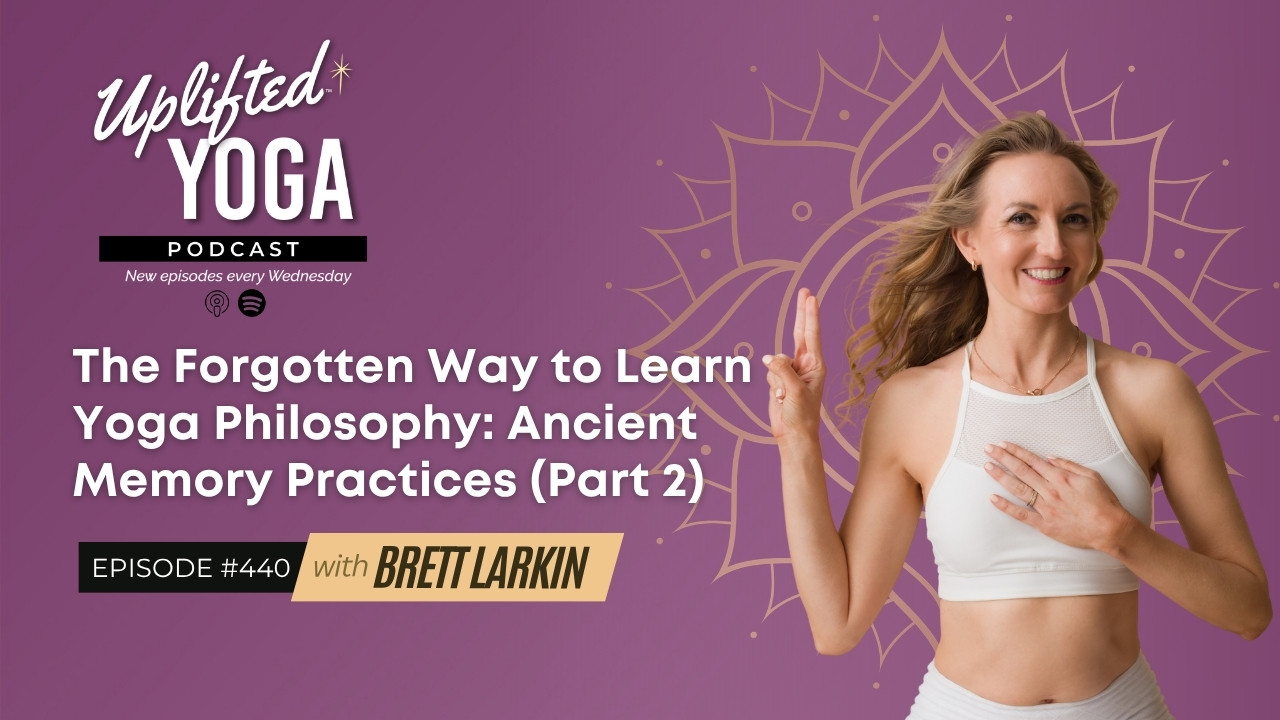
We live in a world obsessed with consuming more information. More podcasts. More reels. More quotes. More content.
But what if transformation doesn’t come from learning something new, but from deeply remembering something ancient?
In this episode, we explore how to intentionally choose a mantra, sutra, psalm, poem, or sacred line to memorize and why this practice can become a powerful anchor for anxiety, overwhelm, distraction, and nervous system regulation.
You’ll learn:
🔹 How to choose a verse or mantra that speaks directly to your current season of life
🔹 Why memorization changes your relationship to wisdom itself
🔹 Somatic and creative techniques for memorizing sacred text
🔹 Why repetition, rhythm, sound, and poetry regulate the nervous system
🔹 How to turn ancient wisdom into a living daily companion
💖 Want to shift what you’re practicing and paying attention to? Join the Uplifted Membership: https://www.brettlarkin.com/uplifted/
✨ Get The Uplifted Journals:
Uplifted Abundance Journal & Guidebook
FREE Practice: Guided Meditation For Intentions: A Grounding Visualization Meditation
Relevant Blog: What are Patanjali’s Yoga Sutras?
Relevant to Today’s Episode:
🐍 Yoga for Self Mastery
🎧 Also Listen to:
#401 – Who Has Your Attention? Attention Economy vs the Ancient Path
#415 – From Self-Improvement to Reverence (Bhagavad Gita Chapter 7)
#437 – The Forgotten Way to Learn Yoga Philosophy: Ancient Memory Practices (Part 1)
© 2026 Uplifted Yoga | BrettLarkin.com

Transcript:
Brett Larkin:
Welcome to the Uplifted Yoga Podcast, where ancient yogic wisdom meets modern business strategy. I’m Brett Larkin, creator of Uplifted Yoga, where I’ve certified thousands of yoga teachers, built a multi-seven figure business, and guided over half a million students on YouTube. Here’s the truth, you don’t have to choose between embodying deep yogic wisdom and building a thriving, freedom-based business.
This podcast is your space to integrate both. Because yoga isn’t just what you do on the mat, it’s how you show up in every part of your life. Whether you’re here to deepen your yoga practice, grow your teaching career, or align your energy with your purpose, you’re in the right place.
Let’s dive in. We are so good at consuming podcasts, reels, books, quotes, courses. Because we’re constantly taking in more and more information.
But what if the real shift wasn’t learning something new, but choosing one line of wisdom and actually letting it stay with you? In a previous episode, I shared why memorizing even a few lines from a sacred text can be so powerful for your nervous system, your focus, and your relationship to the wisdom itself. And today, we’re taking the next step.
Because if you’re on board with this idea, the real question becomes, all right, well, what do I actually choose to memorize? Where do I start? How do I pick something that’s not random, but actually deeply alive for me?
In this episode, I’m going to walk you through how to choose a verse, mantra, or line of ancient text that speaks directly to your life right now, and how you can begin turning it into something that supports you in real time. Let’s dive in. Hello, my friends.
In a previous episode, I talked about all the benefits of memorizing an ancient text. Not the whole text, just a few verses of your choosing. And we’re picking up today with like, how do you choose what to memorize?
So if you’re not fully on board with like, you know what, I think I might want to do this. I think this could train my brain. I think this could maybe help with my social media addiction or phone addiction that we all have.
Listen to the episode, which we’ll link in the show notes, about that, because I think I do a really good job convincing you of why you might want to try this. And then come back, because here we’re going to talk about, well, if memorizing sacred words can strengthen the mind, regulate my nervous system, and basically deepen my relationship to that wisdom, the next question naturally is like, okay, where should I start? What should I actually memorize?
Because obviously the goal isn’t to memorize something randomly. The goal is to really choose words that feel alive for you. So traditionally, people memorize or tend to memorize texts that speak to a struggle they’re going through.
So let’s say you struggle with perfectionism, or you struggle with boundaries, or you’re struggling with grief, or you’re struggling with workaholism, right? That could be a struggle you’re going through. And so you’re kind of going to be searching for a piece of text that speaks to that struggle and helps you reorient your mind and soothe that struggle in a way for you.
Maybe you struggle with anxiety, and you have thoughts running a mile a minute. You could come back to yoga citta vritti nirodhah, like yoga is the quieting of the mind, and use that to anchor you. Or maybe you rush a lot, like you’re always rushing, you’re always ending up places late.
Maybe you need to learn how to slow down. Maybe you want to work with like, be still and know that I am God. We also talked about working with poems, Robert Frost poems, Mary Oliver poems.
So it could be a line from a piece of poetry. But the idea is that it’s speaking to a struggle that you’re going through. Maybe you’re struggling with self-worth.
There are beautiful verses that could speak to that. So that’s one way to look for things, is think about like, what are the big struggles for me? The big, maybe either negative thoughts or patterns I see in Yoga for Self-Mastery, my home study course, we call this EDTs, extra detrimental thoughts, right?
We kind of look at and journal and focus on, what are those thoughts that are like the biggies from which everything else then cascades? Because it’s like, if we can start reframing those, it’s kind of like the most bang for our buck. So thinking, what is something that you just see over and over again that you’re struggling with, and something that speaks directly to that?
Now, a different approach, we could be looking for a verse that expresses a truth that you want to embody more fully. And some verses might do both of these things. But this one’s more like, I want to step into blank.
I want to step into friendliness, equanimity, a deeper sense of devotion. I want to step into steadiness or discipline, right? So that you might choose a very different verse or text from the Gita Sutras.
Again, you can choose it from wherever. But this is another approach. It’s almost a little bit more like aspirational in its origin.
This is what I want to move towards. And then the idea is that you have a somatic experience when you read or say this piece of text out loud. It’s bringing you an inner sense of peace or steadiness.
And it also needs to often, I think, be somewhat simple. That way, it really helps redirect the mind when it spirals. Sometimes if we choose something that’s overly complicated or just sort of awkward to say, you might need to find a different translation that’s less so.
But ideally, it feels smooth in your mind. Think about if you’re going to look and pick up a stone to take home. You’d probably pick up one that’s smooth, maybe, and that feels nice for you to wrap your fingers around and stroke.
Not one that’s maybe really jagged and not symmetrical and hurts when you hold it in your hand. You know, some texts or some translations or certain verses are like, I really like what this is saying. But when I actually say it out loud, it’s just awkward.
The grammar is awkward or something like that. So I would also just look for something that can be that smooth stone that’s simple enough. That way, it really can help redirect your mind when it’s spiraling out.
Because what you’re choosing is a companion for your mind. You’re choosing your mind’s little BFF that can meet you when you’re anxious or distracted or overwhelmed or searching or spiraling. Tip number one.
Actually, we’ve already given some tips, so I don’t know what number to say. But choose something somewhat short. I think short and poetic, right?
That smooth stone analogy is a good place to start. And some great news is that most sacred texts are actually written this way intentionally. So we’ve talked to that in prior podcast episodes, like most of what we have in the sutras, for example, or the Gita or the Psalms are oral traditions that then eventually got written down.
So the sutras, for example, are incredibly, extremely short. The Bhagavad Gita contains many short verses that can stand on their own, whether it’s psalms or poetry, like these are poetic. So they’re designed to be spoken.
They’re designed to be repeated. And then, of course, you could also maybe choose to work with the mantra. And many mantras are only a few words long.
So don’t try to remember, you know, all of stopping by the woods on a snowy evening, like on your very first try with this. Start with things that are short. And then, of course, you can work up to longer things.
Like I’m now able to memorize really long things, but that’s not where I started. So here’s a couple examples, just if it’s helpful for you while you’re listening or driving to sort of feel into what might resonate. This is from the Radiant Sutras, which is a text we look at intensively in my Embodied Yoga Life Coach training when we’re doing the coaching on polarity.
The Radiant Sutras is a dialogue between Shiv and Shakti, super beautiful, super overlooked, I think, in most yoga schools and yoga teacher trainings. Here’s a verse. Wherever you are, whatever you are doing, open to the vastness of your own awareness.
That could be a really beautiful one to memorize. Here’s another. Everything be included in your awareness.
The sounds, the sensations, the thoughts. It’s basically like somatic yoga 101. So those are lovely lines, wonderful for meditation, wonderful for walking around, because they’re redirecting your attention very gently.
From the Yoga Sutras, we already mentioned this one. Yoga is the stilling of the fluctuations of the mind. Yoga Sutra 1.33, which we have a walking meditation for you on this in the Uplifted Membership. But this is another really nice one to memorize. By cultivating friendliness, compassion, joy, and equanimity, the mind becomes clear and serene. So these can function sort of like mental anchors.
From the Bhagavad Gita, one of the most beloved verses, you have the right to your actions, but never to the fruits of your actions. So if you’re grasping or clinging, that can be a great one to come back to. I have the right to my actions, but never to the fruits of my actions.
Or another powerful one. Whenever the mind wanders, gently bring it back. Verses like these are incredibly helpful during stressful moments.
If you want to look at the Psalms from the Christian tradition, there’s beautiful lines in there like, Be still and know that I am God from Psalm 46, which we already talked about. Another really famous one, Even though I walk through the valley of the shadow of death, I will fear no evil, Psalm 23. And then mantras from the yoga tradition.
You could memorize a mantra like the Gayatri Mantra. We actually open our 200-hour teacher training. The opening videos are chanting this mantra.
It’s super cool. And dissecting like each word and the meaning behind it. But the Gayatri Mantra, it’s so beautiful.
And sometimes working with memorizing something that’s not in your native tongue, right, that’s in Sanskrit or in Gurmukhi can actually be an advantage because it kind of shifts your brain into a totally different gear and way of operating. Or if you wanted something really simple, like Kundalini Yogis, yo, we got Sat Naam. Sat Naam.
Sat Naam. Truth is my identity. And mantras work really beautifully because they combine sound, rhythm, and meaning.
Now, here’s another way to choose something to memorize. Sometimes the verse chooses you. Like you read something and you feel a little pause.
You’re just like, Whoa, I love that. Or like, Wait, I want to remember that. Or it comes to you like it floats into your mind in a certain situation.
And then that’s a big sign. It’s like you want to work with that. And when you memorize these, like they can become lifelong companions.
And it’s not just like a tool to retrain your attention. It’s something that you can like make love to. Like that Sutra 1.33 walking meditation that I recorded. I do a lot of walks in the woods. And what I do is I call to mind a piece of scripture or verses that I’ve memorized from an ancient text. And at this point, my memory is pretty good.
I’ve memorized things that are a couple paragraphs even. But I go line by line. And I say the first line.
And then I stop. And I think. And I reflect on like, What does that mean to me today?
And then I say the second line. And I pause. And I think about, OK, what does that mean right now?
And so it becomes this sort of tool that you can braid and use in your mind. I often like to do it walking. But more recently, I’ve also just been doing it in stillness.
And it’s really cool because once I was so deep in the woods that I totally lost service. Luckily, I figured out where I was going. But I was doing that kind of work.
And I wanted to remember something. Like I hadn’t totally memorized the particular verses I was working on. And so I went to look it up in my phone.
And I couldn’t because I had no service. But I was like, well, it’s so great that I’ve memorized like at least the first stanza, which I had. So I was like, I’m just going to work with the first stanza.
But I was it was a cool moment because I was like, wow, like sometimes we don’t have anything with us. Like we don’t have service or the power goes out or and like how cool that I still like I had different verses and the first stanza of that thing that I was trying to memorize like at my immediate recall. And so I was able just to work with it beautifully that way.
Are you tired of bouncing between random yoga videos and trying to figure out what to practice? If you’re craving depth, consistency, and a real educational progression plan, My Uplifted Membership might be exactly what you’re looking for. Inside the Uplifted Members app, you get structured weekly schedules, guided training plans, journaling workbooks, and philosophy courses that build on each other.
It’s designed to help you create a devoted practice, one that strengthens your body, steadies your nervous system, and deepens your understanding of yoga over time. You get over $2,000 worth of practice tools for just $29 a month. Access 14 yoga philosophy courses and two years worth of Yoga Alliance education credits through my courses on Yoga Nidra, the Eight Limbs of Yoga, Embodying the Yamas, the Knee Yamas, and so much more.
Reclaim your body and rewire your nervous system as you find strength, peace, and results across all styles of yoga, somatic, kundalini, restorative, fascial fitness, Hatha Vinyasa, chakra studies, yin, meditation, each with PDF journaling guides and prompts that make everything come together and stick. Whether you’re a beginner or a yoga teacher, there’s a plan for you inside the Uplifted Membership. Go to brettlarkin.com/uplifted to sign up today. So this text has become like a companion for you, something that you take out just like that stone we were talking about, how you would turn the stone around in your hands. You’re going to pull out that verse or those stanzas and you’re just going to say them to yourself, sit with them, reflect line by line, stillness or walking. It’s like, I’m going to spend time with you.
How radical, how counter-cultural to do something like this as opposed to being constantly addicted, like dopamine addiction to new information, looking at our phone 24-7. I want to shift now into some practical tips. So once you’ve chosen a verse or a mantra that speaks to you, the next step would be like actually learning how to memorize it.
And the good news is this doesn’t have to feel like going back to school. There are a lot of really playful, embodied, surprisingly easy ways to start this memorization process. Before we switch into how to memorize, here are just a couple more ideas of things you might want to memorize.
Here’s some more of my favorites from the Radiant Sutras. Wherever you are, enter that place completely. Isn’t that so great?
So short, so poetic. Wherever you are, enter that place completely. Also from the Radiant Sutras, close your eyes, feel the vastness of the inner sky.
I just love that one. Let everything be included in your awareness. So beautiful.
And those of you who’ve been listening to the episodes on the Gita, especially as we’re in that Bhakti Yoga arc right now, that’s very relevant. Another from the Radiant Sutras, rest in the center of the sound. Let the sound carry you into silence.
What’s beautiful about these is they almost also function as like instant meditation instructions. Another one from the Yoga Sutras, if you were curious, Sutra 2.46, which is that the posture should be steady and comfortable. And it’s referring to asana, like the asana seat.
But life should be steady and comfortable, right? So you might even change that to like, my posture or I should be steady and comfortable. And say that when you’re rushing or feeling crazed.
So how to memorize it? You want to study the passage in its original context. So say you’re memorizing a smaller part of like a bigger thing.
That’s totally fine. But I think your first step, you want to really research and understand the context of the passage. And sometimes if this passage is from the Gita, let’s say, or from the Bible, like you need to do some research of like, what was going on during that era or during that time?
Because there’s often just context you need about like, why is there all this talk about like gi rituals or animal sacrifice or, you know, Roman occupation or whatever to like really understand. So you want to understand the broader context of the passage and start broad, like do some journaling before you begin to memorize it. Start thinking about like, what does this passage say?
What does it mean in the broader context of whatever text I’m in? So maybe if you’re memorizing like a Robert Frost poem, it’s like, what was going on in his life when he wrote this, right? Doing a little research into that.
When in his life did he write this? Think about what drew me to this. And then this is really important.
How would I say this in my own words? And when you’re doing that, like I mentioned, thinking the verse silently or aloud or saying it, saying one line and then pausing and reflecting on it, like that reflection could just look like, how would I say this in my own words today? This is when scripture really starts to affect you when you’re like, how would I say this in my own words?
And what is it teaching me? That’s what you’re going to reflect on when you say it to yourself after each line. Okay, then if you’re memorizing something a little bit larger, like six lines, like break it down, break it into smaller sections.
When I’ve done larger texts, I always kind of go like four or five lines at a time. Then my invitation to you is to dedicate either a notebook or you can get my abundance or chakra journals, which have this, but literally a space to write the passage over and over and over again. So those of you that have my chakra journal meditation or my abundance Lakshmi journal, every single day of that journal has a space for you to write.
I think in those journals, it’s called an affirmation, but it’s essentially the same thing, like something that you are working with and drilling into your mind. There’s a space in every single day because it has a very interesting yoga friendly format of like where you write what you practiced and there’s a place to reflect on gratitude each day. But then there’s a big section in the middle of each journaling page where it’s just for you to write repetitively, either like the affirmation or the verse or the thing that you’re working with.
And it usually says one, two, three, four, I believe in both the books. And that’s not to write four different things. You actually just write it over and over and over again.
So you could work with one line at a time and write the passage out. Now, here’s another fun tip. Place a square around the verbs, underline the nouns and circle any adjectives or adverbs.
Then say the passage aloud several times and emphasize the verbs as you repeat it. And then do the same thing and emphasize the nouns and then do the same thing and emphasize the adjectives. And this is really beautiful.
It’s fun to dissect a verse or dissect scripture in this way. So we’re writing it. We’re saying it out loud.
We’re reflecting on the various parts of it, the verbs, the adjectives. And then if you want to gamify it for yourself, you can get a sticky note or something and you can write the first letter of each line of the passage, like the first letter of the first word somewhere. And then you can, throughout the week, look at it and work on your memorization.
Those of you that have access to a whiteboard, writing out the passage on a whiteboard is such a great idea. And then you can erase it and then just work with a few words at a time as you continue to repeat it out loud. And then you can keep erasing parts of the passage until you have it all committed to memory.
The next tip is to songify it. We talked about gamifying it, but actually songifying it, meaning if you can, make up a tune for the passage to sing as you go about your day. And if you’re working with a mantra, this is, in many ways, will already be done for you.
If you’re not working with a mantra, maybe you try singing it to the tune of a favorite song. Or depending what you’re memorizing, often there is people who’ve put what you’re studying to song and you don’t even know. So just do some research.
Stick around on Spotify. Those of you who are visual, it can be really fun to sketch the passage. So visualize what each phrase would look like in the form of a drawing.
Yoga is the quieting of the mind. How would you draw yoga? How would you draw quieting?
How would you draw the mind? I know this sounds silly, but this can be really fun. If you just like to do watercolor on the weekend with your kids, like me sometimes, I don’t know what to paint.
And then I can do something like this and it actually becomes really meaningful and fun. And then I throw it in my journal. In addition to singing it or sketching it, you can also use hand signals to come up with associations for each word or each line or each phrase or even a bigger movement.
That would be a very somatic approach. And then you repeat those as you say it. So same thing, like yoga is the quieting of the mind.
What position would you take with your body or what would you do with your hands? I might make like I just made like a straight line in front of me with both my hands, kind of like I was clearing my space. The quieting of the mind.
I just put my hands on top of my head. So you can work with something like that, especially for longer passages. This can also be really fun.
Then obviously you should say it all the time. So like repeat the passage out loud to yourself as you’re driving, as you’re going through the rhythm of your day, as you’re pouring your coffee, waiting for the water to boil, sitting in traffic, making dinner. And then if you can, listen to the passage read aloud to you.
So you may be able to find the passage in an audio book or on a certain app. Or worst case, you can just record a voice memo on your phone of you reading it and then listen to that throughout your day. It’s really incredible how when we start incorporating the senses and also hearing it in addition to saying it, you’re going to be able to memorize, if you use these tips, like a lot of text quite quickly.
And I know the examples I gave here on the podcast were pretty short, like just a line or two. But like start there, but then aim higher quickly because it’s really, really cool how much you can memorize. Like I’ve memorized so much, you guys, like very, very long things using many of these techniques.
And you just keep them. And then they’re just like these little stones, these little pearls, these little gems that you can just pull out and touch anytime, anywhere. And if your phone loses service, like guess what?
You’re still good. Okay, the next tip is to share with someone that you’re doing this and then have them occasionally quiz you. And so, of course, I did this with my kids because, you know, they love putting me on the spot.
So I told my son, for example, that I was memorizing this pretty lengthy piece of text. And then I asked him, he’s eight, so he can read. I asked him, I said, test me.
And it actually became something really fun that he and I would do together. And he’d correct me if I had something wrong. You can also send the text or the verse that you’re working with, the passage, to someone you love or to different people, many people.
And every time you text it or type it over email, that’s also going to reinforce. So if you’re looking for some more interpersonal ways, those are ideas. Of course, you can also set the passage as your phone lock screen or wallpaper.
I do that a lot because then I see it all the time and it reminds me to practice it and lets me see the words again. But I would say journaling and writing it is one of the best ways. And I’ll make sure to put links in the show notes for both the Chakra journal and the Abundance journal, since we don’t usually publicly have those in stock because I know we don’t have that many copies anymore.
But that way you can find them if you want to do this in the exact journaling page format that I use each day. It’s also a yoga and meditation kind of practice tracker, which is fun, designed to keep you more consistent with your practice. One last thing I’ll say is that if you can really look at the passage or leverage the time before bed and you fall asleep, that can be really powerful.
I do think there is something really powerful about those moments before sleep. So having it on your bedside and reading it or saying it out loud is the last thing you do before you turn the lights off and go to sleep is kind of like a timing tip that I would recommend. But have fun with this.
It is such a fun way to train your mind. It is such a great thing to do instead of shopping, scrolling on your phone, you know, all the other stuff that pulls us in. And if you want to go back and listen to the other podcast that was about this, there are so many health benefits to memorization.
So if you think this is something you’re going to try, I would love to hear from you. You can always DM me at LarkinYogaTV on Instagram. You can always send me an email info at UpliftedYoga.com.
I’m really into this whole memorization thing because it’s a super countercultural act. Instead of collecting more information, we’re digesting and making love to wisdom. So my invitation for you this week is to choose something.
Choose a line. Choose a couple lines, a mantra, a psalm, a sutra, a verse from the Gita, and begin living with it. Make it your new best friend, your new roommate.
Write it down. Say it out loud. Carry it with you.
Let it accompany your thoughts throughout the day. That’s my challenge to you. Until next time, take care of you.
Your personal blueprint to serenity, or join my Uplifted Yoga membership for an all-access pass to my most popular yoga courses, thematic class plans, and practice calendars. Don’t forget to prioritize your well-being and get on your mat today. From my heart to yours, namaste.